



%20--%3e%3c!DOCTYPE%20svg%20PUBLIC%20'-//W3C//DTD%20SVG%201.0//EN'%20'http://www.w3.org/TR/2001/REC-SVG-20010904/DTD/svg10.dtd'%3e%3csvg%20version='1.0'%20id='Layer_1'%20xmlns='http://www.w3.org/2000/svg'%20xmlns:xlink='http://www.w3.org/1999/xlink'%20x='0px'%20y='0px'%20width='64px'%20height='64px'%20viewBox='5.5%20-3.5%2064%2064'%20enable-background='new%205.5%20-3.5%2064%2064'%20xml:space='preserve'%3e%3cg%3e%3ccircle%20fill='%23FFFFFF'%20fill-opacity='0'%20cx='37.785'%20cy='28.501'%20r='28.836'/%3e%3cpath%20fill='%23595959'%20d='M37.441-3.5c8.951,0,16.572,3.125,22.857,9.372c3.008,3.009,5.295,6.448,6.857,10.314%20c1.561,3.867,2.344,7.971,2.344,12.314c0,4.381-0.773,8.486-2.314,12.313c-1.543,3.828-3.82,7.21-6.828,10.143%20c-3.123,3.085-6.666,5.448-10.629,7.086c-3.961,1.638-8.057,2.457-12.285,2.457s-8.276-0.808-12.143-2.429%20c-3.866-1.618-7.333-3.961-10.4-7.027c-3.067-3.066-5.4-6.524-7-10.372S5.5,32.767,5.5,28.5c0-4.229,0.809-8.295,2.428-12.2%20c1.619-3.905,3.972-7.4,7.057-10.486C21.08-0.394,28.565-3.5,37.441-3.5z%20M37.557,2.272c-7.314,0-13.467,2.553-18.458,7.657%20c-2.515,2.553-4.448,5.419-5.8,8.6c-1.354,3.181-2.029,6.505-2.029,9.972c0,3.429,0.675,6.734,2.029,9.913%20c1.353,3.183,3.285,6.021,5.8,8.516c2.514,2.496,5.351,4.399,8.515,5.715c3.161,1.314,6.476,1.971,9.943,1.971%20c3.428,0,6.75-0.665,9.973-1.999c3.219-1.335,6.121-3.257,8.713-5.771c4.99-4.876,7.484-10.99,7.484-18.344%20c0-3.543-0.648-6.895-1.943-10.057c-1.293-3.162-3.18-5.98-5.654-8.458C50.984,4.844,44.795,2.272,37.557,2.272z%20M37.156,23.187%20l-4.287,2.229c-0.458-0.951-1.019-1.619-1.685-2c-0.667-0.38-1.286-0.571-1.858-0.571c-2.856,0-4.286,1.885-4.286,5.657%20c0,1.714,0.362,3.084,1.085,4.113c0.724,1.029,1.791,1.544,3.201,1.544c1.867,0,3.181-0.915,3.944-2.743l3.942,2%20c-0.838,1.563-2,2.791-3.486,3.686c-1.484,0.896-3.123,1.343-4.914,1.343c-2.857,0-5.163-0.875-6.915-2.629%20c-1.752-1.752-2.628-4.19-2.628-7.313c0-3.048,0.886-5.466,2.657-7.257c1.771-1.79,4.009-2.686,6.715-2.686%20C32.604,18.558,35.441,20.101,37.156,23.187z%20M55.613,23.187l-4.229,2.229c-0.457-0.951-1.02-1.619-1.686-2%20c-0.668-0.38-1.307-0.571-1.914-0.571c-2.857,0-4.287,1.885-4.287,5.657c0,1.714,0.363,3.084,1.086,4.113%20c0.723,1.029,1.789,1.544,3.201,1.544c1.865,0,3.18-0.915,3.941-2.743l4,2c-0.875,1.563-2.057,2.791-3.541,3.686%20c-1.486,0.896-3.105,1.343-4.857,1.343c-2.896,0-5.209-0.875-6.941-2.629c-1.736-1.752-2.602-4.19-2.602-7.313%20c0-3.048,0.885-5.466,2.658-7.257c1.77-1.79,4.008-2.686,6.713-2.686C51.117,18.558,53.938,20.101,55.613,23.187z'/%3e%3c/g%3e%3c/svg%3e)
%20--%3e%3c!DOCTYPE%20svg%20PUBLIC%20'-//W3C//DTD%20SVG%201.0//EN'%20'http://www.w3.org/TR/2001/REC-SVG-20010904/DTD/svg10.dtd'%3e%3csvg%20version='1.0'%20id='Layer_1'%20xmlns='http://www.w3.org/2000/svg'%20xmlns:xlink='http://www.w3.org/1999/xlink'%20x='0px'%20y='0px'%20width='64px'%20height='64px'%20viewBox='5.5%20-3.5%2064%2064'%20enable-background='new%205.5%20-3.5%2064%2064'%20xml:space='preserve'%3e%3cg%3e%3ccircle%20fill='%23FFFFFF'%20fill-opacity='0'%20cx='37.637'%20cy='28.806'%20r='28.276'/%3e%3cg%3e%3cpath%20fill='%23595959'%20d='M37.443-3.5c8.988,0,16.57,3.085,22.742,9.257C66.393,11.967,69.5,19.548,69.5,28.5c0,8.991-3.049,16.476-9.145,22.456%20C53.879,57.319,46.242,60.5,37.443,60.5c-8.649,0-16.153-3.144-22.514-9.43C8.644,44.784,5.5,37.262,5.5,28.5%20c0-8.761,3.144-16.342,9.429-22.742C21.101-0.415,28.604-3.5,37.443-3.5z%20M37.557,2.272c-7.276,0-13.428,2.553-18.457,7.657%20c-5.22,5.334-7.829,11.525-7.829,18.572c0,7.086,2.59,13.22,7.77,18.398c5.181,5.182,11.352,7.771,18.514,7.771%20c7.123,0,13.334-2.607,18.629-7.828c5.029-4.838,7.543-10.952,7.543-18.343c0-7.276-2.553-13.465-7.656-18.571%20C50.967,4.824,44.795,2.272,37.557,2.272z%20M46.129,20.557v13.085h-3.656v15.542h-9.944V33.643h-3.656V20.557%20c0-0.572,0.2-1.057,0.599-1.457c0.401-0.399,0.887-0.6,1.457-0.6h13.144c0.533,0,1.01,0.2,1.428,0.6%20C45.918,19.5,46.129,19.986,46.129,20.557z%20M33.042,12.329c0-3.008,1.485-4.514,4.458-4.514s4.457,1.504,4.457,4.514%20c0,2.971-1.486,4.457-4.457,4.457S33.042,15.3,33.042,12.329z'/%3e%3c/g%3e%3c/g%3e%3c/svg%3e)
Nel Teatro Comunale di Firenze spirava aria di famiglia: il nostro non era un capannone industriale, ma una bottega artigiana; ed artigiane, nel vero senso della parola, erano le maestranze tecniche. Scenografi, carpentieri, elettricisti, macchinisti costituivano quanto di meglio potesse produrre una città preziosamente artigiana come Firenze.Footnote 1
(The Teatro Comunale in Florence had a family feeling: ours was not an industrial warehouse but an artisan workshop; and the technical workers were artisans in the true sense of the word. Scene painters, carpenters, electricians and stage technicians constituted the best that an important, artisan city such as Florence could produce.)
In his late 1950s musical memoirs L’usignolo di Boboli (Cinquant’anni di vita musicale italiana), the composer, critic and former Fascist government functionary Mario Labroca, who directed Florence’s Maggio Musicale Fiorentino between 1936 and 1943, described the theatre that hosted the cutting-edge opera festival as a Medieval-style workshop where – to borrow the words of Richard Sennett in The Craftsman – ‘labor and life mixed face-to-face’.Footnote 2 A pseudo-familial environment held together (Sennett would argue) less by love than by a surrogate paternal authority, the 1930s Teatro Comunale can almost be imagined as a descendant of the old guilds or corporations, whose masters provided training to apprentices in the various arts and crafts. Within but also beyond those Medieval ateliers, craftsmanship meant ‘the skill of making things well’, ‘the desire to do a job well for its own sake’.Footnote 3 In a remark that fittingly foreshadows Sennett’s reflections, Labroca himself depicts the Maggio’s artigiano (artisan), a particular incarnation of the Florentine operaio (workman) – Labroca in fact makes no distinction between the two – as a justly proud worker who always performs his services to the best of his ability. ‘Direct interest’ and ‘precise will’ characterise his work as much in the opera house as on private premises.Footnote 4 Manual skill may be his asset, but his calling is a matter of ethics.
Labroca’s reminiscences contain a few tropes that are worth unpacking here. First, his reflections link the work environment and work attitudes he describes to Florence’s distinctive cultural ambience. By calling it a ‘preciously artisan city’, Labroca rehearses the idea of Florence as ‘the most artisan of Italian cities’, a notion that began to take shape in the late nineteenth century, as a response to Italy’s rapid industrialisation. A vibrant hub of artisan culture since the Medieval period, Florence positioned itself after Unification as a stronghold of traditional craftsmanship, which was seen as embodying more authentic, pre-industrial forms of labour. In the 1920s and 1930s, the Fascist regime famously embraced technology as part of its narrative of national regeneration, yet it simultaneously capitalised on – and actively promoted – Florence’s artisanal image.Footnote 5 As Anna Pellegrino has shown, when Alessandro Pavolini, secretary of the Florentine branch of the National Fascist Party, championed the city’s craft-based identity in 1929 through the columns of Il Bargello, he was not simply interpreting recent statistical trends. True, according to the industrial censuses of 1911 and 1927 – the first to offer insights into the most common types of employment across Italy – Florence had experienced a steady rise in the number of its residents working in craft professions, even surpassing the artisanal populations of ‘industrial’ Milan and Turin.Footnote 6 Rather than merely celebrating this growth, however, Pavolini and the broader Fascist regime also strategically harnessed craft as a political tool, aiming to organise and economically legitimise the sector. A prime example of this was the creation of the Federazione fascista degli artigiani in 1926, an organisation intended to represent Italian artisans’ interests. Although still loosely defined by a combination of numerical and (increasingly) qualitative factors, artisans were typically small business owners – working independently or with a small team of employees – operating out of their homes, workshops, or directly at the customer’s premises. Their symbolic value was immediately clear to a regime that looked beyond large industry for models of ‘healthy’ productive and social relationships. Historically embodied in the interpersonal and manual skills nurtured in Medieval and Renaissance workshops, craft offered a vision of social and political stability to a totalitarian state keen to promote an ethics of work and corporatism. Hence not only its expansion but also its gaining of unprecedented prominence in public discourse, particularly in Florence.Footnote 7
Labroca’s depiction of the Maggio’s scenografi as earnest scene painters working shoulder to shoulder with other like-minded craftsmen thus raises important questions about the politics of representing opera production labour in this Fascist, specifically Florentine, cultural context. At the same time, Labroca’s nostalgic view of this bygone era betrays shifting attitudes towards scenografi in mid-twentieth-century Italy. Ever since the beginning of opera, the scenografo’s role had fluctuated between invention and execution, conceptual creation and manual realisation. Initially considered an art in the old, Latin sense of the word – a craft or trade – the profession had then gained increased social and aesthetic respectability, shedding its associations with the technical skills of artisans and acquiring the prestige of modern artistic expression.Footnote 8 Already in the mid-seventeenth century, the work of a well-rounded architect-cum-engineer-cum-set designer such as Giacomo Torelli, active in Venice, Paris and elsewhere, could be promoted as fundamentally different from, and exceedingly superior to, that of simple scene painters and engineers: theatrical workmen skilled with brushes, compasses and set squares, but lacking the original creative spark.Footnote 9 It was not until the early nineteenth century, however, that the notion of the set designer as artist and creator of ideas truly began to take root. As Mercedes Viale Ferrero has observed, in his 1820s travel diary Rome, Naples et Florence, Stendhal praised the Milanese scenografo Giovanni Perego as nothing less than a ‘man of genius’, a new definition echoed by other contemporary commentators.Footnote 10 Similarly, Alessandro Sanquirico, a pupil of Perego and one of La Scala’s most celebrated scenografi, earned widespread praise in the 1830s and 1840s for his power of imagination, which he combined with an impressive speed and technical prowess in set painting.Footnote 11 Inspired by this progressive nineteenth-century redefinition of the scenografo’s image, we might be tempted to view the profession’s transformation from craft to art as an uninterrupted, linear development. To do so, however, would be to dismiss later dissenting voices such as Labroca’s: voices which remind us that, even in the mid-1900s, the artistic elevation of the profession represented by figures such as Torelli, Perego and Sanquirico was never quite as complete (or as irreversible) as their enthusiastic admirers seemed to suggest.
In this article, I explore the complex role and status of operatic scenografi in 1930s Italy, with a focus on Florence and the intersection between cultural and institutional histories of the profession. What was Italian operatic set design at the time? What did this theatrical art mean, represent, produce in Tuscany’s foremost Renaissance city? Is it possible to develop a specifically urban approach to the history of set design before World War II, and where might this leave our understanding of opera production labour both during the Fascist period and today?
The home from 1933 of the Maggio Musicale Fiorentino, Florence provides an ideal entry point for examining the training for and cultural roles of 1930s operatic scenografi. A forwards-looking opera and arts festival subsidised by the regime, from the very beginning the Maggio sought to renovate all aspects of Italian mise en scène, an art then still heavily influenced by late nineteenth-century realism. As previous scholars have noted, Florence’s festival became the most advanced Italian laboratory for aesthetic experiments in operatic scenography and direction, two fields in which northern Europe, particularly Germany, had been leading the way. At the same time, it served as a primary site for the elaboration of Fascist politics and Fascist values.Footnote 12 As early as April 1933, shortly after the first Maggio’s inauguration, Labroca himself described the festival as a ‘powerful lever for our propaganda, and therefore a typically Fascist institution’, linking its mission to the broader project of restoring Florence to its historical role as ‘a city that educates and instructs in the field of the arts’.Footnote 13 Given these premises, and the survival of its extensive yet underutilised archive, the early Maggio provides an ideal looking-glass into the complex meanings that operatic set design – understood now as art, now as craft, and always in relation to other aspects of Florentine identity – mobilised in this particular local and historical context.
Before proceeding further, some observations on terminology are in order. In the 1930s, the term ‘scenografo’ could refer to individuals with different yet complementary roles. It could, for example, denote the material executor of the scenery: the specialised artisan who painted the sets according to the sketches provided to him. Improvisation had no place in a profession that required precise manual and technical skills, skills that the leading theorist and theatre practitioner Anton Giulio Bragaglia (writing in the 1950s, but very much in the spirit of the 1930s) thought ‘can only be earned through thirty years of practice’.Footnote 14 At the same time, ‘scenografo’ could indicate the painter or architect who designed the sets: an original, creative pursuit that aligned their work with the realm of so-called art.Footnote 15 This second meaning of the term typically went hand in hand with a modern conception of operatic spectacle in which the scenografo, much like the director, was (and perhaps still is) expected to reveal the opera’s ‘inner’ or ‘hidden’ meaning. For example, painter Cipriano Efisio Oppo – one of several ‘pure’ artists who designed the sets for early Maggio productions – explained in 1936 that ‘what is required from the scenografo of today is […] that they create an “artistic climate” [that will] “help” with the spiritual understanding of the opera’.Footnote 16 Clearly, a semantic slippage was taking place that allowed contemporary commentators to move the meaning of ‘scenografo’ freely between the two ends of the set designer/scene painter spectrum. Even the law soon came to recognise the artistic value of works of scenography. In 1941, following a lawsuit between the son of designer Edoardo Marchioro and the set production company Ditta Sormani over whether set design could be considered art and thus copyrighted, the Italian legal system acknowledged set designs as, at least potentially, opere dell’ingegno (intellectual works) to the extent that it deemed them opere di pittura (works of painting) – unlike the sets themselves, which were considered the product of mechanical, executional work.Footnote 17
When we consider these professional, aesthetic and legal developments, the case of Florence, or even of Italy, was certainly not unique. As David Bisaha has shown for the USA during the years 1915–40, a period marked by the rise of abstract set design and a shift towards set design professionalism, in that country, too, this theatrical activity became increasingly divided at its core between its ‘artistic’ and ‘craft’ aspects. Mental invention and manual artistry, once the domain of a single, versatile set designer-cum-scene painter, were now the responsibility of separate individuals, each with distinct careers, employment contracts, professional networks and media presence.Footnote 18 In Italy, a country with a prestigious set design tradition dating back to the Renaissance, renowned set designers had always relied on a team of (often unacknowledged) collaborators for help with painting and building the sets. This was particularly true in the later nineteenth century, when the geographical scope of set designers’ commissions expanded, making an efficient, industrial model for set production and delivery essential.Footnote 19 Nevertheless, a new rift opened in the 1930s between the creative and executional roles of the scenografo, an evolution that did more than simply create new professional categories or work models. As we shall see, this development also had a significant cultural–political dimension, especially in Florence – the symbolic heart of the Fascist craft revival. On the one hand, the widening gap between set designer and scene painter challenged a longstanding national (and nationalist) conception of the scenografo as a master of the brush and colour mixing, an artisan formed through years of experience in the corporate environment of the atelier. On the other, it elevated precisely the most manual aspects of the profession, turning them into qualities especially worth promoting – even as set design was redefined as an art – during a period when artigianato served as a key political resource.
For the modern scholar, the separation of set designer and scene painter also presents both practical and methodological challenges. While the sketches and models created by twentieth-century set designers, including those for the Maggio, often survive and offer ample opportunity for cultural interpretation – especially when examined in relation to broader artistic trends – the manual labour of scene painters, scene architects and other workmen involved in set production is much harder to trace and then assemble into meaningful narratives. This challenge stems from what Christin Essin, in her history of backstage work in Broadway theatres, has called the ‘incomplete and intermittent archives of technical theater labor’: those archives, whether physical or digital, that allow us to document the practices and experiences of individuals working behind and beneath the stage before and during productions; individuals whose names and activities, not to mention views, are often remarkably difficult to recover.Footnote 20 1930s Florence does offer some such archives: the Maggio’s own records, for example, or specific collections in other local institutions. Yet, the quantity and quality of information available from these repositories of memories of backstage life and labour are typically less tantalising than one might hope. In this respect, we can readily accept Viale Ferrero’s warning that ‘a history of stage design that focused exclusively on the design side would be lamentably incomplete’, for such a history would leave out the meanings and experiences embedded in those who painted and built the scenery, brushstroke after brushstroke, nail after nail. However, as she further asserts, we must also remember that ‘following the different threads of the way sets were actually built is no simple task’.Footnote 21 What follows is a brief journey through some of the forgotten corners of the Maggio’s backstage, a discursive and physical space where contested visions of both opera’s and Florence’s futures repeatedly met.
Artisans of the theatre
We can start this journey with some further recollections, this time by the Florentine painter and set designer Gianni Vagnetti. In an unpublished typescript dating most likely from the late 1930s, the time of his first collaborations with the Maggio, Vagnetti sketched a rare portrait of the festival’s in-house scenografo on the job:
Donatello Bianchini, nel suo freddo androne grande come una piazza d’armi, a Porta Romana, alla testa di una pattuglia di pittori, dirige, decide, disegna, dipinge. Il bozzetto è là, su un cavalletto. Uno sguardo di tanto in tanto e Bianchini, con la sicurezza del Maestro, centro geometrico di una teoria di stagne di petrolio riempite di tinte, impugnando come una lancia una pertica con in cima un pennellone, segna per terra, su kilometri di tela, scaloni, alberi, montagne, mari e cieli. È interessante osservare come piccoli segni appena percettibili nel bozzetto divengano, su quei teloni smisurati, grossi come pali di telegrafo e lunghi qualche metro. Tutto è in questa proporzione. Occorre quindi, per dipingere le vere scene, oltre un preciso studio di piante e di alzati una pratica almeno decennale ed una grande duttilità interpretativa. Quando le scene saranno dipinte partiranno per i cantieri del teatro dove un reggimento di macchinisti, agli ordini di [Augusto] Martelloni e di [Attilio] Bracci, renderanno quelle fragili tele, per mezzo di rivestimenti in compensato e di complicati intrecci perfetti come tele di ragno, rigide, solide e corporee come muri di pietra.Footnote 22
(In his cold entrance hall as big as a parade ground, at Porta Romana, Donatello Bianchini directs, decides, draws, paints at the head of a squadron of painters. The sketch is there, on an easel. A glance every now and then and, with the certainty of a Master, Bianchini, the geometric centre of a line of tin oil containers filled with paints, holding like a spear a pole with a big brush on top, marks on the ground, on kilometres of canvas, steps, trees, mountains, seas and skies. It is interesting to see how small signs barely perceptible in the sketch become, on those enormous canvases, as big as telegraph poles and a few metres long. Everything stands in this proportion. In order to paint real scenes, therefore, in addition to a precise study of plans and elevations, at least ten years of practice and great interpretative flexibility are required. When the sceneries are painted, they will leave for the theatre’s construction sites, where a regiment of stagehands, on Martelloni and Bracci’s orders, will make those fragile canvases, by means of plywood coverings and complicated weavings, perfect like spider webs, rigid, solid and corporeal like stone walls.)
A professor of set design at Florence’s Istituto d’Arte di Porta Romana – a school of applied arts in perennial competition with the Accademia di Belle Arti, or school of fine arts – Bianchini presided for many years over the Maggio’s scenography workshop. Following initial experiments with mixed (part-in-house and part-outsourced) scenery and costume manufacturing, the festival management had decided to establish its own workshops, so that the visual components of the stagings could be produced entirely and safely in Florence. The scenography workshop was located just next to the Istituto (on the opposite side of the river Arno to the Teatro Comunale) and served simultaneously as Bianchini’s personal workshop, the Teatro Comunale’s workshop and a storage for scenery.Footnote 23 In this space, a small army of painters and workmen working under Bianchini’s supervision built the sets according to the sketches and instructions received from the Maggio’s appointed visual artists. As is well known, these artists included some of the most prominent Italian modernist painters and architects: Giorgio de Chirico, Felice Casorati, Cipriano Efisio Oppo, Pietro Aschieri and others. The works for which they conceived their sets (and sometimes costumes) were primarily early nineteenth-century Italian operas by then long out of the repertory, in addition to some Baroque and, increasingly, contemporary compositions, all interpreted according to innovative, non-naturalistic visual principles.Footnote 24
Celebrated though these artists were in their respective fields, few of them had experience of working for the theatre, and it is not uncommon to find criticism of their scant set design training in the press. In 1933, for example, shortly after the close of the first festival, the critic Cipriano Giachetti noted how the Maggio experiment with avant-garde painters and architects had demonstrated that ‘it is rather difficult to improvise oneself set designer, and that our painters […] must develop a practical attitude, which, at the moment, they mostly lack’.Footnote 25 The involvement of ‘pure’ artists in the Maggio’s renovation project of Italian mise en scène, a project carried out in collaboration with leading foreign theatre directors, fostered an ever more radical split between the designer and the executor of the scenery, a split that reflected changing approaches to opera production more generally. At a time when staging was being reconceived as an ‘art in its own right’ rather than a mechanical repetition of previous models, innovative set designers were needed who could offer fresh, ‘up-to-date’ interpretations of both well-known and forgotten operas.Footnote 26
These tensions, as well as the evolving prestige of the scenografo profession, are clear from the sometimes timid, sometimes brazen requests that born-and-bred theatrical scenografi such as Bianchini submitted to the Maggio’s management. In a 1932 letter that reflects early negotiations of his responsibilities for the forthcoming first festival, Bianchini asked its organiser Guido M. Gatti to be entrusted not only with directing the painting of the sets, in his role as Direttore pittore scenografo, but also of designing them (compito di progettista), with economic advantages, he maintained, that would be felt by the theatre itself.Footnote 27 No matter how sensible Bianchini’s request, it went nowhere for the time being. In the intervening years, he would design the occasional set for the Teatro Comunale’s autumn and winter opera seasons, but it was not until 1944 that he received a similar commission for the more prestigious Maggio. Until then, his role at the festival was limited to overseeing the production of the scenery, working with a team that he selected and whose wages were paid by the theatre.Footnote 28
If we now return to Vagnetti’s account, two features are worth noting. First, the numerous military references (piazza d’armi, pattuglia, lancia, reggimento), which we can attribute to the prewar climate, especially if we consider that Vagnetti’s typescript must date from or just after 1937, the year he designed the scenery for his first opera at the Maggio: Verdi’s Luisa Miller. Presented as an all-eyes, self-assured old master who directs every phase of the painting of the sets, Bianchini resembles a military general determined to place everyone and everything in its proper place. Equally notable is Vagnetti’s portrayal of the scenografo as a seasoned scene painter eager to participate in the manual labour performed by his apprentices. Placed at a safe distance on the easel, the bozzetto – clearly a ‘high’ signifier of art – stands as an almost sacred icon, to be carefully and respectfully brought to life. The skills that (Vagnetti implies) Bianchini embodies are still both intellectual and practical, a bipartite understanding of the scenografo’s competences that had long been a hallmark of the Italian set design tradition. But the more genuinely artistic aspects of Bianchini’s profession are already becoming separated owing to the rise of new approaches to staging and new set production models.
As the Maggio’s chief in-house scenografo, Bianchini had significant set production power concentrated in his hands. At a time when Italian scene painting remained highly mobile and decentralised – witness the plethora of local and national firms offering their services to the Maggio – this concentration of power did not sit well with some of Bianchini’s competitors.Footnote 29 In 1936, for example, the Florentine scene painter Emilio Toti, backed by several Fascist authorities and artist Primo Conti, complained that ‘the only job available on the market has been entirely absorbed by [Bianchini]’, leaving him and his family in a state of destitution.Footnote 30 The Maggio’s strategy of tightening its working relationship with Bianchini to the point that little space was left for other, particularly non-Florentine, scenografi seems to have been a deliberate effort to promote local crafts. Since 1929, Pavolini had made artigianato a central element of his threefold political programme, which also aimed to revitalise the city’s tourism and restore its once uncontested (yet now waning) cultural primacy. In this context, as one Maggio administrator explained, even the festival’s props ought to be commissioned from Florentine manufacturers.Footnote 31 What is more, Bianchini’s set design workshop enabled better control, by both the festival’s managers and its designers, over the entire set production process, from the initial study of the designs to the final delivery of scenery.
From 1938, Bianchini’s close collaboration with the Maggio also led him and Labroca (the festival’s superintendent) to explore the possibility of establishing a set design school directly affiliated with the Teatro Comunale. This initiative was to have a twofold aim. First, the school would give the festival greater continuity, by making its workforce more stable; second, it would support the careers of promising young students by providing them with both technical and artistic experience.Footnote 32 Framed as an attempt to boost complementary types of expertise, this project, which ultimately remained unrealised, responded to a widening and especially ‘un-Italian’ gulf perceived between arts and crafts. Whereas in the Middle Ages and the Renaissance craftsmen and artists often coincided or at least collaborated closely, since the nineteenth century, various observers opined, they had become totally separated.Footnote 33 Unfortunately, we do not know how exactly Bianchini and Labroca would have run their school, had this been created. Yet, we can imagine that they would have chosen a well-rounded approach to teaching and learning, combining traditional fine art training with hands-on craft activities. As a teacher at the Istituto d’Arte (albeit one trained in the Accademia di Belle Arti), Bianchini himself would have been well acquainted with the model of education, centred on the artisan workshop, that constituted his school’s chief pedagogic and cultural model. In the 1920s, the Istituto, whose students worked in workshops adjacent to their teachers’ studios, prided itself on producing ‘excellent artisans’, leaving ‘pure artists’ as the educational target of fine arts academies.Footnote 34 Even during the following decade, when its educational status shifted upwards, the Istituto kept modelling itself after Medieval and Renaissance ateliers, whose social and work values remained a key element of its national, and increasingly international, branding.Footnote 35
More broadly, Bianchini’s and Labroca’s planned school reflected the renewed prestige of scenography in 1930s Italy. Following centuries in which the artform had thrived within distinctive local traditions – Tuscan, Roman, Bolognese and so forth – since the mid-1800s it had undergone substantial structural transformations, which, according to some, had contributed to its gradual decline.Footnote 36 Contemporary observers cited various causes for this deterioration, including both aesthetic and technological factors: from the excesses of stage realism and spectacular allegorical ballets to the introduction of gas lighting in theatres and the increased mobility (and recyclability) of operatic sets brought by railways.Footnote 37 To halt the decline of Italian set design and the resulting degradation of public taste, plans for renovating the artform were urgently needed. Proposals for specialised set design schools flourished across various cities and institutions, partly driven by the concurrent redefinition of scenography’s sister discipline, architecture (on which more shortly). When, in 1941, Felice Carena, the director of Florence’s Accademia di Belle Arti and a renowned painter, appealed to the Ministry of National Education for support to establish a ‘school for the training of skilled set designers’ to bridge the gap between the creative and technical aspects of the profession, he was only the latest in a growing chorus of reformers calling for specialised set design programmes.Footnote 38 This movement gained further momentum after the success of the Maggio, which elevated the aesthetic status of the scenografo profession. Yet time and again doubts arose: Is stage design a form of intellectual creation or a craft? Where exactly should its teaching take place: in fine arts academies, or applied arts schools, or theatres, or yet elsewhere? The Maggio’s experiments with modernist mises en scène inspired by contemporary visual arts had far-reaching effects. Although its painters and architects brought the festival immediate cultural prestige and even placed it at the forefront of avant-garde stagings in both Italy and Europe, they simultaneously revived a series of old, thorny questions about the nature and function of set design – questions enriched, in 1930s Florence, with timely urban resonances.
Architectural crossovers
The first of these resonances came, as we have just seen and we will see more clearly later, from artigianato. Another came from architecture. Widely discussed in the months that preceded the first Maggio, Florence’s new Santa Maria Novella railway station, designed by Giovanni Michelucci with a group of young Tuscan architects, was the first, rationalist architectural project that aroused a national debate in Italy. Although in the spring of 1933 the station had not yet been built (its inauguration took place only in 1935), its profile was already well known since it had been publicised in a host of local and national papers (Figure 1).Footnote 39 Among its supporters was the writer, literary and art critic, and soon theatre director Corrado Pavolini: Alessandro’s brother, and later himself a man of the Maggio. According to Corrado, Michelucci’s station design recalled the ‘wide, smooth eurythmics’ of Tuscan Renaissance buildings, stripped of their decorative elements to heighten their musical and lyrical motives.Footnote 40 Another observer, the architect and art historian Roberto Papini, agreed that the building struck a chord of genuine Tuscanness through its capacity to summarise the ‘stern austerity of Florentine architecture, great builder of pure volumes in space [and] of smooth walls as backdrops to its scenes’.Footnote 41 In the context of a national and, even more, a local culture that opposed the crudest aspects of modernisation, Florence’s new Santa Maria Novella station seemed to many a balanced way forwards for Italian architectural art – a cornerstone of Fascist politics and propaganda.Footnote 42 The building’s low, horizontal shape and its employment of pietraforte, the typical Florentine stone, allowed it to merge with the city’s existing urban texture, simultaneously highlighting the vertical movement of the nearby Medieval church of Santa Maria Novella.Footnote 43 That a whole segment of the local political elite and population strenuously rejected its design, however, reveals the resistance faced, particularly in historical cities like Florence, by such modernist urban projects.
Giovanni Michelucci and the Gruppo Toscano’s winning project for Florence’s Santa Maria Novella railway station. Published in L’illustrazione italiana (19 March 1933), 424.

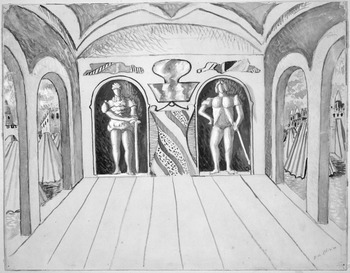
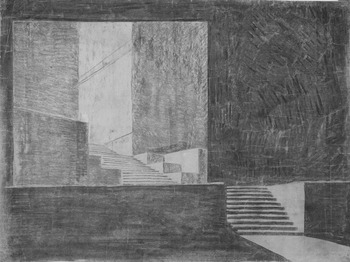
And not only urban projects. In two judgements that reflect contemporary attitudes to the transformations of the stage as much as those of the city, Michelucci’s station provided a yardstick for assessing the radical scenery that Giorgio de Chirico and Pietro Aschieri had conceived respectively for the stagings of Bellini’s I puritani and Verdi’s Nabucco at the first Maggio (Figures 2 and 3). In the words of an anonymous letter writer, who voiced his discontent to marquis Luigi Ridolfi, president of the Teatro Comunale, such architectural and theatrical ‘trash’ was tantamount to the ‘gangrene of the twentieth century’, de Chirico’s scenery representing an indecorous move for a theatre that prided itself on being one of the foremost in Europe.Footnote 44 This criticism was echoed by the journalist Oberon, who, writing in L’Italia letteraria, claimed that Florentines had perceived the ‘stink of Michelucci’ in Aschieri’s set designs.Footnote 45 Admittedly, Michelucci’s building and Aschieri’s three-dimensional sets do bear striking similarities: one can notice their common terraced profiles, neat cube-shaped volumes, and expansive, smooth vertical and horizontal surfaces. The correspondences with de Chirico’s scenery are a little harder to pinpoint – the arches in Figure 2, for example, are entirely absent from the train station – even though the modernist character of both the painter’s work and Michelucci’s building is evident. All this said, how should we interpret the anonymous letter writer’s and Oberon’s statements? Once all affinities and differences between their objects of comparison have been noted, how are we to approach their intertwined analyses of Florence’s new urban and theatrical landmarks?
Giorgio de Chirico, set design for Vincenzo Bellini, I puritani, Act I scene 3 (Maggio Musicale Fiorentino 1933). Archivio Storico del Maggio Musicale Fiorentino.

Pietro Aschieri, set design for Giuseppe Verdi, Nabucco, Act II scene 2 (Maggio Musicale Fiorentino 1933). Archivio Storico del Maggio Musicale Fiorentino.

We might start by saying that both observers probably intended their remarks as simultaneous commentaries on cityscape and stagescape. As Medina Lasansky has shown, a growing interest in urban space characterised Italian culture in the 1920s and 1930s, a period when ‘the representation and experience of the city in its many forms’ regularly spilt over the imagined landscapes of other arts.Footnote 46 Those years also brought about a comprehensive facelift of many cities, with new, Fascist buildings springing up side by side with historic ones, and urban landmarks – including Michelucci’s station – increasingly evaluated in the context of their surroundings.Footnote 47 A hint of this all-pervasive urban space awareness must lie behind the juxtaposed judgements of real and fictional buildings in Oberon’s review and the anonymous letter. Yet, there is no doubt that the Maggio’s new visual aesthetics was a more pressing concern for both writers than contemporaneous urban developments. After all, the man who impudently contacted Ridolfi to denounce de Chirico’s ‘obscenities’ was a regular audience member – one who signed his lengthy tirade ‘an exasperated habitual [opera-goer]’. As such, he was presumably less interested in scrutinising recent architectural trends than in condemning what appeared to him a ‘disfiguring’ of good old Italian opera.Footnote 48 For his part, Oberon conveyed Florentine opinions on Aschieri’s sets within the context of a broader critical review of the first Maggio, in which he noted that the festival had been preceded by months of debate over Michelucci’s station. Given his reference to the ‘stink’ supposedly linking the two projects, we may be surprised to discover that Oberon was in fact Corrado Pavolini: a man (writing here under one of his pseudonyms) who, as we have seen, had elsewhere expressed approval of Michelucci’s building. Why, then, draw attention to objections regarding the alleged echoes of that very building on the Nabucco stage? Although Pavolini’s support for Italian rationalist architecture was never unreserved, due to his distaste for its more international elements, on the whole he did favour a return to the functional simplicity of Italian vernacular buildings – particularly Tuscan country houses.Footnote 49 His comments on Aschieri’s rationalist-style sets, therefore, reflect less his personal stance on architectural modernity than a broader scepticism over the perceived convergence between city and stage.
In both Pavolini’s and the exasperated opera-goer’s cases, the direct comparison between a work of architecture and a work of scenography is indeed significant. Neither Nabucco nor I puritani are set in Florence, nor were they in the 1933 Maggio stagings; thus, the two men’s judgements cannot serve as assessments of the realism (or lack thereof) with which Aschieri and de Chirico had rendered the architectural substance of the two operas. Nor can their words be taken simply as modern-day rehearsals of the old analogy between city and theatre stage that had periodically resurfaced in public discourse ever since the Renaissance.Footnote 50 Rather, Pavolini’s and the opera-goer’s observations seem to point to something even more historically contingent. By evoking the spectre of direct and uncontrollable influences between the work of architects and that of set designers, they suggest a resurgence of aesthetic exchanges between architecture and operatic set design (as seen at the early Maggio), exchanges that were generating divided opinions on what modern buildings and modern stages should – or should not – look like in relation to each other.
Architecture and stage design had, of course, long occupied overlapping professional and aesthetic territory. As Donald Oenslager noted many years ago, ‘from the Renaissance down to [the twentieth] century, […] with equal facility, architects and painters designed villas and gardens, chapels and reception halls, catafalques and parades, masquerades, plays, and operas’.Footnote 51 A prime example of this versatility was Giovanni Perego: the early nineteenth-century ‘man of genius’ praised by Stendhal, and one in a long line of scenografi who worked both within and beyond the theatre, in Perego’s case designing Milan’s Palazzo Saporiti as well as scenery and elements of the interior decor of La Scala. As the century progressed, however, operatic set design became a more self-contained field, increasingly the domain of theatre specialists. The realism (or lack thereof) of onstage buildings could provoke comparisons with actual urban landmarks;Footnote 52 but it was not professional architects who designed those fictional cities, nor did the latest additions to the urban fabric typically drive stage discourse. This is nevertheless precisely what happened with Pavolini and the frustrated opera-goer at the 1933 Maggio. At a time when theatrical metaphors – images of fondali, quinte, scenari (backdrops, wings, scenery) – were frequently invoked to explain the genuinely ‘Florentine’ aesthetic impact of Michelucci’s railway station on the Santa Maria Novella square, these interactions between the discourse of the city and that of the stage point to a moment of convergence: a suggestive blending of 1930s architecture and set design aesthetics.Footnote 53
This notion becomes even more compelling if we consider how both arts were being redefined as disciplines and professions. Since around Unification, architecture in Italy had been taught either in fine arts academies, with a dominance of historical-artistic subjects, or in engineering schools, where a technical-scientific approach had prevailed. Those who completed an architecture programme at a fine arts school were normally entitled to teach the subject but not to practise as professionals, even though many professors were – legally or not – practising architects themselves. Following decades of legislative chaos and animated debates over the skills required of a good architect, the 1920s and 1930s brought about much-awaited reforms. Between 1919 and 1933, six independent Scuole Superiori (later Facoltà) di Architettura were founded, starting in Rome and culminating in Milan, with Florence’s institution opening in 1930. What is more, in 1923 a decree introduced the title of architect, marking a legislative watershed that would be followed by the publication of the first professional code.Footnote 54
In the century that some at the time called ‘of architecture’ and that saw this discipline gain academic and professional recognition, set design set off on a similar journey: the result of its own identity crisis.Footnote 55 No sooner had the first modern architectural schools opened than set design training, earlier often hosted within such courses as ‘perspective’ or ‘applications of descriptive geometry’, began looking for enhanced, more independent homes either in the new architectural schools themselves or in the old fine arts academies (or both), with curricular leanings now more towards the technical, now more towards the artistic aspects of the profession.Footnote 56 Whereas in Milan an independent set design programme was established at the Accademia di Brera in 1923, the same year that the Bologna and Rome academies introduced similar programmes,Footnote 57 in Florence it was not until Carena’s 1941 request to the government that the Accademia di Belle Arti hosted one, although from 1933–4 student architects could already study elements of set design at the Istituto Superiore di Architettura (as well as at Bianchini’s Istituto d’Arte). Taught by Celestino Celestini, an engraver, set designer and frequent collaborator of the Maggio, the Istituto’s corso di scenografia covered both the history and the practice of the profession, having been conceived by the school council as a ‘useful integration to the culture of architects’ and a gateway for them to ‘new avenues of professional activity’.Footnote 58 Even though attempts to establish a partnership with the Maggio repeatedly failed, the module still gave Celestini’s students opportunities to engage in set design projects for the Teatro Comunale’s standard seasons, as well as for prominent touring directors such as Guido Salvini.Footnote 59
During a period when architecture and set design were each being redefined academically, professionally and aesthetically, the connections between architects’ and set designers’ training and activities therefore remained strong. In fact, these ties were, from one point of view, even reinforced by the aforementioned drive to move set design away from the control of theatrical scenografi of old (of the Bianchini type) and towards new, artist-like designers, both painters and architects. Pavolini and the Maggio’s exasperated opera-goer may or may not have had these professional exchanges in mind when they compared Michelucci’s train station to Aschieri’s and de Chirico’s sets for Nabucco and I puritani at the 1933 Maggio. Still, they clearly noted the aesthetic similarities between the two projects – similarities they found revolting – and they pointed to a troubling convergence in the recent trajectories of architecture and operatic set design. Cast in a more positive light, this very connection resurfaces in a series of 1930s and 1940s promotional newsreels about the Maggio, which provide further insight into the festival’s engagement with artigianato through its approach to staging.
Supplemental craft
Lasting between one and six minutes each, four of the five Maggio newsreels produced between 1935 and 1940 by the state-funded Istituto LUCE spotlight painters, carpenters, stagehands, electricians and seamstresses working on the Teatro Comunale’s (back)stage.Footnote 60 A modern viewer might initially be puzzled by such an ‘un-musical’ celebration of Italian opera, the only music-focused visual moments in these shorts being a couple of excerpts from performances and orchestral rehearsals. However, it soon becomes clear that backstage labour can be just as powerful a vehicle for conveying Italianness as bel canto singers and voices. The opera production process, displayed in its most artisanal qualities – a clear paean to Florence’s centuries-old crafts traditions – is the true protagonist of these newsreels, which plunge the viewer into a living, breathing world of ‘set designs, wings, sceneries, props and costumes’ where even the accompanying noises of stage work are worth recording.Footnote 61 Rather than foregrounding the efforts of directors, conductors and performers, or even the final aesthetic product – the fully staged production – these shorts make ordinary and by now largely unidentifiable individuals into heroes: men and women frantically and collectively labouring to deliver the operas to the stage.
This idea of the (back)stage as a space brimming with and breeding craft labour meets the discourse of architecture in another, slightly longer film directed by Pietro Francisci for the private yet government-influenced Industria CortiMetraggi (INCOM).Footnote 62 Titled Invito alla musica (1939), this film, which was commissioned by the Ministry of Popular Culture for national and international propaganda, extends the LUCE newsreels’ immersive exploration of the Maggio’s backstage by documenting a full day of opera rehearsals. To the notes of Rossini’s Guglielmo Tell overture, and as a small army of stagehands hurries up moving different pieces of scenery, the voiceover draws a parallel with the work of the architect – presented in a playful, childlike version:
Sotto la volta di un inusitato firmamento [di batterie luminose] l’uomo, come al solito, attende a costruire. È divertente osservare come il suo lavoro, che qui si direbbe soprattutto di combinazione e di montaggio, ricordi, a prescindere dalle dimensioni dei pezzi, taluni infantili giuochi d’architettura.Footnote 63
(Under the vault of an uncommon firmament [of battery powered lights], man, as always, attends to constructing. It is amusing to observe how his work, which here is primarily one of combination and assemblage, recalls, regardless of the size of the pieces, certain children’s architectural games.)
The process itself of assembling the sets links the world of architecture to that of theatre: a hands-on, material take on scenography that shifts the focus of this artform’s intersections with architecture from questions of training and design alone to the artisanal, executional aspects of both professions. A few seconds later, after watching a series of set designs pass before us, we are presented with what would seem a real stage and proscenium arch only to discover, as a man emerges from behind the mountains, that it was a theatre scale model. Causing the viewer to step into and out of the fictional world of sets seems to be the logic of a film that constantly redirects our attention from designer drawings and models to their full-scale stage realisation and the ‘real’ architecture of both theatre and city, to the point where we lose track of what is what. For there is no break in continuity either in the transition from the views of springtime Florence – rolling hills, artistic landmarks and all – in the opening, solely musical and uncommented part of the film, to the interiors of the Teatro Comunale, where the chronicle of a day at the Maggio soon starts to unfold. Just as the pastoral section of Rossini’s Tell overture draws to a close and leads into the next section (the march or galop), we enter the theatre from the fly tower, with a cut that uses a window to introduce us first to two flymen manoeuvring weights and ropes, and then, as the camera looks down, to the orchestra playing in the pit.Footnote 64 A few more seconds of images and music, and the descent from the ethereal heights of Florence is completed with a sharp transition to the aestheticised operatic backstage.
Much of the craft- and architecture-focused rhetoric that permeates the LUCE newsreels and this INCOM film also surrounds other forms of Fascist spectacle, most notably the Carri di Tespi – travelling, demountable theatres that blended human and mechanical labour.Footnote 65 The Maggio’s celebration of artigianato nevertheless reached its most vivid expression at a Mostra dei mestieri artigiani nel teatro (exhibition of theatre crafts) that Pavolini and other Fascist authorities inaugurated in Florence in 1942. Taking place in lieu of the annual Fiera dell’artigianato (crafts fair), an event that since 1931 had signalled to the world Italy’s unrivalled leadership in the crafts, the 1942 exhibition focused specifically on the many backstage jobs provided by theatre, which the journal Il legionario described as ‘a true training ground for craftsmanship, a vibrant and industrious training ground that provides bread and work to a host of people’.Footnote 66 Once more, as in the LUCE and INCOM shorts, it was carpenters, scene painters, set designers, dressers, make-up artists, shoemakers, electricians, propmen and stagehands – often featured while at work in purpose-built ateliers – who took to the spotlight, and who were charged with demonstrating how ‘Fascist craft [is] the living and working essence of the State.’Footnote 67 The Maggio was praised by the Mostra’s reviewers for increasing both the number and the specialisms of Florentine artisans, and was allocated no less than three pavilions to display its own theatre and stage models, set and costume designs, costumes, armours, wigs and even an entire luthier workshop.Footnote 68 Taken together, the living presence and activity of these ‘patient and hard-working artisans’ of the stage were intended to shift public perceptions of opera and theatre from a simple association with art towards a more full-rounded (or even dominant) and politically relevant association with craft.Footnote 69
This grand celebration of theatre crafts thus brings us back to where we started, prompting us to reconsider Labroca’s postwar reminiscences of the early Maggio in light of the interwar developments in operatic set design that I have traced in this article. To return to Labroca’s recollections for a moment: Why include scenografi in a list of Florentine artisans? Why present them as manual or technical labourers alongside carpenters, electricians and stage technicians, when by the 1950s a new, modern notion of set design as art had taken shape?
As mentioned at the start, by the 1930s the term ‘scenografo’ had multiple meanings. Both Bianchini and Toti, the painter who lamented the lack of job opportunities at the Maggio, were primarily scenografi in the sense of scene painters – a meaning that evoked the manual world of crafts. A series of derived expressions (pittore scenografo, aiuto pittore scenografo, apprendista scenografo, bardotto per la scenografia, and so forth) could, moreover, specify the exact role and status of each member of the scenografo’s team.Footnote 70 Nevertheless, despite widespread efforts to preserve or even revive the artisanal aspects of the profession, critical understandings of the scenografo’s function were changing. Not only did the Maggio encourage set design commissions from ‘pure’ artists, but the emergent phenomenon of opera direction increasingly foregrounded interpretation in all aspects of mise en scène. Producing sets that ‘adhered to’ or ‘commented on’ the music and drama – a new notion reflected in a new critical vocabulary at the time – required more than mere technical or manual skills, however outstanding.Footnote 71 When the Maggio architect Enrico Rava saw one of his set designs published in The Weekly News mistakenly under Bianchini’s name, it was not long before he raged against both the journal and Labroca for attributing his work to a man ‘whose only task is to manufacture the sets created by others’ (underlining his). At a time when the roles of set designer and set maker were becoming separated, the English word ‘scenery’, he explained, ‘can easily give rise to misunderstandings’.Footnote 72 Indeed, whenever Italians had to distinguish between these two, complementary scenografo figures – or, even better, between the old theatrical scenografo who both designed and painted the scenery, and the modern one who only designed it – they began to use different, value-laden terms. Those commentators who wanted to emphasise the original, interpretative contributions made to operatic stagings by modern designers referred to them as ‘artisti’ (artists), while dubbing the old, specialised scenografi disparagingly as ‘mestieranti’ or ‘praticanti’: words, derived from mestiere and pratica, that retain a hint of the skills earned in traditional artisan workshops, but that also imply manual workers lacking the inventiveness and status of their creative colleagues.Footnote 73
To sum up: 1930s Italian operatic set design was ambiguously poised, as an object of discourse, between art and craft, creative interpretation and material realisation. It at once encroached upon (as an art) and resisted (as a craft) the more conceptual aspects of modern staging, the end product of which was meant to be an organic whole of words, music and visuals. In line with this ambiguity, commentators could inflect the meaning of the word ‘scenografo’ in different ways, depending on the aesthetic values they wished to support. In his 1950s memoirs, Labroca may well have chosen to remember only, and only positively, the scenografo-praticante, underlining his fellowship in both skillset and mindset with other Maggio artisans, all members of the same, praiseworthy community of Florentine craftsmen. But there is no doubt that he also recognised the tension that had arisen between the conceptual and executional aspects of set design, a tension he had not hesitated to expose years earlier when promoting the new generation of scenografi-artisti. In a 1933 review of Spontini’s La vestale, designed for the Maggio by Felice Casorati, he had explained without mincing words that ‘we have seen how an artist can do what a mediocre craftsman [mestierante] will never be able to do, that is, highlight the characteristics of the drama and the atmosphere of the music and therefore deeply move people’.Footnote 74 Labroca’s dismissive attitude, in this early review, towards the work of set designers with deep theatrical roots, in favour of an easel painter and leading exponent of Italian Magic Realism, can be understood in the context of the time he was writing. Despite the craft promotion rhetoric that characterised the early Maggio and the broader Fascist period, Labroca’s contempt for mestieri and mestieranti suggests that, in the 1930s, craft could also – when invoked with a negative connotation – serve as the kind of ‘conceptual limit’ or ‘frontier’ that, according to craft scholar and curator Glenn Adamson, allows artistic practices to mark themselves as different from and superior to crafts.Footnote 75 In contrast, by the 1950s, after set design had firmly established itself as a creative, artistic endeavour – distinct from the business of scenery manufacturing – Labroca could confidently invoke the aura of the old Florentine scenografi-as-craftsmen, paying tribute to a world that had largely vanished.
Other historical figures who played a key role in the early Maggio put different spins on these debates. Theatre director and designer Guido Salvini, who supervised the 1933 Maggio’s mises en scène and later served as guest director at subsequent festivals, wrote an article in 1931 that anticipated many of the later polemics. Its title, ‘Un primato da difendere: la scenografia’ (A Primacy to Defend: Set Design), immediately reflects Salvini’s framing of the question of the scenografo’s identity in national rather than local terms. In Salvini’s view, not just Florence but Italy as a whole had been home to an unparalleled set design tradition stretching back to the Bibienas, Sebastiano Serlio and Filippo Brunelleschi. Using the word ‘scenografo’ to refer exclusively to the executor of the scenery, Salvini vigorously supported the cause of the old specialised painter of Italian lineage: the ‘perfect, accomplished artisan’; the craftsman trained in the atelier; the master ‘who knows the secrets of mixing the colours and the illusion of perspective, he who was born in Italy and in Italy rose to greater glory than in other countries’.Footnote 76 The scenografo’s task, Salvini explained, is to carefully interpret and paint the sketches provided to him, acting as a ‘faithful executor’ of an external artistic idea, which he brings to life through his impeccable technique.Footnote 77 Given the exceptional talent found in Italian arts and crafts workshops, Salvini believed the creation of ‘set design schools as such’ by theatres or other institutions to be wholly unnecessary, for it was through side-by-side work with their masters that set design students could truly learn their mestiere. Footnote 78 In other words, without dismissing the more intellectual aspects of the profession – in fact arguing that, now more than ever, students of set design must communicate with those of opera direction – Salvini still portrayed set design as essentially a craft: a venerable Italian tradition that had reached a peak of technical excellence during the Renaissance, and that was still flourishing in the twentieth century under the aegis of those great old models.Footnote 79
Once again, then, as in Labroca’s case (both his 1933 article and his 1950s memoirs), we see craft wielded as an instrument in a broader aesthetic and cultural politics, whether local or national, centred on theatre and opera. Salvini’s essay indeed helps us to weave together several themes that have shaped this article: the question of where, how and by whom set design training ought to be provided in 1930s Italy; the issue of whether operatic scenografi should be regarded as artists or craftsmen; and the politico-cultural meanings mobilised by artigianato. If we let it resonate beyond its immediate historical context, his essay might even prompt broader questions of greater contemporary relevance. What, for example, might Salvini’s conception of set design as craft have to offer opera studies today?
Taking Salvini’s call to preserve the skills and values embodied by scene painters and their work seriously might, first of all, involve broadening our scholarly exploration of opera production labour, moving beyond scenografi to uncover other forgotten figures who historically inhabited the operatic backstage and understage. To name just one such group: prompters have rarely appeared in modern operatic histories, remaining on the margins of scholarly commentary even though their contributions to the smooth running of performances were deemed as essential by both critics and audiences as those of more visible (or more audible) operatic participants.Footnote 80 If allowed more space in our narratives, scene painters, scene carpenters, stagehands, prompters and their likes might well return us a more mundane, ‘crafty’ image of opera-making than the focus on ‘high’ artistic agents – composers, directors or set designers – has so far allowed.
To recover such an image requires confronting a fundamental tendency in all craft towards effacement, for as Adamson reminds us, craft has a ‘supplemental’ character that contrasts with the ‘autonomous’ character of modern art. Understood as a process, no craft is meant to be noticed (much like the frame surrounding a painting); on the contrary, all craft is bound to disappear, make itself invisible, fade as inaudible.Footnote 81 In an age like ours, so anxiously concerned about the survival of opera as an artform, recalling the endlessly re-negotiated boundary between so-called art and so-called craft may well help to ease some distress.
Yet an even more fundamental shift is already under way within the contemporary opera industry, where digital design, fabrication and visualisation tools have become integral to performances, opening up new dimensions for understanding set design as craft within this changing landscape. In part, digital technologies are challenging traditional hierarchies between intellectual and manual forms of labour, narrowing the gap that once separated the designers from those responsible for the construction of the sets. Today, the skillsets required of both set designers and scene manufacturers often include the mastery of digital software, with their collaborative processes also evolving in an increasingly globalised and computer-mediated operatic environment.Footnote 82 Above all, the use of animated projections and installations capable of responding to external stimuli in real time are creating dynamic stage environments, ones that continually call into question long-standing distinctions between art and craft. One wonders whether the traditionally ‘supplemental’ and self-effacing nature of craft – the notion of hidden, ephemeral labour behind static sets that served merely to frame art – can still hold relevance in this new context. As the physical and virtual worlds continue to merge, it may be that craft, with its emphasis on active, relational processes, reasserts itself all the more powerfully and visibly in opera.
Acknowledgements
I am grateful to Marco Ladd, Roger Parker, Emanuele Senici and two anonymous reviewers for their helpful comments on earlier versions of this article. All translations are my own unless stated otherwise.


 Open access

