Even Rossini's most enthusiastic commentator did not have much to say about the text for the first act finale of L'italiana in Algeri. Henri Beyle (alias Stendhal), normally so eloquent, becomes blandly factual when faced with Angelo Anelli's libretto: ‘It's true that the Bey says “I'm like a cannon going boom” and that Taddeo too says “I'm a crow, going caw!”’ But to focus on the words at this particular moment of the opera, he maintains, is to miss the point entirely:
In Venice, where this finale was sung by Paccini, Galli and la Marcolini, the spectators, by the end, were gasping for breath, and wiping the tears from their eyes. The impression created is exactly what people of taste expect from an opera buffa; the effect is extremely powerful, therefore the work is a masterpiece. One wasn't obliged in Venice or Vicenza to descend to the level of explaining the details of this reasoning, everyone cried out through gales of laughter: Sublime! Divine! […] It is just not possible to say more … – but how to make such things clear to those people who pay attention only to the libretto?Footnote 1
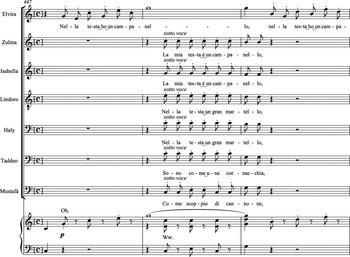
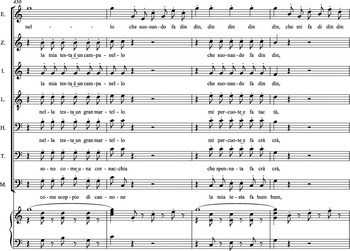
Far more important to Stendhal is the power and immediacy of Rossini's music, the way it acts upon the body and demands that the listener succumb to sensual pleasure. And what is significant is how this pleasure is brought about: through the immersion of the listener in noise. Anelli's text, despite Stendhal's dismissal, thematizes the very loss of self in sound that Stendhal describes; the passage is self-referential, offering onomatopoeic amplification of – or perhaps justification for – the music's commotion. The finale, as is customary, is built around two expressive extremes: mute surprise and riotous cacophony.Footnote 2 After each and every character is crammed on to the stage, a shocking revelation – the reunion of two long-lost lovers – strikes the entire company dumb. A slow, hushed passage of stepwise melody is followed by various efforts to explain or undo the tangled web of assumptions. The attempts succeed only in unleashing a flurry of motion and the raucous confusion reaches fever pitch. One of Rossini's famous crescendos builds and then erupts, and suddenly each character begins to impersonate a noise-maker – pounding hammer, croaking bird, clanging bell, booming cannon (see Ex. 1). As in other chaotic moments in Rossini, here individual identities are dissolved in a babbling collective. If the head is imagined as a smithy, a bell tower or a battlefield, the dissolution of the characters' interior space turns their minds inside out; they are left empty, human resonators merely echoing the din. Reason flees, sensation takes over.
L'italiana in Algeri, Act I, finale.


Rossini's comic finales consistently foreground the propensity of noise to overwhelm the senses, to both signify and induce madness or confusion, and to transform the bodies on stage into noisy automata, wound up and left to play like music boxes. But musicologists encountering Rossinian noise have tended to remain mute, struck dumb in the face of all the clamour.Footnote 3 After all, a certain amount of chaos is to be expected from a comic finale; there are similar moments in Il barbiere di Siviglia and La Cenerentola. Many of these moments depend on the transformation of the human into something machine-like, a move which, according to Henri Bergson's De rire, is at the heart of the comic enterprise.Footnote 4 Indeed, one could argue that the noisy finales and ensembles of Rossini's opere buffe work precisely because of the limited and predictable – in other words, the mechanical – nature of their musical gestures. Applications of Bergson's theory of laughter to musical mechanisms are built on his notion that comedy involves making the human and vital seem uncharacteristically inert, stiff, bumbling and repetitive.Footnote 5 From this perspective, Rossini's mechanical noisiness may appear ‘naturally’ comic and dramatically appropriate – and therefore hardly in need of comment. But it is worth remembering that examining how, why and when audiences laugh can reveal larger tensions or conflicts, places where social values are actively contested and transformed. Rossinian noise was just such a point of contention for critics; even Stendhal, who describes the din of L'Italiana's finale as a source of intense pleasure and bodily engagement, at times finds it a source of discomfort. The tendency of Rossini's music to devolve into noisy mechanism is thus ripe for exploration and critique.
This essay suggests that Rossini's mechanical noise has as much to do with the particular political, aesthetic and physiological concerns of early nineteenth-century Italian and French culture as it does with universal or timeless truths about comedy.Footnote 6 I situate Rossinian noise – and the controversy surrounding it – in the context of a pervasive ambivalence concerning the place of the sensible body. Because it seemed to act on the body in such powerful ways, noise very easily allowed commentators to invoke a whole panoply of overlapping discourses – of politics, sentimentality and sensibility, morality, medicine and physiology. In addition, critical concern with the sheer sonic force of Rossini's music was so widespread and so varied that anyone wishing to explore the significance of this trope must reconcile a broad, decidedly non-local view with focused investigation of specific critics and operas. Weaving together a study of the theme of noise in Rossini reception with an investigation of noisy moments in his operas, I use the writings of Stendhal as both focal point and impetus as I seek to clarify how Rossini's music became a nexus for debates about the place of reason versus sensation and the troubled relationship between physiological and moral stimulation. These tensions are especially apparent in two operas from 1817, La Cenerentola and La gazza ladra. Both works tend to subvert the conventions of sentimental comedy by ironizing sentimental display, mocking tender feelings, or, most tellingly, juxtaposing tears with violent cacophony – tactics that did not always sit well with critics.Footnote 7 ‘Noise,’ however, is a multivalent idea in Rossini reception, a motif with many implications, and as we shall see, can be used to suggest an array of meanings, some of them contradictory.Footnote 8
Stendhal's 1824 Vie de Rossini, an idiosyncratic meditation on the composer's life and works, perhaps best embodies the conflicting responses and approaches to Rossinian noise circulating in the early nineteenth century. The text is marked by all the classic Stendhalian traits: hyperbole, episodic excurses and general waywardness.Footnote 9 Indeed, read in the light of the broader critical press, Stendhal's Vie seems like a virtuosic compendium of contemporary opinion, some of it possibly plagiarized, much of it self-contradictory, and all of it vividly immediate.Footnote 10 Stendhal's ambivalence about the sheer physical force of Rossini's music reflects a larger division between fans and critics, a bifurcation that produced an immense volume of printed matter. Marcello Conati has argued that ‘perhaps it would be easier, faced with the mass of material, to take the path of least resistance, to imitate the miraculous synthesis that Stendhal achieved in his (never verifiable but nonetheless most “true”) biography’.Footnote 11 The attractions of using Stendhal as a kind of expert witness are indeed strong. But when placed in dialogue with other voices, Stendhal appears not as a unitary author, but as a kind of cross between fan and critic – a many-voiced spokesperson for a larger cultural moment. I will aim, then, neither to cite Stendhal as an authority nor to unmask him as a mere spinner of prejudiced fictions about Rossini. Instead, I will focus my attention on ‘Stendhal’ the literary construct rather than Henri Beyle, the actual person behind the pseudonym. By keeping Stendhal's unique position between the real and the fictional always in view, I hope to show how his strange ambivalence towards Rossinian noise – an ambivalence that mirrors the broader discourse on the composer – can complicate and enrich our understanding of such operatic moments, perhaps even pointing to the threat of soulless mechanicity that seemed to shadow these new and modern sensual pleasures.
Sound, sentiment, mechanism
Whether they spoke of the babble and acclaim of the crowd, ‘meaningless’ vocalises or an orchestral sound akin to the artillery of Napoleonic battles, Rossini's critics consistently depicted the effect of certain moments in his operas as lying beyond the bounds of verbal description or even good taste – as a devolution of music into noise. Although Bergson's pairing of comedy with the mechanical would come much later, early nineteenth-century witnesses had already described his noisy music as machine-like. It was not comic mechanism that preoccupied these commentators, however, but rather an alarming, inhuman mechanicity with broader moral, political and physiological implications. Since the eighteenth century, theories of sensibility had posited that the body, in its capacity for tender sentiments, was the seat of good taste, nobility, reason and morality. Noise seemed to jeopardize the body's natural order, threatening to over-stimulate or corrupt the exquisitely tuned nerves of listeners. Whether it was thought to excite, incite or simply dull the critical faculties, operatic noise posed a real problem.
Rossini's cool reception among contemporary German critics is well known; cast as the superficial foil to Beethoven's serious depth, his propensity for crescendos and florid vocal display was thought to appeal to the listener on a merely physical level, leaving the soul unmoved. But despite Dahlhaus's well-known characterization of Rossini and Beethoven as the opposite poles of the ‘twin styles’, Italian and French writers also routinely accused Rossini of being too ‘Teutonic’, and thus a corrupter of the true, melodious Italianate tradition. This strand of reception understood Rossini's cacophony as part of a larger cultural degradation of literary style and musical taste; anticipating the screed of A. B. Marx, these critics decried the decline of a musical ethos. Writing to the women's journal Il corriere delle dame after the première of Il barbiere di Siviglia in 1816, for example, Lattanzi attacked Rossini on the grounds that his opera was an unpatriotic imitation of ‘foreign’ ways, in which the sense of the words was divorced from the sound of the music:
We will never cease to complain at seeing true Theatre neglected by the Italians. While there should exist in the Athens of Italy a permanent theatre where the works of our classics, and those who follow in their footsteps, would be performed, it is a long time since we have had a company worth mentioning. The musical theatre that the Italians, unlike other nations, prefer, is one that tyrannizes our stage and hinders the progress of the art of Sophocles and Menander. We will not pause long to examine the Barber of Seville, the libretto currently sung at the [Teatro della] Pergola, because it is completely unworthy of comment. It is enough to reveal that there are versi quinari such as these:
Laran la lera
Laran la la
Poor Metastasio, for such people, you laboured to write! The music is by Sig. Rossini, who took on the difficult task of vying with Paisiello by setting the same subject, going back to entire passages of Generali, Paër and others, and recopying them himself, substituting for the simple and moving Italian music a music that is overburdened, confused and noisy, and corrupting the good taste of the country of Cimarosa with imitations of northerners [oltramontani]. In a situation in which the characters, so as not to be caught, say ‘hush hush, softly, softly’, our composer bursts into music that could be heard miles away.
[Non cesseremo mai di lagnarci nel vedere il vero Teatro negletto d'italiani. Mentre dovrebbe esistere nell'atene dell'Italia un Teatro permanente in cui si recitassero le opere dei nostri classici, e di quelli che sulle loro orme camminano, è molto tempo che non abbiamo una compagnia degna di esser mentovata. Il teatro musicale, che gli Italiani diversamente dalle altre nazioni predileggono, è quello che tiraneggia le nostre scene e non fa progredire l'arte dei Sofocli e dei Menandri. Non ci fermeremo ad esaminare il Barbiere di Siviglia, libretto attualmente cantato alla Pergola, perchè inferiore affatto alla critica. Solo si farà rilevare che vi si trovano dei versi quinari siffatti: Laran la lera/Laran la la. Povero Metastasio, per qual gente ti sei tu affaticato a scrivere! La musica è del sig. Rossini, che si è accinto alla dura impresa di rivaleggiare nell'istesso soggetto con Paisiello, riportando degli squarci interi del Generali, di Paër e di altri, e ricopiando se stesso, sostituendo alla musica italiana semplice e commovente una musica carica, intralciata e rumorosa, e corrompendo il gusto della patria Cimarosa colla imitazione degli oltramontani. In una situazione in cui i personaggi per non esser sorpresi dicono ‘Zitti zitti, piano piano’ il nostro compositore prorompe in una musica da sentirsi lungi le miglia.]Footnote 12
Perhaps the most immediately striking aspect of this passage is the peculiar brand of nationalism it espouses, a position tailored to respond to Madame de Staël's remarks about the puzzling ‘backwardness’ of Italy's literary culture. Staël's infamous essay ‘On Translation’, in which she argued that Italians should read the classics of other countries in order to jump-start their own literary movement, had been reproduced in Il corriere and was hotly debated by readers for many months.Footnote 13 Lattanzi here agrees with Staël's assessment that Italy remains disconnected from its own cultural heritage, but she does not believe that the solution lies in translations of foreign literature. On the contrary, she claims that imitation of oltramontani (those living north of the Alps – most likely German-speakers) is leading Italian music astray from its own natural idiom, the ‘simple and moving’ style of Cimarosa and Paisiello.
Lattanzi's veneration of Paisiello is no accident: it was the composers of an earlier age, the last representatives of the so-called ‘Neapolitan school’, that Rossini's critics invariably held up for comparison. The famed composer of Nina took a very different approach in his operatic treatment of Beaumarchais's play: light orchestration, unadorned vocal writing, and comparatively simple harmonies make the earlier Barbiere a gently comedic essay about the bumpy path to marriage. Rossini's opera, in contrast, with its vocal fireworks, overwhelming crescendos and harmonic special effects, plays up the ridiculous and sensational aspects of the comedy.Footnote 14 In Lattanzi's view, the irrationality and meaninglessness of Rossini's Il barbiere, with its nonsense syllables arranged into versi quinari and its ‘heavy, confused, and noisy’ music which clashes with the demands of the text, was not only un-Italian, it also corrupted the listener's taste. The moral overtones of Lattanzi's rhetoric alert us to the sentimental subtext of the passage. Simplicity and the capacity to move listeners were perhaps the most highly prized values of eighteenth-century sentimental culture: recovering a more ‘natural’ vocal idiom, a kind of expression that could reach into listeners' souls and motivate them to moral action, was perceived as an important social function of opera.Footnote 15 Lattanzi's objection to the disjunction between text and music and her apparently reactionary censure of nonsense syllables become clearer in this light: when listening to opera we should be roused to something (pity, noble actions), not just (a)roused. Meaningless speech and needlessly noisy music could thus be seen as immoral – sensually stimulating, but with no higher purpose.
Lattanzi's response is intriguing not merely because it argues (as so many Italians did) for a kind of retrogressive music of the future, but also because it associates a decline in the intellectual and cultural heritage of Italy with a currently fashionable operatic style. The negative moral implications of such music and its potential corruption of taste were very real concerns for commentators responding to Rossini's operas. For many, it was a short step from comic cacophony to senseless babble, and finally to the decline of literary culture at large. This strand of reception – what Carlida Steffan calls the ‘neoclassical’ view – was primarily concerned with preserving the values of an earlier age.Footnote 16 What resulted, Steffan argues, was a growing gulf between a vocal minority of critics and an enthusiastic public swept up in Rossini fever. Unwary listeners were thought to be infected with an enthusiasm that dulled their capacity to appreciate true beauty. As we shall see, portrayals of Rossini's audience as credulous, tasteless, ever-expanding, and possessed by a kind of frenzied illness were an important corollary to the critical obsession with Rossinian noise.
The terms of Lattanzi's complaint – that musical noise, while perhaps arousing pleasing sensations, was at odds with the sentimental stress on morality through sympathy – were echoed in French critic Henri Berton's 1826 essay De la musique mécanique et de la musique philosophique. Berton's pamphlet was a reprint of a series of articles that first appeared in 1822, in response to Stendhal's gushing essays likening Rossini to Napoleon (essays that would later serve as the basis for the Vie).Footnote 17 Although Berton never explicitly mentioned Rossini, the Italian composer is the obvious target of his attack, as the article appeared on the occasion of a new performance of Gluck's Armide at the same time that Rossini's Semiramide and Boïeldieu's La Dame blanche were having their Paris premières.Footnote 18 Margery Selden has characterized Berton's critique as one that ‘lashes out at the modern generation's constant seeking of bizarre and sensational effect. Particularly criticized were the “excessive roulades” typical of the new operatic score, roulades which were even “misapplied to servant's roles”, as well as the use of any vocal or instrumental technique as a device of sheer sensationalism’.Footnote 19 Berton sees the popularity of Italian opera in Paris as a threat to ‘philosophical’ music and warns that appeals to sensation should be viewed with caution: ‘By reducing musical art to the sole employ of its physical means and by depriving it of those things which give it the power of its moral and rational part, one exiles it from the domain of the fine arts, and that entitles us, therefore, to give to music composed in this system the epithet of “mechanical music”’.Footnote 20 Berton then recalls a conversation with Johann Nepomuk Mälzel, the famous metronome-maker and creator of mechanical instruments and musical automata. When asked by Berton whether he could create a machine capable of reproducing roulades and runs, and to compose music ‘like Monsieurs XXX’, Mälzel replies yes with confidence. ‘But’, the inventor continues, he could make ‘nothing that might produce anything like the works of Mozart, Cimarosa, Sacchini, etc., etc., … To Divinity alone belongs that right.’Footnote 21 The implication is clear: the music of composers like Rossini was formulaic and could be produced just as easily by a machine. Berton closes with an appeal to young composers, who are clearly meant to aspire to music worthy of divine genius and not simply churn out notes like a well-made automaton.
The equivocal body
Musicologists have tended to look to the writings of Stendhal for an antidote to ‘anti-sensation’ stances like Berton's. His Vie de Rossini seems to embrace what Lattanzi and Berton dismiss, repeatedly insisting that Rossini's music – indeed all music – works on the body in physical ways. This, he claims, is what makes music superior to the other arts: ‘the quality in music, which makes of it the most enthralling pleasure that the soul can know, and which gives it so marked an advantage over even the finest poetry… lies in the element of physical intoxication which it contains’ (15). Stendhal's approach to Rossini is the basis for his larger claim that music neither contains nor conveys emotion. ‘The only reality in music’, he writes, ‘is the state of mind which it induces in the listener’ (18). Music acts on the listener's senses, spurring his imagination, and thus brings to mind emotions with which the listener is ‘already preoccupied’ (17). This insistence leads him to assert that all music necessarily depends upon mechanical action:
Music exerts a certain pressure upon the nervous system of the ear, creating a given degree of tension, and thus producing a physical, purely mechanical type of sensory pleasure (as, for example, during the first-act finale of Mozart's Così fan tutte); and apparently this physical pleasure communicates a certain degree of tension or irritation to the brain, forcing it to produce a series of pleasurable mental images, or else to react, with drunken intensity twenty times more violent than usual, to mental images which, in normal circumstances, would have inspired nothing deeper than the most vulgar sensual satisfaction – just as a handful of nightshade berries, picked accidentally in the garden, can turn the brain to madness (16).
Like a powerful drug, Stendhal argues, music acts on our bodies in such a way that it heightens states of mind or intensifies emotions already present. Such physiological explanations pepper the Vie de Rossini, and the author's recognition of music's sensual effects has made him attractive to those seeking alternatives to formalist analytical methods. Following the lead of Roland Barthes, scholars interested in grounding a new music criticism in the body have embraced Stendhal as an antidote to dominant critical approaches.Footnote 22 Robert Fink finds in his work the seed of an anti-organicist musical analysis and explicitly sees him as a role model, while Stephen Downes calls for a new mode of analysis that, à la Stendhal, would start from the fact of physical pleasure.Footnote 23 But modern-day appropriations of Stendhal often renege on the promise of a body-centred criticism. Downes, for example, enthusiastically reiterates that Stendhal tends to open the critical act with the physical intoxication music induces, but ultimately he concludes that Stendhal seems more interested in the ‘shift from sensation to reflection’ (236) and the ‘educated listener's movement from the sensual to the spiritual’ (242). Downes's argument mirrors this process: he begins with a meditation on love (Stendhal's De l'amour) and ends with a Schenkerian excavation of deep structure. He speculates that ‘Stendhal's listener – undoubtedly an idealized self-portrait – is an admiring one with keen, sharp ears and a vivid imagination who, after first delighting in the beautiful effects one might assign to musical surface, in ideal reflection digs deep and build[s] structures’.Footnote 24 What is ultimately attractive about Stendhal's criticism is not what it might reveal about nineteenth-century listening practices, but the licence it gives to contemporary methods of musical analysis.Footnote 25
One reason why an admirer of Stendhal's body-centred, pleasure-orientated criticism might end up talking about abstractions like deep structure may be because Stendhal is not the unproblematic champion of the body he appears to be at first glance. Indeed, Rossini reception in general was marked by a conundrum: even the composer's most ardent supporters (Stendhal included) had trouble justifying what they admitted to be the most intoxicating element of his music – its effect on the body. Librettist and critic Giuseppe Carpani, a staunch defender of Rossini, was candid about music's appeal to the senses, but found it difficult to embrace this sensual charm wholeheartedly.Footnote 26 Carpani's letter on Elmira, which was reprinted in his collection of letters entitled Le Rossiniane in 1824 and may have served as a model for Stendhal, features a lengthy discussion of musical aesthetics in an out-of-the-way footnote in the appendix. Here we find the familiar insistence that music does not contain essential states of being, but instead induces them in the listener through direct, immediate, physical action:
music, in contrast to her sister arts, acts primarily on us as a physical power, so that, even without imitating nature, it bears within itself considerable and distinct sensual pleasure or displeasure, according to the rules of the quality and the union of its sounds. Dissonances lacerate our ear, consonance delights, and the succession of similar and beautifully linked tones bewitch the ear even without words.
[la musica in ciò diversa dalle arti sorelle, agisce principalmente su di noi come potenza fisica, cosicchè, anche senza l'imitazione della natura, ci reca notabile e ben distinto piacere o dispiacere sensuale, a norma delle qualità e della unione de' suoi suoni. Le stonature ci lacerano l'orecchio, gli accordi lo beano, e la successione di tuoni analoghi e ben concentenati lo incanta anche senza la parola.]Footnote 27
Although Carpani argues that we could formulate a theory of the ‘physical delight of hearing [fisico diletto dell'udire]’ that might resemble a theory of gastronomy for the ‘delights of the palate’, he is careful to distinguish these more ‘physical’ modes of perception from the faculty of sight. ‘The faculty of sight is not like that of smell, of taste, and of hearing, destined by nature to strongly affect [forte agire] us on the physical level by its direct action’, he claims. On the contrary, unlike the more physical senses, sight ‘is a medium of ideas rather than a means of producing pronounced and bodily sensations of various types and remarkable effects’.Footnote 28
Carpani seems to be on the verge of carving out a place for a sensual aesthetics of music, one that would argue for the primacy of its bodily effects. But such an aesthetics remains an illusion: Carpani pulls up short, so to speak, and strives to integrate the neo-classical values of beauty and imitation of nature with the ‘sensualist’ position.Footnote 29 In the passage that follows, music's effect on the body is reimagined as the first stage of a process that ultimately leads the listener to the realm of mimesis and ennobling, ideal beauty. Thus the claim that music's primary effects are physical is tempered with Carpani's insistence that music acts on a ‘higher’ level:
But look here: music also raises itself to the level of mimetic art, and from this humble and sensual pasture of the ear it becomes a sublime and divine art, acting to please the soul above all the other arts. Of this there is no doubt; but in this apotheosis of music the faculty of hearing has not changed in form or in inclination: it is left out from this process that nature brings about, and these vibrations that sweetly tickle the ear and render it content constantly call out to us. Music, therefore, has not with this ennobling of itself lost or diminished its physical force – its primitive, strong, direct and immediate effect on the senses – or those gifts which nature bestowed upon it for our comfort. This perhaps makes it necessary that music first satisfy the ear with the pleasure of the senses, then the soul with the imitation of beauty, which is more laudable, but less indispensable. (emphasis mine)
[Ma dirammi ognuno: la musica s'è pur levata al rango d'arte imitativa, e da pascolo innorato e sensuale delle orecchie, è divenuta arte sublime e divina, atta a beare gli animi sovra ogn'altra. Non v'ha dubbio; ma in questa apoteosi della musica l'organo dell'udito non ha cambiato di forma o di fame: è rimasto quale la natura il fece, e vi chiede costantemente quelle vibrazione che dolcemente lo solletichino e rendan pago. La musica quindi non ha col tanto nobilitarsi perduta o sminuita la sua forza fisica, la sua azione primitiva, grande, diretta ed immediate sul senso che per lei fu creato, od a cui dalla creatrice liberalità fu accordata per nostro sollievo. Che però riesce necessario ch'essa soddisfi primamente l'udito col piacere del senso, poi l'animo con quello più lodevole, ma meno indispensabile, della bella imitazione.]Footnote 30
This slippery passage suggests that Carpani is attempting to reconcile music's physical effects with its action on the ‘higher’ faculties. Granted, Carpani seems to argue, music does somehow have an effect on the soul – it transports us, it ennobles us – but let us not forget that it does so through the basest mechanical means. Carpani's repeated insistence on the importance of music's physical action is undermined somewhat by his realization that such an assertion flies in the face of neo-classical thought. Music's siren-like temptation towards physical pleasure – its ability to ‘tickle’ the ear – may be a fact, but it is still a sticking point. Notice that here the faculty of hearing is shunted aside in the transition to the sublime: it is, in Carpani's words, ‘left out’ or ‘left over’.
Carlida Steffan has suggested that Carpani may have been unique in his effort to reconcile seemingly irreconcilable positions: the neo-classicist commitment to the abstract ideal of beauty and the idea that music works directly on the body and the senses in a purely physical or mechanical way (Steffan, xx–xxi). But Carpani's insistence that music cannot contain anything but physical pleasure or displeasure and his account of music's effect on the ear are clearly reminiscent of Stendhal's discussions of the bodily effects of music. The similarity between the two authors' positions is perhaps unsurprising given the fact that Carpani famously accused Stendhal of plagiarism in a very public exchange of letters.Footnote 31 Whatever the lines of influence between the two, it is worth pursuing their shared ambivalence, for Stendhal too has a problem with the body, and he shies away from an enthusiastic embrace of what he calls Rossini's ‘glittering new sensations’. Although Stendhal began the Vie with a meditation on music's effect on the nerves, his fascination with science, medicine and the body cannot be squared with his simultaneous belief that music should express what he calls ‘true sentiment’ and thus stimulate the listener's moral faculties. Stendhal may have been dazzled by the new sensations Rossini's music offered, but he also mourned the passing of the old order, a time when Cimarosa and Mozart imbued their operatic characters with nobility and moral depth. This nostalgia is expressed as a conceptual tension in the Vie de Rossini between the themes of noise and sentiment, a tension that is especially apparent in Stendhal's discussion of La Cenerentola and La gazza ladra.
Stendhal's nausea
Stendhal's mixed feelings receive vivid expression in his response to La Cenerentola, performances of which he attended in 1817 in Milan, soon after the opera's Roman première, and again two years later in Florence.Footnote 32 His account of the experience wavers between grudging admiration for the opera's sensational effects and shrill denunciation of the work as ‘vulgar’. The trouble begins with mysterious physical symptoms. Stendhal is puzzled by his own indifference and ascribes it to illness. ‘On the first occasion’, he writes,
I was convinced that I was unwell; subsequently, however, as performance after performance left me cold and unmoved, while the crowds around me cheered to the pitch of delirium, I was forced to admit that my dissatisfaction must have its roots in some permanent personal idiosyncrasy. The music of la Cenerentola, beautiful as it is, seems to me to be lacking in some essential quality of ideal beauty (240).Footnote 33
We could read Stendhal's unusual antipathy as evidence of his desire to set himself apart from the crowd, a symptom of his distaste for what he calls ‘rub[bing] shoulders with the hoi polloi’ (240). But Stendhal's physical ailment also has a moral cause: Rossini's opera fails to move him because it falls short of the ‘ideal’. And this failure, it becomes clear, is inextricably tied to Rossini's treatment of sentimental expression and the lack of ‘true’, ‘deep’ emotion in the portrayal of characters of humble birth.
The plot of La Cenerentola is more mundane than fantastic, and it is perhaps this earthiness that makes it vulnerable to Stendhal's opprobrium. Jacopo Ferretti's libretto places the well-known fairy tale in a bourgeois context, subtly altering the classic tale of good triumphing over evil into a more modern account of virtue rewarded: his subtitle, La bontà in trionfo (‘The triumph of virtue’), makes it clear that this Cinderella is viewed through the lens of sentimental opera.Footnote 34 Here, no fairy godmother magically grants Cinderella her ball gown and coach. Rather, the Prince's tutor, who wishes to see his royal protégé marry a simple, honest girl, supplies her dress. The larger-than-life wicked stepmother is absent as well, replaced by a petit-bourgeois stepfather whose only concern is his family's social status and who desires a match with the Prince for the material benefits it will bring. Finally, Cinderella's reversal of fortune comes about not through any test of her physical beauty and delicacy – the fact that she can wear a tiny glass slipper – but thanks to a bracelet given to her by the Prince, who wooed her at the ball while disguised as his own servant. Cinderella's acceptance of this simple gift bestowed upon her by a supposed servant proves her disdain for the superficial trappings of wealth and status and earns her the Prince's love. Despite the parallels with the typical sentimental narrative – particularly its virtuous, class-defying heroine – Rossini's opera, according to Stendhal, remains woefully rooted in the trivial concerns of the bourgeoisie. What is more, Rossini's score does nothing to elevate the commonplace concerns of the plot: ‘The music clutches at my imagination and willy-nilly drags it down to its own level, among the petty hurts and pettier triumphs of snobbishness…’ (240–1).
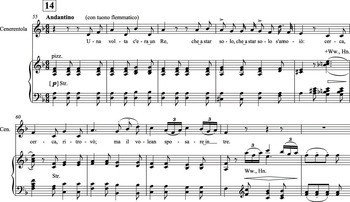
The very first scene sparked Stendhal's revulsion. As Cinderella's two stepsisters preen themselves, she selflessly tends the fire and prepares coffee. While the sisters' music is light and frivolous, Cinderella sings a minor-mode folksong (‘Una volta c'era un re’) that tells of a king's decision to choose a wife who is good and innocent. This restrained, simple andantino (Ex. 2), with its mood of gentle melancholy, creates a sense of nostalgia appropriate not only for the ballad, but for Cenerentola's own status as a fairy-tale heroine removed from the trivial, modern worries of her sisters.Footnote 35
Cenerentola's folk-like song (Act I).
[Cenerentola: Once there was a king, / Who was alone, who was bored of being alone; / He searched and searched and found; / But all three wanted to marry him …]

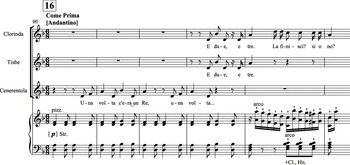
When the sisters interrupt, however, they do not offer contrasting material but engage in a brief parody, singing Cenerentola's own melody back to her in mocking tones: ‘Una volta, e due, e tre!’ (Ex. 3). In performance, the contrast between their shrill, sing-song voices and Cinderella's mellow contralto is jarring. If the listener has been drawn into the sentimental dream-world of Cinderella's song, this derisive echo is a rude awakening. Stendhal focuses on this brief moment as the source of his physical discomfort:
Cinderella's song is touching [touchant], but touching as [melo]drama is, touching thanks to commonplace misfortune. All of this seems written under the influence of the proverb: Let sleeping dogs lie [Glissons, n'appuyons pas]. The music is preeminently Rossinian. Neither Paisiello nor Cimarosa nor Guglielmi ever attained this degree of lightness. [But] the melody for the words Una volta, e due, e tre! seems to me completely trivial. At this moment, the music of la Cenerentola invariably begins to make me nauseous; and this reaction, which is never entirely dissipated, recurs periodically and with increasing violence.Footnote 36
The sisters' interruption.
[Cenerentola: Once … Clorinda and Tisbe: And twice and three times. Clorinda: Are you finished? Yes or no?]

Although Stendhal does not seem particularly taken with or even moved by Cenerentola's song – dismissing it with that disdainful three-fold repetition of the word ‘touchant’ – hearing it parodied was apparently enough to make him nauseous.This brief moment acts as an irritant to Stendhal, whose invective, like a Rossinian crescendo, gathers strength as it progresses:
Whenever I hear the tune Una volta, e due, e tre! I always believe I am in the back of some shop off the rue Saint-Denis. The Pole or the inhabitant of the city of Trieste may not have this disagreeable impression: as for me, I desire with all my heart that there should be happiness in all the back-shops in France, but I would be unable to associate with the people who live there; I would repel them even more than they repel me.Footnote 37
It seems hard to believe that a brief moment of musical parody should occasion such strident critique. That Stendhal finds the parody of Cinderella's sentimental tune somehow reminiscent of a shop room may be more than simple elitism or mere snobbery.Footnote 38 It could also be read as a reactionary response to the sisters' apparent critique of sentimentality. Indeed, the very force of Stendhal's reaction suggests that despite his effort to distance himself from the ‘touching’ scenes of middle-class drama, he finds the sisters' uncouth caricature even more objectionable.
Ironically, given his tangential excoriation of shopkeepers', Stendhal also takes issue with Rossini's portrayal of characters of humble birth. Stendhal's claim that Rossini fails to invest these characters with any essential nobility suggests that he is just as committed to sentimental ideals as Il corriere delle dame's Signora Lattanzi. Stendhal repeatedly draws attention to Rossini's inadequacy in this respect and compares it with Cimarosa's mastery:
Cimarosa would have preferred to show us the passions of his unsophisticated characters, rather than their social mannerisms, acquired as a direct result of contact with society at a particular level; but then he would have shown us how these passions were thwarted by the degrading circumstances of a humble social position … The first-act finale, which opens with a chorus of courtiers attendant upon the Prince hauling a half-tipsy don Magnifico up from the depths of the cellar … is a perfect pastiche of the older buffo style of Cimarosa – but without the essential undertones of deep emotion. I can only repeat what I have said before (perhaps far too often!), that when inferior characters are stripped of the dignity of true emotion, all the unpleasantness pertaining to their humble social status breaks through… (247, 249)
The conventions of earlier opera buffa are held up as a model – a model that Rossini fails to follow. By setting up a distinction between ‘passions’ and ‘mannerisms’, Stendhal invokes Rousseau's natural man and implicitly refers to the view that noble feeling is not confined to noble rank. The quality of idealism that La Cenerentola supposedly lacks thus recalls not just beauty in the abstract, but also the sentimental ideal of the innate nobility of those whose sensibility allows them to sympathize with the plight of others.
On the other hand, Stendhal's discussion of La Cenerentola endorses the same ‘sensational’ effects that Lattanzi and Berton felt undermined modern opera's moral integrity. After a sustained critique of the opera's lack of ‘real’ emotion and reprehensible vulgarity, he heaps praise upon those brash and overbearing moments that engage the listener physically, independent of any appeal to noble feeling. Rather than praising the few moments in the opera when characters are at leisure to express tender sentiments, Stendhal prefers those speedy, mechanical passages in which the characters are caught up in the events around them – where they are not acting as individuals, but as cogs in a noisy, highly regulated collective. He singles out the Act I duet and finale (‘Zitto, zitto: piano, piano’) and the second-act sextet (‘Questa è un nodo avviluppato’) for special commendation. He writes, ‘The pace and brilliance of this duet, which offers an unparalleled display of musical fireworks, are quite unique. Never before had music been known to bombard the listener with so rich, so glittering, so spontaneous, so original a succession of new and tantalizing sensations’ (250). The rhetorical shift from emotion to sensation in Stendhal's critique is significant. Unlike our two earlier critics, he does not pit the sensuous against the moral or noble. Apparently, disgust at the opera's lack of ‘nobility’ and ‘ideal beauty’ does not interfere with Stendhal's ability to delight in the effects of Rossini's music on the body.
The tension between sentiment and sensation in Stendhal's account is symptomatic of a period in which the continued viability of the sentimental dynamic was in question. Concern that sentimental values had been demolished or appropriated by the middle and lower classes flourished in the early decades of the nineteenth century, as the privileges of class and rank were radically revised in the wake of the Revolution. Claudia Johnson has explored the ‘crisis of sentiment’ sparked by the French Revolution in her discussion of Edmund Burke's lament for the demise of the man of sensibility. Burke saw the code of chivalry and honour, the ‘generous loyalty to rank and sex’ that marked the age of sensibility, as mortally threatened.Footnote 39 The notion that a sentimental mode of expression could be wilfully adopted by those without the ‘finer character’ that purportedly came with higher rank threw the transparency of that mode into doubt. Stendhal's complaints about La Cenerentola's supposed vulgarity and the disappearance of ‘true’ feeling, then, are not wholly idiosyncratic.Footnote 40 Indeed, his longing for the ‘real emotion’ of Cimarosa's operas is, by the 1820s, a longing for something irretrievably lost. If Stendhal's incantatory repetition of the word ‘touchant’ in his description of Generentola's song is an attempt to distance himself from sentiment, perhaps it also shows a desire to call it back into being.
Sympathy and contagion
Stendhal's ambivalence concerning bodily sensation may have stemmed from his encounters with – and appropriations of – theories of physiology and sensibility. Fascinated with galvanism and the relationship between physiological and emotional reactions, Stendhal was, in Richard Coe's words, ‘profoundly influenced’ by Pierre-Jean-Georges Cabanis's Rapports du physique et du moral de l'homme (1802), a treatise written on the cusp of a new era in physiology.Footnote 41 Cabanis's treatise was only one episode in the long-standing debate about sensibility, a concept that, in tandem with sentiment, gained particular traction in the late eighteenth and early nineteenth centuries. Anne C. Vila has argued that the word ‘sensibility’ was used by eighteenth-century authors as a ‘bridging concept – a means of establishing causal connections between the physical and moral realms’, a role that made it particularly susceptible to conflicting definitions and theories. During Stendhal's lifetime (and for decades before his birth), sensibility was both ‘exalted’ and thought of as ‘potentially dangerous’. As Vila describes it, ‘sensibility was situated somewhere between enlightenment and pathology: it was seen as instrumental in the quest for reason and virtue, but was also implicated in the epidemic of nervous maladies that seemed to be overtaking the population of France and Europe in general’.Footnote 42 The material philosophy of the nerves, of which Cabanis was a well-known exponent, had called into question the clear distinction between ‘mechanical’, animal responses and the physical manifestation of the movements of the soul. Whereas earlier thinkers like Albrecht von Haller maintained a strict division between the base, material fact of irritability (for example, in the observation that muscles continue to contract after death) and sensibility, which requires the interaction of the senses and the soul, Cabanis blurred those boundaries. His study of sensibility and irritability challenged the work of physiologists who came before him because he did not preserve a special realm where the soul and the body interacted (often known as the ‘common sensorium’).Footnote 43 Cabanis argued that sensibility is not necessarily a higher faculty: he perceived what he called ‘sympathy’ or a ‘drawing together’ even in the smallest one-celled organisms and undeveloped animals. For Cabanis, a proto-conscious ‘sympathy’ is something that exists at the most basic, mechanical level – for example, in the two halves of the developing heart, which ‘seek each other out’ as if the material itself possessed a will.Footnote 44
Cabanis further suggested that all material is sensible; he strove to break down the traditional distinction between organic and inorganic matter, noting that ‘inanimate matter is capable of becoming organized, of living, of feeling’.Footnote 45 In separating sensibility from intellect (and even consciousness), Cabanis implied that sensibility was available to everyone, no matter their social class. Sympathy and sensitivity were no longer proof of innate nobility: every man was potentially a ‘man of feeling’. A similar understanding of bodily sensation – the notion that muscular or nervous stimulation could influence the higher faculties – lay at the root of earlier theories of sympathetic vibration such as those of Franz Anton Mesmer.Footnote 46 Although the Mesmerist belief that an invisible fluid infused all creation was certainly concerned with improving the health of the individual, it was also attacked as a dangerous fad. The notion that diseases of the nerves could be cured through ‘magnetic’ therapies went hand in hand with concerns that such physical stimulation could pass through the thick matter of the body and disturb the rational mind.Footnote 47
If physical excitation achieved through sympathetic vibration harboured the potential to overwhelm the rational or moral faculties, music could be just as dangerous. Heather Hadlock has discussed the problem represented by instruments such as the glass harmonica, which was thought to play on the body's susceptibilities and pose dangers to both players and listeners.Footnote 48 Many critics thought Rossini's music possessed a similarly dangerous capacity; indeed, it was precisely its ability to animate and excite the material bodies of the listening audience and to cause them to ‘draw together’ that proved so worrisome to critics.Footnote 49 This worry is evident in the rhetoric of medicine and illness that accompanies discussions of the physiological effects of Rossini's music. A writer for the Giornaletto ragionata teatrale, on the occasion of the 1820 Milan revival of La gazza ladra, characterized the enthusiasm for Rossini as a kind of plague that travels from person to person by way of a galvanic charge. This ‘contagion’, the critic argued, is not a result of any special susceptibility on the listeners' part but rather due to the music's peculiar force:
History documents that men in society are sometimes subject to a certain malady, one that could be called an infection of the imagination, because the exaltation of the individual's imagination … spreads like an electric charge to many others simply from close contact with the original infected person, without needing to repeat the cause of this propagation. The enthusiasm that is arising everywhere for certain of Rossini's masterworks was long suspected of being a [mere] symptom of this malady, so that one had to attribute it to the weakness of those infected with it, rather than to the activity of the cause [i.e. the music] that produces it. We are obliged, therefore, to clarify this point, with the assistance of an observation we ourselves have made, and it is that no matter how many times we have been forced to hear one of these masterworks feeling the greatest unwillingness in the world, in fact at times with a good dose of contrarian prevention as well, we were never able to leave the theatre without feeling inflamed with this delicious sentiment, that thanks to the strength of such seductive music, secretly slips into us and takes possession of the heart.
[La storia ci documenta che gli uomini in società vanno soggetti talvolta ad una certa malattia, la quale può denominarsi contagio fantastico, perché l'esaltamento della immaginazione di un individuo … si propaga a guisa di fuoco elettrico a parecchi altri, senzaché di questa propagazione si possa ripeterne la sorgente, fuorché dalla loro vita commune coll'ammalato. L'entusiasmo, che destano per ogni dove alcuni capi d'opera del Rossini, ci ha tenuti lungamente in sospetto che potesse essere un sintomo di questa malattia, cosicché si dovesse attribuire piuttosto a debolezza de' soggetti che ne sono attaccati, di quello che all'attività della causa, che lo produce. Ci siamo dovuti però chiarire su questo punto con la scorta di un'osservazione fatta su di noi stessi, ed è che quante volte ci siamo accostati ad udire uno di questi capi d'opera con indosso la maggiore svogliatezza del mondo, anzi talora con una buona dose altresì di sinistra prevenzione, non ci è riuscito mai di uscire dal teatro senza sentirci caldi di quel delizioso sentimento, che in virtù di una musica seducente sdrucciola in noi di soppiatto e s'impadronisce del cuore.]Footnote 50
Here even unwilling or suspicious listeners are unable to resist Rossini's pull. The futility of withstanding his music's power makes it akin to a force of nature; the rapidity of its spread resembles that of a pernicious infection. Other critics describing the Rossini epidemic resort to more generalized language suggestive of a social disorder, proposing that operatic noise has disrupted society's previously harmonious functions and habits. Eleutorio Pantologo, his rhetoric echoing that of the Giornaletto ragionato, argued that a fanatical devotion to Rossini had ‘spread’, suggesting the Rossinian noise generates overly aroused and noisy spectators: ‘But why so much pleasure nowadays in uproar and explosion? It is difficult to know how to make sense of it, while fashion, that capricious Divinity, governs the world without any fixed law or rule … The theatre, particularly the opera, has become at present nothing more than a huge conversation, where almost the last object is to pay attention to the spectacle.’Footnote 51 The saturation of the theatre with ‘too many garrulous spectators’, that part of society which ‘call[s] themselves the bel mondo’, is making the theatre a space for noise, where only ‘clamorous harmony’ gains the attention and favour of the audience. ‘The feminine sex form the loudest part’ of this audience, Pantologo maintains, and he insists that only the young and soldiers, who are ‘well-schooled in the deafening roar of the cannons of Austerlitz, Wagram, and Moscow’, have the tin ears to withstand the din from both the spectators and the orchestra.Footnote 52
Pantologo suggests, then, that Rossinian noise spawned an epidemic of raucous opera-goers and that this epidemic is self-perpetuating, since only music loud enough to penetrate the din created by the newly noisy spectators can make an impression on them. Rossini's intense effect on his audiences, his ability to overpower them in a show of almost militaristic force, is described by Pantologo as the most visible symptom of a social ill. Rossini, the ‘conqueror who stupefies the universe with his exploits’, is one manifestation of the fact that ‘the sciences and the arts, once fruits of leisure, are now tending toward warlike calamity’.Footnote 53 Pantologo laments the fact that the martial resonances of Rossini's music could only be described as a product of the times; music's proper place is in the hallowed halls of the ancients, far removed from the battlefield and the military conflicts of the day. Ultimately, the issue of Rossini's noisy pathology is harnessed to a larger argument about the composer's abandonment of the principles of mimetic art and ideal beauty. In Pantologo's estimation, Rossini has substituted for ideal beauty a kind of ‘bello fittizio’: a fake beauty that has nothing to do with the style of his forebears (128). Rossini deserves censure for seeking only the applause of ‘dumbfounded and non-reasoning listeners [attonito e non ragionante uditorio]’, who, according to Pantologo, lack ‘standards [criterio]’ and have ‘bad taste [cattivo gusto]’.Footnote 54
The babble of the crowd
Pantologo's characterization of Rossini as a kind of musical ‘conqueror’ is only one of a host of such descriptions – the opening salvo of Stendhal's Vie declares he has taken the place of the now-dead Napoleon as the most talked-about man in the world – and the image of Rossini as ‘revolutionary’ is by now well known. The political undercurrents of descriptions of ‘Rossini fever’ are more than empty rhetoric, however. In the later eighteenth and early nineteenth centuries it seemed difficult to talk about the body – its ailments, sensations, capabilities – without also speaking of the body politic. Robert Darnton has described how the Mesmerists sought to ‘reverse the historical trend of physico-moral causality, reforming institutions by physically regenerating Frenchmen. Improved bodies would improve morals, and better morals would eventually produce political effects.’Footnote 55 Noisy bodies, gathered together in a collective, energized (or ‘electrified’) by stimulating music: one of the central concerns of much Rossini criticism is clearly the threat of the crowd. Distant echoes of the revolutionary mob and their noisy musical celebrations may also have played a part in critical distrust of the contagious enthusiasm for Rossini. If music could unite listeners into a singing, babbling collective, it might be a short step to a chaotic multitude over which reason has no sway.
The crowds who flocked to hear Rossini were not just accused of bad taste by critics like Pantologo – they were also portrayed as incapable of critical engagement with the music. Indeed, a common theme in Rossini reception was the typical Romantic trope of the music's sublimity striking the critic dumb (as in Carpani's letter on Zelmira or Stendhal's description of the finale of L'italiana), making it impossible to describe or capture the musical experience in words. A reviewer in Il corriere delle dame, for example, writing about La gazza ladra (a work which, as we shall see, often crops up in discussions of Rossinian noise), starts to describe the opera's most exquisite moments, only to stop short, inserting suggestive ellipses: ‘we will say nothing therefore about the duet and finale of this act, and will not remark on the Grande Scena della Sentenza that … ; but the cultivated and impartial audience speaks for us, with one voice, and for all three evenings that the Maestro sat at the keyboard called him out to the stage to receive much-deserved applause at the end of both acts’.Footnote 56 The author chooses not to add his literary voice to the acclaim; public applause drowns out even an assenting opinion. Even Rossini's supporters agree that the most appropriate responses for the lover of Rossini seem to be shouts, applause, even swoons, and not the written word or rational discourse.
Views of the Rossinian listener as overt, noisy, extroverted and public-orientated are all the more striking when set next to other descriptions of Rossini's Italian audience. Stendhal characterized Italians as an essentially silent people, cowed by political censorship into secrecy and privacy (10–12). But Stendhal's description of Rossini's fans implies that his music can unite these ‘typically silent’ people in song. Read this way, Stendhal's famous account of the popularity of ‘Di tanti palpiti’ (from Tancredi) takes on a new significance:
Tancredi enjoyed a popularity verging on the delirious; it was a true furore, as the expression runs in Italian [ … ] Everyone, from the humblest gondolier to the proudest lord in the land, was singing, singing … ‘Ti rivedrò, mi rivedrai’ … and in the very courts of law the judges were forced to call for order among the spectators, who were disturbing the proceedings by singing ‘Ti rivedrò' – in the salon of Signora Benzoni I have met hundreds of people who will bear out the truth of this fact. (50)
Stendhal's tale, when placed next to other accounts of Rossini's influence on crowds – and the dangerous contagion his music represented – highlights the political implications of a noisy, wildly popular music that infects even the ‘courts of law’ and disrupts the business of the state.
What I have identified as Stendhal's ambivalence towards the ‘Rossinian body’ makes more sense in this context. This is an ambivalence concerning not only individual bodies, but also the body politic. For although Stendhal was drawn to theories of physiology and fascinated by music's physical effects, this politically charged connection with his fellow man through the medium of music seems to have made him uneasy. Throughout the Vie de Rossini, Stendhal espouses a solitary, proto-Romantic listening stance, where the lights are turned low and awareness of other spectators does not interfere with his own sensations. In justifying his mode of listening, Stendhal has recourse to physiological theories: quoting a doctor friend, he argues that ‘a too-bright light irritate[s] the optic nerve; and it [is] impossible that conscious awareness should be fully present in the optic and auditory nerves at the same time’. Even the presence of fellow listeners poses a problem for Stendhal; he points out that ‘the animal heat which emanates from a foreign body appears to have a most pernicious effect upon the enjoyment of music’ (17). The physical stimuli of light and heat thus interfere with musical enjoyment in the same way that noise, in Stendhal's discussions of La Cenerentola, interferes with ‘true’ feeling. Stendhal readily admits that musical noise has the potential to electrify a crowd, but once again, he appears somewhat uncomfortable with the results.
Stendhal's description of the audience's response to the overture of La gazza ladra on its opening night in Milan on 31 May 1817 places great stress on the reciprocal relationship between noisy music and noisy audiences. Despite the fact that he was not in attendance at the première (and probably did not see the opera until 1820), Stendhal sets the scene masterfully, describing an audience made up of intellectuals, former members of ‘Napoleon's army of administrators’, all prepared to greet Rossini's newest work with loud disapproval.Footnote 57 But the opera's overture, thanks in part to the prominent drum rolls, which Stendhal claims gave the music ‘reality’, won over the suspicious audience and sent listeners into a frenzy:
It would be equally impossible for me to describe the transports and the madness of the parterre in Milan at the appearance of this masterpiece. After having clapped to excess, having shouted and made all the racket imaginable for five whole minutes, when the physical strength necessary to cheer was gone, I noticed that each person was talking to his neighbour – something totally contrary to the suspicious Italian temperament. In the boxes, the coldest and most aged spectators were gasping: O bello! o bello! and this word was repeated twenty times on end, not addressed to anyone in particular (for such repetition was a bit ridiculous); everyone had forgotten that they had neighbours, each one was speaking to himself.Footnote 58
Stendhal's account recapitulates familiar tropes, but with a crucial difference. The sheer racket of the overture is literally echoed by the furore of the audience; this passage recalls contemporary descriptions of the sensitive Rossinian dilettante as a ‘quivering tympanum’.Footnote 59 When the physical energy of the audience is sapped, they turn to speech. The uproar and pandemonium of the audience's acclaim is followed by conversation, by a desire to talk about and perhaps share the sensation created by Rossini's music. Yet Stendhal quickly moves away from sound's potential to draw the audience together: after stating that each ‘person was talking to his neighbour’, he then claims that the spectators were reduced to babbling a single word over and over like a character in one of Rossini's comic finales. Significantly, by the end of the passage every member of the audience is isolated by his or her own sensitivity, lost in a private world and muttering: ‘everyone had forgotten they had neighbours’. Stendhal does not, therefore, see political solidarity in the audience's shared sensitivity to sound. If he imagines that Rossini's music has created a noisy collective, united in its enthusiasm, it is a collective curiously eviscerated of any potential political agency – its members seem unable even to express their solidarity.
Tears and drums
Attention to the political ramifications of Rossinian noise and the critical preoccupation with noise's ‘contagious’ qualities might help us to understand Rossini's moments of raucous mechanism as more than comic inevitability. I have been arguing that the tension between noise and sentiment in Stendhal's Vie is a particularly potent illustration of contradictory threads of contemporary reception. But might there also be something about Rossini's music that encourages such double-edged readings? A closer look at the opera that was at the heart of many discussions of Rossinian noise may be instructive. La gazza ladra's overture, with its immediately catchy tunes and stirring drum rolls, was often cited in arguments both pro and contra Rossinian noise and the contagious enthusiasm of his audiences. But noise is not simply confined to the overture; listening closely to the moments of uproar in La gazza ladra allows us to hear the social implications of Rossini's noisy bodies more clearly.
Based on the 1815 melodrama La pie voleuse, Rossini's La gazza ladra tells the allegedly true story of an eighteenth-century serving girl who was condemned for a theft she did not commit. The original play by J. M. T. Badouin d'Aubigny and Louis-Charles Caigniez was so immensely popular in the theatres of the Boulevard that it was said ‘all Paris went to shed tears for the fate of the serving-girl of Palaiseau’.Footnote 60 But whereas the original ended tragically, Giovanni Gherardini's libretto for this opera semiseria contains both comic and sentimental elements, including the requisite happy ending common to the genre.Footnote 61La gazza ladra has a tangled plot and numerous misunderstandings, features it shares with opera buffa, but it also revels in the various injustices that Ninetta must endure at the hands of her mistress Lucia, who resents the girl's attachment to her son, and of the Mayor, who has made advances that Ninetta has rebuffed. Add to this already convoluted situation the element of filial duty: Ninetta's father, a soldier, has deserted his post in order to avoid a death sentence of his own and asks his daughter to sell his silver to procure money for his escape. Her father's initials are the same as her employer's (F.V.), and when a peddler reveals that Ninetta sold a silver fork and spoon bearing those initials, Lucia believes the girl pawned the stolen silver. Ninetta spends the entire second act either incarcerated or on trial, and these scenes of pathos are relieved only by a last-minute rescue from the gallows when it is discovered that a magpie was responsible for snatching the missing silver.
Although La gazza ladra draws on both the musical conventions of sentimental drama and the antic energy typical of Rossini's comedies, its moments of noisy mechanism function differently than similar moments in the comic finales, offering commentary on the opera's sentimental elements. Here cacophony is not just the comedic representation of inner confusion: it is also turned outward in the martial drums, bells and gunshots that resonate throughout the score. These sonic markers of the political machine in La gazza ladra are juxtaposed with the sentimental topoi of familial and amorous affection, revealing a truly Stendhalian tension between noise and sentiment.
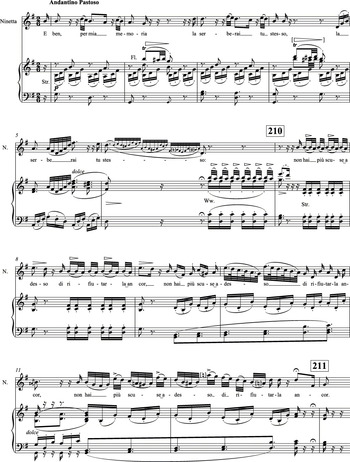
The Act II duet between Ninetta (soprano) and Pippo (trousered mezzo) is especially marked by this tension. Here Ninetta has given up hope that she will be pardoned, and when her young friend Pippo visits, she says farewell and gives him a cross to remember her by. The farewell scene shifts between the expected lamenting figures and a more mechanical music-box style, ultimately undermining the characters' bid for sympathy. At first glance, this mechanical style appears normative for Rossini; anyone familiar with his operas would expect to hear variation-like vocal writing that allows the singer ample opportunity to demonstrate precision and flexibility. When this style is set into relief against a more plaintive idiom, however, it becomes something more, prompting us to take Berton's accusations of mechanism seriously. Ninetta begins her farewell with a reticent sighing phrase set to a gentle triplet accompaniment (Ex. 4). Her vocal line is broken into small fragments (‘E ben … per mia … memoria, La ser … berai … tu stesso’) and Rossini illustrates his heroine's sighs not only with the small intervening silences but also with appoggiaturas that shape her brief utterances. But almost immediately, her musical discourse becomes more fluid and extroverted: a soaring arpeggio leads to an elaborate turn figure, expanding Ninetta's range to a high F. The coda of the first stanza ends with a flourish of coloratura, suggesting that the sentimental topos that began the duet is not going to be the number's overriding affect.
La gazza ladra, Act II, Duet (Ninetta–Pippo).
[Ninetta: No, you yourself keep it / In memory of me. / Now you have no excuse / To refuse it any longer.]

Throughout the duet, the two characters repeatedly indulge in sentimental display only to step away from it, playfully renouncing tears. For example, lamenting topoi return in the small orchestral interlude that prefaces the next phrase (b. 6): the woodwinds enter with quick, fluttering appoggiaturas that sustain the dominant harmony. In an echo effect, Ninetta responds with a dotted-rhythm variant of these sighs. But, as if captivated by the sound of her own voice, she soon abandons direct imitation to spin varied ornaments on the original sighing phrase. Mirrored in the orchestra, Ninetta indulges in this gentle ornament like a singing Narcissus. Pippo's duet statement traces the same progression from halting sighs to echoing filigree. The satisfyingly exact formal repetition is another kind of mechanism: there is no abandonment to grief here, no breaking outside of the established rules in order to paint distress.
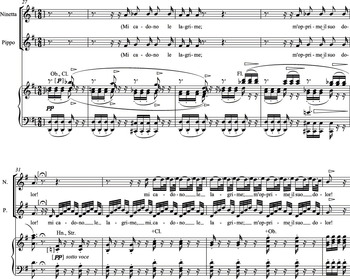
By far the most striking juxtaposition of the two contrasting topoi occurs in the next section (Ex. 5). Here, Pippo and Ninetta sing a due to an overtly anguished and lamenting accompaniment in the tonic minor (G) supported by pulsing strings and pathetic single tones from the oboe and clarinet. The two voices simply rock back and forth on a semitone in very literal representation of the text: ‘Mi cadono le lagrime, m'opprime il suo dolor! [My tears are falling, his/her grief overwhelms me!]’ The slow descent of the string accompaniment figure almost seems a too-obvious depiction of falling teardrops, especially considering Rossini's reputation as a composer supremely unconcerned with word-painting.Footnote 62 Just as the listener may begin to wonder if this overwrought mood is for real, the music undergoes a surprising transformation: at bar 31, this same tearful text becomes the basis for an episode of cheerful clockwork music in the tonic major. While Pippo pipes a repeating arpeggio figure, Ninetta flits, birdlike, between the two tones of a whole step (D and E). Thanks to the sustained dominant pedal in the bass, moreover, the entire passage has a strangely static and block-like quality despite its busyness. The abrupt appearance of a chirping music-box style here is startling. From a dramatic (perhaps overly dramatic) and literal representation of the lamenting text, we have shifted to a mechanistic passage that asks the two female voices to imitate a flute clock. This moment seems to undercut the sincerity of the previous sentimental episode: the singers so suddenly reveal the mechanism underlying their vocal performance that their sighs and sobs retrospectively appear to be merely another form of technique.
Duet (Ninetta–Pippo), ‘Mi cadono le lagrime’.
[My tears are falling; his/her grief overwhelms me!]

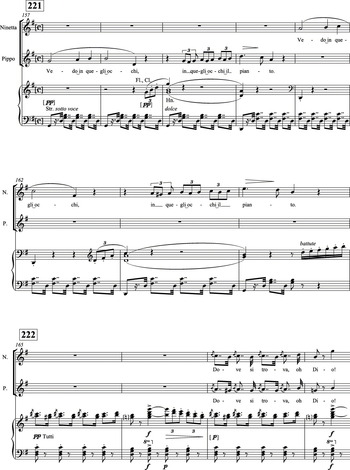
The disjunction between tearful text and cheerful music recurs in the cabaletta (Ex. 6), where Pippo and Ninetta jauntily comment on the tears they see in each other's eyes after having bid each other yet another anguished farewell in the tempo di mezzo. The voices begin with an arching, ascending phrase that leaps downward only to ascend again in a flurry of triplets. But unlike earlier in the duet, the cabaletta is characterized by a different kind of mechanism: a relentless dotted rhythm, which gives the music a pronounced galloping feel. Even when the singers abandon their athletic singing for sustained notes, that loping rhythm drums away in the orchestra.
Duet (Ninetta–Pippo), cabaletta.
[Ninetta and Pippo: I see tears in those eyes. / Where can one find, oh heaven! / (A more sincere love?)]

The very persistence of this rhythm seems to have annoyed Stendhal, who singled it out for special censure. His comments seem so out of proportion to this rather innocuous conventional accompaniment that we may be tempted to speculate that the performance he attended had problems with balance. But his criticism does point to the duet's conflicting sentimental and mechanical modes in a particularly telling way. This is an instance, Stendhal argues, where Rossinian noise gets in the way of sincere feeling and distances the listener from total identification with and sympathy for the characters:
‘Fin che mi batte il cor …’ and ‘Vedo in quegli occhi il pianto …’ are touching passages; but, towards the end of the duet, one notices with distress a certain loud and inappropriateorchestral hammering; it reminds the spectator of the technical means in a moment when he wants nothing more than to surrender to melancholy. This duet always brings to mind those emotionally unresponsive people [les gens peu sensible] who assume a tearful expression whenever they conscientiously would like to be sad because the situation requires it.Footnote 63
Stendhal draws a connection between the ‘hammering’ of the orchestral accompaniment and the performance of false sentiment. Here the mechanism for stimulating sympathetic melancholy is revealed. The duet is like a person who ‘assume[s] a tearful expression’ in tragic surroundings without actually feeling any sadness. Significantly, it is noise that pulls back the sentimental mask for Stendhal; as an intrusive and too-obvious technique for creating an emotional effect, noise prevents his full sympathetic engagement. Stendhal seeks to set himself apart from those unresponsive listeners who succumb to conventional expressions of sadness merely because they are habitual. One could even read this passage as a veiled critique of the public display of tears so common at the performance of sentimental dramas, the communal, pro forma weeping that had more to do with custom than it did with spontaneous sincerity.
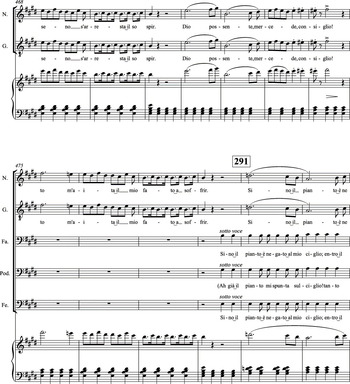
Stendhal's conflicted relationship to Rossinian noise and Rossini's own deployment of mechanical topoi in the midst of a conventionally sentimental scene suggest that the noisy finales of La gazza ladra are more than nods to comic convention. Indeed, the Act II finale (Ex. 7), the scene of Ninetta's trial, portrays the conflict between mechanism and sentiment as a political problem – how can one express sincere emotion or plead for mercy when those in power use empty tears to mask their own corruption? After Ninetta is sentenced, the finale's text displays two conflicting moods: Ninetta, Giannetto and the two fathers are so distressed as to find weeping impossible, and sighs are ‘stifled in their breasts’. The mayor and the chorus of judges, witnesses to their pain, are apparently able to weep freely, but their pity will not change anything: the law must be obeyed. The abrupt about-face of the judges and mayor – their sudden tearful sympathy – perhaps leaves us wondering whether they are actually weeping or just engaging in a perfunctory show of pity. This impression is strengthened by the fact that Rossini here deploys all the normal, noisy conventions of the buffo finale. At the start of the famous crescendo, he introduces cymbals, piccolo and drums, and at the climax, conspicuously rapid scalar figures for the trombones.
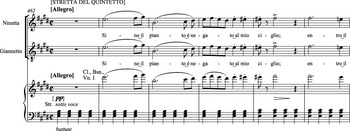
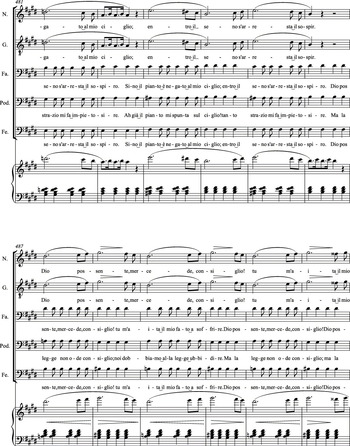
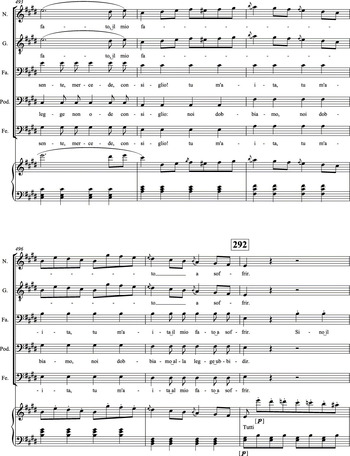
In the speedy, mechanistic din of the finale, weeping and sighing are impossible (Ex. 7). Ninetta and Giannetto are required to begin their phrase at a velocity – a cut-time allegro – that makes it incredibly difficult to spit out the dotted quavers on the phrase ‘arresta il sospir’ (b. 469). The frantic breathlessness that results is certainly evocative of the text. But this is not the frozen immobility of shock or the halting, broken speech of sentimental distress. Here, the characters seem caught up in a machinery that is literally breaking them down. Even when the two lovers do get to emote a bit as they sing swelling lines outlining a fourth (b. 479), they soon abandon the lyrical mode in rapid, athletic passages (b. 494).
La gazza ladra, Act II, finale.
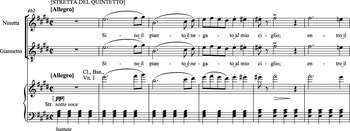


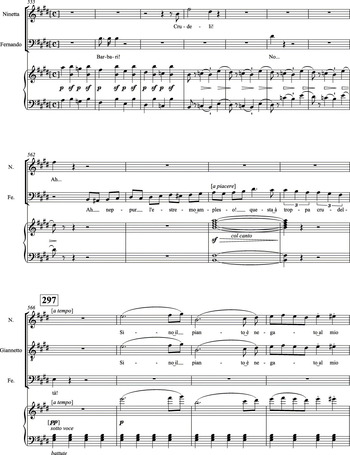
Between the two statements of the stretta, however, the mechanism briefly cracks open, giving us a taste of tears as Ninetta and Fabrizio call out ‘father’ and ‘daughter’ and rail against the cruel judges (Ex. 8). First, the accompaniment jerkily travels down a minor mode scale, alternating sforzando Bs on the off beats, as if the machinery of the finale is winding down. Then the strings enter with weeping figures, the accents now placed on the proper beats. This brief episode of instrumental tears opens up a new sonic space – it is as if a person forced to run at full tilt for longer than he is able suddenly halts, crying and panting. The respite is short lived, however: the conventions of the number-structure demand that the machinery start all over again.
La gazza ladra, Act II, finale: interlude of weeping.
[Fernando: Savages! Ninetta: Cruel men! Fernando: No … Ninetta: Ah … Fernando: Ah, not even a last embrace! / This is too inhuman! Ninetta and Giannetto: Even tears are denied my eyes …]

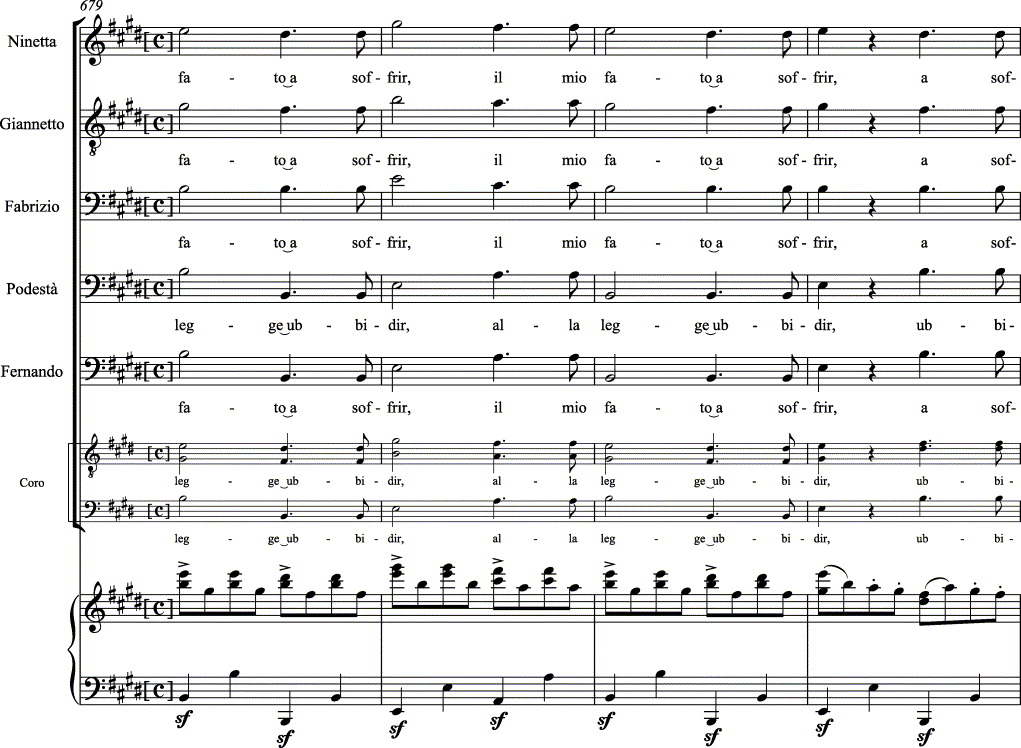
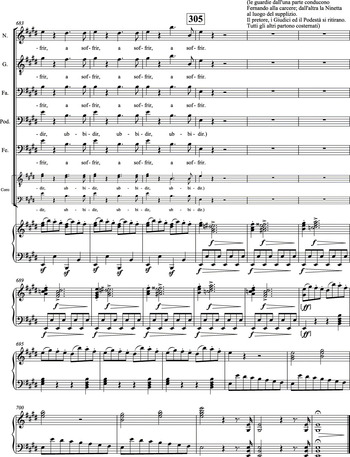
The finale thus turns Rossini's well-known propensity for physical titillation to critical ends; here the transformation of the mechanical conventions of the comic stretta connects overpowering noise with oppressive politics. Tears are fruitless, unable to move those in power to show pity and mercy. Only the collective noise-machine holds sway. By the end of the finale, the textual conflict between God and the law becomes even more jarring thanks to Rossini's talent for cacophony (Ex. 9). The judges insist again and again, to relentless cadence figures, that the law cannot be influenced, while the frantic ensemble calls on God to help them bear their fate. The number thus ends in a battle between the words ‘ubbidir’ and ‘soffrir’. The simultaneous thunder of two opposing parties shouting ‘obey!’ and ‘suffer!’ is chilling, despite the familiar comic convention of the repeated cadence. This violent clash is echoed in the orchestral coda to the stretta (b. 687), where cymbals and drums punch out the first beat of the bar and the strings enter on the offbeat with forte dissonant chords. As the blows from cymbals and drums are answered by dissonant cries from the strings, one could be forgiven for hearing this coda as enacting the effect of the machinery of justice on the bodies of its subjects.Footnote 64
La gazza ladra, Act II, finale: ‘soffrir’ (to suffer) vs. ‘ubbidir’ (to obey).
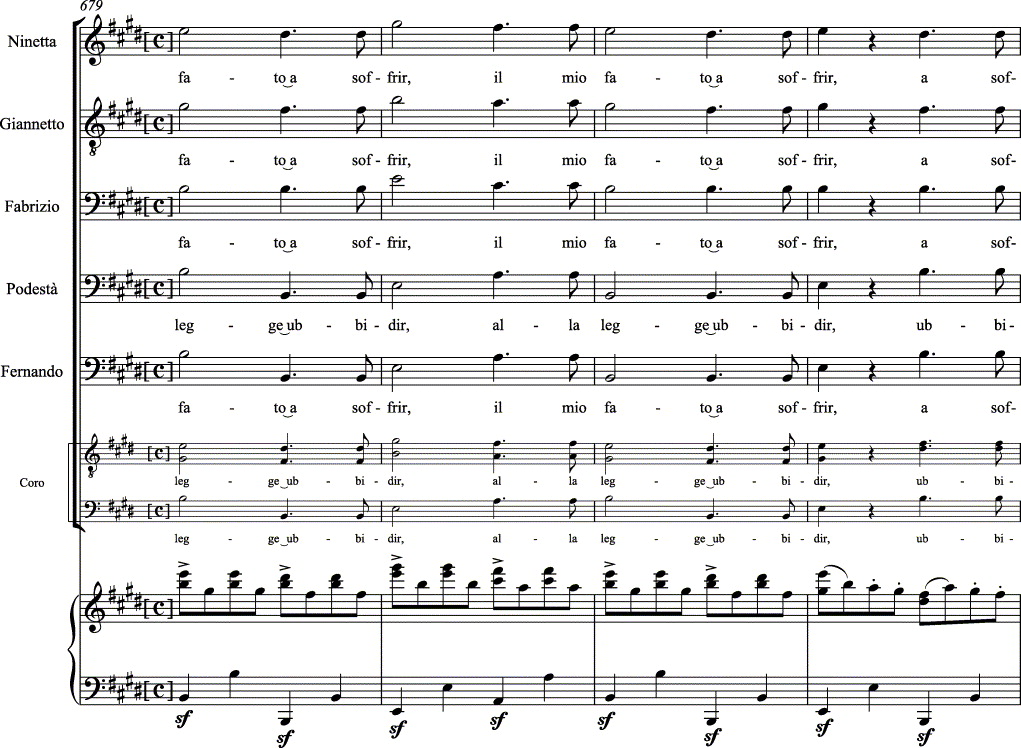

What Rossini's critics might dismiss as the composer's typical inattention to words is in fact revealing. The text, which thematizes the inability to weep, emote or express, is set to overbearing, militaristic music complete with drums and cymbals, making it seem as if noise has stepped in to replace true feeling. At moments like this La gazza ladra suggests that the efficacy of sentimental display has been undermined once and for all. Tears no longer have any power to produce real social effects; it is new evidence that saves Ninetta. In a society without justice, the finale implies, all that remains are the sensations aroused by a military band and the mechanical singing of the collective.
What are we to make of Rossini's propensity for noisy, mechanical display at precisely the moments of greatest sentimental significance in La gazza ladra? This stylistic feature is more than simply comic convention. Rossini's noisy bodies – and the critical responses they spurred – can be understood as a symptom of cultural anxiety about the viability of the sentimental dynamic on an operatic stage forever altered by revolution and restoration. Whereas in sentimental opera, the body's sensitivity – its blushes, tears and swoons – acted as a kind of somatic conscience, in Rossini's moments of cacophony the body's responsivity is not a spur to moral feeling or noble acts, nor is it proof of innate goodness. Instead it acts as a kind of social leveller, binding together audience and performers alike in a feverish enthusiasm that, critics worried, listeners might be powerless to resist. The larger implications of this dissolution of individual feeling and autonomy into a collective noise machine are manifold. Jacques Attali's landmark cultural critique, Noise, argued that noise has served as the degraded other to ‘true’ music throughout history and that the notion of noise itself inevitably has political associations and functions.Footnote 65 To Attali, music – all music – tames and contains the threat represented by noise. If noise is violence, invading and imposing itself upon the listener (Attali likens it to murder because of the way it destroys communication), then music is an ordering of that violence, akin to the way ritual sacrifice channels the homicidal impulse. An interpretation influenced by Attali might therefore understand the eruption of cacophony in Rossini's operas as a powerful transgressive force, creating the potential for political critique. The idea that Rossinian noise could be heard as a disruption of the established order would seem to be supported by the wealth of contemporary critical opinion characterizing Rossini as a musical revolutionary who overturned traditional rules and paved the way for a thoroughly modern opera, one that echoed the din of real life.
But Rossini was also highly regarded by those in power and a favourite with royalty; just five years after La gazza ladra he accepted a commission from Prince Metternich to write cantatas for the Congress of Verona and in 1825 he produced Il viaggio a Reims to celebrate the coronation of Charles X. Nearly everyone agreed that Rossini's music possessed the power to move listeners in new ways. It was the implications of that power that prompted debate. For all the gushing accolades likening Rossini to a musical liberator of Europe, some uneasiness accompanied his music's ability to captivate – to make captives of – listeners and drown out the voices of reason or judgement. In this view, the listener exposed to Rossinian noise is subject to a different kind of control, struck dumb by sheer orchestral force, or set babbling (as in Stendhal) like a mechanical toy. Rossini's semiserie of 1817 seem to pursue both possibilities: certainly noisy moments in these operas enact a kind of jouissance, a release from stultifying rules of plot and the bounds of taste, inviting listeners to revel in enthusiasm and release. But Rossinian noise never strays far from the mechanical and as such, it raises the spectre of oppression and subjugation. Is the individual listener swept up and overwhelmed in a glorious wave of sound or drawn into the workings of a musical machine? Ultimately, it was this tension in Rossini's music that both attracted and worried Stendhal. And it is his response to the divergent meanings suggested by Rossini's noisy bodies that offers crucial historical insight. Stendhal's insistence that Rossini's music opened up the possibility for a kind of solitary, quintessentially Romantic listening stance has long puzzled scholars used to thinking of Rossini's appeal as the sensuous counterpart to Beethovenian depth. But reading Stendhal in the context of larger cultural trends suggests that his infamous distaste for ‘yapping female voices’ at the opera and the ‘animal heat’ of his fellow spectators was more than personal idiosyncrasy. Following the trajectory of the sensible body over the first decades of the nineteenth century reveals the surprising contribution Rossinian noise made to the fashioning of the Romantic listener, a contribution that had little to do with hearing noise as ‘pure music’.Footnote 66 In the years following the Napoleonic Wars, the finely tuned physical sensitivity so prized in the age of sentiment could be newly reinterpreted as a sign of susceptibility to the contagion of dangerous ideas or sensations and even a precursor to political instability. Perhaps this is why Stendhal insists upon the private and subjective nature of the emotions aroused by Rossini's music, why he rhapsodizes at length on the flights of fancy made possible by these startling new sensations. If Rossini's music threatened to break down the boundary between listeners, to dissolve them into a babbling mob or a clanking machine, retreat into the self – and into a new, solitary, contemplative listening stance – was the surest way of neutralizing that danger.