



%20--%3e%3c!DOCTYPE%20svg%20PUBLIC%20'-//W3C//DTD%20SVG%201.0//EN'%20'http://www.w3.org/TR/2001/REC-SVG-20010904/DTD/svg10.dtd'%3e%3csvg%20version='1.0'%20id='Layer_1'%20xmlns='http://www.w3.org/2000/svg'%20xmlns:xlink='http://www.w3.org/1999/xlink'%20x='0px'%20y='0px'%20width='64px'%20height='64px'%20viewBox='5.5%20-3.5%2064%2064'%20enable-background='new%205.5%20-3.5%2064%2064'%20xml:space='preserve'%3e%3cg%3e%3ccircle%20fill='%23FFFFFF'%20fill-opacity='0'%20cx='37.785'%20cy='28.501'%20r='28.836'/%3e%3cpath%20fill='%23595959'%20d='M37.441-3.5c8.951,0,16.572,3.125,22.857,9.372c3.008,3.009,5.295,6.448,6.857,10.314%20c1.561,3.867,2.344,7.971,2.344,12.314c0,4.381-0.773,8.486-2.314,12.313c-1.543,3.828-3.82,7.21-6.828,10.143%20c-3.123,3.085-6.666,5.448-10.629,7.086c-3.961,1.638-8.057,2.457-12.285,2.457s-8.276-0.808-12.143-2.429%20c-3.866-1.618-7.333-3.961-10.4-7.027c-3.067-3.066-5.4-6.524-7-10.372S5.5,32.767,5.5,28.5c0-4.229,0.809-8.295,2.428-12.2%20c1.619-3.905,3.972-7.4,7.057-10.486C21.08-0.394,28.565-3.5,37.441-3.5z%20M37.557,2.272c-7.314,0-13.467,2.553-18.458,7.657%20c-2.515,2.553-4.448,5.419-5.8,8.6c-1.354,3.181-2.029,6.505-2.029,9.972c0,3.429,0.675,6.734,2.029,9.913%20c1.353,3.183,3.285,6.021,5.8,8.516c2.514,2.496,5.351,4.399,8.515,5.715c3.161,1.314,6.476,1.971,9.943,1.971%20c3.428,0,6.75-0.665,9.973-1.999c3.219-1.335,6.121-3.257,8.713-5.771c4.99-4.876,7.484-10.99,7.484-18.344%20c0-3.543-0.648-6.895-1.943-10.057c-1.293-3.162-3.18-5.98-5.654-8.458C50.984,4.844,44.795,2.272,37.557,2.272z%20M37.156,23.187%20l-4.287,2.229c-0.458-0.951-1.019-1.619-1.685-2c-0.667-0.38-1.286-0.571-1.858-0.571c-2.856,0-4.286,1.885-4.286,5.657%20c0,1.714,0.362,3.084,1.085,4.113c0.724,1.029,1.791,1.544,3.201,1.544c1.867,0,3.181-0.915,3.944-2.743l3.942,2%20c-0.838,1.563-2,2.791-3.486,3.686c-1.484,0.896-3.123,1.343-4.914,1.343c-2.857,0-5.163-0.875-6.915-2.629%20c-1.752-1.752-2.628-4.19-2.628-7.313c0-3.048,0.886-5.466,2.657-7.257c1.771-1.79,4.009-2.686,6.715-2.686%20C32.604,18.558,35.441,20.101,37.156,23.187z%20M55.613,23.187l-4.229,2.229c-0.457-0.951-1.02-1.619-1.686-2%20c-0.668-0.38-1.307-0.571-1.914-0.571c-2.857,0-4.287,1.885-4.287,5.657c0,1.714,0.363,3.084,1.086,4.113%20c0.723,1.029,1.789,1.544,3.201,1.544c1.865,0,3.18-0.915,3.941-2.743l4,2c-0.875,1.563-2.057,2.791-3.541,3.686%20c-1.486,0.896-3.105,1.343-4.857,1.343c-2.896,0-5.209-0.875-6.941-2.629c-1.736-1.752-2.602-4.19-2.602-7.313%20c0-3.048,0.885-5.466,2.658-7.257c1.77-1.79,4.008-2.686,6.713-2.686C51.117,18.558,53.938,20.101,55.613,23.187z'/%3e%3c/g%3e%3c/svg%3e)
%20--%3e%3c!DOCTYPE%20svg%20PUBLIC%20'-//W3C//DTD%20SVG%201.0//EN'%20'http://www.w3.org/TR/2001/REC-SVG-20010904/DTD/svg10.dtd'%3e%3csvg%20version='1.0'%20id='Layer_1'%20xmlns='http://www.w3.org/2000/svg'%20xmlns:xlink='http://www.w3.org/1999/xlink'%20x='0px'%20y='0px'%20width='64px'%20height='64px'%20viewBox='5.5%20-3.5%2064%2064'%20enable-background='new%205.5%20-3.5%2064%2064'%20xml:space='preserve'%3e%3cg%3e%3ccircle%20fill='%23FFFFFF'%20fill-opacity='0'%20cx='37.637'%20cy='28.806'%20r='28.276'/%3e%3cg%3e%3cpath%20fill='%23595959'%20d='M37.443-3.5c8.988,0,16.57,3.085,22.742,9.257C66.393,11.967,69.5,19.548,69.5,28.5c0,8.991-3.049,16.476-9.145,22.456%20C53.879,57.319,46.242,60.5,37.443,60.5c-8.649,0-16.153-3.144-22.514-9.43C8.644,44.784,5.5,37.262,5.5,28.5%20c0-8.761,3.144-16.342,9.429-22.742C21.101-0.415,28.604-3.5,37.443-3.5z%20M37.557,2.272c-7.276,0-13.428,2.553-18.457,7.657%20c-5.22,5.334-7.829,11.525-7.829,18.572c0,7.086,2.59,13.22,7.77,18.398c5.181,5.182,11.352,7.771,18.514,7.771%20c7.123,0,13.334-2.607,18.629-7.828c5.029-4.838,7.543-10.952,7.543-18.343c0-7.276-2.553-13.465-7.656-18.571%20C50.967,4.824,44.795,2.272,37.557,2.272z%20M46.129,20.557v13.085h-3.656v15.542h-9.944V33.643h-3.656V20.557%20c0-0.572,0.2-1.057,0.599-1.457c0.401-0.399,0.887-0.6,1.457-0.6h13.144c0.533,0,1.01,0.2,1.428,0.6%20C45.918,19.5,46.129,19.986,46.129,20.557z%20M33.042,12.329c0-3.008,1.485-4.514,4.458-4.514s4.457,1.504,4.457,4.514%20c0,2.971-1.486,4.457-4.457,4.457S33.042,15.3,33.042,12.329z'/%3e%3c/g%3e%3c/g%3e%3c/svg%3e)
Impact statement
Households now charge an expanding network of personal devices, electric vehicles and home batteries, yet these everyday energy practices remain misaligned with the temporal dynamics of renewable energy supply. By reframing charging with a scope of User Experience (UX) and as an everyday practice, this research article introduces CgX, a Charging Experience framework when designing for charging-centric experiences that support domestic demand flexibility. The framework highlights user control, rhythms and routines, incentives, learning and collective ownership as considerations for charging experiences and design procedures of composing, aligning and signalling to embed them in supporting wider household participation in coordinated energy programmes. This work provides designers, engineers and policymakers with actionable principles for developing energy agents, apps and community services that strengthen participation, improve equitable outcomes and enhance the social acceptance of demand-side programmes.
Introduction
With the ubiquity of mobile phones and other portable personal devices, most people charge devices with batteries every day. Charging is universal and all-pervasive. We charge devices before sleeping, during commutes, at work, on holidays and even while hospitalised. We charge phones, watches, glasses, earpieces, computers, domestic robots, power tools, bikes, cars and home batteries. Some charging is user-controlled, some automated and for some, control is divested externally. Depending on the type of device, its battery size and energy load, each charging experience (CgX) is different. Charging time, location, load requirements and the degree of user control or automation all generate a multitude of everyday routine energy-use patterns. With content and communications represented and delivered by mobile media and devices allowing us to participate in everyday life, charging infrastructures are now embedded into everyday environments and routines (Pink, Reference Pink2025). With designated charging sockets for family members at home, shared electric vehicle (EV) charging stations at car parks, and selling and buying energy from one’s home battery or car on a two-way consumer grid, energy use through charging is a social practice (Shove et al., Reference Shove, Trentmann and Wilk2009, Reference Shove, Pantzar and Watson2012). As we search for flexibility within growing energy demand to support a just and equitable energy transition, charging of devices, vehicles and homes is moving beyond just a human utility.
The intention of this article is to explore designing for CgX and is presented with a particular background and context. Firstly, it addresses design for and research on domestic energy services for a constructive design research output (Koskinen et al., Reference Koskinen, Zimmerman, Binder, Redström and Wensveen2011; Acharya, Reference Acharya2016; Acharya et al., Reference Acharya, Bekteshi, Trovalla and Trovalla2017; Wu and Acharya, Reference Wu and Acharya2024). Secondly, in an age necessitating flexibility in energy demand on one side and an onslaught of dense digital media experiences on the other, there is a particular scope and opportunity in designing for user experience (UX) (Forlizzi and Ford, Reference Forlizzi and Ford2000; Roto et al., Reference Roto, Law, Vermeeren and Hoonhout2011; ISO, 2019; Lee et al., Reference Lee, Jun, Lee and Lee2024) of charging devices. Thus, if CgX can engage consumers to manage and control the flow of energy into devices, then how can this practice be channelled to enhance digital energy futures that are more responsible and ethical (Korsmeyer and Pink, Reference Korsmeyer and Pink2025)?
This article builds on the ongoing changes occurring in the Australian energy infrastructure landscape. Currently, Australia has the highest rooftop solar capacity per capita globally, with nearly one in three homes having solar production capacity and continuing to grow (Bertoli et al., Reference Bertoli, Rozite and Veerakumar2023). Recent policy implementation and rebates are rapidly increasing solar integration, domestic energy storage capacities and new transmission infrastructures (DCCEEW, Australian Gov., 2025a, 2025b, 2025c). This is resulting in new mechanisms and hybrid platforms for energy production and delivery. Albeit with technical issues, economic concerns and political resistance, Australia is in the midst of pulling together a variety of stakeholders for the two-way consumer grid. There are state actors, energy retailers, transmission stakeholders, digital platforms and private citizenry assets all involved in the collaborative participation in new infrastructure for a transition. While there is a sense of a collective drive to increase renewables in the energy mix, flexibility from the residential sector and participation in coordinated energy programmes with private energy assets are still limited (ACCC, 2025).
It is with such a background that this paper asks how CgX, for owners, users and households of energy assets, big and small, might become a design space for domestic demand flexibility? Towards such a scope, this article develops a framing of CgX and an approach to engage and shape it. Overall, the article presents four contributions. First, it conceptualises CgX as a distinct design domain within domestic energy transitions. The second contribution is methodological, using abductive translation to generate interaction design procedures. Thirdly, as output from the methodology, it derives five experiential categories and three interaction design procedures through qualitative synthesis and multidisciplinary expert interviews. Finally, it presents CgX as a proposal and design lever for increased participation in the two-way consumer grid. These contributions are preliminary, require future work and are also not without limitations. Both these aspects are presented in the discussion after the results section of the paper.
Approaching CgX
Charging as everyday practice
With the intention of designing for CgX, this article begins by conceptually framing the charging of devices as an everyday energy practice (Shove et al., Reference Shove, Trentmann and Wilk2009; Shove and Walker, Reference Shove and Walker2014; Shove, Reference Shove2021). Charging is understood here as the routinised act of storing or refilling electrical energy in a battery that powers a device. A battery here is understood as “a device that converts chemical energy contained in its active materials directly into electric energy by means of an electrochemical oxidation–reduction reaction” (Jones et al., Reference Jones, Jervey, Roche and Barnowski2017). This clarification is necessary because, in demand management, a battery can also be a hydroelectric dam or any other system that can store and shift energy temporally. In this article, however, the focus is on the chemical charging and recharging of metal-ion consumer batteries, such as lithium-ion and lithium iron phosphate batteries, that are embedded within devices to facilitate communication and participation in everyday life.
Charging as everyday experience
The widespread domestication of such rechargeable batteries is historically recent. Over the past two decades, charging has evolved from an occasional technical and utility task into an increasingly ubiquitous everyday practice. It now extends from handheld personal devices to EVs and domestic energy storage. While this rapid transformation has fundamentally altered everyday relationships with energy, comparatively little attention has been given to charging itself as an object of design and experiential inquiry.
Following Forlizzi and Ford (Reference Forlizzi and Ford2000), this article begins by approaching charging not as an experience, a discrete and memorable event, but as part of the continuous stream of everyday banal experience. Charging, therefore, has rarely been seen as foregrounded; rather, it exists as an ongoing background condition that quietly supports communication, mobility and domestic life. Drawing on Star’s concept of infrastructure (Star, Reference Star1999), charging can be framed with an infrastructural relation, which largely remains invisible while functioning successfully, becoming noticeable primarily at moments of breakdown and unavailability. But more recently, Sarah Pink (Reference Pink2025) has extended an understanding of charging as an anticipatory practice, where devices are charged not because they are immediately needed, but in preparation for future participation in everyday activities. So, the historical positioning of charging as a background infrastructural experience is beginning to change, moving from infrastructural background and surfacing as anticipation. As electricity systems evolve into two-way consumer energy infrastructures, mechanisms such as virtual power plants, digital retail energy platforms and vehicle-to-grid services increasingly require households to make charging decisions or delegate them to automated systems. Charging is now oscillating between the background and foreground. Charging as experience is becoming an object of attention, transaction and participation. It is this transition, from background infrastructural support to an increasingly visible and designable foregrounded everyday experience, that provides a timely focus to examine opportunities for designing future energy services using CgX.
Stage one: Charging in digital energy futures
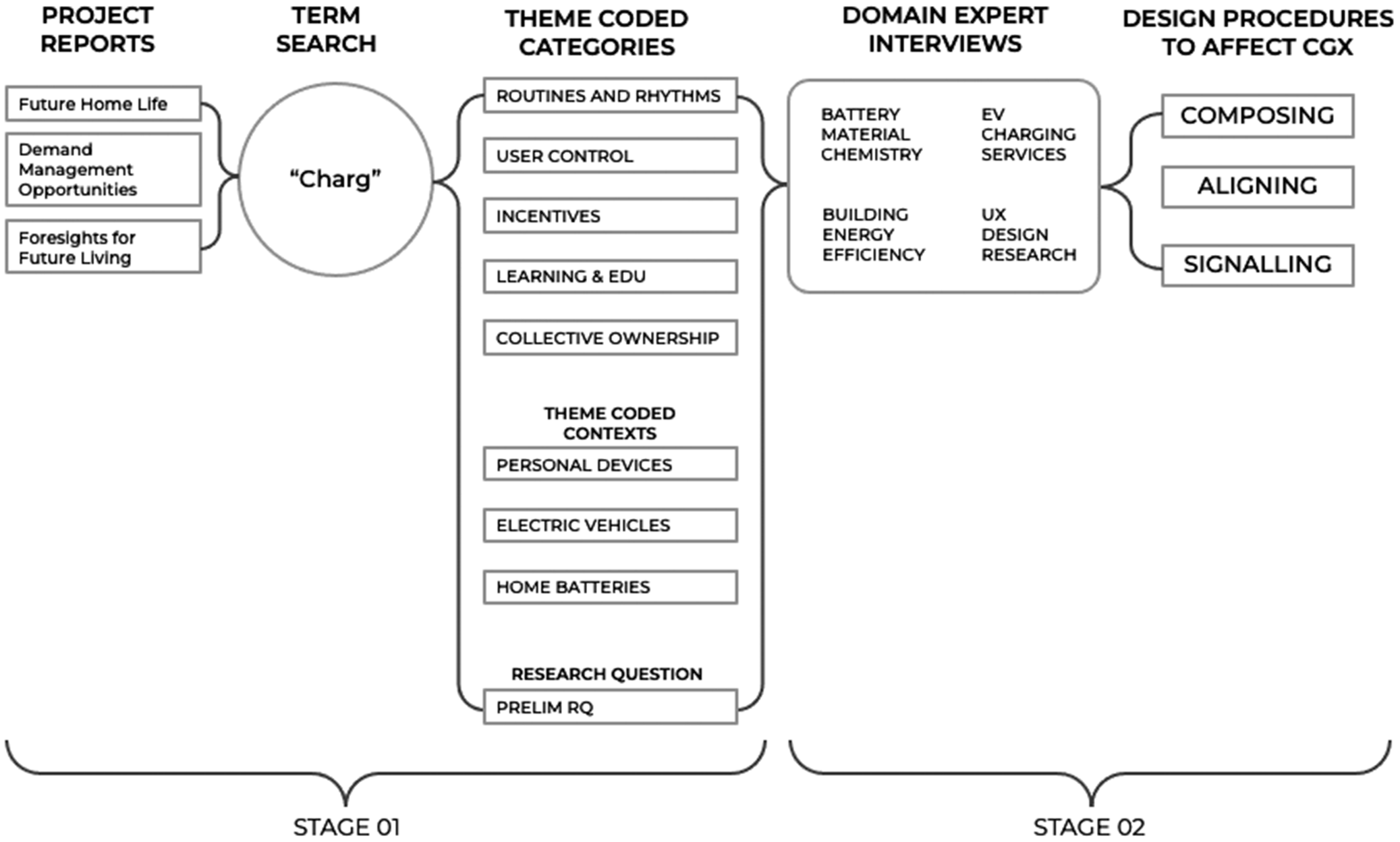
This article presents a two-stage qualitative research process. The first stage analysed an existing longitudinal research project on Australian Digital Energy Futures to identify charging-related contexts, themes and experiential considerations. The second stage subjected the preliminary findings from the first stage to multidisciplinary domain experts from four complementary disciplines through semi-structured interviews. The first stage generated three charging contexts, five theme-coded categories and a preliminary research question related to charging. The process from the second stage refined these findings into three interaction design procedures, presented as the outcome of the research.
Analysis of reports
The first corpus of data was drawn from the Digital Energy Futures project (Strengers et al., Reference Strengers, Pink, Dahlgren and Korsmeyer2023), a four-year interdisciplinary research programme examining how emerging technologies are reshaping everyday life and the implications for future Australian household electricity demand. Conducted in partnership with electricity distribution businesses in New South Wales, Victoria and Energy Consumers Australia, the project combined industry collaboration with ethnographic and qualitative social research to inform future energy forecasting.
The analytical dataset for this article comprised four reports from that project: Review of Industry Trends, Visions and Scenarios for the Home (Dahlgren et al., Reference Dahlgren, Strengers, Pink, Nicholls and Sadowski2020), Future Home Life (Strengers et al., Reference Strengers, Dahlgren, Nicholls, Pink and Martin2021), Demand Management Opportunities (Nicholls et al., Reference Nicholls, Strengers, Dahlgren, Pink and Martin2021) and Foresights for Future Living (Pink et al., Reference Pink, Korsmeyer, Dahlgren, Strengers, Martin, Kaviani and Nicholls2022), together with the accompanying documentary film Digital Energy Futures (2022).
The first report reviewed 64 energy and digital technology reports to examine prevailing industry visions of future domestic energy systems. The second synthesised ethnographic research with 72 Australian households across seven consumer groups, focusing on everyday practices associated with household energy demand. Building on this work, the third report translated the ethnographic findings into opportunities for household demand flexibility and demand management. The fourth report extended the research through qualitative foresighting, presenting new concepts and future scenarios relating to EV charging, domestic comfort and care and future routines under changing climatic conditions.
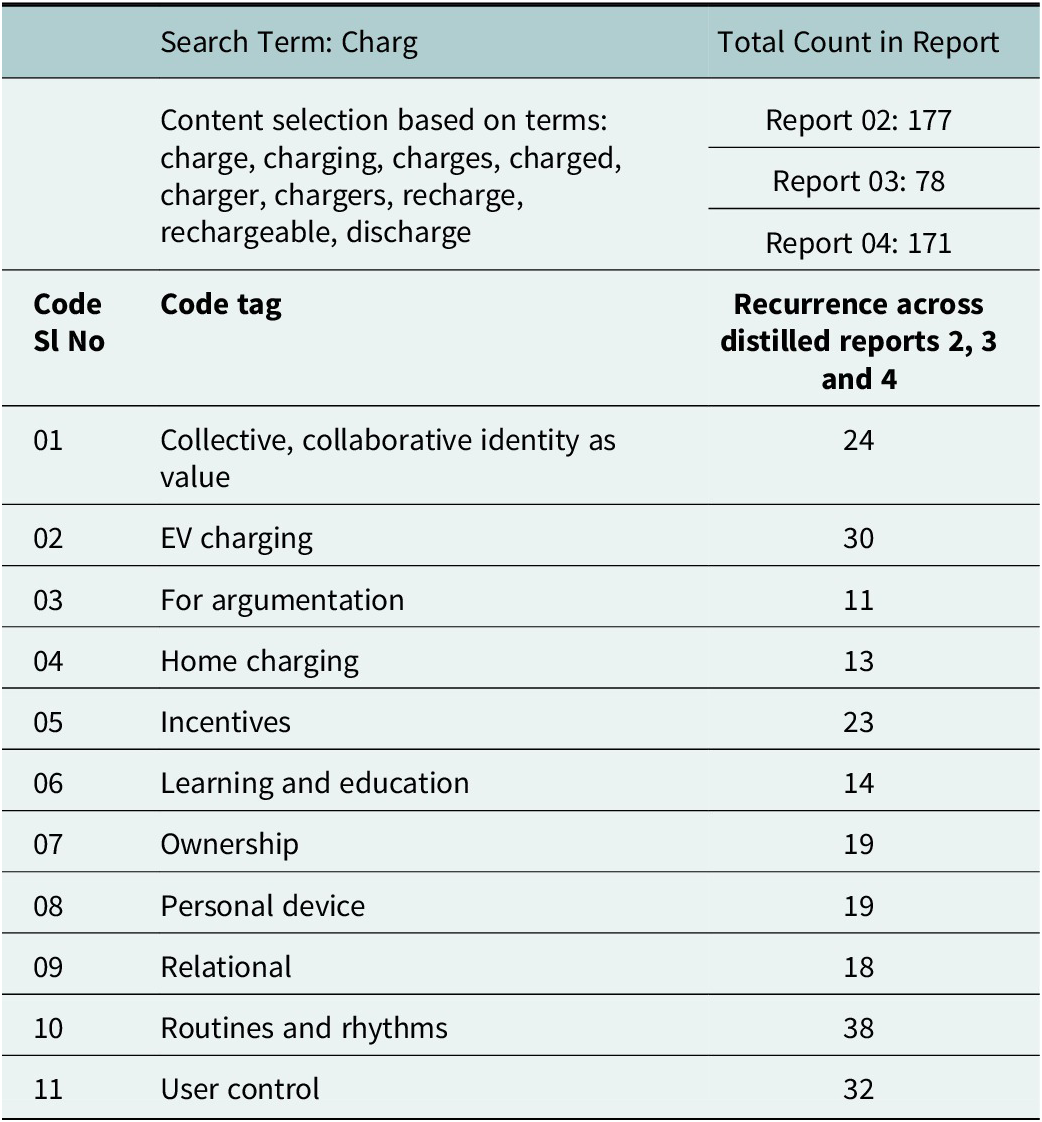
To identify charging-related contexts, themes and experiential considerations, all four reports were first reviewed using the truncated search term “charg,” capturing occurrences of charge, charging, charger, charged, recharge discharge and related terms (Table 1). Relevant textual excerpts, including participant quotations, analytical observations and report findings, were extracted around the terms into a separate corpus.
Term and code analysis chart

Table 1. Long description
The table is divided into two main sections.
Top Section: Search Parameters
* Search Term: Charg.
* Content selection based on terms: charge, charging, charges, charged, charger, chargers, recharge, rechargeable, discharge.
* Total Count in Report 02: 177.
* Total Count in Report 03: 78.
* Total Count in Report 04: 171.
Bottom Section: Code Analysis (Columns: Code Sl No, Code tag, Recurrence across distilled reports 2, 3 and 4)
* 01: Collective, collaborative identity as value: 24.
* 02: E V charging: 30.
* 03: For argumentation: 11.
* 04: Home charging: 13.
* 05: Incentives: 23.
* 06: Learning and education: 14.
* 07: Ownership: 19.
* 08: Personal device: 19.
* 09: Relational: 18.
* 10: Routines and rhythms: 38.
* 11: User control: 32.
Following this initial review, the first report was excluded from detailed qualitative coding. Although valuable in establishing industry perspectives, it primarily synthesised existing reports rather than presenting first-hand empirical findings. It therefore functioned as a critique of prevailing industry visions rather than as an ethnographic report dataset.
The remaining three reports were then subjected to a second round of qualitative analysis using Taguette (Rampin et al., Reference Rampin, Rampin and DeMott2021). Excerpts of charging-related contexts, themes and experiential considerations were coded abductively and iteratively. Ten recurring codes were initially identified before being consolidated into five higher-order theme-coded categories: Rhythms and Routines, User Control, Incentives, Learning and Education and Collective Ownership. In parallel, three charging contexts emerged consistently throughout the dataset: Personal Devices, Electric Vehicles and Home Batteries. One of the initial coding categories was utilised to process and frame a preliminary research question that will be presented in the next section. These three charging contexts, five theme-coded categories and the research question informed the second stage of the research through multidisciplinary expert interviews.
First findings: Question, contexts and experiential categories
As seen in Figure 1, the first-stage analysis generated two complementary analytical outputs and a working research question. The first distinguished three contexts in which charging occurs: Personal Devices, EVs and Home Batteries. The second identified five recurring theme-coded categories associated with experiential considerations related to charging. Together, these constituted the preliminary analytical framework.
Two stage project process and methodology.

Preliminary research question
The first-stage analysis generated the following preliminary research question: When designing new digital energy services, what considerations for the user experience of charging devices can balance household needs while addressing issues of peak energy demand during the energy transition? This question was useful as an initial scaffold and became a useful opening during domain expert interviews.
Charging contexts
The qualitative analysis of the reports produced three contextual categories of charging: Personal Devices, EV Charging and Home Batteries. To further ground these as charging contexts, these were mapped in relation to embodied human interaction. Accordingly, chargeable devices were grouped into the following three contextual categories:
-
a) Devices with chargeable batteries that can be carried on the human body or moved by the human body
-
b) Devices with chargeable batteries that aid mobility and can carry one or more humans
-
c) Chargeable home batteries that can store and feed energy and be portable or remain fixed
By mapping and relating to embodied human practice, this categorisation provides a workable way to compare charging across different scales of consumer battery use, from portable devices to mobility systems and domestic storage.
Experiential categories
Based on the extraction of the “charg” term, the following five theme-coded categories emerged as charging-related experiential considerations from the analysis of the three reports. Such an output is then presented as provisioning a preliminary conceptual basis for designing everyday charging experiences. As analytical categories, they hold opportunities for translating into experiential features within future chargeable products, services and energy systems.
Rhythms and routines
The coding analysis identified Rhythms and Routines as the most frequently occurring theme associated with charging. Across the reports, charging repeatedly appeared as a temporal practice embedded within everyday household routines, while remaining poorly aligned with the rhythms of renewable energy production. Charging therefore emerged as a practice situated between two temporal systems: the social rhythms of everyday life and the infrastructural rhythms of electricity generation. This observation established Rhythms and Routines as the primary analytical category carried into the second stage of the research. Designing for multiple and interacting rhythms therefore becomes an experiential resource within CgX. Conversely, failure to align these temporal structures may undermine the effectiveness and adoption of charging or a digital energy service.
User control
This was the second-largest recurring code category in the analysis, and User Control emerged as one of the central issues across all the reports. The reports convey that households prefer to retain meaningful control over their energy assets that are connected to their everyday practices rather than divesting these entirely to external automation. This preference applies equally to the charging of devices, vehicles and energy storage. People favour control over the location, timing and amount by which their devices and batteries are charged, whether for personal devices, EVs, rooftop solar photo-voltaic charging or even hot water systems. While automation and control of some energy assets, such as hot water heating, may be acceptable for convenience, there is a preference for its visibility with an option of control. Provisioning meaningful user control helps establish trust between households and charging services while allowing automation to remain visible, understandable and, where necessary, overridable. Accordingly, given this insight, control and informational granularity and timing of charge become important considerations for CgX.
Incentives
In a growing two-way consumer energy system, balancing loads between households and the grid means there is a continuous rhythmic interaction of taking and giving control of household energy assets. EVs and domestic solar energy storage batteries participating in VPP programmes and shifting energy loads through time-of-use pricing means electricity retailers and distribution network companies are providing households with financial incentives for participation. Yet household energy savings and shifting are motivated by a far more diverse set of factors than price. Time-of-use tariffs and financial incentives alone are unlikely to encourage significant load shifting. Instead, the reports highlight consumers’ desire to share excess energy with others in the community, aspirations toward self-sufficiency, sustainability or environmental values and even learning opportunities as more effective drivers. Consequently, CgX provides a rich opportunity to compose financial, environmental, educational and social incentives into coherent participation experiences rather than relying solely on price signals.
Learning
New energy technologies, services and demands require new learning across stake-holding entities. The constant influx of such new technologies into the domestic realm creates varying degrees of knowledge and (mis)understanding regarding use and maintenance of new technologies within households. While some like to learn, research and make decisions themselves, there emerges a scope for energy-related sectors, like governments, industry, device manufacturers and service providers, to become trusted sources of information and advice. Rather than treating charging simply as an operational task, the analysis of the reports allows interpreting charging as a recurring point of interaction through which households can gradually develop knowledge about batteries, energy systems and their own everyday practices. Accordingly, CgX can provide a recurring and rhythmic opportunity for learning through participation rather than instruction alone.
Collective ownership
This final category, Collective Ownership, is a combination of two lower-level codes, Collective, Collaborative Identity and Ownership, coming together as Collective Ownership. The nature of larger environmental problems, the emerging two-way consumer grid, digital systems interfacing the new consumer grid and all such combinations of forces, implicitly signal a household as part of a collective, as in a new energy market. Privately owned energy assets like home batteries and EVs that produce and feed energy to a public grid through a two-way transaction convey collaborative relationships. On the other hand, the report mentions that collectives also emerge when certain groups lack access to energy, infrastructure and information due to disparities and inequalities. CgX therefore provides an opportunity not only to make collective participation and inequalities more visible, but also to communicate, negotiate and potentially reshape relationships between privately owned energy assets and the wider public energy system.
Together, these five theme-coded categories, the three context categories and the preliminary research question provided the first analytical results relating to CgX from the Digital Energy Futures reports. Rather than constituting a final framework, they identify charging-related experiential considerations that require further interpretation before becoming actionable for design. To explore how these initial results might inform the design of future charging services, they were presented to domain experts from four disciplines complementary to charging as a practice and technology. As a procedural summary, the five meta-categories describe what can be considered when designing for charging experiences; next, by taking these considerations to domain experts and with a multidisciplinary positional analysis, this paper will present how such considerations can be made actionable as interaction design procedures when designing for charging experiences in new energy services.
Stage two: Interviews and interaction procedures
Domain expert interviews
The second stage of the research sought to interrogate and refine the preliminary analytical thematic findings developed from the Digital Energy Futures reports analysis. Rather than validating the findings through consensus, the objective was to examine how the three charging contexts, five theme-coded categories and the preliminary research question would be received and interpreted from different disciplinary perspectives concerned with the design, operation and experience of current digital energy and storage systems.
To achieve this, four semi-structured expert interviews were conducted with specialists representing four complementary domains: battery material chemistry, building energy efficiency, EV charging services and user experience and design research. The experts were purposively selected on the basis of their demonstrated research, technical and professional expertise within their respective domains. Together, they represent complementary perspectives spanning scientific research, engineering practice, commercial service development and user experience research. The battery chemistry expert is the founder and CEO of a company developing next-generation aluminium-ion batteries and holds an advanced research degree in materials science. The building energy efficiency expert is the founder and CEO of an Australian energy efficiency consultancy with over two decades of professional experience in commercial, industrial and residential energy systems. The EV charging expert is the founder of an Australian EV charging company specialising in charging infrastructure for multi-residential buildings. The UX expert is a researcher and university educator whose work focuses on user experience, interaction design and service design. Collectively, these perspectives provided disciplinary breadth across the material, infrastructural, service and experiential dimensions of charging systems, allowing the preliminary framework to be interrogated beyond a single disciplinary viewpoint.
Each interview followed a common structure. Participants were first introduced to the background of the Digital Energy Futures project, the preliminary research question that had emerged from the first stage of analysis, the three charging contexts (Personal Devices, EVs and Home Batteries) and the five theme-coded categories (Rhythms and Routines, User Control, Incentives, Learning and Education and Collective Ownership). This ensured that all experts responded to the same analytical framing while interpreting it through the lens of their own disciplinary expertise.
The interviews then explored five related areas. Participants were first invited to articulate their own position on charging as an experience within their domain. They were subsequently asked to prioritise the five theme-coded categories when designing an ideal charging service, identify additional considerations absent from the preliminary framework, discuss each theme from their disciplinary perspective and reflect on its implications for future charging services. The interview schedules were customised only through domain-specific terminology, while retaining an equivalent sequence of questions and analytical intent across all four interviews.
Following transcription, the interviews were analysed comparatively using a tabular matrix. Responses were organised within a cross-domain analytical matrix using the five theme-coded categories as common points of comparison. This enabled similarities, differences and recurring design considerations to be examined across disciplines. Rather than seeking agreement between experts, the analysis focused on identifying convergences that could inform the design of charging experiences across different technological and application contexts. The synthesis of these convergences forms the basis of the three interaction design procedures presented as a result of the overall exercise.
Interaction design procedures for shaping CgX
A systematic comparative analysis of interview transcripts of four different domain experts in battery materials, building energy efficiency, EV charging and UX research, indicated the recurring ways to address experiential considerations across these domains. Iterative comparisons and synthesis led to a convergence of approaches. This distilling of approaches from multidisciplinary perspectives are presented as three interrelated interaction design procedures for shaping CgX, namely Composing, Aligning, and Signalling. Drawing on Akrich’s (Reference Akrich, Bijker and Law1997) concept of inscription, these three interaction design procedures can be understood as design operations through which charging-related experiential considerations can be intentionally “inscribed” into products, services and energy infrastructures (Figure 2). As verbs rather than categories, these procedures emphasise action and therefore occupy a procedural and strategic role within the design process. Rather than describing fixed properties of charging systems, they provide designers with operations for configuring and scripting relationships between technologies, energy systems, markets and everyday life. Although analytically distinct, the three procedures are mutually influential and may be deployed independently or configured together in different combinations according to the aims and context of a charging service.
The CgX procedural wheel.

Figure 2. Long description
The Charging Experience concentric procedural wheel showing five theme categories of charging, namely Rhythms and Routines, User Control, Incentives, Learning and Collective Ownership, in the outer circle, and Composing, Aligning and Signalling as design procedures to affect Charging Experience as the inner circle.
Composing
Composing is a design procedure for choosing and assembling experiential considerations that shape CgX. The assembling may include incentives, learning opportunities, battery health, transparency, user control and community participation depending on the design context.
Telling them that this is a basic concept that batteries will lose their efficiency with time, but you can increase the age of your battery if you follow these steps. So I think that way science can be brought into the conversation.
-Battery Material Design Expert
So for instance, yeah, also like a game, oh we’re all here charging in this physical space…in that virtual world, we’re all farming when charging… we’re all neighbors, you know? Like, yeah, so there is so much you can do.
-UX Expert
The quotes above suggest intentionally introducing additional experiential elements into charging. Rather than treating charging solely as an operational necessity, battery health, learning and collective play or other forms of value can be assembled around charging to create richer experiences. Composing therefore concerns selecting and blending experiential considerations that together can shape CgX.
Design Example: A charging and battery health application that invites owners of the same phone model to participate in a collective online game while charging according to manufacturer-recommended practices, thereby composing learning, play and battery stewardship into the charging experience.
Aligning
Aligning is a design procedure for coordinating different rhythms within dynamic two-way energy systems. It involves bringing together different temporal rhythms from disparate and hidden systems into CgX. Through such coordination, charging can be designed to better respond to battery behaviour, renewable energy availability, electricity carbon intensity and the everyday routines of users.
Yeah, so we manage those rhythms through that dynamic load control, so whatever is the rhythm of the user or whatever is the rhythm of the building’s electricity profile, then we make sure that they kind of breathe together
-EV Charging Expert
So what I’m saying here is that…to respect the user’s own social rhythm still is the priority and the rest of it, we need to design them to align well with that person’s individual and social rhythm and to create as much comfort and freedom as possible while still being ecologically sustainable.
-UX Expert
And incentives is probably the key part. Like they have to ensure that everyone is being rewarded fairly and equally and that no one is excluded because of inherent barriers that can be removed from a regulatory point of view.
-Building Energy Efficiency Expert
The quotes above suggest that charging is shaped by multiple temporal rhythms operating simultaneously across battery materials, infrastructures and everyday life. Rather than privileging one rhythm over another, Aligning involves coordinating these different temporal structures so that they work together as part of the CgX.
Example: As part of Christmas holiday offer if an apartment EV charging service that is integrated within a V2G program, made an offer to its customers to power the cooking and thermal comfort needs of their local church events.
Signalling
Signalling as a procedure makes legible and evident the different compositions and alignments constituting CgX, thereby facilitating informed participation by end users. It involves communicating the state, purpose and value of charging in ways that are meaningful, understandable and actionable for end users, households and customers.
Visibility is extremely important when you’re designing or when you’re thinking about new systems, because I know how the batteries work, but to make sure that the customer also understands how to use it better can only be possible if it’s visible for them. Yeah, it’s visible that whatever they are doing is actually helping everyone.
-Battery Material Design Expert
I think probably the other just is the time factor, like it’s got to be in the moment and it’s got to be like near real time. Yeah, and in different ways. So, visual reminders, messaging reminders, whatever, kind of prods, that makes people experience the incentive in different senses.
-Building Energy Efficiency Expert
Reflection is important, like not to force people to learn, but make them to reflect that, they want to learn. Yeah. So one example I [will] give is like if charging with low carbon and then it just tells low carbon, and then [otherwise] it’s high carbon
-UX Expert
The quotes above suggest not only a continual communication requirement of battery status, charging conditions, incentives and system behaviour, but also choice and reflection. Rather than approaching signalling as the simple display of technical information, features like battery health, transparency, messaging and feedback become opportunities for communicating the purpose and value of a new energy service. Signalling therefore involves making the composed and aligned elements of CgX visible and meaningful so that users can understand, trust and participate in CgX-related services.
Example: A dynamic VPP scheme that communicates participation through free electric bike mobility and access to public swimming pools for households contributing battery capacity during the 30 highest temperature days of summer.
Discussion
Following a constructive design research approach, this article introduces CgX as a conceptual framework for approaching charging as an object of design within the emerging two-way consumer grid. While charging has been approached as an operational requirement of batteries and energy systems, this article argues that it can also be approached as an everyday experience that can be intentionally designed. Through an abductive analysis of charging-related contexts, themes and experiential considerations, followed by multidisciplinary expert interpretation, the proposition develops a design-oriented perspective on charging that extends beyond technical optimisation or economic incentives alone.
With this, the article makes four contributions. First, it contributes conceptually by framing charging as an everyday experience situated between domestic practices, digital infrastructures and emerging consumer energy systems. Second, it contributes methodologically by demonstrating how qualitative insights from ethnographic energy research can be progressively translated through abductive coding and multidisciplinary expert interpretation into actionable design knowledge. Third, it contributes to design practice by presenting Composing, Aligning and Signalling as three interaction design procedures that provide designers, engineers and policymakers with a practical vocabulary for designing future charging services across personal devices, EVs and domestic battery systems.
The final contribution of the article is a proposal of CgX as a design lever for household participation in coordinated energy programmes. While household ownership of distributed energy resources continues to grow rapidly in Australia and beyond, participation in coordinated energy programmes remains comparatively limited. Australia now has millions of rooftop solar systems and a rapidly growing fleet of household batteries (AEMO, 2026), yet only a relatively small proportion of these privately owned energy assets participate in coordinated programmes such as virtual power plants or other orchestration services (ACCC, 2025). Recent system planning by the Australian Energy Market Operator assumes substantially higher levels of participation from consumer energy resources, because coordinated participation can reduce overall system costs while improving reliability and renewable integration. The contribution of this article is not to propose another market mechanism or optimisation algorithm, but to suggest that CgX itself can become an additional design lever for increasing household participation. If interaction design can improve participation in coordinated charging programmes across personal devices, EVs and domestic batteries, then privately owned energy assets may contribute more effectively to the operation of the two-way consumer grid, supporting lower system emissions and a more effective energy transition.
There are, however, limitations to this research. The first stage of analysis is derived from a single longitudinal Australian research project and therefore reflects one geographical context. In addition, the qualitative coding and synthesis were undertaken by a single researcher, limiting opportunities for inter-coder comparison. While the second stage of the research broadened the analytical perspective through expert interviews spanning four complementary domains, the proposed interaction design procedures should be regarded as a preliminary first step requiring further empirical evaluation through implementation and use.
Future work will focus on designing, developing and deploying charging services informed by CgX and the three interaction design procedures presented in this article. Such deployments will enable empirical examination of charging experiences across personal devices, EVs and domestic energy storage, allowing the procedures to be refined through practice. More broadly, the article points towards opportunities for interaction design to contribute to the development of new forms of participation, relationships and services within the evolving two-way consumer grid. This calls for CgX to be addressed as an important and useful component from multiple positions and perspectives when approaching the future of domestic energy transitions.
Open peer review
To view the open peer review materials for this article, please visit https://doi.org/10.1017/etr.2026.10022.
Acknowledgements
The author thanks the domain experts for their time and thoughtful contributions, and Prof George Xydis, Editor-in-Chief of the Energy Transitions Journal, for constructive comments and feedback on an early draft of this manuscript.
Data availability statement
The first-stage data analysed in this study comprises publicly available reports from the Digital Energy Futures project published by the Emerging Technologies Research Lab, Monash University. The reference to the report has been cited throughout the manuscript. The second-stage data comprise semi-structured expert interviews conducted specifically for this study. Interview excerpts supporting the analysis are included within the manuscript. The full interview transcripts are not publicly available because participants did not provide consent for public data sharing. Reasonable requests for further information may be directed to the author.
Declaration of interests
The author declares no competing interests. While the author is involved in the development of a separate, ongoing project exploring charging-based digital energy services, this article presents independent, conceptual design research and does not evaluate, promote or derive benefit from any commercial product or service.
Author contribution
The author is solely responsible for the conception, design, analysis and writing of this work.
Financial support
This work was supported by Delectro Pty Ltd.
AI statement
AI-assisted tools were used for language editing and readability improvements only. All conceptual development, analysis, interpretation and scholarly arguments are the sole work of the author, who retains full responsibility for the content of this article.


 Open access


Comments
Dear Editors-in-Chief,
Please find enclosed our manuscript entitled “CgX: A Design Framework for Charging Experiences in Domestic Energy Transitions” for consideration as a Research article in Cambridge Prisms: Energy Transitions.
The article introduces CgX, a five-point design framework for charging experiences across personal devices, electric vehicles, and home batteries, grounded in a qualitative synthesis of the Digital Energy Futures project reports from Australia. Drawing on social practice theory and user experience research, the paper reframes everyday charging as a site for domestic demand flexibility and contributes a user-centred perspective to demand-side energy transition research.
The manuscript is original, has not been published previously, and is not under consideration elsewhere. All authorship, ethical, and disclosure requirements of the journal have been met. Any use of AI-assisted tools was limited to language editing only, with all conceptual development and analysis undertaken by the author.
I confirm that I will have no editorial role in the handling or review of this manuscript and will recuse myself fully from the editorial process.
Thank you for considering this submission. I would be pleased to respond to any questions or revisions the reviewers or editors may suggest.
Yours sincerely,
Dr Kartikeya Acharya
Founding Director
DELECTRO
EnergyLab,
Sydney, Australia