





Impact statement
England’s water system is under intensifying pressure from scarcity, flooding, pollution, biodiversity loss and climate change, yet the prevailing model of water cycle management remains fragmented, resource-intensive and too often focused on managing symptoms rather than causes. This paper argues that doughnut economics offers a timely and practical framework for reform. By bringing together social foundations such as clean and affordable water, wastewater services, flood resilience, public health and access to blue-green space, with ecological ceilings such as freshwater limits, nutrient loading, chemical pollution, climate emissions and biodiversity loss, it provides a coherent basis for whole-system decision-making. The impact of this paper is to reframe water management in England as the stewardship of a social-ecological system that must deliver human wellbeing within environmental limits. It highlights why existing regulatory and investment approaches are insufficient to secure long-term resilience. In doing so, it supports current policy momentum created by the Cunliffe Review and the Government’s New Vision for Water, whilst pushing further towards a genuinely integrated, catchment-based and cross-sectoral approach. Its practical contribution is to translate doughnut thinking into the water context through clear operating principles, measurable outcomes and indicative targets. This creates a language through which regulators, utilities, planners, local authorities and environmental stakeholders can align investment, governance and public expectations. At a time when England needs both renewed public legitimacy and more effective delivery, the paper offers a strategic framework for achieving a safe and just water future that restores rivers, reduces demand, improves resilience and enables prosperity within planetary boundaries.
Introduction
England’s water system is not in good shape. The “Cunliffe Review” (Independent Water Commission, 2025) diagnosed “systemic, interlocking failures” and proposed 88 recommendations for a “fundamental reset”, including a single integrated regulator and regional system planners. The government’s response was published on 21 January 2026, setting out “A New Vision for Water”. This commits to the creation of a single integrated and empowered regulator, which will set out clear national, overarching targets and long-term goals for water. It foresees a joined-up, systems-based approach that acknowledges catchments as the core unit of planning. It also commits to the creation of a Regional Planning Steering Group that will consider how best to establish regional planning bodies. Now is therefore a suitable time for the industry to reflect on the ways forward that will best deliver for people, the economy, nature and the water environment.
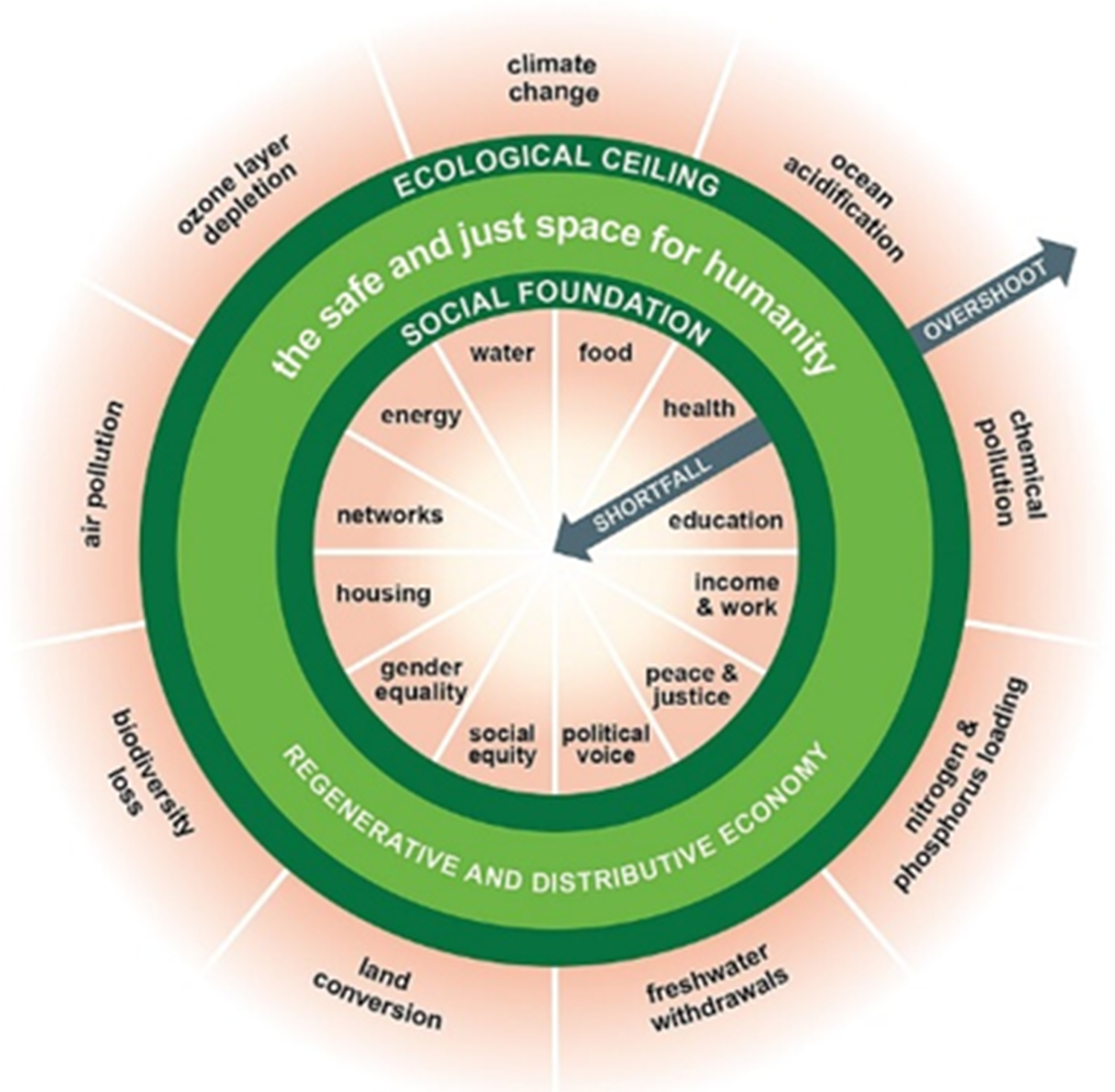
This paper outlines an approach to integrated water cycle management that aligns with the ideas set out by Kate Raworth in her book “Doughnut economics: seven ways to think like a 21st-century economist” (Raworth, Reference Raworth2017). In this book, Raworth envisions a just and safe society where our economies are geared to ensuring that everyone has the essential resources required to fulfil their human rights (“social foundations”), but resource use is limited to a level that can be sustained within the limits imposed by planetary ecosystems (“ecological ceilings”). The doughnut itself represents the “safe and just space for humanity”. The hole in the centre of the doughnut represents a situation where societies are failing to meet their basic needs; outside the doughnut ring lies a domain characterised by societies living beyond their means. This simple rationalisation – illustrated in Figure 1 – provides a coherent framing for how to achieve sustainable development, under Gro Harlem Brundtland’s famous definition of “meeting the needs of the present without compromising the ability of future generations to meet their own needs” (United Nations Secretary-General, 1987).
The classic image of the doughnut (copyright ShareAlike4.0 International).

Figure 1. Long description
At the center is a white circle divided into twelve segments representing the SOCIAL FOUNDATION. Clockwise from the top, the segments are labeled water, food, health, education, income and work, peace and justice, political voice, social equity, gender equality, housing, networks, and energy. A dark gray arrow labeled SHORTFALL points from the outer edge of this circle toward the center.
Surrounding the core is a green ring labeled the safe and just space for humanity. The inner border of this ring is the SOCIAL FOUNDATION and the outer border is the ECOLOGICAL CEILING. The bottom half of the green ring contains the text REGENERATIVE AND DISTRIBUTIVE ECONOMY.
Outside the green ring is a light red perimeter divided into nine sectors representing planetary boundaries. A dark gray arrow labeled OVERSHOOT points outward from the green ring into this area. Clockwise from the top, the sectors are climate change, ocean acidification, chemical pollution, nitrogen and phosphorus loading, freshwater withdrawals, land conversion, biodiversity loss, air pollution, and ozone layer depletion.
The UK government acknowledges a “human right to water and sanitation” as a state party to the International Covenant on Economic, Social and Cultural Rights (Foreign and Commonwealth Office, 2012). The question of how much water we can extract, treat, use, treat again and discharge back into the environment, without this placing an unsustainable burden on natural ecosystems, remains moot. Whilst price mechanisms have some impact in limiting use, these mechanisms are weak because water is undervalued (United Nations University Institute for Water, Environment and Health, 2026). Significant regulation exists to protect the water environment, not least the Water Environment (Water Framework Directive) (England and Wales) Regulations 2017, which aim to achieve “Good Ecological Status” for our water bodies by 2027 (or “Good Ecological Potential” in the case of heavily modified water bodies). However, in 2024, only 16% of rivers and 14% of lakes in England met these objectives (Joint Nature Conservation Committee, 2025). Moreover, how we currently manage the water cycle overall, and the societal issues associated with having too much water (i.e. flooding) and too little water (i.e. drought) reflects an approach that has become energy and resource intensive. There is consequently a risk that adaptation and resilience measures designed to safeguard society from the impacts of climate change, flooding and drought will contribute to further exceedance of ecological ceilings. That is, unless we adopt a doughnut-shaped approach that specifically aims to provide firm social foundations for all, whilst remaining within defined, safe ecological limits.
How is doughnut economics relevant to water management in England?
Doughnut economics reframes successful water cycle management as meeting social foundations (e.g. safe water, flood resilience, sanitation, health, affordability, participation) without breaching the ecological ceiling (e.g. climate stability, freshwater integrity, biodiversity, chemical pollution). It is compatible with Agenda 2030 and the 17 sustainable development goals (United Nations, n.d.) but frames these objectives in a way that acknowledges the fact that there are limits to consumption-based economic growth imposed by a) resource availability and b) the ability of the natural environment to absorb pollutants and regenerate.
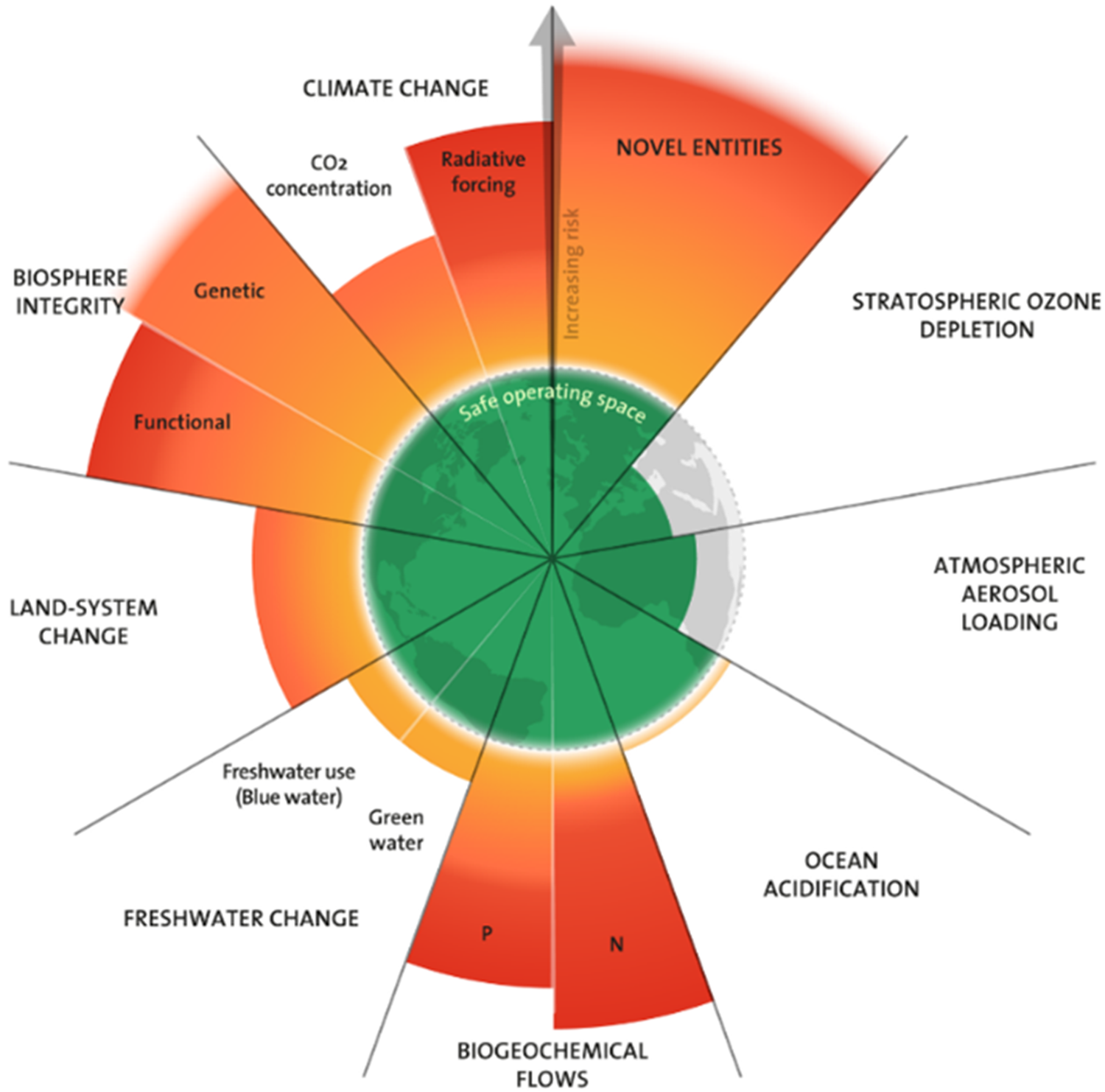
The doughnut concept is closely allied to the philosophies of the economist EF Schumacher, who championed the idea of “sufficiency” in the 1970s (Schumacher, Reference Schumacher1973). A sufficiency-orientated approach aims to limit consumption to sustainable levels, on the simple premise that using resources at a rate faster than planetary systems can purify and replenish them cannot be continued indefinitely. Since the 1970s, many academics have observed that societies dominated by consumption-based economic growth have continued to consume long after their basic needs have been fulfilled (Jackson, Reference Jackson2016). It is now increasingly appreciated that sustainable consumption can only be assessed on the basis of a planetary systems analysis. The Stockholm Resilience Centre, in particular the research of Johan Rockström and his colleagues, has developed the concept of nine “Earth system boundaries”, the exceedance of which risks triggering large-scale, abrupt or irreversible environmental change (Steffen et al., Reference Steffen, Richardson, Rockström, Cornell, Fetzer, Bennett, Biggs, Carpenter, de Vries, de Wit, Folke, Gerten, Heinke, Mace, Persson, Ramanathan, Reyers and Sörlin2015). These boundaries, illustrated in Figure 2, are equivalent to Raworth’s ecological ceilings and have been assessed in relation to the following:
-
• Climate change
-
• Ocean acidification
-
• Chemical pollution/novel entities
-
• Nitrogen and phosphorus loading (Biogeochemical Flows)
-
• Freshwater withdrawals
-
• Land-use change
-
• Biodiversity loss
-
• Air pollution (Atmospheric Aerosols)
-
• Ozone layer depletion
The 2025 update to the planetary boundaries. Licensed under CC BY-NC-ND 3.0. Credit “Azote for Stockholm Resilience Centre, based on analysis in Sakschewski et al. Reference Sakschewski, Caesar, Andersen, Bechthold, Bergfeld, Beusen, Billing, Bodirsky, Botsyun, Dennis, Donges, Dou, Eriksson, Fetzer, Gerten, Häyhä, Hebden, Heckmann, Heilemann, Huiskamp, Jahnke, Kaiser, Kitzmann, Krönke, Kühnel, Laureanti, Li, Liu, Loriani, Ludescher, Mathesius, Norström, Otto, Paolucci, Pokhotelov, Shahi, Raju, Rostami, Schaphoff, Schmidt, Steinert, Stenzel, Virkki, Wendt-Potthoff, Wunderling and Rockström2025”.

Figure 2. Long description
At the center is a green and blue globe representing Earth. A green circular ring immediately surrounding the globe is labeled Safe operating space. An upward-pointing arrow from the center is labeled Increasing risk. The diagram is divided into nine radial wedges.
* Climate Change: Divided into C O sub 2 concentration and Radiative forcing. Both extend into the red high-risk zone.
* Novel Entities: A large orange and red wedge extending far beyond the safe boundary.
* Stratospheric Ozone Depletion: The wedge remains within the green safe operating space.
* Atmospheric Aerosol Loading: The wedge remains within the green safe operating space.
* Ocean Acidification: The wedge remains within the green safe operating space.
* Biogeochemical Flows: Divided into P and N. Both extend deep into the red high-risk zone.
* Freshwater Change: Divided into Green water and Blue water. Green water extends into the red zone while Blue water is in the orange increasing risk zone.
* Land-System Change: The wedge extends into the orange increasing risk zone.
* Biosphere Integrity: Divided into Genetic and Functional. Both extend into the red high-risk zone.
All but two of these Earth system boundaries (Ozone Layer Depletion and Atmospheric Aerosols) have already been breached. The water environment plays a critical role in all seven of these. Doughnut thinking is therefore highly relevant to our management of the water cycle in England. Applied to water, the doughnut becomes a set of operating principles to ensure universal access and resilience whilst staying within hydrological and ecological limits. This approach has been explored by the Doughnut Economics Action Lab in relation to Mexico’s water sector (Leñero, Reference Leñeron.d.).
How well does the current approach to water cycle management in England reflect doughnut economics principles?
England faces serious long-term sustainability challenges related to the water cycle. The Environment Agency estimates that by 2050, England may see a shortfall of around 5 billion litres per day between available supply and demand for public water, roughly one-third of current usage (Environment Agency, 2025). Office of Water Services (Ofwat)-funded research by the Enabling Water Smart Communities project estimates water scarcity could cost the UK economy £25 billion over the next five years due to halted housing developments, as there may not be enough water to supply new homes in water-scarce areas (Public First, n.d.). Lack of available water resources to support both a healthy water environment and economic growth is already a constraint in the Southeast and East of England.
A major programme of strategic resources option studies and infrastructure development is currently underway involving multiple inter-basin transfers, new reservoirs, groundwater schemes and treatment/re-use of water from other sources, including treated effluent. It is recognised that these measures may be insufficient to cope with future demands. Ofwat is shortly commencing a major programme of initiatives related to the wise use of water and water efficiency, a task that until recently has been left to third-sector organisations such as Waterwise (Ofwat, 2025c). At present, every litre of that water we use in England is treated to drinking water standard and pumped into supply, regardless of the use to which it is put. The majority of this water then becomes a waste product requiring treatment. The average English person currently uses over 140 l of water each day (it is possible to live with dignity using less than 50 l of water per day). Consequently, about 3% to 4% of the UK’s energy consumption is used to treat and transport water and wastewater (Mottram, Reference Mottram2024). Meanwhile, increased societal interest in, and focus on, river health has resulted in a major national programme of combined sewer overflow (CSO) and wastewater treatment works upgrades. Peak rainfall intensities are predicted to increase by upwards of 40% over the coming century across much of the country (Environment Agency, 2024). This has major implications for urban surface water flooding and ongoing CSO performance.
Major infrastructure remains essential to ensure the provision of safe drinking water at scale, to manage wastewater and to coordinate water resource management across regions. Regulatory frameworks and investment cycles have, for the most part, reinforced the need for such infrastructure, focusing on asset-heavy capital programmes rather than decentralised, catchment-based solutions. However, relying wholly on centralised infrastructure (reservoirs, treatment works, sewer networks) and engineering-led solutions has the potential to be inefficient and inflexible as a means of responding to changes in climate without contributing to further exceedance of ecological limits (Husain, Reference Husain2026). Limits which, as discussed above, are already being exceeded.
Major infrastructure is also essential to manage the risks of flooding from rivers, the sea and surface water. Currently, about 6.3 million properties in England face flood risk from these sources, and this could rise to 8 million (one in four) by mid-century with climate change (Environment Agency, 2024). Net sea level rise and increases in peak river flows are already placing increased strain on existing flood defence infrastructure. Whilst over £1 billion per annum is allocated to flood and coastal erosion risk management in England by Risk Management Authorities, the available evidence suggests that this will not be sufficient to prevent overall increases in the economic consequences of flooding from occurring (Environment Agency, 2019). The majority of this investment is currently targeted at the construction and maintenance of flood defence infrastructure. Such infrastructure reinforces long-term floodplain occupancy, potentially locking society into pathways that involve ever-increasing levels of resource use to resist the rising impacts of climate change. Whilst the Environment Agency’s flood management strategy (Environment Agency, 2020) aims to enhance whole-system resilience, adopt a catchment-based approach and use nature-based solutions, the reality is that current floodplain occupancy levels will be very resource-intensive to sustain.
Looked at through the above lens, it is not clear that current human interactions with the water cycle in England, let alone future plans, are aligned with doughnut principles.
What are the key challenges likely to be faced by those who favour a doughnut economics approach to water cycle management?
The key challenge faced by those who advocate for doughnut economics is the perception that explicitly acknowledging ecological ceilings, and using these to guide how we manage the water cycle, has the potential to constrain economic growth. Deregulation is seen by many as the key to economic prosperity and the only means of generating the wealth required to invest in the things we need as a society. For example, the statutory protection afforded to our most highly valued ecological assets from nutrient enrichment is considered by many to be placing a regulatory burden on housebuilders, with legislation now requiring developers to achieve nutrient neutrality for housing estates within 27 catchments designated as sensitive for nitrogen, phosphorus or both nutrients. Similarly, a reluctance to withdraw developers’ automatic right to connect to the “public” sewer is no doubt explained by similar concerns.
A second challenge is that the idea of imposing limits on water use is unpopular. This is not because people do not care about the environment, but because water use restrictions can affect people’s basic needs, can result in visible personal costs, can raise fairness and trust concerns and offer benefits (healthy aquatic ecosystems) that can feel remote and abstract. There was no doubt downward pressure on the water industry to keep bills low by governments concerned about the cost-of-living crisis in the period of austerity following the 2008 financial crisis.
For a doughnut economics approach to take root, these challenges will need to be addressed directly. Regulation is not inherently bad for economic growth. Bad regulation can slow growth; good regulation can enable sustainable, inclusive and resilient growth. The question is how regulation is designed and governed, not whether it exists. When it comes to imposing limits, the key here will be to do so in ways that are self-evidently just and fair, which is a core principle of the doughnut economics approach.
What might a doughnut-based approach look like for the water cycle in England?
The aim of a doughnut-based approach would be to transform water cycle management from one of “supplying water at lowest short-term cost while supporting economic growth”, to “ensuring a safe and just water system that delivers human wellbeing within the limits imposed by ecological ceilings”. This reframing should be embedded in the national water strategy, regional water resources plans, regulatory objectives and all the performance metrics used to monitor success. If we can bring our activities back to within these ecological ceilings, the outcome will be an environment compatible with human thriving.
The means of achieving these ends will necessitate a “whole-of-society approach” to sustainable water cycle management, in which all those with agency to use water more wisely – all of us – are incentivised and empowered to do so. This would entail whole-system regulation that treats the water cycle as an integrated social-ecological system, optimised to provide safe and just social foundations within clear limits that cannot be traded off for short-term financial returns.
Optimising for the following targets would provide the social foundations for a just and fair society:
-
1. Clean and affordable drinking water for all.
-
2. Affordable and effective wastewater disposal for all.
-
3. A minimum standard of protection from all sources of flooding.
-
4. Access to blue-green space within a prescribed proximity.
-
5. Restoration of all our rivers to good ecological status, with minimum levels of access provided to all, enhancing public health, wellbeing and amenity.
Achieving all five of these social foundations will require actions that extend well beyond the remit of privatised water utility companies. Achieving targets 1 and 2, whilst staying beneath ecological ceilings, will be significantly easier if the means of achieving targets 3, 4 and 5 adopt a whole-system approach, with regulation used to drive innovation in how sources of drought, flooding and pollution are addressed at source. For example, long-term plans to phase out chemical and pharmaceutical products known to impact the water environment would stimulate investment in new, safer products, reducing treatment costs; urban rainwater management programmes will enhance biodiversity and ease pressure on combined sewers; improved soil health and fertiliser application technologies will attenuate runoff and reduce nutrient loads. So, in general, the approaches to long-term sustainability will likely need to draw on a wider portfolio of tools with a focus on demand-side management and source control measures. This is discussed a little further below in the context of water use.
The use of block tariffs to manage demands for water is a tried and tested method that ensures everybody has access to the essential water required for their sanitary needs, drinking and cooking, but is charged more for higher usage (WWF UK, n.d.). Several English water companies are already trialling this approach (Ofwat, 2025a). Water metering is essential to this method. Approximately 60% of households currently have a water meter fitted in England. But no water company is required to introduce universal metering. Existing legislation simply provides water companies with permissive powers to install meters as a way of managing drought risk in their area (UK Parliament, 2019). The Environmental Incentives Common Framework, English New Connection Rules (Ofwat, 2025b) was introduced in April 2025. These are designed to incentivise water efficiency, something that many water companies have been doing for years. The framework for new connections is broadly in line with existing Building Regulations, Part G, Table 2.2. These incentives target relatively modest reductions to the current average usage levels. They assume that all our water needs are met using water treated to potable standards. Managing and using water where it lands has significant potential to achieve step change reductions and is under investigation by UK Water Industry Research. Rainwater capture and re-use can reduce property-level water demand by approximately 35%. Use of storage tanks designed to empty ahead of forecast storms occurring can also enable the use of this storage for flood attenuation.
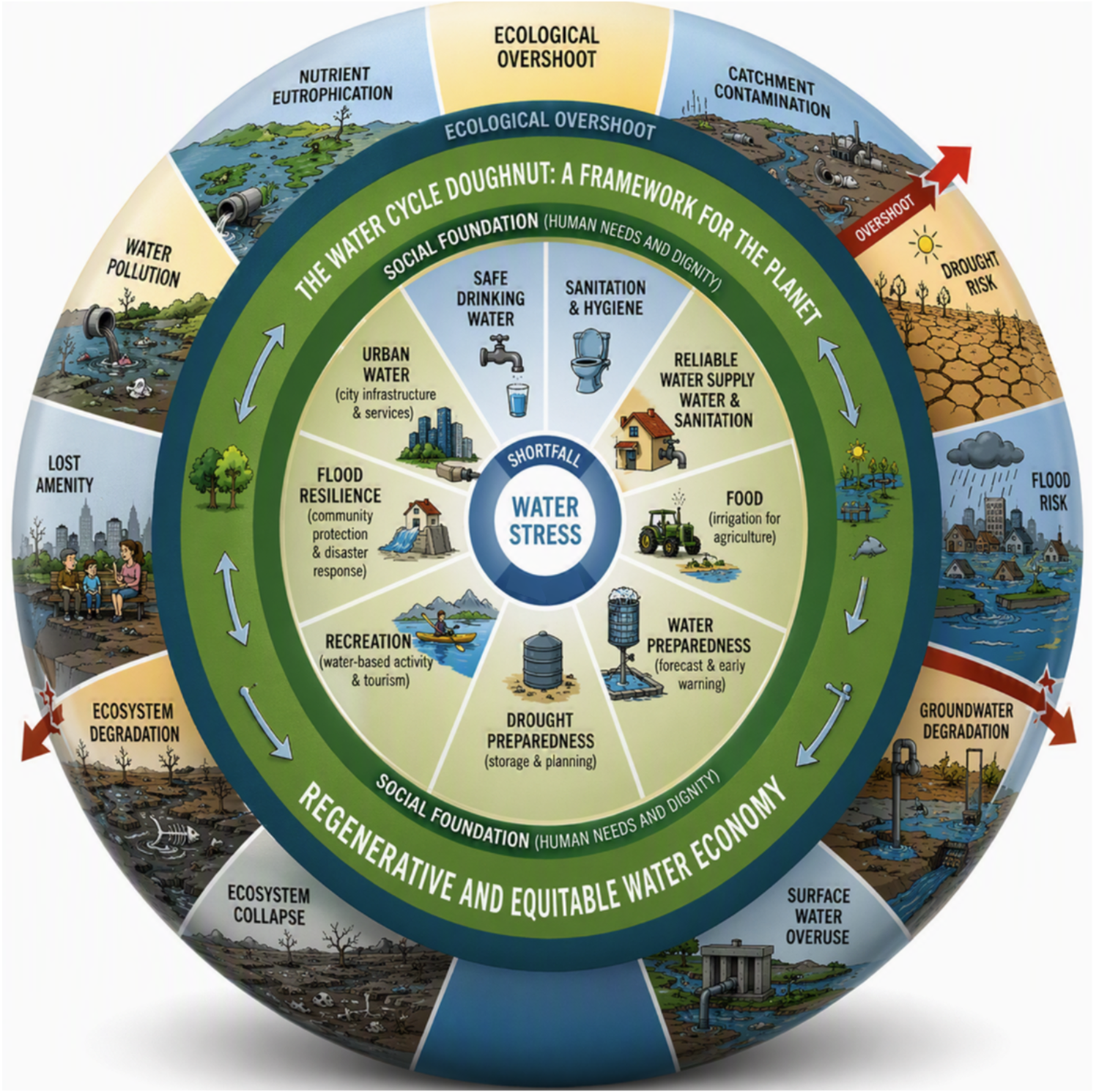
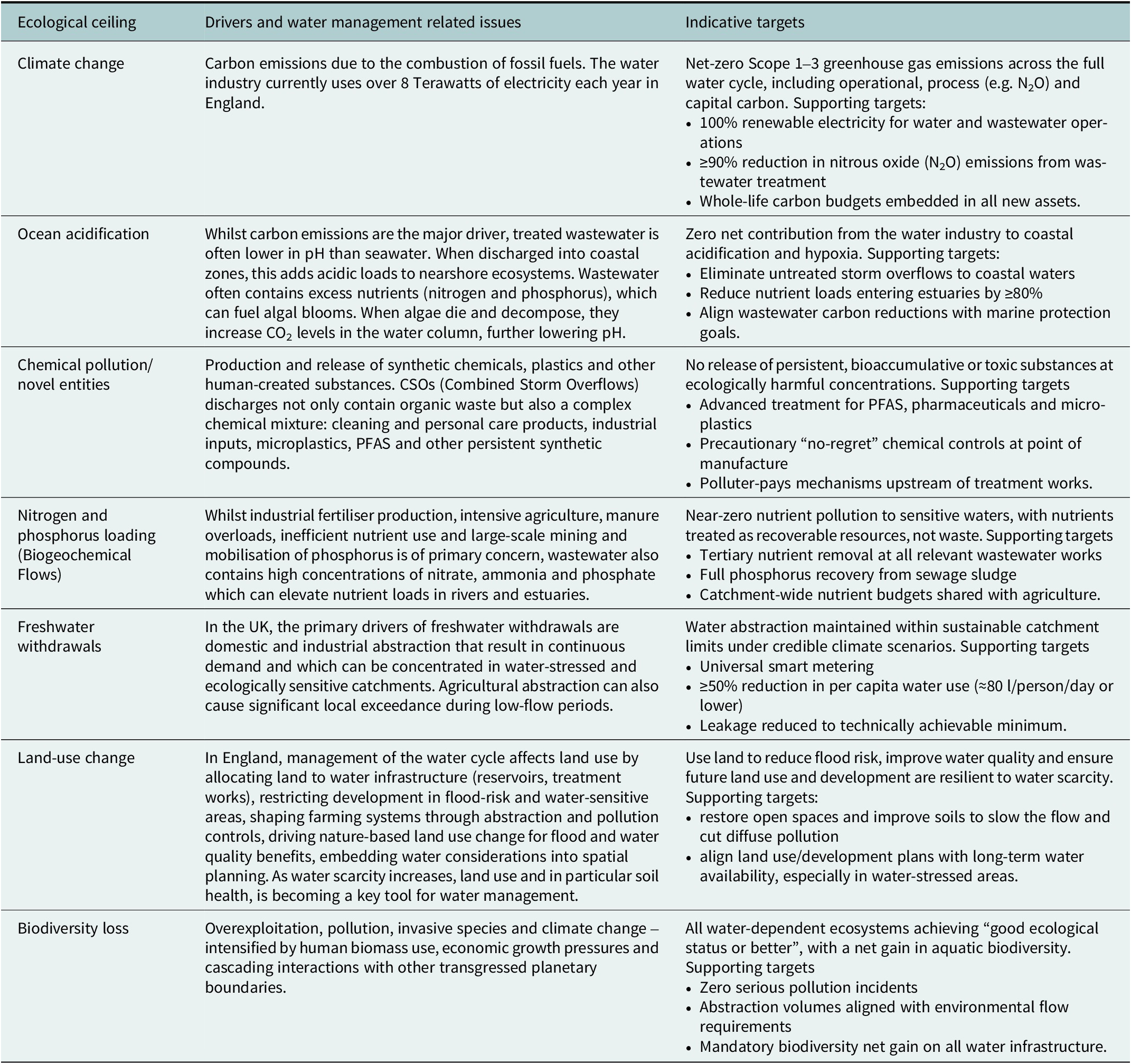
The principles outlined in this paper are captured in summary form in Figure 3, which was generated by Gemini using prompts from the content of this paper. Table 1 provides a range of targets that could be optimised to ensure that how we manage the water cycle directly contributes to bringing resource use back to within ecological ceilings.
The water cycle doughnut, as generated by Gemini based on the content of this paper.

Figure 3. Long description
At the center is a blue and white core labeled Water Stress, divided into Shortfall and Excess.
The next layer outward is the Social Foundation (Human Needs and Dignity), divided into nine segments with icons:
- Safe Drinking Water (tap and glass)
- Sanitation and Hygiene (toilet)
- Reliable Water Supply Water and Sanitation (house and pipe)
- Food (irrigation for agriculture with a tractor)
- Water Preparedness (forecast and early warning with a water tower)
- Drought Preparedness (storage and planning with a tank)
- Recreation (water-based activity and tourism with a kayak)
- Flood Resilience (community protection and disaster response with a house and sandbags)
- Urban Water (city infrastructure and services with skyscrapers).
This inner ring is enclosed by a green band labeled Regenerative and Equitable Water Economy.
The outermost layer is the Ecological Overshoot perimeter, showing environmental consequences in nine corresponding segments:
- Ecological Overshoot (top center)
- Catchment Contamination (industrial runoff)
- Drought Risk (cracked earth)
- Flood Risk (submerged city)
- Groundwater Degradation (well and polluted aquifer)
- Surface Water Overuse (draining river)
- Ecosystem Collapse (barren landscape)
- Ecosystem Degradation (dead fish and polluted stream)
- Lost Amenity (people sitting by a polluted urban river)
- Water Pollution (pipe discharging waste)
- Nutrient Eutrophication (algal bloom).
Red arrows point outward from the green ring toward the overshoot segments, while double-headed blue arrows circulate within the green band.
Water cycle related drivers of ecological ceiling exceedance and suggested indicative targets compatible with recovery and regeneration

Table 1. Long description
The table consists of three columns: Ecological ceiling, Drivers and water management related issues, and Indicative targets.
* Climate change: Driven by carbon emissions from fossil fuels and water industry electricity use (over 8 Terawatts per year in England). Targets include net-zero Scope 1 to 3 greenhouse gas emissions, 100 percent renewable electricity, and a 90 percent or greater reduction in N sub 2 O emissions.
* Ocean acidification: Driven by low pH treated wastewater and nutrient-fueled algal blooms that increase C O sub 2. Targets include zero net contribution to coastal acidification, eliminating untreated storm overflows, and reducing nutrient loads by 80 percent or greater.
* Chemical pollution/novel entities: Driven by synthetic chemicals, microplastics, and P F A S from C S O discharges. Targets include no release of toxic substances at harmful concentrations and advanced treatment for P F A S and pharmaceuticals.
* Nitrogen and phosphorus loading (Biogeochemical Flows): Driven by wastewater nitrate, ammonia, and phosphate. Targets include near-zero nutrient pollution, tertiary nutrient removal, and full phosphorus recovery from sewage sludge.
* Freshwater withdrawals: Driven by domestic and industrial abstraction in water-stressed catchments. Targets include maintaining abstraction within sustainable limits, universal smart metering, and a 50 percent or greater reduction in per capita water use to approximately 80 liters per person per day.
* Land-use change: Driven by land allocation for infrastructure and development restrictions. Targets include using land to reduce flood risk and improve soil health to cut diffuse pollution.
* Biodiversity loss: Driven by overexploitation and pollution. Targets include all water-dependent ecosystems achieving good ecological status, zero serious pollution incidents, and mandatory biodiversity net gain (B N G) on all infrastructure.
Governance considerations
The Cunliffe Review (IWC, 2025) primarily examined the economic regulation and governance of water companies – their ownership, investment and performance. Its remit did not extend to fully integrating agriculture, land use and wider environmental governance under one statutory framework. Furthermore, the review did not integrate flood risk governance fully into the new regional water system planners’ powers. This means that the Risk Management Authorities’ flood defence responsibilities, farm and highway runoff regulation and nature recovery programmes would continue to operate in parallel with, rather than being embedded within, a unified catchment planning framework. Consequently, if the IWC’s recommendations were to be implemented, catchment management will continue to rely on voluntary collaboration and alignment with existing frameworks (e.g. Local Nature Recovery Strategies, River Basin Management Plans). This new water regulator would have no powers related to soil health, rural and urban runoff control, diffuse pollution and habitat restoration. In the context of a proposal to create a system of water governance capable of adopting a strategic, holistic, integrated and catchment-based approach to water cycle management, this is potentially a major shortcoming.
System-wide optimisation is very challenging without system-wide authority. Water governance would need to be both extended, to cover policy and regulation related to all parties with a stake in water stewardship, and democratised to ensure equitability of decision-making. Without governance extensions, responsibility would remain diffuse, negative externalities would persist and long-term sustainability would likely be sacrificed to short-term sectoral goals. Governance would therefore need to span public and private actors in multiple sectors and at multiple spatial scales (catchment, regional, national). There are several emerging cross-sector/systems planning initiatives from which such planning could evolve. NISTA, the five regional water resources planning groups, local partnerships, such as “Living with Water” (Hull) and “Connected by Water” (South Yorkshire), and the proposed regional system planners all provide vehicles to help drive more holistic thinking. This issue has been analysed closely by Arup, and recommendations were made to the IWC in the evidence submission (Arup, 2025).Footnote 1 The essential attributes of the Catchment Governance Model proposed by Arup include:
-
• water managed more as an integrated system targeting outcomes (rather than outputs)
-
• the ability to make trade-off decisions at the right level, from local to regional to national
-
• well-evidenced catchment plans, focused on relevant issues, that are actionable and investable
-
• local and place-based objectives and choices reflected with democratic representation and accountability
-
• efficient and effective allocation of funds.
The recommendation made from over 17 potential models considered is to make adjustments to the existing Regional Flood and Coastal Committee governance structure, broadening its remit and building its capacity related to water resources and quality.
Such an approach would facilitate the management of the water cycle using levers that are simply not available under existing arrangements in a meaningful sense. For example, pollution and rainfall could be managed at source by implementing rainwater capture, surface water separation from combined sewers and use of SuDS by default. It would also unlock the prospect of implementing coordinated programmes of catchment-scale interventions to control diffuse pollution, improve soil health and help realise nature recovery targets. Coupled with enhanced monitoring systems and the insight-generating capability of artificial intelligence and machine learning, the prospects of optimising for the outcomes dictated by a doughnut economics-based approach would be significantly enhanced by a whole-system governance model of this kind.
Conclusions
The Cunliffe Review and subsequent New Vision for Water create structural room for systems thinking, integrated regulation, regional planning and long-term strategy. The water sector is no stranger to target setting and has a great deal to achieve under the legal provisions of current legislation. It is not clear, however, that long-term outcomes for the sector will bring water cycle management activities to within prescribed ecological ceilings. Doughnut economics, applied within the context of a whole water cycle approach to regulation and governance, has the potential to centre human needs (affordability, reliability, amenity) and planetary limits (spills, nutrients, flows, biodiversity) within a single, practical framework. At a time when England needs both renewed public legitimacy and more effective delivery, the paper offers a strategic framework for achieving a safe and just water future that restores rivers, reduces demand, improves resilience and enables prosperity within planetary boundaries.
Open peer review
To view the open peer review materials for this article, please visit http://doi.org/10.1017/wat.2026.10028.
Data availability statement
The data that support the findings of this study are publicly available, and no new data was generated.
Author contribution
Will McBain is the sole author of this article. He was responsible for the conception and design of the work, development of the argument, literature review, analysis and interpretation of evidence, preparation of figures (with AI assistance where acknowledged) and tables, drafting of the manuscript and critical revision of the final text. The author approved the final version of the manuscript for submission and accepts responsibility for the integrity of the work.
Funding statement
No financial support has been provided for this publication.
Competing interests
I am not aware of any competing interests.
AI statement
I made use of an AI-enabled Google search engine to source many of the references used in this publication. I have cited the sources used in the footnotes. I used Gemini to generate Figure 3, as indicated in the text.

 Open access


Comments
Dear Sir
Please find my perspective “Is it time for a doughnut-shaped approach to water cycle management in England?” attached.
Kind regards
Will