Principles and concepts are vital to constructive ethical debates. We express moral beliefs from approval to unease and outrage with reference to principles. For instance, Barack Obama condemned Iranian authorities’ clampdown on protesters as an “unjust action against its own people.”Footnote 1 French legislators call for a ban of the burka arguing that it amounts ”to a breach of individual freedoms on our national territory.”Footnote 2 The Muslim Women's League maintains that “[s]piritual equality … for both men and women is a well-developed theme in the Quran.”Footnote 3
For principles to be useful in ethical debates, they need to be
a) widely known
b) specified
c) attributable.
For instance, an ethical principle that is widely used in South Africa, Ubuntu Footnote 4, will be useless in Germany, where the term denotes a Linux-based operating system. Likewise, if the essence of a principle cannot be explained and specified, it will be no more useful in ethical debates than a random word. And, finally, failure to attribute principles reasonably to entities will lead to irresolvable disagreements in ethical debates (e.g., an insistence that all animals have a right to freedom of movement).
The concept of dignity is omnipresent in law, religion, the media, literature, politics, and ethicsFootnote 5. It is almost impossible to avoid its encounter on a daily basis. As a result, it fulfills condition (a) easily; it is widely known. Yet, eminent bioethicists and philosophers have argued that it is a useless concept,Footnote 6 very dubious,Footnote 7 a conversation stopper without clear meaning,Footnote 8 and an idea that cannot be thought.Footnote 9 These concerns focus on the vagueness of the concept, that is, that it cannot be specified satisfactorily and therefore does not meet condition (b). By contrast, I argue that dignity can be specified if one accepts that there is no single meaning but that its problems lie with difficulties of attributability, that is, condition (c).
Different Meanings of Dignity
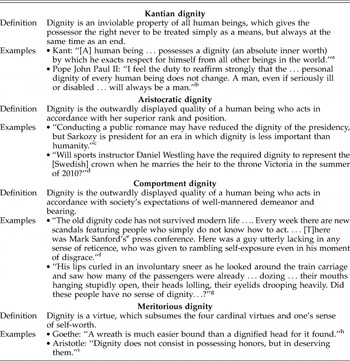
In an earlier piece in CQ,Footnote 10 I argued that dignity is more than simply respect for autonomy and that an analysis of the concept can illuminate ethical debates as long as one does not expect just one clearly delineated meaning. I identified and defined four distinct meanings, summarized in Table 1.
Four concepts of dignity

a Kant I. Metaphysische Anfangsgründe der Tugendlehre. Hamburg: Felix Meiner Verlag; 1990:74 (434ff).
b Pope John Paul II. Address of John Paul II to the participants in the International Congress on “Life Sustaining Treatments and Vegetative State: Scientific Advances and Ethical Dilemmas” March 2004; available at http://www.wf-f.org/JPIILifeSustaining0304.html (last accessed 17 Jul 2009).
c Tharoor S. Sarkozy: Low on dignity, high on humanity. The Times of India 2008:Jan 27.
d Die Königskinder (2008). Zweites Deutsches Fernsehen program described in: Hörzu, 19 Jun 2009:59 (my translation).
e Governor of South Carolina who, during a press conference in 2009, gave considerable detail on his affair.
f Brooks D. In search of dignity. The New York Times. 2009 Jul 6; available at http://www.nytimes.com/2009/07/07/opinion/07brooks.html?_r=1&scp=1&sq=%22In%20Search%20of%20Dignity%22&st=cse (last accessed 9 Jul 2009).
g Coe J. The House of Sleep. London: Penguin Viking Books; 1997:312.
h Ein Kranz ist gar viel leichter binden, als ihm ein würdig Haupt zu finden (my translation); available at http://www.gutzitiert.de/zitut_autor_johann_walfgang_von_goethe_thema_auszeichnung_zitat_4597.html (last accessed 29 Sep 2009).
i Attributed; available at http://thinkexist.com/quotation/dignity_does_not_consist_in_possessing_honors-but/7419.html (last accessed 1 Jul 2009).
In the following, I first expand these four concepts of dignity to five, then contract the five meanings into two distinct groupings, namely, inviolable and aspirational dignity. Finally I show that the vagueness and alleged uselessness of dignity derives from unresolved issues around the attributability of inviolable dignity.
Kantian Dignity Reexamined
If one looks at the four definitions of dignity in Table 1, it is noticeable that only the Kantian concept of dignity does not tell us what dignity actually is. It simply tells us that it is inviolable and that it confers rights upon its human holders. By contrast, the other three dignity concepts are almost graphic in their clarity. Whether we agree with his judgment or not, we understand what the Indian journalist means when he counterposes the dignity of the French presidency with a courtship conducted in swimming trunks in an Egyptian beach resort.Footnote 11 And whether we agree with Coe's protagonist or not, we understand what he describes when he disapproves of the comportment of fellow passengers napping on a train, mouths open. We also understand Goethe's sentiment that a dignified head is rare, though we may each have different mental pictures of who deserves to be thus crowned.
Does Kantian dignity also have such graphic clarity? No, it does not. In the following I argue that the vagueness derives from a contradiction between the alleged universal inviolability of dignity and the conferment of rights.
According to Kant, human beings have a moral right never to be treated only as a means. He writes:
[A] human being regarded as a person, that is, as the subject of a morally practical reason, is exalted above any price; for as a person (homo noumenon) he is not to be valued merely as a means to the ends of others or even to his own ends, but as an end in himself, that is, he possesses a dignity (an absolute inner worth) by which he exacts respect for himself from all other beings in the world.Footnote 12
Hence, the Kantian right never to be treated only as a means derives from dignity. Yet, before one can accept that human beings have such rights due to their absolute inner worth, one has to explain why they have dignity. Only if one can support this move can one assign rights to people.
According to Kant, human beings have dignity because of their reasoning faculties, which give them the freedom and ability to distinguish moral from immoral actions. They are “the subject of a morally practical reason.”Footnote 13 Or as Kant scholars often put it, human beings have dignity because of their ”rational nature in its capacity to be morally self-legislative.”Footnote 14 They can go beyond simply following rules given externally through authorities. They can ponder whether or not it is morally right to lie and can come to the conclusion that it is not. This conclusion is open to all rational humans; humans can think and give themselves moral commandments. They are autonomous and, according to Kant, ”autonomy is … the ground of the dignity of human nature and of every rational nature.”Footnote 15 Allen Wood paraphrases this idea of Kant's in the following manner:
We could sum up the qualities Kant thinks make for dignity if we said that dignity belongs to the capacity to think for oneself and direct one's own life with responsibility both for one's own well-being and for the way one's actions affect the rights and welfare of others.Footnote 16
For Kant, holders of dignity and human beings in general are therefore two distinct groups, and the latter is larger than the former. Some human beings, such as patients in a permanent vegetative state (PVS), have irreversibly lost the capacity to direct their own lives and, by implication, no longer have dignity in the strict Kantian sense. This may be a deplorable result, but if one stays within the Kantian justification of dignity, it is unavoidable. A more accurate Kantian definition of dignity would therefore be:
Dignity is an inviolableFootnote 17 property invested in all rational beings due to their capacity for moral self-legislation, which gives the possessor the right never to be treated simply as a means, but always at the same time as an end.
The emphasis in this definition is on the capacity for moral self-legislation. This means that all those who are still developing the capacity (e.g., children) or all those who have only lost it temporarily (e.g., reversible coma or sleep) are included. This move closes the reasoning gap on why most human beings have the right never to be treated as a means only. Persons, as Kant calls them, the subjects of a morally practical reason, are exalted above any price and possess an absolute inner worth, that is, dignity, because of their capacity for moral self-legislation. They can always exact respect from others, that is, they have rights. With this move to justify rights, however, we have lost the attribution of dignity to all human beings. At this juncture, one can only retain one of the two. Either we keep a foundation for rights, namely the Kantian justification equating dignity with the capacity for moral self-legislation and lose its attribution to all human beings, or we attribute dignity and rights to all human beings while losing its justification.
The use of dignity in constitutional law and international legal instruments does exactly that: attribute dignity to all human beings without reference to its foundation. For instance, the Universal Declaration of Human Rights recognizes in its Preamble the “inherent dignity … of all members of the human family.”Footnote 18 The European Constitution (II-61) maintains that human dignity is inviolable.Footnote 19 Inviolable human dignity cannot be lost as the only condition is being human. There is no difference, therefore, between PVS patients and a rational, autonomous decisionmaker in this regard. They each partake of dignity in equal measure. Indeed, my earlier definition of Kantian dignity fits this description:
Dignity is an inviolable property of all human beings, which gives the possessor the right never to be treated simply as a means, but always at the same time as an end.
This definition of dignity could still be perfectly legitimate, of course, if one found a justification for dignity, which applied to all human beings.
For instance, for Christians, dignity derives from God and the belief that human beings are formed in his image. The Catholic Director of a Canadian Centre for Clinical Ethics, Hazel Markwell, describes this as follows: “The value of dignity of the individual arises from the belief that life has intrinsic worth because people are created in the image and likeness of God.”Footnote 20
Commenting on care for PVS patients, the Archbishop of Philadelphia Cardinal Justin Rigali and Bishop William Lori say: “Our love and support for patients in P.V.S. should be modelled on God's love, which is based not on their current ability to act and respond but on their enduring dignity as human beings, made in his image and likeness and facing an ultimate destiny with him.”Footnote 21
This belief has also been expressed by Pope John Paull II as follows: “Man, living man, is the glory of God (Gloria Dei vivens homo). … Man has been given a sublime dignity, based on the intimate bond which unites him to his Creator: in man there shines forth a reflection of God himself.”Footnote 22
For Christians, this would complete the justification of dignity and its attribution to all, that is, the first part of any definition (Dignity is an inviolable property of all human beings). However, the second part would still be open. What exactly is dignity? Or, failing clarity on this point, what does it achieve or demand?
It is possible to deduce the demands Christian dignity places upon others from speeches and texts. For instance, Patrick Lee, a Catholic Professor of Bioethics, argues that ”suicide [is] contrary to the intrinsic dignity of human persons.”Footnote 23 Presbyterian minister and bioethicist Holly Vautier maintains that the ”dignity of all human life has been influential in maintaining … prohibitions against abortion.”Footnote 24 Pope John Paul II declared that even ”our brothers and sisters who find themselves in the clinical condition of a 'vegetative state' retain their human dignity in all its fullness.”Footnote 25
From the above Christian prohibitions against suicide, abortion, and the withdrawal of artificial feeding/hydration one can conclude that, for Christians, God-given dignity makes every human life sacred. If dignity forbids suicide or the removal of feeding tubes, dignity demands respect for the sanctity of human life. This link between dignity and the sanctity of life is most clearly expressed in Pope John Paul II's ”The Gospel of Life," an encyclical issued in 1995. In it, he says: “[T]he Gospel of the dignity of the person and the Gospel of life are a single and indivisible Gospel.”Footnote 26
An appropriate definition to capture Christian dignity is, therefore:
Dignity is an inviolable property invested by God in all human beings, which makes their life sacred.
In the above, I have redefined Kantian dignity to differentiate it from Christian dignity and to capture Kant's emphasis on the human capacity for self-legislation. Recognizing that some Christians accept abortion and many the removal of feeding tubes in PVS patients,Footnote 27 I term my fifth concept of dignity ”Traditional Christian Dignity.”
Aspirational versus Inviolable Dignity
Five different meanings of dignity: Is that not confusing? Does this not confirm the critics' view that dignity is a useless, dubious conversation stopper, an idea that cannot be thought? In many respects, yes. If we had five different words to capture these five different meanings of dignity, ethical debates could proceed more smoothly. However, dignity is so omnipresent in human discourse that ”the demand to purge it from ethical discourse amounts to whistling in the wind.”Footnote 28
Let me return to the three conditions that make a principle useful in ethical debates: (a) widely known, (b) specified, and (c) attributable. Dignity is a concept that is widely known beyond any doubt.Footnote 29 It is also a concept that can be specified, if one is prepared to allow for several, distinct meanings. To simplify matters, I now group the five different meanings into two groupsFootnote 30 before proceeding to an assessment of point (c), attributability.
Aristocratic, comportment, and meritorious dignity require deliberate and conscious effort, the measuring up to a standard, the fulfillment of an aspiration. Whether the new Prince of Sweden will measure up to the expectations applying to those of superior rank depends on his understanding of these expectations and his efforts and willingness to comply. Whether the next politician being accused of adultery will show more equipoise and calm comportment depends on his understanding and acceptance of societal expectations and his resulting efforts. Whether somebody deserves the honor of dignity according to Aristotle, and thereby the Goethean wreath, depends on her efforts to be virtuous.
By contrast, Kantian dignity and traditional Christian dignity involve no element of conscious effort or aspiration. They belong to human beings as an inviolable birthright, either forever or with the Kantian proviso, as long as they have the capacity for rationality. What human beings do with this birthright is immaterial. Pedophiles, rapists, and mass murderers partake in Kantian and traditional Christian dignity in the same way as Maximilian Kolbe, Steve Biko, or Sophie Scholl. Using a broad stroke, one can therefore distinguish two types of dignity: aspirational and inviolable dignity.
As I have shown in an earlier CQ piece,Footnote 31 medical ethics debates can be illuminated significantly by taking into account the different meanings of dignity. For instance, Death with Dignity organizations often focus on aspirational dignity in discussions of euthanasia and physician-assisted dying whereas their opponents focus on inviolable dignity.
Attributing Dignity: The Remaining Problem
The remaining problem with the concept of dignity in ethical debates lies elsewhere. As noted earlier, prominent human rights declarations or constitutions confer dignity upon all human beings. In this regard, their use of the term dignity aligns with the traditional Christian understanding and none of the others. At the same time, most of the constitutions allow suicide, abortion, and sometimes physician-assisted dying. Hence, they do not align with the prescriptions that come with their adopted version of dignity. Fetuses are exempt from the prescriptions, dying patients are exempt, and so are suicidal persons. As a result, the use of dignity in constitutions seems arbitrary. If dignity were God given and linked to the sanctity of life, it would—at least in the traditional Christian understanding—prohibit certain actions. If these actions are allowed, the biblical derivation of dignity cannot apply, and therefore its attribution to all cannot be justified. However, the Kantian derivation does not apply either, as constitutional dignity is attributed to all human beings, including PVS patients who have irrevocably lost their capacity for moral self-legislation.
The fact that human beings are understood to have dignity must then be a contractual agreement between legitimate representatives and their peoples, transformed into written law. It is then attributed to all by contractual agreement rather than philosophical justification. It is simply a decision made by parliamentarians on behalf of its peoples. However, if that is the case, human dignity is no longer special and distinguishable from agreed-upon human rights. As a consequence and given its myriad meanings, it might then be advisable to achieve contractual agreement on specific human rights and dispense with a reference to human dignity in constitutions. Not because the principle of dignity fails on condition (a); it is widely known. And not because it fails on condition (b); it can be specified in at least five meaningful ways. But because—to date—it has been impossible to achieve reasonable agreement on condition (c), to whom can dignity be attributed?