In The Healer's Power, Howard Brody placed the concept of power at the heart of medicine's moral discourse. Struck by the absence of “power” in the prevailing vocabulary of medical ethics, yet aware of peripheral allusions to power in the writings of some medical ethicists, he intuited the importance of power from the silence surrounding it. He formulated the problem of the healer's power and its responsible use as “the central ethical problem in medicine.”1
Brody H. The Healer's Power. New Haven, CT: Yale University Press; 1992:36.
Brody argued that without power physicians cannot heal. The healer, therefore, cannot relinquish his power—it “irreducibly remains with the physician”2
See note 1, Brody 1992:132.
See note 1, Brody 1992:116.
Yet if the healer, in order to heal, is called on to make proper use of his power, we may ask what the sufferer, the sick person, the patient—in order to be healed, cured, or treated—is called on to do. If the healing process should be collaborative, then both parties are working.
Does the concept of the patient's work make sense? The very notion of the patient's work may seem surprising if not self-contradictory. The patient, by virtue of his medical condition, generally enjoys a reduced work load, not an increased one. And it is the doctor, not the patient, who is at work when they meet. The hospital, the clinic, and the office are the workplaces of the doctor, not the patient. Medical ethics has been concerned with defining and prescribing the proper conditions of the doctor's work, not the patient's. Or has it? The patient's work—not unlike the healer's power—has been a subject whispered about and alluded to, but not openly and fully explored within medical ethics.4
In one of the rare essays directly addressing the question of the obligations of the patient, Martin Benjamin, in “Lay Obligations in Professional Relations,” simply “requires lay people to honor commitments and disclose relevant information.” Benjamin M. Lay obligations in professional relations. Journal of Medicine and Philosophy 10;1985:85–103. See also Brody H. Patients' responsibilities. In: Encyclopedia of Bioethics. New York: Macmillan; 1995.
Work in Psychotherapy and Rehabilitation
Although in general the concept of the patient's work has been absent from the discourse of medical ethics, there are two fields within medicine in which the notion that the patient is working is not alien. In psychiatry—at least in psychotherapy—and in rehabilitation medicine, we commonly speak of the patient working. In the former the work is emotional and cognitive; in the latter it is primarily physical. In both fields the process of treatment depends fundamentally on the patient's active participation and on a collaborative interaction between therapist and patient. The patient's motivation is considered crucial to the treatment process, and resistance to the process is commonly encountered—even expected—in both fields. Engagement of the patient in the treatment process is an essential condition for both psychotherapy and rehabilitation—in a way that it may not be in other medical fields—although recognition of and respect for the need for disengagement may in some cases also be essential to maintaining a therapeutic alliance. Psychotherapy and rehabilitation medicine also share as primary goals—alongside the alleviation of symptoms—the enhancement of the patient's functional capacity (emotional or physical functioning) and, more broadly, the enhancement of the patient's sense of autonomy—that is, his ability to direct himself either physically or psychologically. All of these goals require an active, participating—working—patient.
Psychotherapy and rehabilitation medicine occupy peripheral regions of the medical map as we currently conceive it. They can be and often are practiced by nonphysician therapists. Rehabilitation takes place after the properly medical work of surgery is done or after the acute treatment of stroke or trauma or other medical illness is complete. And although psychiatry has in recent decades become increasingly “medicalized” through psychopharmacology, psychotherapy remains ancillary to the prevailing conceptions of organicist medicine. Yet just as Brody argued that primary care is more an attitude than a specialty, and that that attitude can and should be imported into the relationship between doctor and patient, so we argue that the patient's work is a useful concept not only in psychotherapy and rehabilitation medicine, but within the doctor–patient relationship more generally.
Work in Doctor–Patient Models
Has the concept of the patient's work truly been foreign to the ethics of the doctor–patient relationship? Insofar as the patient's work has been discussed in the ethics of the doctor–patient relationship, it has been buried under other names than “work” or it has been found outside medical ethics itself. In the paternalistic paradigm of the doctor–patient relationship, the patient has had a role, most thoroughly described by the sociologist Talcott Parsons. In the autonomy paradigm the patient has had a responsibility, most strongly articulated by Jay Katz. Role and responsibility have been the disguised forms taken by the patient's work in these models.
Parsons described the sick role and the social and psychological expectations that accompanied it. He taught us that “being sick” is not simply a natural fact, but a social role, with an “institutionalized expectation system” that is “not only a right of the sick person but an obligation upon him.” The exemption from normal responsibility, for example, is accompanied by the obligation to stay in bed. The sick role further relieves the sick person from responsibility for being sick—he is not to blame for his condition—but requires him to want to get well, to seek technically competent help, and to cooperate with the helper. Failure to do so would raise questions of malingering and of the “secondary gain” from illness, and would abrogate the person's exemptions from his usual responsibilities. Of the obligation to cooperate in the treatment, Parsons writes, “it is here, of course, that the role of the sick person as patient becomes articulated with that of the physician in a complementary role structure.”5
Parsons T. The Social System. New York: Free Press; 1951:436–7.
The theorists of patient autonomy rejected this definition of the sick role, which they criticized for its dependency features. The patient in this role was deferential, compliant, and regressed. Katz writes:
It is not surprising that this model has been instinctively embraced by physicians and patients alike. Doctors embraced it because it called for unquestioning compliance, unilateral trust, and verbal silence. It appealed to patients, engulfed by pain and suffering, because surrender to powerful, wise, and soothing caretakers was strongly fostered by memories of earlier days when a parent satisfied all discomforting bodily needs. Thus, the regression to more childlike functioning that can result from illness becomes augmented by a patient's wish for caretaking by a parent–physician who, as memory informs, will immediately alleviate all suffering. The regression is also reinforced by doctors' proclivities to view patients as helpless and incompetent children.6
Katz J. The Silent World of Doctor and Patient. New York: Free Press; 1984:100–1.
In reaction to this image of the infantilized patient, Katz painted a picture of the independent adult patient, allowed to exercise his “right to self-determination”7
See note 6, Katz 1984:122–3
Indeed, I take a further step and postulate a duty to reflection that cannot be easily waived. Asserting such a duty sounds strange. We are accustomed to recognizing a right to choice as an aspect of the right to self-determination, but a duty to reflection as a component of autonomy is quite another matter. Yet, if my views on psychological autonomy have merit, then respect for the right of self-determination requires respect for human beings' proclivities to exercise this right in both rational and irrational ways. Doctors are obliged to facilitate patients' opportunities for reflection to prevent ill-considered rational and irrational influences on choice.
Patients, in turn, are obligated to participate in the process of thinking about choices. In arguing that both parties make every effort to facilitate reflection in order to sort out the rational and irrational expectations that eventually can converge on choice, I express a value preference for the enhancement of individual psychological autonomy.8
See note 6, Katz 1984:104.
The patient might have to be encouraged to be autonomous and free. The exercise of choice, the making of one's own decisions, has become a duty.9
Schneider CE. The Practice of Autonomy: Patients, Doctors, and Medical Decisions. New York: Oxford University Press; 1998:9–32.
Behind the movement for patient autonomy lay not only reactions against dependency, distrust of authority, and an ideology of self-determination, but also an understanding of the psychology of illness. The control over bodily functions—from the regulation of excretory functions to speech and the purposive use of the limbs—is an early and significant developmental achievement, which is a source of childhood self-esteem as well as a precondition for socialization. The loss of bodily control is a frequent, if not a universal, feature of physical illness, which, depending on the nature and severity of the illness as well as the life situation and personality of the patient, is often accompanied by feelings of shame and helplessness, and at times depression. Loss of bodily control involves a degree of loss of self-control because our sense of self is woven into our relationship to our bodies. A burgeoning psychological literature from the 1960s and 1970s based on a “learned helplesness” model of depression argued for the importance of active control over one's environment as a key to maintaining self-esteem in the face of adversity or failure.10
For an overview see Seligman MEP. Helplessness: On Depression, Development, and Death. San Francisco: Freeman; 1975.
In the face of physical illness, the patient's “taking control” became a therapeutic act. For some proponents of patient autonomy, control involved not only becoming informed—understanding one's illness and knowing what to expect—but making decisions as well. Controlling one's own treatment decisions was part and parcel of overcoming one's illness. The duty to control was simultaneously a moral duty to make one's own decisions, a therapeutic requirement for psychological health, and part of the social obligation to get well.
In retrospect, the psychological assumptions underpinning the autonomy model can seem naive. How can Katz's patient, who he describes as “engulfed by pain and suffering,” be expected to exercise his right—his duty—to self-determination by making complex medical decisions? Should we condemn the dependency needs—or wishes—of sick people or assume that those needs are a form of false consciousness created by an authoritarian social structure of which the traditional doctor–patient relationship forms a part? Moreover, even if assuming active control helps many people cope with the psychological threats of illness, what of those patients to whom such control is psychologically unwelcome or emotionally detrimental? Should they be manipulated, cajoled, coerced, forced to decide? Carl Schneider, who in The Practice of Autonomy critically examines the vaunted benefit as well as the assumed desire of the sick to be in control of medical decision making, concludes:
Real people are stubbornly more complicated than this model supposes. Some people may behave as autonomists imagine, but an imposing number of them act quite differently. Their desire for information is more equivocal than the model assumes; their taste for rational analysis is less pronounced; their personal beliefs are not as well developed, relevant, or strong; and their desire for control is more partial, ambivalent, and complex.11
See note 9, Schneider 1998:229.
Dissatisfaction with the simplifications and excesses of an individualist, autonomy-centered ethical model, and with the contractual and consumerist conception of medical treatment that usually accompanies it, has led to alternative methodological approaches to medical ethics and alternative models of the doctor–patient relationship.
Some of these newer models expand upon the concept of autonomy to encompass more than the mere exercise of control through decision making. Ezekiel and Linda Emanuel, for example, recognized that the paternalistic model of the doctor–patient relationship in which autonomy had meant patient assent had been replaced in practice by an informative model in which “the conception of patient autonomy is patient control over decision making.”12
Emanuel EJ, Emanuel LL. Four models of the physician-patient relationship. JAMA 1992;267:2221.
See note 1, Brody 1992:162. See also Dochin A. Understanding autonomy relationally: Toward a reconfiguration of bioethical principles. Journal of Medicine and Philosophy 2001;26:365–8.
If the patient's work in the paternalistic ethic is the performance of a sick role and in the autonomy ethic the making of decisions and taking of control, then what is the patient's work in the mutualist ethic? Brody, as we have seen, wishes the doctor–patient relationship to resemble an ongoing dialogue through which patient and physician place the patient's medical choices within the context of the patient's life plans. And Arthur Frank, a sociologist of illness and advocate for the ethical importance of illness narratives, writes of one type of illness narrative—the “quest stories”—that they “meet suffering head on; they accept illness and seek to use it. Illness is the occasion of a journey that becomes a quest.”14
Frank A. The Wounded Storyteller. Chicago: University of Chicago Press; 1995:115.
Broyard A. Intoxicated by My Illness. New York: Clarkson Potter; 1992:45.
The patient's work recognizes the psychological importance for the patient of having an activity, of participating in the process of treatment, of exercising control in a situation of loss of control. The autonomy model recognizes that one way that people achieve a sense of control is by being informed and making decisions. Unfortunately, it fails to appreciate that other ways that people achieve a sense of control may include obedience or distraction or denial or telling stories. These ways are recognized by the other models.
Comparing the Models
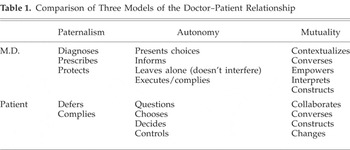
To view these models through the prism of the concept of the patient's work, we compare them (Table 1) in terms of the characteristic activities of the doctor and the characteristic activities of the patient.
Comparison of Three Models of the Doctor–Patient Relationship

In many obvious ways the three models conflict: The deferential, compliant patient of the paternalistic model is incompatible with the questioning, choosing, deciding, controlling patient of the autonomy model. From another perspective, they are related dialectically—as thesis, antithesis, and synthesis, with the mutualist synthesis combining elements of the first two to produce something different from either. Yet in another respect, they are disjunctive—and therefore not in conflict—in that they apply under different medical circumstances and in different social contexts. We generally accept that in emergency situations doctors can behave paternalistically, attending first and foremost to diagnosing and treating the medical condition—serving the patient's immediate health interests—and taking the patient's autonomy rights and life plan into consideration only secondarily, unless they are clearly known ahead of time. Similarly, a consultation with a specialist unknown to the patient who recommends an invasive treatment might best fall under an autonomy model, in which the patient questions, gathers information, solicits different opinions, and decides for himself. The treatment of insulin-dependent diabetes in a primary care setting, on the other hand, might best be understood as an ongoing dialogue between doctor and patient in which an understanding of the meaning to and impact upon the patient of the illness and its treatment form the context within which choices are made and the treatment is conducted.
Yet another way of understanding these three models is that they correspond to different psychological types of patients, which we might call the dependent patient, the “take charge” patient, and the conversational or meaning-seeking patient. Different personality styles and psychological needs will fit best with each of the models. And if patient empowerment and avoidance of patient coercion by the physician are ethical aspects of all doctor–patient relationships, then adaptation of the relationship to fit patient styles and needs would place each model on an equal ethical plane. When it comes to doctor–patient relationships, one size does not fit all, and insisting that they do disrespects the individuality of the patient.
Each of these three relational models may come into play in one and the same treatment. Consider, for example, the treatment by a psychiatrist of a patient with bipolar disorder—a chronic, remitting, and recurring illness—that involves both psychopharmacology and psychotherapy. During asymptomatic periods the focus of the treatment will most resemble a conversation in which perceptions, meanings, and life plans will be explored, contextualized, interpreted, and constructed. When medications are changed, the psychiatrist is likely to present the patient with information, choices, and a recommendation, leaving the patient to decide, although a discussion of the meaning of the medication change to the patient may be a part of the process. At times of crisis, such as an acute manic episode in which the patient has lost any insight into his illness, the psychiatrist will behave paternalistically, prescribing a treatment—hospitalization, for example—with limited if any choice or discussion.
What does this example tell us? First, it implies again that the different models apply in different clinical situations and that treatment situations are constantly evolving.16
In this case, as in many psychiatric cases, the evolving treatment situation includes changes in the patient's mental state or state of self.
The notion of the patient's work implies that the patient can fail to perform his work or work badly.17
Brody H. Stories of Sickness. New Haven, Conn.: Yale University Press; 1987:128–42.
Although, of course, noncompliance may be a sign of the doctor's failure to do his work of engaging the patient in the treatment process. In the paternalistic model, however, engaging the patient in the treatment does not form part of the doctor's work.
In addition to prescribing forms of work to the patient, each of the three models assigns the physician a moral function alongside his technical function. The paternalistic model assigns the doctor the moral function of trustee of the patient's health interests. In the autonomy model, the physician is the facilitator of the patient's autonomy, as epitomized in the process of informed consent, through which, when properly enacted, the patient is engaged as a moral agent in his own treatment.19
Despite the oft-noted resistance by many doctors to informed consent, there is evidence that what Robert Zusman has called “the culture of rights” has permeated into the medical world. See Zusman R. Intensive Care: Medical Ethics and the Medical Profession. Chicago: University of Chicago Press; 1992:219–29.
All three models, then, give both doctor and patient moral work to do with the aim of restoring the patient's health or relieving suffering. They allow the doctor to be engaged with the patient but at the same time detached from him, as in Renee Fox's classic formulation of “detached concern” and, more recently, Brody's notion of the physician's “empathic curiosity.”20
Fox RC. Training for uncertainty. In: Schwartz H, Kart C. Dominant Issues in Medical Sociology. Reading, Mass.; 1978; see note 1, Brody 1992:260–7.
Ethical Implications
The notion that the patient has work to do is commonly accepted in end-of-life medical situations. Indeed, one of the justifications for truth-telling of terminal diagnoses is the importance for the patient of completing whatever “unfinished business” is left. We expect dying patients to complete their work. Such unfinished business generally involves getting one's house in order, both materially and emotionally. It might involve “finding meaning” at the end of life. “If a patient does not know he is dying, he will not be able to find meaning in the dying process,” writes Fins.21
Fins JJ. Truth-telling and reciprocity in the doctor-patient relationship: A North American perspective. In: Portenoy RK, Bruera E, eds. Topics in Palliative Care, vol. 5. New York: Oxford University Press; 2001:92.
Our pluralistic view of the three models of the doctor–patient relationship, which places them all on an equal ethical plane, reopens the debate on the morality, as well as the wisdom, of this accepted American practice of informing patients when they are dying. If one doctor–patient relationship does not fit all patient types and clinical situations, then one rule cannot necessarily be universally correct. One could argue that, just as in the emergency situation, the paternalistic model should be in place barring some compelling reason to the contrary, so in the dying situation, the autonomy model should be in place barring some compelling reason to the contrary. But this is a subject for ongoing debate.
Maintaining personal dignity in the face of illness is an important ethical issue in contemporary medicine. The critically ill patient hooked up to pumps, catheters, and respirators has become an image not only of the loss of control but also of the loss of dignity. Medical disability, with the concomitant incapacity to participate fully in social and family functions, has long incurred damage to a person's social status and has become the occasion for a movement to reclaim the dignity of the handicapped. And stigma, which adheres to certain diseases—from AIDS to cancer to epilepsy to schizophrenia—spoils the social identity of the sick person and does further injury to his dignity.
In our society, work is an important source of personal and social dignity. Conceiving of the patient as having work to do is a means of dignifying the patient's activities, of thinking about the patient as an active agent, engaged in directed, purposive activity toward an end. Seeking empathically to understand what the patient is engaged in during the process of his illness can enable those involved in treating him to see the person beneath and beyond the patient. This can help the patient maintain a sense of himself as a person during a life-altering experience such as serious illness and, therefore, maintain a sense of his dignity despite the indignities inflicted by disease.
But this requires that those treating him understand that individual psychologies can differ significantly, and that one person's way of working at maintaining his personal dignity (by making his own decisions, for example) may be quite different from another's (by obediently following doctor's orders, for example). We should not make metaphysical assumptions about the universally valid goods of life, which both the autonomy model and the mutualist model seem to make, implying that the work of making one's own decisions or of finding meaning is the proper work of humans.
Indeed, the invisibility of the patient's work—its hitherto absence from the conceptual lexicon of medical ethics—may derive in part from the fact that the healthy take health for granted and have difficulty seeing the work involved in coping with illness. Especially for people with serious or chronic illnesses, which may have a profound impact on global functioning—such as the bipolar patient we described earlier—to accept and stick with a treatment regimen despite distressing side effects and to be willing to experiment to find acceptable, if not optimal, therapy all involve work on the part of the patient.
The concept of the patient's work can serve as an organizing metaphor for physician and patient as they forge a therapeutic relationship. It reminds the physician that the patient is an active participant in the process of treatment, even if that activity may take various forms, from compliance to decisionmaking to conversing. It encourages the doctor to understand the patient's particular manner of working and to work with it himself. It can also serve as a heuristic device in educating medical students and house staff. We hope that the concept and the attendant clinical skills will help physicians integrate as part of their work the facilitation of the patient's work. This can enhance the doctor's ability to see beyond the patient to the person and improve the quality of medical care by rendering it both psychologically richer and morally more dignity preserving and, therefore, more humane.