




1 Introduction
The morphosyntactic alignment in all Inuit varieties is standardly described as ergative-absolutive.Footnote 1 Transitive objects and intransitive subjects are both marked with absolutive case (which is null in the singular), regardless of the unergative/unaccusative status of the verb, while transitive subjects are marked with ergative case, as shown with the Inuktitut examples in (1a–c).Footnote 2

Note also that absolutive and ergative arguments are co-indexed on the verb with verbal inflection, which explains why verbal inflection displays a pattern of double agreement in (1a) but, conversely, single agreement in (1b–c). As a consequence, there seems to be a one-to-one correlation between structural case assignment and verbal agreement.Footnote 3 And as demonstrated in (2a–c), with examples analogous to those in (1a–c), verbal inflection in transitive constructions cannot alternatively bear single agreement, nor can intransitive subjects be marked with ergative instead of absolutive.

An important theoretical point for the analysis below is the growing consensus in the literature that verbal agreement across all Inuit varieties occurs in the CP-domain, as it is sensitive to clause type (see Johns Reference Johns2007, Spreng Reference Spreng2012, Compton Reference Compton, Sherry Hucklebridge and Nelson2018, Yuan Reference Yuan2018, Carrier Reference Carrier2021). In fact, it is also often argued that ergative and absolutive arguments must move to the CP-domain (see Compton Reference Compton, Sherry Hucklebridge and Nelson2018, Carrier Reference Carrier2021).Footnote 4 One reason for this assumption is that they are both systematically interpreted with wide scope over sentence-level operators like negation (see Bittner Reference Bittner1987, Reference Bittner1994; Wharram Reference Wharram2003; Branigan and Wharram Reference Branigan and Wharram2019).Footnote 5 A second reason is that absolutive arguments are interpreted as sentential or aboutness topics (see Berge Reference Berge2011, Johns and Kučerová Reference Johns, Kučerová, Jessica Coon, Massam and Travis2017, Carrier Reference Carrier2021), which is a discursive feature also argued to be part of the CP-domain (see Frascarelli and Hinterhölzl Reference Frascarelli, Hinterhölzl, Susanne Winkler and Schwabe2007; Bianchi and Frascarelli Reference Bianchi and Frascarelli2010; Miyagawa Reference Miyagawa2017, Reference Miyagawa2022).Footnote 6
Yet, positing that verbal agreement in Inuktitut is responsible for absolutive case assignment is problematic, as absolutive arguments can also be found in certain nominalized constructions, which lack verbal agreement. For example, Beach (Reference Beach2012) observes that absolutive arguments surface in some gerund constructions, nominalized with the morpheme -niq, as shown in (3).Footnote 7

(Beach Reference Beach2012: 280, 282)
More precisely, the subjects Jaani ‘John’ and Suusi ‘Sue’ in the two gerund constructions above are absolutive, even though the gerunds bear nominal agreement, as shown with the possessive agreement marker -nga in both examples, followed by different case markers (i.e., locative case and allative case, respectively).
Absolutive arguments may also surface in other nominalized constructions. For example, consider the participial construction in (4), nominalized with the passive participle -jaq/-taq.Footnote 10

In (4), the argument Pauli ‘Paul’ is absolutive even though the following passive participle form bears nominal agreement, as shown with the possessive agreement marker -ra. Moreover, notice the morpheme -viniq ‘former/old’ (interpreted here as the past tense) attached after the passive participle -jaq. This morpheme can only attach to nominal bases, as illustrated in (5).

Above, we see that the morpheme -viniq can attach to a noun like illu ‘house’ in (5a) to convey that the latter is old or no longer in use but not directly to a verbal root like sana- ‘build’ in (5b) to express the past tense, as in the participial construction in (4). In fact, the verbal past tense is commonly expressed with the morpheme -lauq, which conversely cannot attach to nominal bases, as illustrated below in (6).

Therefore, the examples in (5) and (6) confirm that the participial construction in (4) is indeed a nominal one, which then brings into question how absolutive case is assigned. Moreover, considering that the passive participle form is nominalized, this suggests that it is also absolutive and that case matching occurs between the argument Pauli ‘Paul’ and the participle. That said, the analysis of participial constructions in Inuktitut is complex, as the participle morphemes are sometimes analyzed as verbal mood markers, similar to indicative ones in other languages. This is because participial constructions seem to be interpreted as verbal constructions whenever they stand alone rather than surfacing in an argument position. Building on Lowe (Reference Lowe1978), Johns (Reference Johns1992), Beach (Reference Beach2012), and Yuan (Reference Yuan2013), who analyze participial constructions as nominalized, we will show that this analysis holds for a specific subset of participial constructions in Inuktitut, regardless of their use and apparent interpretation.
Below, we analyze two types of nominalized constructions in Inuktitut exhibiting case variation on one of their arguments, which is marked with absolutive case only in very specific contexts. More precisely, we show that the subject in gerund constructions is marked with absolutive case only when such constructions appear in oblique positions, while participial constructions assign absolutive case only when they stand alone and act as main clauses. Crucially, while the examples in (3)–(4) show that absolutive case is not assigned directly through verbal agreement, we argue that absolutive case assignment is nonetheless tied to the CP-domain. Adopting the articulated structure of the CP-domain as first developed by Rizzi (Reference Rizzi and Liliane Haegeman1997) (but see also Rizzi and Cinque Reference Rizzi and Cinque2016, Rizzi and Bocci Reference Rizzi, Bocci, Martin Everaert and van Riemsdijk2017), we claim that absolutive case is systematically assigned in any clause endowed with illocutionary force and therefore projecting syntactic structure known as the clausal left periphery. We propose that having illocutionary force makes a clause project ForceP, bundled with TopP in Inuktitut, which we argue is responsible for the assignment of the absolutive case. Importantly, this proposal still accounts for the fact that absolutive arguments are systematically interpreted with wide scope and as sentential or aboutness topics, as discussed in more detail in section 2.2. Furthermore, it falls in line with other studies that argue that the availability of aboutness topics relies on the presence of illocutionary force (and hence ForceP) (see Haegeman Reference Haegeman2006, Reference Haegeman2012; Bianchi and Frascarelli Reference Bianchi and Frascarelli2010; Frascarelli Reference Frascarelli, Valéria Molnár, Egerland and Winkler2019). Absolutive case assignment is thus impossible in clauses with no clausal left periphery. Syntactic phenomena associated with the highest projections of utterances, such as topicalization, have traditionally been called root phenomena (see Emonds Reference Emonds, David Adger, de Cat and Tsoulas2004, Reference Emonds, Lobke Aelbrecht, Haegeman and Nye2012) or main clause phenomena (see Haegeman Reference Haegeman2006, Reference Haegeman2012; Miyagawa Reference Miyagawa2022), since they occur primarily in matrix clauses, though they may also be available in a restricted set of embedded clauses. We therefore conclude that absolutive case assignment is a root (or main clause) phenomenon in Inuktitut.
The next sections are organized as follows. In section 2, we give more details about relevant grammatical aspects of the language, including case as well as both verbal and nominal agreement. In sections 3 and 4, we analyze gerund and participial constructions to determine the specific contexts in which absolutive case is assigned. We conclude with a discussion of our analysis in section 5.
2 Background
Inuktitut is one of the four dialect groups of the Inuit language, along with Iñupiaq, Inuvialuktun, and Kalaallisut, and is mainly spoken in Nunavut, Nunavik, and Nunatsiavut in the Canadian Arctic (see Dorais Reference Dorais2010). This section describes the grammatical aspects of Inuktitut that are relevant for the analysis of the different syntactic constructions discussed in the following sections. First, section 2.1 considers the basic morphosyntactic alignment of the language, which is commonly described as ergative-absolutive. Next, section 2.2 examines in more detail verbal agreement and case. Finally, section 2.3 looks at the possessive construction and the morphological parallel found between nominal and verbal constructions.
2.1 Morphosyntactic alignment
As previously shown with examples (1a–c), the morphosyntactic alignment in Inuit varieties is standardly described as ergative-absolutive, since transitive objects and intransitive subjects receive the same case marking while transitive subjects are marked with ergative case. However, the language has another type of bivalent (or dyadic) construction, namely the antipassive construction, as exemplified in (7).

(Compton Reference Compton, Jessica Coon, Massam and Travis2017: 844)
From a morphosyntactic perspective, antipassive constructions pattern with intransitive ones, since antipassive subjects are marked with absolutive case and are the only arguments co-indexed on the verb by verbal inflection (compare with (1b–c)). Thus, unlike transitive objects, antipassive objects are not co-indexed by agreement and bear modalis case (sometimes labelled instrumental case).Footnote 11 Note also that some verbs require the antipassive morpheme -(t)si when they are antipassivized, like the verb kii- ‘to bite’ in (7b). The alternation between transitive and antipassive constructions in the Inuit language has been widely discussed in the literature (e.g., Kalmár Reference Kalmár1979; Spreng Reference Spreng, Alana Johns, Massam and Ndayiragije2006, Reference Spreng2012; Berge Reference Berge2011; Carrier Reference Carrier2017, Reference Carrier2021; Johns and Kučerová Reference Johns, Kučerová, Jessica Coon, Massam and Travis2017; Yuan Reference Yuan2018, Reference Yuan2022), including in work arguing that Inuit varieties are undergoing a shift whereby the antipassive construction is progressively becoming the default transitive construction, resulting in a nominative-accusative alignment (see Johns Reference Johns1999, Reference Johns2001a, Reference Johns and Jan Terje Faarlund2001b, Reference Johns, Alana Johns, Massam and Ndayiragije2006; Carrier Reference Carrier2017, Reference Carrier2021; Yuan Reference Yuan2018). This ongoing change does not impact our proposal concerning the clausal left periphery in Inuktitut. We assume that the alternation is conditioned by the discursive properties of these constructions, as explained in more detail in the next section.
2.2 Verbal agreement and case
As discussed in section 1, absolutive and ergative arguments are typically co-indexed on the verb. It is also worth noting that these arguments are often dropped in thediscourse when they are contextually retrievable. Verbal agreement is further sensitive to clause type, as shown in (8) with intransitive inflection in different verbal moods.

(Harper Reference Harper1974: 8–17)
It is thus regularly argued that verbal agreement occurs in the CP-domain, as clause type features are expected to be located there (see, e.g., Bittner and Hale Reference Bittner and Hale1996, Johns Reference Johns2007, Spreng Reference Spreng2012, Compton Reference Compton, Sherry Hucklebridge and Nelson2018, Yuan Reference Yuan2018, Carrier Reference Carrier2021). Previous work also often argues that both absolutive and ergative arguments move high in the left periphery for agreement and case, arguably to [Spec, CP] (see, e.g., Compton Reference Compton, Sherry Hucklebridge and Nelson2018, Carrier Reference Carrier2021), as such arguments are systematically interpreted with wide scope over sentence-level operators like negation. This is exemplified in (9).

(Wharram Reference Wharram2003: 39–40)
As for other arguments, which are marked with oblique cases and are never co-indexed on the verb, they can receive either wide or narrow scope, as illustrated in (10).

(Branigan and Wharram Reference Branigan and Wharram2019: 27)
To account for the scopal ambiguity of oblique arguments, different proposals have been advanced. For instance, building on Bittner (Reference Bittner1994), Carrier (Reference Carrier2021) argues that obliques can be interpreted with either wide or narrow scope depending on whether they move to [Spec, CP] at LF. Alternatively, Branigan and Wharram (Reference Branigan and Wharram2019) propose an analysis based on a choice functional D that may be removed through the deletion of the head of DP.
Lastly, in addition to moving to the CP-domain for case and agreement, it has been claimed that absolutive-marked arguments represent the topic of the sentence (see, e.g., Tersis and Carter-Thomas Reference Tersis and Carter-Thomas2005; Berge Reference Berge2011; Carrier Reference Carrier2012, Reference Carrier2017, Reference Carrier2021; Johns and Kučerová Reference Johns, Kučerová, Jessica Coon, Massam and Travis2017). Despite some minor differences, there is a growing consensus that they refer to ‘aboutness topics’ in the sense of Reinhart (Reference Reinhart1981), who argues that both shifting and continuing topics should count as aboutness topics, which help build topic chains across consecutive sentences. This is illustrated in the excerpt below, in which the speaker talks about 13 children who had to move to another community to go to school. Crucially, nominal arguments referring to the children as well as null arguments, as evidenced by agreement patterns, are continually absolutive across all constructions, which alternate between intransitive, transitive and passive.

Further evidence for the aboutness topic status of absolutive arguments in Inuktitut comes from text-based quantitative measures commonly used to investigate topicality in discourse, such as referential persistence (see Givón Reference Givón and Thomas Givón1983, Reference Givón2017; Rude Reference Rude1986; Cooreman Reference Cooreman1987; Chiriacescu and von Heusinger Reference Chiriacescu and von Heusinger2010). More precisely, referential persistence measures the number of consecutive sentences in which a referent remains present in subsequent discourse. In other words, referential persistence assesses the local importance of a referent in a given stretch of discourse, thus assessing the local importance of that referent in a given stretch of discourse. In a quantitative analysis of recordings of personal stories in North Baffin Inuktitut collected for Carrier’s doctoral research, referents encoded by absolutive arguments were found to display significantly higher referential persistence than referents encoded by other argument types. This pattern further suggests that topic continuity is built around arguments marked with absolutive case, as also argued by Berge (1997) and Carrier (Reference Carrier2021).
Another type of evidence for the topical status of absolutive arguments in Inuktitut comes from case assignment in existential constructions. Different types of restrictions have been reported in the literature in relation to the nominal pivot in existential constructions across various languages. For instance, the nominal pivot is commonly subject to a Definiteness Restriction (Milsark Reference Milsark1974), which is why pronominals as well as proper names most generally cannot surface in this position. More importantly for the current article, Reinhart (Reference Reinhart1995: 85) also notes that “[there] is one context all studies agree upon: the NP in there-sentences can never be topic”. Thus, if absolutive case marks topicalized arguments in Inuktitut, the nominal pivot in existential constructions should not receive absolutive case. There are actually different types of existential constructions in Inuktitut, but we will only consider what Hartmann (Reference Hartmann2008) calls there-V sentences, in which the main verb is intransitive rather than the verb be (e.g., There arrived three men). For example, compare the standard intransitive construction in (12a) with an analogous existential construction in (12b).

(Yuan Reference Yuan, Daniel K. E. Reisinger and Green2023: 1)
In (12a), the intransitive subject pingasut angutit ‘three men’ gets the absolutive case and triggers plural agreement on the verb. On the other hand, in the analogous existential construction in (12b), the verbal predicate tikit- ‘arrive’ must be participial and incorporated into the verb -qaq ‘have’. Crucially, the nominal pivot is now marked with the modalis case and does not trigger plural agreement on the verb. Yuan (Reference Yuan, Daniel K. E. Reisinger and Green2023, Reference Yuan, Jiayi Lu, Petersen, Zaitsu and Harizanov2024) also shows that the nominal pivot cannot be interpreted as definite and is always interpreted within the scope of the incorporating verb -qaq ‘have’. The nominal pivot must therefore receive case in situ and does not undergo movement for agreement, unlike the absolutive subject as in (12a). The morphosyntactic analysis of existential constructions in the language goes beyond the scope of this article (but see Yuan Reference Yuan, Daniel K. E. Reisinger and Green2023, Reference Yuan, Jiayi Lu, Petersen, Zaitsu and Harizanov2024). However, we consider the assignment of the modalis case to the nominal pivot (rather than the typical absolutive case for intransitive subjects), as well as the absence of movement of the latter to the clausal periphery, as a direct consequence of the restriction imposed on nominal pivots in existential constructions not to be interpreted as a topic.Footnote 12
Assuming an articulated structure of the CP domain, as proposed in Rizzi (Reference Rizzi and Liliane Haegeman1997, Reference Rizzi2004), the sensitivity of verbal agreement to clause type as well as the aboutness topic interpretation of absolutive arguments could be accounted for by positing that verbal agreement in C minimally projects Force, which expresses clause type, and Topic, where absolutive arguments must move for case assignment reasons.Footnote 13 This means that the obligatory movement of absolutive arguments to the CP-domain combines properties of both A- and Aʹ-movement, as also claimed for Dinka by van Urk (Reference van Urk2015). Due to this, the traditional A/Aʹ-distinction is not entirely clear in Inuktitut either. Following van Urk, we assume that these two types of movement are better distinguished based on the type of features driving the movement. For instance, features can be obligatory, in the sense that they are always present and constrain movements to be more bounded. Such features drive A-movements and are typically person, number and case. Alternatively, features can be optional, in which case they can be absent. These other features drive Aʹ-movements and typically include topic, focus and wh. As the verbal agreement features in C are not optional in Inuktitut, we assume that the movement of absolutive arguments is A-movement, regardless of their topicalization.
2.3 Possessive constructions
Gerund and participial constructions, which were discussed briefly in section 1 and will be studied in more depth in sections 3 and 4, display nominal inflection instead of verbal inflection (since they are nominalized constructions). As will be discussed later, the nominal morphology found in those constructions is similar to the one found in possessive constructions. Basic possessive constructions have the following shape, with the possessor marked with genitive case and the possessum bearing possessor/possessum agreement in person and number with the possessor combined with the number of the possessum:

(Inuit Uqausinginnik Taiguusiliuqtiut 2018: 21, 30)
This pattern of genitive case on the possessor and possessive agreement on the possessum holds even when the latter bears any overt non-absolutive case, as shown in (14).Footnote 15

(Inuit Uqausinginnik Taiguusiliuqtiut 2018: 30)
However, overt possessors do not need to be present whenever retrievable from the context, and first- or second-person possessors are typically required to be absent, as shown in (15).Footnote 16

(Inuit Uqausinginnik Taiguusiliuqtiut 2018: 29)
For simplicity, we will assume that the syntactic structure for possessive constructions involves a possessive projection, in which the Poss head takes the possessum as a complement whereas the possessor merges in the specifier position of PossP (see, e.g., Alexiadou et al. Reference Alexiadou, Haegeman and Stavrou2007). We further posit that possessums undergo head movement to Poss for agreement, and that possessors receive genitive case inherently from Poss after merging in this Spec-head configuration, as shown in Figure 1. See also Manlove (Reference Manlove2015) for a similar proposal for Kalaallisut.
Possessive constructions.

Figure 1 Long description
A black branching tree is arranged vertically. At the top center, the label “PossP” sits above a split into two downward branches. The left branch ends at the label “DP” with “GEN” written as a subscript and the text “N-up” appears below it on the same left side. The right branch ends at the label “Poss” followed by a prime mark and from this node two branches extend downward: the left branch ends at “Poss” with “-nga” written below it and the right branch ends at “NP” with “N” written below it. A curved arrow runs from the lower left area near “Poss -nga” toward the upper left area near “PossP.”.
Lastly, note that genitive case has the same morphological form as ergative case (compare (12a) with (1a)). In fact, the transitive morphology found in Inuit-Yupik-Unangan languages is historically related to the morphology found in possessive constructions. However, we will argue in section 4 that this morphological parallel with possessive constructions actually now holds only with nominalized constructions, such as gerund constructions and a subset of participial constructions that we analyze as nominalized, building on previous work on participial constructions in Inuktitut by Johns (Reference Johns1992), Beach (Reference Beach2012), and Yuan (Reference Yuan2013).
3 Gerund constructions
In this section, we will analyze the gerund construction in Inuktitut. As explained in section 1, Beach (Reference Beach2012) reports that absolutive case is assigned in some gerund constructions, which is unexpected since such constructions are nominalized and absolutive case assignment is generally thought to be associated with verbal agreement occurring in the CP-domain. Beach also does not provide a theoretical analysis of when and why absolutive case is assigned in gerund constructions. We will argue that gerund constructions vary in size and that only gerund constructions appearing in oblique positions assign absolutive case, since they act as main clauses with illocutionary force, thus having a clausal left periphery and projecting ForceP bundled with TopP, which we claim is responsible for absolutive case assignment in the language.
This section is organized as follows. Section 3.1 describes the properties of gerund constructions in Inuktitut, and section 3.2 defines the gerund constructions in which absolutive case is assigned. Next, we present our syntactic analysis of gerund constructions in section 3.3 and argue that oblique case marking on gerunds is comparable to verbal agreement in the language, as it expresses a meaning equivalent to illocutionary force/clause type (see section 2.2). We also claim that the assignment of absolutive case (instead of genitive case) to subjects in oblique gerund constructions is an instantiation of possessor raising, which occurs in other constructions in the language.
3.1 Basic properties of gerund constructions
In their simplest form, gerunds consist of a verbal root and the gerundive suffix -niq, as in (16).

Thus, gerunds are nominalized forms that surface in argument positions. In the example above, the gerund miqsurniq ‘sewing’ is an object of a transitive construction, triggers verbal agreement (by default third-person singular agreement) and is marked with absolutive case.
Briggs et al. (Reference Briggs, Johns and Cook2015) provide the definition in (17) for the gerundive suffix -niq in the Utkuhikšalingmiut dialect of the language:

(Briggs et al. Reference Briggs, Johns and Cook2015: 384)
Importantly, any arguments of a nominalized verb in a gerund construction can still be expressed, in which case possessive morphology is used (see section 2.3). Standardly, the subject receives genitive case and the gerund cross-references it in person and number with possessive agreement. For example, compare the two gerund constructions in (18a–b) with the possessive one in (18c).

The examples in (18a–b) also show (i) that the subject in gerund constructions is standardly marked with genitive case regardless of the unergative or unaccusative status of the verb, and (ii) that possessive agreement markers encode the subject as a possessor and the gerund as a possessum, which again systematically triggers third-person singular agreement by default.
Gerund constructions can also be built around transitive verbs, in which case the subject receives genitive case while the object is marked with modalis case, similarly to antipassive objects (see (7a–b)).Footnote 18 Crucially, the object could not alternatively be marked with null absolutive case, which is typically given to transitive objects (see (1a)), as shown in (19).

The examples in (20) below show that only the subject in gerund constructions can be coindexed with person and number in possessives and never the object (marked with modalis case).

The fact that objects in gerund constructions are never marked with absolutive case nor coindexed in person and number with possessive agreement on the gerund is an important distinctive property of such nominalized constructions, because we will see later in section 4 that transitive objects in participial constructions are marked with absolutive case in some contexts and are systematically cross-referenced in person and number with possessive agreement.
The subject can be omitted in gerund constructions whenever it receives a generic interpretation or is shared with the main clause. In such cases, there is no possessive inflection on the gerund, even if an object is present, as exemplified in (21).

As a result, Beach (Reference Beach2012: 280) argues that the possessive agreement on gerund verbs acts as a type of verbal agreement: “My analysis will be that these are really intransitive verbal conjugations.” However, considering the fact that ‘bare’ gerunds trigger a third-person singular default agreement in the verbal inflection of a matrix verb, as shown in (16), and that the gerund verb stands in for the possessum in gerund constructions with possessive agreement, as later exemplified in (18a–c), it seems more reasonable to conclude that gerunds trigger a third-person singular default agreement in possessive inflection (whenever present). Hence, we will assume that possessive morphology surfacing in gerund constructions is the same as that of ‘regular’ possessive constructions.
Importantly, note that gerund constructions may also appear in oblique positions. In such cases, the gerund verb is marked with an overt oblique case marker, like the locative case marker -ni or the allative case marker -nut. However, these oblique cases have different functions and meanings in such gerund constructions as compared to when they attach to ‘regular’ nouns. As one example, the locative case commonly marks nouns referring to a location (as in ‘in/at/on X’) but conveys the meaning ‘after X’ when attached to a non-negated gerund verb or ‘before X’ when attached to a negated gerund verb, as exemplified with the gerund constructions in (22).

(Beach Reference Beach2012: 283)
Likewise, the allative case typically marks nouns corresponding to the goal or the beneficiary of an action (as in ‘to/for X’) but expresses the causal meaning ‘because X’ in gerund constructions, as will be shown in (24b).Footnote 19 The gerund constructions in oblique positions are of a special interest in this article due to their unexpected case pattern, as will be discussed in the next section.
3.2 Unexpected case pattern in gerund constructions
In the previous section, we saw that the subject in gerund constructions is standardly marked with genitive case (see also Fortescue Reference Fortescue1984 for gerund constructions in Kalaallisut). Yet Beach (2011) reports that, in some gerund constructions, it is absolutive case that is assigned to the subject (see (3)). However, Beach does not provide any generalization for when absolutive case is assigned in gerund constructions. Our own investigation reveals that the subject in gerund constructions is in fact marked with genitive case whenever such constructions surface in subject or object positions, as in (23), but with absolutive case when they appear in oblique positions, as in (24).


Thus, the case on the subject is conditioned by the type of case marking found on the gerund verb. When the latter is marked with a structural case, like absolutive case (23a) or modalis case (23b), the subject is marked with genitive case.Footnote 20 Conversely, when it is marked with some oblique case, like locative case (24a) or allative case (24b), the subject is marked with the absolutive case. Importantly, though, recall that these oblique cases have different functions and meanings in gerund constructions as compared to when they attach to regular nouns (see section 2.2). More precisely, the locative case conveys the meaning ‘before X’ or ‘after X’ (depending on whether the gerund is negated) rather than marking a noun referring to a location (as in ‘in/at/on X’), while the allative case expresses the meaning ‘because X’ rather than marking a noun corresponding to the goal or the beneficiary of an action (as in ‘to/for X’). In the next section, we analyze this change of function and meaning of oblique cases in gerund constructions in more depth.
3.3 Analysis of gerund constructions
This section presents our analysis of the gerund constructions in Inuktitut, accounting for the basic properties of such nominalized constructions, as well as case variation on the subject discussed in the previous section. Kornfilt and Whitman (Reference Kornfilt and Whitman2011) argue for four possible levels of nominalization based on the highest verbal projection in the structure, namely VP, vP, TP and CP. As evidenced by the fact that gerund constructions can contain tense marking, such constructions must at least be as large as TP nominalizations, as exemplified in (25).

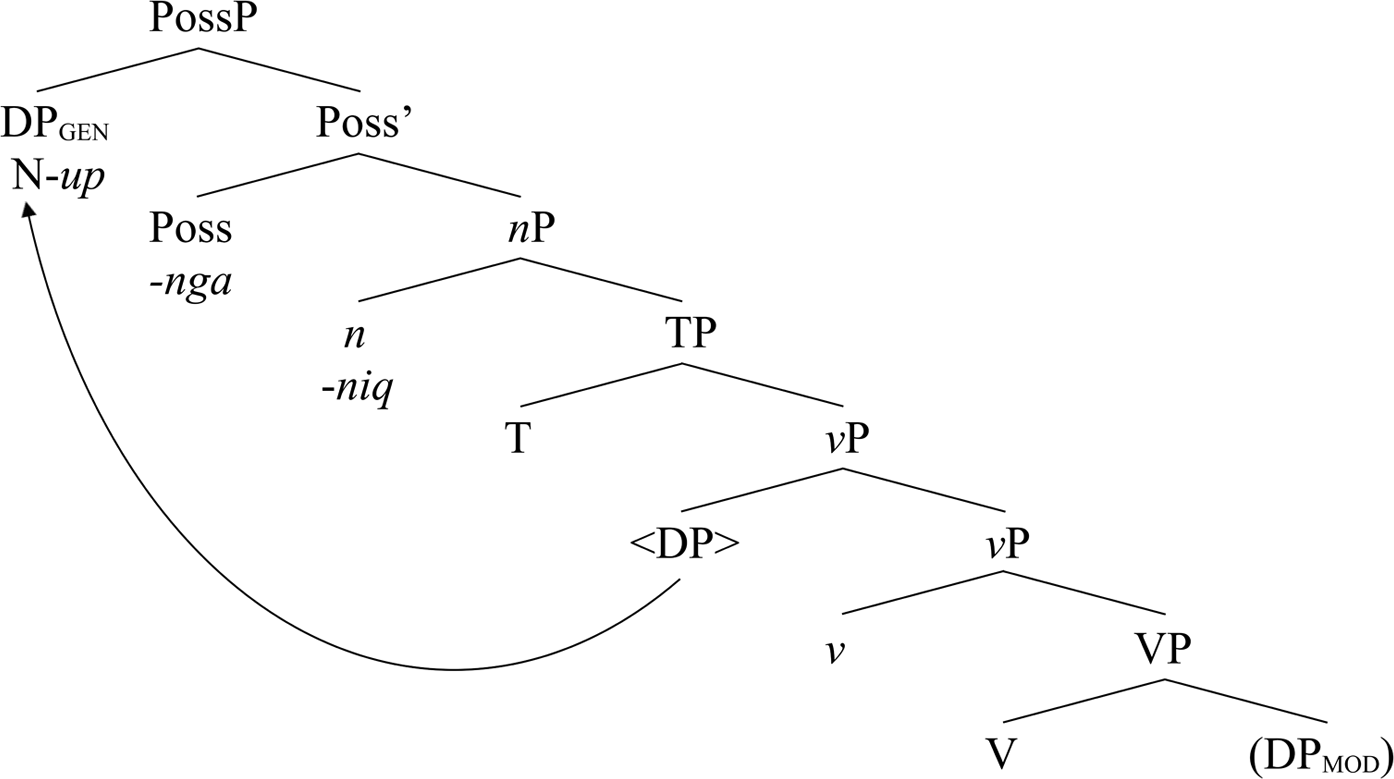
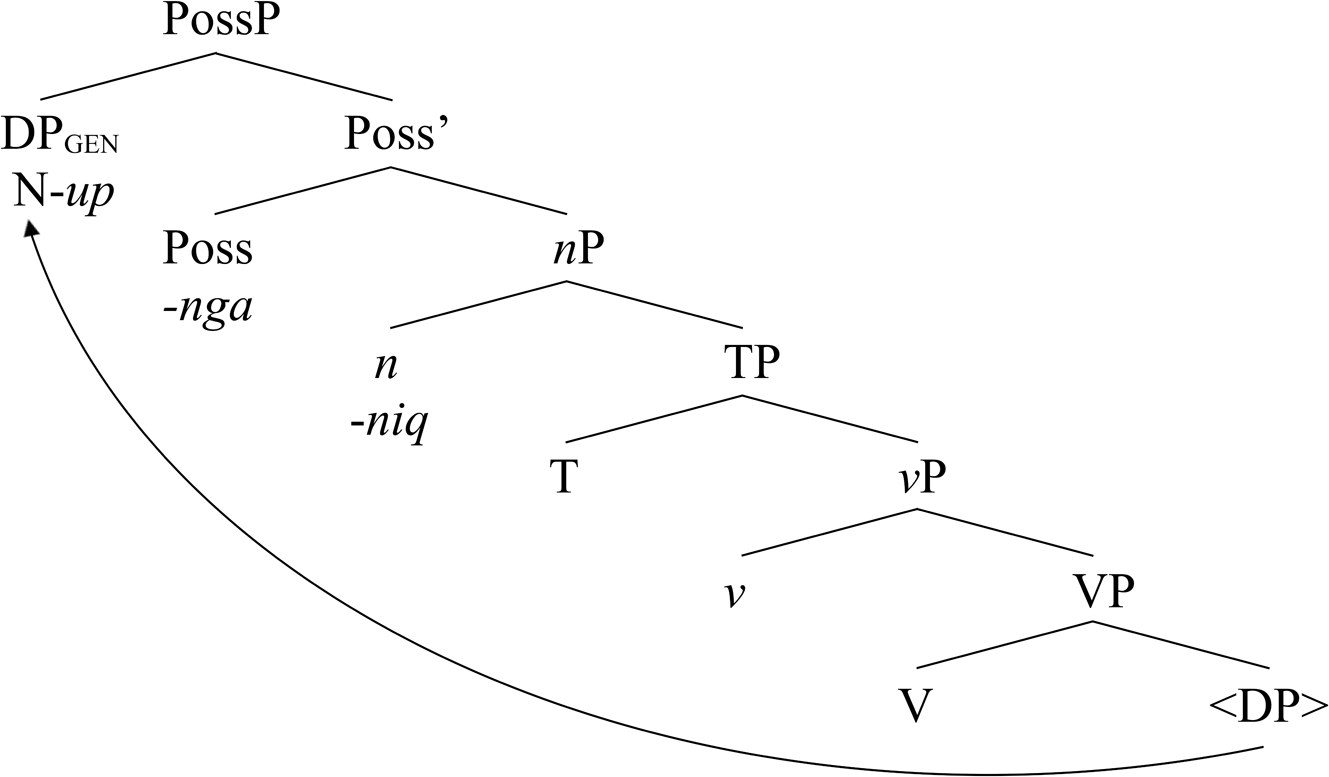
Consequently, we propose the following syntactic structures for gerund constructions built around either transitive/unergative verbs (Figure 2) or unaccusative verbs (Figure 3). Importantly, though, note that these structures, just as they are, depict gerund constructions in subject/object positions, in which the subject receives genitive case and the gerund is marked with a structural case, but will be expanded shortly in order to account for gerund constructions in oblique positions, in which the subject gets absolutive case and the gerund is marked with an oblique case (see section 3.2).
Transitive/unergative gerund constructions.

Figure 2 Long description
The diagram is a syntactic tree representing a gerund construction. It begins with 'DP subscript GEN' at the top left, which branches into 'PossP'. From 'PossP', a line descends to 'Poss prime', which further branches into 'Poss' labeled '-nga' and 'nP'. 'nP' branches into 'n' labeled '-niq' and 'TP'. 'TP' leads to 'T' and then to 'vP'. 'vP' branches into '<DP>' and another 'vP'. The second 'vP' branches into 'v' and 'VP'. 'VP' further branches into 'V' and '(DP subscript MOD)'. A curved arrow connects 'N-up' to 'DP subscript GEN'.
Unaccusative gerund constructions.

Figure 3 Long description
The diagram is a syntactic tree structure representing gerund constructions with unaccusative verbs. It begins with 'DP subscript GEN' and 'N-up' at the top left, connected by a curved line to 'PossP'. Below 'PossP', the structure branches into 'Poss' and 'nP'. 'Poss' further divides into 'Poss' and '-nga'. 'nP' branches into 'n' and 'TP', with 'n' leading to '-niq'. 'TP' connects to 'T', which leads to 'vP'. 'vP' branches into 'v' and 'VP'. 'VP' further divides into 'V' and '<DP>'. The diagram visually represents the hierarchical structure of these linguistic elements.
More precisely, we propose that the nominalizer -niq selects TP, and a possessive phrase selects the nominalized structure whenever the subject is expressed and possessive morphology is present (see section 3.1). The polysynthetic nature of the verbal bases, which may contain a large number of morphemes and have been argued to consist of syntactic structures corresponding to the domain of CP when they instantiate a verbal clause (see Compton and Pittman Reference Compton and Pittman2010), can be accounted for by assuming head movement of the verbal bound root up to the Poss head, as very often assumed in the literature (see Johns Reference Johns1987, Compton Reference Compton, Sherry Hucklebridge and Nelson2018, Branigan and Wharram Reference Branigan and Wharram2019, Carrier Reference Carrier2021).Footnote 21
As for case assignment, we assume that the object of transitive verbs (if present) is marked in-situ with modalis case licensed by little v, as commonly proposed for antipassive objects, which are also marked with this case (see section 2.1) (e.g., Bok-Bennema Reference Bok-Bennema1991, Spreng Reference Spreng2012, Yuan Reference Yuan2018, Carrier Reference Carrier2021).Footnote 22 For gerund constructions in subject/object positions, the nominalized verbal base, being the head of PossP, gets the appropriate case-marking (i.e., absolutive or modalis) depending on its syntactic position in the matrix clause. The analysis of the subject in gerund constructions is a little more complicated, as case marking of the latter varies depending on whether it appears in gerund constructions in subject/object or oblique positions (see section 3.2). First, we posit that the agent argument of transitive/unergative verbs and the theme argument of unaccusative verbs must both move to [Spec, PossP] for case and agreement with the Poss head, like the possessor in possessive constructions, except that the latter is base-generated in this position instead of moving there (see section 2.3). Importantly, we argue that the presence of PossP as well as the agreement with the Poss head is a necessary condition for the licensing of the subject in gerund constructions.
In other types of nominalized constructions in the language, the possessive agreement morphology on the verb appears to be optional. Crucially, however, the subject is marked with genitive case when possessive agreement morphology is present and with allative case when the latter is not. This is exemplified in (26a–b) with two similar constructions nominalized with -vik ‘place’, one with and one without possessive agreement morphology on the verbal base.

(Beach Reference Beach2012: 229)
Indeed, the subject Jaani ‘John’ is marked with genitive case in (26a) when the verbal base bears the possessive agreement marker -nga but then allative case in (26b) when it does not. Note that the allative case is the case employed to mark the by-phrase in passive constructions in Inuktitut.Footnote 23 Thus, the two examples above show that the subject in such nominalized constructions is not required to be licensed through possessive agreement and may be marked with an oblique (allative) case instead of genitive case. Going back to gerund constructions, the two examples below show that the subject could not be marked with allative case with no possessive agreement morphology on the verbal base, and, importantly, no matter whether the construction appears in a subject/object position, as in (27a), or in an oblique position, as in (27b).

(Beach Reference Beach2012: 283)
Furthermore, possessive agreement morphology on the gerund is obligatory whenever the subject is expressed, and again no matter if the gerund construction surfaces in a subject/object position, as in (28a), or an oblique position, as in (28b).

Therefore, we take (27a–b) and (28a–b) as evidence that the movement of the subject to [Spec, PossP] is a necessary condition for the licensing of the latter in any gerund constructions.
The final piece of the puzzle is to explain why the subject in oblique gerund constructions is marked with absolutive case rather than the expected genitive case. Recall from section 3.2 that oblique cases on gerunds do not instantiate their typical function and meaning. Interestingly, though, their ‘new’ function and meaning are the same as the ones expressed by verbal clause-type markers found in subordinate clauses (see section 2.2). Indeed, the combination of the gerundive nominalizer -niq and the locative case -ni or the allative case -nut can be replaced with subordinate verbal endings in the contemporative or the contingent clause type, respectively, without any difference in meaning. For instance, compare the following subordinate verbal clauses in (29) with their corresponding oblique gerund constructions in (24).

Hence, the oblique cases on gerunds serve the exact same function as verbal clause-type markers in the language, namely introducing adverbial subordinate clauses. The only difference between the two types of constructions is that gerund constructions are nominalized clauses, but the subject is nevertheless marked with absolutive case, as in their corresponding verbal subordinate clauses. As verbal clause-type markers (which also encode verbal agreement) are commonly assumed to be exponents of C and the absolutive case is argued to mark aboutness topic in the Inuit language, a discursive feature that is also associated with the CP-domain (see section 2.2), we assume that the oblique cases on gerunds similarly project a clausal left periphery. In the articulated structure of the CP-domain developed by Rizzi (Reference Rizzi and Liliane Haegeman1997) (see also Rizzi and Cinque Reference Rizzi and Cinque2016, Rizzi and Bocci Reference Rizzi, Bocci, Martin Everaert and van Riemsdijk2017), the head labelled Force is the one expressing illocutionary force and clause type. We propose that the oblique cases on gerunds are in fact an instantiation of Force markers projecting ForceP bundled with TopP, which assigns absolutive case. One issue, though, is that in Rizzi’s original decomposition of CP, Force is positioned on top of all the other functional heads (i.e., Force > Topic > Focus > Topic > Fin). The situation is necessarily different here as nothing could justify the presence of Topic prior to Force in oblique gerund syntactic structures.
Yet this organization of functional heads in the CP-domain is debated. Haegeman (Reference Haegeman2006, Reference Haegeman2012), for instance, argues that topicalization depends on the presence of Force and, as such, Topic should dominate Force (i.e., Topic > Focus > Topic > Force > Fin). This proposal is in tune with others claiming that aboutness topicality is a root (or main clause) phenomenon and thus only available in clauses endowed with illocutionary force (see Krifka Reference Krifka2001, Reference Krifka, Caroline Féry, Fanselo and Krifka2007; Bianchi and Frascarelli Reference Bianchi and Frascarelli2010; Frascarelli Reference Frascarelli, Andreas Dufter and Stark2017, Reference Frascarelli, Valéria Molnár, Egerland and Winkler2019). The unavailability of aboutness topicality would then be a direct consequence of the absence of Force (and by extension of a clausal left periphery). This is also the position we adopt here. We argue that absolutive case assignment in oblique gerund constructions stems from the presence of ForceP, projected by these oblique case markers, which do not instantiate their typical oblique case function, but rather a function similar to that of verbal mood markers expressing illocutionary force and clause type. We propose the structure in Figure 4 for oblique gerund constructions.
Oblique gerund constructions.

Figure 4 Long description
The diagram is a syntactic tree representing the structure of oblique gerund constructions. It begins with 'TopP' at the top, which branches into 'Top' and 'Top prime'. 'Top' further branches into 'ForceP', which contains 'Force' labeled with '-ni or -nut'. Below 'ForceP', there is 'PossP', which branches into '<DP>' and 'Poss prime'. 'Poss prime' leads to 'Poss' labeled with '-nga' and further branches into 'nP'. 'nP' contains 'n' labeled with '-niq' and continues to an ellipsis indicating continuation. The tree structure visually represents the hierarchical organization of these syntactic elements.
Essentially, oblique gerund constructions project more structure than other gerund constructions, due to these oblique case markers being endowed with illocutionary force and thus projecting ForceP bundled with TopP, which is responsible for absolutive case assignment. Consequently, we account for the fact that absolutive case is available in this type of nominalized construction despite the lack of verbal agreement, as previously assumed to be directly responsible for absolutive case assignment in the Inuit language (see section 1).Footnote 25
That said, one might wonder what happens to the genitive case usually assigned by the Poss head to the subject that had previously moved into its specifier position. We argue that this is an instance of possessor raising, as sometimes observed in constructions involving noun incorporation. First, note that verbs that permit noun incorporation in the language obligatorily incorporate their object (see, e.g., Tersis and Mahieu Reference Tersis and Mahieu2006; Johns Reference Johns2007, Reference Johns2009). Possessor stranding is allowed but only with a subclass of incorporating verbs describing location and direction of movement, as shown in (30).

(Johns Reference Johns2009: 188–189)
With all other incorporating verbs, possessor stranding is strictly prohibited, regardless of whether the incorporated noun is marked with a possessive marker or not, as shown in (31).

(Johns Reference Johns2009: 187)
Interestingly, though, several incorporating verbs that do not allow possessor stranding may have an ambiguous interpretation when used in transitive constructions, whereby the absolutive object can be interpreted as the possessor of the incorporated nouns, as exemplified in (32).

In order to account for the possible possessive interpretation, we follow Deal’s (Reference Deal2013) analysis of possessor raising in Nez Perce, according to which possessors remain in the possessive DP and receive genitive case in situ only when they are ineligible to receive another case via movement to a higher athematic A-position. Thus, we assume that the possessum incorporates into the verb via head movement, while the possessor raises to the higher A-position that licenses absolutive case – TopP, in our analysis – as shown in Figure 5. This is also the type of analysis proposed by Baker (Reference Baker1988) and Bittner (Reference Bittner1994) for such examples in the language.Footnote 26
Possessor raising involving noun incorporation.

Figure 5 Long description
The diagram is a syntactic tree structure showing the process of possessor raising. At the top, 'DP subscript ABS' is connected to 'N'. Below, a branching line leads to an ellipsis in parentheses, indicating omitted material. This connects to 'VP', which branches into 'V prime'. 'V prime' further branches into 'V' and another 'V', with the rightmost 'V' connecting to 'N'. Below 'VP', 'PossP' branches into '<DP>' and 'Poss prime'. 'Poss prime' further branches into 'Poss' and '<N>'. Arrows indicate movement from '<DP>' to 'DP subscript ABS' and from '<N>' to 'N' under 'V'.
The same reasoning extends to oblique gerund constructions. We argue that the subject first moves to [Spec, PossP], as in other gerund constructions, but then undergoes possessor raising to TopP, where it can receive structural case without being assigned a new θ-role, as in Deal’s (Reference Deal2013) analysis of Nez Perce. Importantly, recall that, building on van Urk (Reference van Urk2015), we assume that the movement of absolutive arguments to the CP-domain, which minimally consists of Force and Topic in Inuktitut, is an instance of A-movement, as the features driving movement are obligatory (see section 2.2), possibly triggered by an EPP-like feature. As a consequence, absolutive case must be discharged whenever the ForceP/TopP layer is projected, which explains why the subject in oblique gerund constructions cannot be marked with genitive case. Thus, the only difference between oblique gerund constructions and verbal constructions is that the features of the former contain case but not person and number.
In fact, we believe that the case variation on the subject in gerund constructions provides arguments against previous proposals arguing that absolutive case is a default case in the language, as claimed in Yuan (Reference Yuan2018, Reference Yuan2022) and Mikkelsen and Thrane (Reference Mikkelsen and Thrane2024). More precisely, such proposals consider default morphological absolutive case as syntactic caselessness, where “nominals that are outside of the purview of the Case Filter are realized as abs (…)” (Yuan Reference Yuan2018: 241). In other words, nominals that cannot be assigned any other case are then marked with absolutive case by default.Footnote 27 This cannot be the case here. Examples (28a–b) showed that possessive agreement morphology on gerunds is obligatory whenever the subject is present in any type of gerund construction, which crucially indicates that the movement of the subject to [Spec, PossP] is a necessary condition for the licensing of the latter. This also explains why the subject in gerund constructions appearing in subject/object positions is marked with genitive case (assigned by the Poss head), but also indicates that the subject in oblique gerund constructions moves to a position where it can be assigned case. As a result, it would be difficult to explain why the subject in oblique gerund constructions is marked with absolutive case (rather than genitive case) without assuming an obligatory A-movement towards a higher functional head, as in the present proposal. In section 4.3, we give more evidence against the absolutive-case-as-a-default-case approach in the language.
4 Participial constructions
This section analyzes the participial construction in the language. First, in section 4.1, we describe the basic properties of participial constructions whenever the latter appear in an argument position. In section 4.2, we then consider participial constructions when they stand alone and are interpreted as main clauses, in which situation absolutive case is assigned to one of their arguments, despite being nominalized clauses. In section 4.3, we present our syntactic analysis for participial constructions that can surface in argument positions as well as main clauses. We argue that both types derive null predicative constructions but that absolutive case is assigned only when such constructions are interpreted as main clauses since they are endowed with illocutionary force and thus project ForceP and TopP in their left periphery, following our analysis of oblique gerund constructions.Footnote 28 We also argue for a syntactic split across participial constructions, whereby those that only contain nominal inflectional morphology are indeed always nominalized, regardless of their verbal or nominal interpretation, whereas the others are systematically derived as verbal constructions.
4.1 Basic properties of participial constructions
The active participle morpheme -juq/-tuq and the passive participle morpheme -jaq/-taq derive nouns referring to, respectively, the agent/experiencer or the patient/theme denoted by a verb, respectively, as exemplified in (33).

As nominalized verbal forms, participles can take nominal inflectional morphology. For example, they can be marked with a case marker, as the active participle marked with allative case in (34a) (compare with the nominal argument, also marked with allative case, in (34b)). Notice also the nominal modifier -kuluk ‘small’ attached immediately after the active participle morpheme.

Possessive inflectional morphology can also surface in passive participial constructions, whereby the passive participle bears possessive agreement morphology, which encodes both the person and the number of the subject as well as the object, and the subject is marked with genitive case, as shown in (35a) (compare with the possessive construction in (35b)).

The subject of an active participle and the object of a passive participle can also be expressed syntactically, in which case these arguments are marked with the same case as the one marking the participle. Crucially, this case is assigned within the matrix clause to the argument position in which the participial construction surfaces, as exemplified with the active participial construction in (36a) and the passive participial construction in (36b).

Note that the case matching between the subject and the active participle, as in (36a), and the object and the passive participle, as in (36b), will be an important element of our syntactic analysis of participial constructions, proposed in section 4.3. Recall also that their corresponding arguments in verbal constructions, namely intransitive subjects and transitive objects, are conversely always marked with absolutive case (see examples (1a–c)). In participial constructions appearing in argument positions, such arguments are marked with absolutive case only when the construction surfaces in an argument position to which absolutive case is assigned within the matrix clause (and the participle is also marked with absolutive case), as illustrated in (37).

Accordingly, this shows that absolutive case is never assigned within participial constructions when the latter serve as arguments, which makes sense if we assume that absolutive case is connected to verbal agreement (see section 1) and such constructions are nominalized. However, there is one context in which absolutive case is assigned within participial constructions, namely when the latter do not serve as arguments but as main clauses, as discussed in the next section.
4.2 Unexpected case pattern in participial constructions
In the last section, we saw that absolutive case is never assigned within participial constructions serving as arguments. Consequently, in such nominalized constructions, intransitive subjects and transitive objects, which are always marked with absolutive case in ‘regular’ verbal constructions (see examples (1a–c)), are marked instead with whichever case is assigned within the matrix clause to the argument position in which the participial construction surfaces (see examples (36)–(37)). However, when participial constructions can stand alone and serve as main clauses, for example as a response to a question, these arguments are marked with absolutive case, as shown in (38)–(39).


Crucially, note that these two participial constructions must be nominal, since the nominal modifier -viniq ‘old/former’ can only attach to nominal bases, as shown earlier with the examples in (5a–b), and it follows the participle morpheme in both examples. This case pattern is therefore unexpected if we assume that absolutive case can only be licensed through verbal agreement (see section 1). Importantly, note that the participle forms in both examples are also marked with absolutive case, which suggests the same type of case matching observed with participial constructions appearing in argument positions (see examples (36)–(37)).
As mentioned in the introduction, though, the two participle morphemes in Inuktitut seem to have a dual function. On the one hand, they seem to be nominalizers and build participial constructions appearing in argument positions, as in all examples presented in section 4.1. On the other hand, they also seem to function like verbal mood markers and form what look like verbal constructions in a verbal mood semantically similar to the indicative mood (see (8a)). Consequently, participial constructions in isolation are in fact semantically ambiguous, as shown in (40).

(Johns Reference Johns1992: 60, 75)
Recall also that the transitive morphology in Inuit-Yupik-Unangan languages is historically related to the possessive morphology, as mentioned in section 2.3. The morphological parallel still holds between the forms of the ergative case and of the genitive case (compare (1a) with (13a)) and also between the forms of the agreement markers found in possessive constructions and passive participle constructions, as shown in Table 1.
Agreement in possessive and passive participial constructions in Inuinnaqtun (Lowe Reference Lowe1985)

Table 1 Long description
The table compares agreement suffixes in Inuinnaqtun for possessive noun phrases built on “qaja” (canoe) and passive participial verb forms built on “takuja” (saw). Each row pairs a possessive form with a corresponding passive participial form that uses the same person and number ending. For first person, the endings are ra for singular, kka for two, and tka for three or more, as in qaja-ra “my canoe” and taku-ja-ra “I saw him or her.” For second person singular subject or possessor, the endings are n for singular, kkin for two, and tin for three or more, as in qaja-n “your canoe” and taku-ja-n “you saw him or her.” For third person, the endings are a for singular, ik for two, and it for three or more, as in qaja-a “his or her canoe” and taku-ja-a “he or she saw him or her.” Across both constructions, number is consistently distinguished as singular, two, and three-plus, and the agreement markers align between possessive and passive participial forms. Glosses indicate person and number of the possessor or subject and the number of the possessed item or object; other grammatical details are not provided in the table.
Importantly, the parallel holds only if the object in passive participial constructions is third person, as the language does not have possessive agreement markers for first/second-person possessums. When the object is first or second person, verbal agreement markers cross-referencing first- or second-person intransitive subjects are then attached after the possessive agreement marker that cross-references a third-person singular possessum (by default), as shown in (41).Footnote 29

(Johns Reference Johns1992: 74)
Moreover, note that passive participial constructions with a first-/second-person object as well as active participial constructions with a first-/second-person subject are never semantically ambiguous and can only be interpreted as verbal, as also shown with the examples in (41a–b).
In the next section, we will demonstrate that participial constructions like the ones in (38) and (39) should be analyzed as null predicative clauses, following Yuan (Reference Yuan2013). Furthermore, building on our analysis of oblique gerund constructions in section 3.3, we will argue that such constructions are also endowed with illocutionary force, which makes them project TopP/ForceP, allowing them to license absolutive case (contrary to participial constructions surfacing in argument positions). Finally, we will show that even participial constructions interpreted verbally but containing only inflectional nominal morphology, like the examples in (40), should in fact also be analyzed as null predicative clauses.
4.3 Analysis of participial constructions
In this section, we present our analysis of participial constructions with the goal of accounting for absolutive case assignment when such constructions are employed as main clauses, as explained in section 4.2. First, again following Kornfilt and Whitman’s (Reference Kornfilt and Whitman2011) typology of nominalizations, we argue that participial constructions are TP nominalizations, as they can contain tense, as shown with the active participial construction in (42a) and the passive participial construction in (42b).

While both types of participles form DPs, passive participles may also take possessive morphology whenever the subject is expressed, overtly or not (see (35a–b)). In such circumstances, we assume that passive participles merge in the complement position of a Poss head and then move to the Poss head for agreement, while their subject subsequently moves to the specifier position of PossP to receive genitive case. The syntactic derivation for passive participle constructions is thus similar to that of transitive/unergative gerund constructions up to that point (see Figure 2).
A bit more challenging are the structures in which the subject of an active participle or the object of a passive participle is expressed syntactically. As we saw in (36), repeated below as (43) for convenience, these arguments are marked with the same case as the active/passive participle when participial constructions appear in an argument position.

For that reason, such complex participial constructions have been argued to consist of two DPs in apposition, where the participial DP is right-adjoined to the other nominal (see Compton Reference Compton2012, Yuan Reference Yuan2013), as illustrated in Figure 6.
Participial constructions as two DPs in apposition.

Crucially, even if the second DP seems to function like a relative clause, participial constructions used in such contexts cannot be considered genuine relative clauses, as it would be impossible to argue that an operator undergoes Aʹ-movement to the specifier position of CP within the DP. This is because participial constructions are TP-nominalizations and hence lack a CP layer. Nevertheless, the participial constructions appearing in argument positions present restrictions that are sometimes observed in relative clauses, since the first DP is restricted to refer to the subject of the active participle or the object of the passive participle (see Johns Reference Johns1992; Yuan Reference Yuan2013, Reference Yuan2018), which could suggest some type of Aʹ-extraction restriction. The problem with the proposal that participial constructions appearing in argument positions consist of a participial DP right-adjoined to another DP, as illustrated in Figure 6 above, is that these restrictions are not accounted for.
Such participial constructions could well be pseudo-relative clauses, which are often analyzed as some kind of small clauses (e.g., Guasti Reference Guasti1988, Reference Guasti1992; Cinque Reference Cinque and Guglielmo Cinque1995; Rafel Reference Rafel1999; Casalicchio Reference Casalicchio and Ernestina Carrilho2016). This is the approach we will adopt. We argue that all participial constructions containing only inflectional nominal morphology, whether serving as arguments or main clauses, are small clauses. This proposal builds on Yuan (Reference Yuan2013), who analyzes main clause participial constructions as null predicative clauses. Similar analyses, albeit using different formalisms, have been proposed by Lowe (Reference Lowe1978), Johns (Reference Johns1992), and Beach (Reference Beach2012) for main clause participial constructions. Indeed, null predicative clauses exist independently in the language, as exemplified in (44).

In both examples, two absolutive DPs are placed in apposition to form a null predicative clause. Interestingly, if any verbal categories are expressed, like negation or tense, the second DP must be followed by one or the other of the affixal verbs -u and -gi, which seem to function as verbalizers to allow the affixation of verbal categories and are commonly translated as ‘be’ and ‘have as’, respectively, due to their interpretation in such constructions.Footnote 30 Crucially, the verbal base is thereafter re-nominalized with the active participle or the passive participle, and the given participial form remains marked with absolutive case, as shown in (45).

The participial constructions in (45) are in fact very similar to those presented in (38) and (39), repeated in (46) and (47) for convenience, with the sole exception that the root of the participles is nominal (i.e., ilisaiji ‘teacher’) instead of verbal (i.e., iqqanaijaq- ‘work’ and uqauti- ‘talk to’). Yuan (Reference Yuan2013) proposes that the null predicative head is Infl, which takes the participial construction as its complement, and the first DP in its specifier. As for how absolutive case is assigned, Yuan posits that absolutive case is inherited from C by Infl (following Pesetsky and Torrego Reference Pesetsky, Torrego and Michael Kenstowicz2001) and then assigned to the first DP in [Spec, Infl], as illustrated below in Figure 7.
Main clause participial constructions as null predicative clauses, based on Yuan (Reference Yuan2013).

Figure 7 Long description
The diagram is a syntactic tree representing the structure of a clause. It begins at the top with 'CP' and branches down to 'C prime' and 'C'. From 'C', the structure continues to 'InflP', which further branches into 'DP subscript ABS' and 'N'. Below 'InflP', 'Infl prime' is shown, leading to 'Infl' with a null symbol. The tree then extends to 'PossP', branching into 'DP subscript GEN' and 'N-up'. 'PossP' continues to 'Poss prime', which leads to 'Poss' with '-nga'. Finally, the structure ends with 'NP' labeled as 'passive participle'. Arrows indicate the flow and connections between the elements, illustrating the hierarchical syntactic relationships.


The assignment of absolutive case by Infl to the argument in its specifier is, however, not in line with the growing consensus in the literature that absolutive case-marked arguments must move into the CP-domain in order to explain their systematic wide scope over sentence-level operators and be interpreted as sentential or aboutness topics (see section 2.2). This proposal also does not account for why the participle form also receives absolutive case whenever such constructions act as main clauses, as shown with examples (45)–(47), suggesting the same case matching operation seen in participial constructions surfacing in argument positions, as shown with (43a–b). In fact, when null predicative clauses like those in (44)–(45) appear in argument positions (rather than standing alone and acting as main clauses), the second DP is also marked with the same case as the first DP, no matter whether the second DP is a noun (48a) or a participle form (48b).

(Beach Reference Beach2012: 41)
Consequently, this further suggests that null predicative clauses and participial constructions are indeed similar syntactic constructions, regardless of whether they serve as arguments or main clauses. Building on Yuan’s (Reference Yuan2013) proposal, we argue that the two DPs in apposition are linked by a null predicative head (i.e., Pred) rather than by Infl. The null predicative head expresses identity between the two DPs, namely that they are semantically related constituents. This explains why the two DPs are always marked with the same case by assuming case matching, as also argued by Schütze (Reference Schütze2001) for languages in which the subject and the postcopular DP in copulative clauses must have identical case. Thus, the second DP is never in a syntactic relation with any case assigner and its case-marking simply matches the one of the first DP. Interestingly, this gives more evidence against proposals arguing that absolutive case is a default case in the language, as briefly discussed at the end of section 3.3. In fact, Yuan (Reference Yuan2018) and Mikkelsen and Thrane (Reference Mikkelsen and Thrane2024) claim that absolutive case is a default case as the postcopular DP in copulative constructions, as in (45), is outside of the purview of the Case filter and is realized as absolutive. However, as we can see in (48), when such constructions appear in argument positions, the second DP is not necessarily absolutive and its case-marking simply matches the one of the first DP. If absolutive case was a default case in such circumstances, we would then expect the second DP to always be absolutive. However, this is not the case.
Assuming that such constructions are null predicative clauses, we propose the structures in Figures 8 and 9 for active and passive participial constructions surfacing in argument positions.
Active participial constructions in argument positions.

Figure 8 Long description
The diagram is a syntactic tree structure representing active participial constructions. At the top, the node labeled DP subscript 1 branches into two paths: one leading to DP subscript 1 with a sub-branch labeled N and the other leading to PredP. PredP further branches into PRO subscript 1 and Pred prime. Pred prime splits into Pred, marked with an empty set symbol and DP subscript 2, which is labeled as active participle. The structure visually represents the hierarchical relationship between these elements in a sentence.
Passive participial constructions in argument positions.

Figure 9 Long description
The diagram is a syntactic tree structure with a vertical orientation, illustrating passive participial constructions. At the top, the node labeled 'DP subscript 1' branches into 'N'. Below, 'DP subscript 1' connects to 'PredP', which further branches into 'PRO subscript 1' and 'Pred prime'. 'Pred prime' leads to 'Pred', which is marked with a null symbol. 'Pred' connects to 'PossP', branching into 'DP subscript GEN' and 'Poss prime'. 'DP subscript GEN' is linked to 'N-up'. 'Poss prime' branches into 'Poss subscript 2' and 'NP'. 'Poss subscript 2' is labeled '-nga' and 'NP' is labeled 'passive participle'. An arrow curves from 'Poss subscript 2' to 'NP', indicating a relationship between these elements.
Both types of participial constructions form complex DPs, in which the null predicative clause modifies the first DP as an adjunct and is crucially analyzed as a control structure with a PRO in its subject position that is coindexed with the first DP.Footnote 31 Most importantly, such structures allow us to account for the fact that the modified DP (i.e., the first DP) can only refer to what we have called the subject of the active participle or the object of the passive participle, but which in both cases actually correspond to the subject of the null predicative clause (or, semantically, the constituent being in an identity relation with the following participle form). Note that this is also in line with previous studies on pseudo-relatives, which also argue for control structures in order to account for the so-called subject-object asymmetry, according to which the antecedent is always coindexed with the subject of such clauses (see Graffi Reference Graffi1980, Reference Graffi, Roberta D’Alessandro, Iannàccaro, Passino and Thornton2017; Kayne Reference Kayne and Richard Kayne1983; Cinque Reference Cinque and Guglielmo Cinque1995; Côté Reference Côté, Francis Corblin, Dobrovie-Sorin and Marandin1999; Casalicchio Reference Casalicchio and Ernestina Carrilho2016). Lastly, as for case marking, the first DP is marked with whichever case is assigned within the matrix clause to the argument position in which the participial construction surfaces. We further assume that the subsequent participle form receives the same case as the first DP following case matching, as explained earlier.
As for participial constructions as main clauses, we propose the following structures formed with the active or the passive participle, building also on our analysis of oblique gerund constructions proposed in section 3.3.
Like participial constructions appearing in argument positions, those acting as main clauses also form null predicative clauses. However, the first DP merges directly into the subject position of the null predicative clause (instead of having a PRO), as the latter is no longer modifying this DP but is now implementing an independent conversational move that affects the common ground of the conversation (e.g., Krifka Reference Krifka, Caroline Féry, Fanselo and Krifka2007, Bianchi and Frascarelli Reference Bianchi and Frascarelli2010, Frascarelli Reference Frascarelli, Andreas Dufter and Stark2017), since asserting an identity relation between the first DP and the following participle form DP represents a speech act. Main clause participial constructions therefore possess illocutionary force (i.e., the illocutionary force of assertion), and, as was argued for oblique gerund constructions in section 3.3, must project ForceP bundled with TopP. Thus, we argue that the first DP then moves to [Spec, TopP], where it is assigned absolutive case. Recall that we assume that the movement of absolutive arguments to the CP-domain, which minimally consists of Force and Topic in the language, is an instance of A-movement, since the features driving movement are obligatory (see section 2.2). The fact that the participle form is also systematically marked with absolutive in such participial constructions is once again explained by assuming case matching between the first DP and the participle form, as just discussed.
Finally, recall that active participial constructions with a third-person subject and passive ones with a third-person object are ambiguous in isolation between nominal or verbal interpretations (see examples in (40)). In fact, there is a long-lasting debate in the Inuit literature as to whether such participial constructions should still be analyzed as nominalized constructions even when interpreted verbally (see, e.g., Lowe Reference Lowe1978, Johns Reference Johns1992, Sadock Reference Sadock1999, Beach Reference Berge2011, Yuan Reference Yuan2013). Interestingly, the examples below clearly indicate that such constructions must be nominalized, as they allow nominal modification after the participle, as we saw earlier with examples (38)–(39).
More precisely, the nominal modifier -kuluk ‘small’ can attach to either the absolutive argument or the participle both in the active participial constructions (49) or in the passive ones (50). Importantly, the interpretation is the same in both pairs, and -kuluk ‘small’ systematically modifies the absolutive argument. This can be explained if and only if (i) the active participle morpheme and the passive one function as nominalizers rather than verbal mood markers (and consequently such participial constructions are nominalized ones), and (ii) the absolutive argument is placed in a syntactic relation in which this argument and the participial construction are interpreted as being in a semantic relation of equivalence or identity (which explains why the modifier -kuluk ‘small’ still modifies the absolutive argument even if attached to the participle). We take this as evidence that such participial constructions also form null predicative clauses, as illustrated in Figure 10 and Figure 11 above, despite their apparent verbal interpretation.


Active participial constructions as main clauses.

Figure 10 Long description
A plain black-and-white line diagram illustrating a syntax tree. The diagram begins with TopP, which splits into DP with ABS subscript labeled N and Top-bar. Top-bar divides into Top and ForceP. ForceP branches into Force and Pred-bar. Pred-bar splits into Pred labeled with the null symbol (O slash) and DP with ABS subscript labeled active participle. A curved arrow indicates a dependency from DP with ABS subscript to N. The diagram is straightforward with no decorative elements, focusing on the hierarchical relationships and syntactic structure.
Passive participial constructions as main clauses.

Figure 11 Long description
The diagram is a syntactic tree representing the structure of a passive participle construction. It begins at the top with 'TopP' and 'DP subscript ABS N' on the left, connected by a curved line. Below 'TopP' is 'Top prime', leading to 'Top', which connects to 'ForceP'. 'ForceP' branches into 'Force' and 'PredP'. 'PredP' further divides into '<DP>' and 'Pred prime'. 'Pred prime' leads to 'Pred' and 'PossP'. 'Pred' is marked with a symbol 'Ø'. 'PossP' branches into 'DP subscript GEN N-up' and 'Poss prime'. 'Poss prime' connects to 'Poss subscript ABS -nga' and 'NP'. 'NP' is labeled 'passive participle'. The structure shows hierarchical relationships between these elements, illustrating the syntactic arrangement in passive participle constructions.
As for active participial constructions with a first-/second-person subject, as well as passive ones with a first-/second-person object, which conversely require verbal agreement markers to encode the latter arguments (see (41)), such participial constructions are not only never interpreted as nominal constructions, they also disallow nominal modification, as shown in (51).

Therefore, we argue for a syntactic split in participial constructions, whereby those bearing only inflectional nominal morphology are nominalized constructions and derive null predicative clauses, while the participial constructions taking verbal agreement markers have no nominal properties and are derived like any other verbal constructions in the language. Yet Johns (Reference Johns1992) argues that the nominal base in such participial constructions are in fact re-verbalized with the attachment of verbal agreement markers, rather than having the same derivation as other verbal constructions, due to the presence of the participle morpheme as well as possessive agreement morphology in passive participial constructions. However, if this were the case, the examples in (51) would be grammatical, as the nominal modifier -kuluk ‘small’ attaches to the participle morpheme (before the said re-verbalization). We therefore assume that the participle and the agreement morphemes in ‘verbal’ participial constructions now form portmanteau morphemes, which are equivalent to verbal mood markers (see section 2.2). Further evidence for the present morphological analysis is the fact that such verbal agreement markers can no longer freely attach to nominal bases, as shown in (52).

(Johns Reference Johns1987: 67, 72)
The null predicative clause in (52a) is similar to the one presented in (44b). But the possessum in the null predicative clause in (52b) bears both possessive and verbal agreement morphology, now similarly to so-called verbal participial constructions like the ones presented in (41a) or (51a), with the intended meaning ‘I am John’s mother’. However, the example in (52b) is ungrammatical, indicating that verbal agreement markers can indeed no longer attach to nominal bases.
5 Conclusion
In this article, we analyzed gerund and participial constructions in Inuktitut to account for the unexpected assignment of absolutive case to one of their arguments in two specific contexts. Absolutive case assignment in such nominalized clauses is surprising, as it is commonly assumed to be tied to verbal agreement occurring in the CP-domain (see Johns Reference Johns, Alana Johns, Massam and Ndayiragije2006; Spreng Reference Spreng, Alana Johns, Massam and Ndayiragije2006, Reference Spreng2012; Compton Reference Compton, Sherry Hucklebridge and Nelson2018; Carrier Reference Carrier2021). However, gerund and participial constructions not only lack verbal agreement, as they are nominalized constructions, but they also correspond to TP nominalizations, lacking a CP layer. Absolutive case assignment in them thus poses a theoretical problem.
A deeper analysis of these nominalized constructions helped us determine that they can assign absolutive case when they have illocutionary force and thus project ForceP bundled with TopP, which we argue is responsible for absolutive case assignment, as this case is used to mark sentential or aboutness topics in the language (see Tersis and Carter-Thomas Reference Tersis and Carter-Thomas2005; Berge Reference Berge2011; Carrier Reference Carrier2012, Reference Carrier2017, Reference Carrier2021; Johns and Kučerová Reference Johns, Kučerová, Jessica Coon, Massam and Travis2017). More precisely, gerund constructions assign absolutive case to their subject whenever they are marked with certain oblique cases and become equivalent to subordinate verbal constructions. As for active and passive participial constructions, they assign absolutive case only when they stand alone and are interpreted as main clauses. The analysis of these nominalized constructions deepens our understanding of the left periphery in Inuktitut by establishing that absolutive case is not only assigned in verbal clauses, but in any clause endowed with illocutionary force. By extension, this further indicates that absolutive case assignment represents a root phenomenon in the language, as it requires the clausal left periphery. Aboutness topics have been claimed as being among the clearest representatives of root clause phenomena cross-linguistically in several studies (e.g., Hooper and Thompson Reference Hooper and Thompson1973, Haegeman Reference Haegeman2006, Bianchi and Frascarelli Reference Bianchi and Frascarelli2010, Frascarelli Reference Frascarelli, Valéria Molnár, Egerland and Winkler2019). However, to our knowledge, this is the first study in which root phenomena have been argued to be also available with nominalized clauses.




 Open access

