


1. Introduction
Commissive readings of the modal can are well-attested cross-linguistically, as the following English (1a), French (1b), and Italian (1c) examples illustrate:Footnote 1

It immediately becomes clear that this modality cannot be reduced solely to the abilitative modality, as shown in (2), and it is tempting to state that this is an instance of speech act modality that contributes a commissive force offer scoping over propositional content  $p$ (e.g., Sweetser Reference Sweetser1990; Papafragou Reference Papafragou2000; Rossari and Smirnova Reference Rossari and Elena2021). In this Searlian framework (Searle Reference Searle1969), the examples in (1) would be analyzed as offer(
 $p$).

Ninan (Reference Ninan2005) also proposes that modals, and in particular deontic modals, are akin to speech acts and have the force of imperatives. Examples (3a) and (3b) would thus be equivalent.Footnote 2

Here we account for the offer interpretation of can, distinguishing layers of meaning and articulating core semantic modal content (of ability, in this specific case) together with conditional content.
We show that the abilitative content contributes the commissive interpretation of the modal and argue for a series of preconditions to be satisfied, which most notably includes an authority relation. We argue that the speech act-like interpretation is built on what is referred to as a non-conditional conditional of the form If you want, I can  $\phi$, where the speech act interpretation arises via anchoring of the protasis of the conditional to the addressee. We do not assume Searlian force, nor an equivalence between modality and speech acts.
Our article proceeds as follows: we unpack the ingredients of offer-can in section 2, we present our analysis in section 3, and we compare it with Copley’s (Reference Copley2009) analysis of offer-will in section 4. We discuss the conditional meaning in section 5, where we compare the conditional structure of offer-can with those of biscuit conditionals, discourse-structuring conditionals, anankastic conditionals, and eparkastic conditionals. In section 6 we also offer some thoughts on cases similar to offer-can, namely can-you-pass-me-the-salt questions and permission-can, showing that a manipulation of the authority parameter explains how the injunctive use of the question arises. In particular, we advance the new hypothesis of the authority shift in questions. We also argue that the semantic architecture of permission-can is similar to that of offer-can. Section 7 concludes.
2. Unpacking offer-can
2.1. Problems and solutions
What is the meaning of (4)? In a sense, it highlights a possibility of me going to the lab. But more than that, it makes an offer: it proposes to solve the problem of my addressee having left her papers to review in the lab. In this sense, can is used to make an offer: it proposes a solution to a problem. This is the sense of can that we examine in this article.

The problem, at the time the offer is made, might be acknowledged and endorsed by the addressee, but this is not necessarily the case. The speaker may believe that the addressee has a problem to solve, but the addressee can deny that this is the case, as illustrated in (5).

The proposed solution, on the other hand, is always part of a set of epistemic alternatives of the speaker. The speaker envisions several possible manners to solve the problem and thus projects epistemic alternatives where these solutions become operationals. At a very first approximation, offer-can is a proposal which the speaker believes to be a possible solution to a real or a potential problem.
Offers can also be made with will, as discussed in Copley (Reference Copley2009). However, unlike offer-will (6), offer-can highlights one of several possible solutions to the problem. As discussed in Copley (Reference Copley2009), offer-will leaves no room for a multiplicity of solutions.

Example (6) issues an offer presented as the sole alternative, suggesting that the problem cannot be solved other than by changing the oil in Madera. With offer-can, the solution is envisaged as one of many potential ways to solve the problem.

2.2. Offers are conditional on acceptance
In the dialogue in (5), the addressee has refused the offer by clarifying that there is no problem to begin with. The addressee can also refuse the offer in cases where she recognizes that the problem is real and not merely hypothesized by the speaker. If, for whatever reason, the addressee does not want to accept the offer, the offer can be refused.
To state this otherwise, the realization of an offer is conditional on the acceptance of the offer by the addressee (Copley Reference Copley2009; Geurts Reference Geurts2019, a.o.), and even when not overtly expressed, a covert restriction of the type if you want is always present and intrinsic to the statement of the offer. For this reason, we call offer-can a conditional offer (CO):

The antecedent is optionally realized, as we just mentioned, and also mobile.

The verb in the consequent of a CO is heavily constrained: the weak modal can seems always licensed, but never the strong must. Moreover, predicates of ability quite close to the abilitative can, like know how or be able are not straightforwardly compatible with the offer reading (see discussion in section 2.3).

The antecedent appears to have quite an idiosyncratic role in the offer: rather than describing a sufficient condition for the consequent or simply restricting the domain of quantification (Kratzer Reference Kratzer, Arnim von Stechow and Wunderlich1991), it makes explicit the nature of the speech act by uttering the full sentence. Just as a question begs for answers, an offer ultimately relies on the preferences of the addressee to whom it is made, since they will determine whether it will be accepted or rejected. This view provides a natural explanation for the incompatibility of the first person in the antecedent: the preferences of the speaker are not relevant for the felicity of an offer.

At the same time, an overt antecedent can also have the role of restricting the domain of quantification, as in (12):

Yet, the antecedent that spells out the pragmatic condition of offering can be added even in this case, which shows that the two antecedents have different functions:

To conclude, we assume with Geurts (Reference Geurts2019) that offers are conditional propositions. The condition encoded in this conditional proposition is the acceptance of the offer itself on the part of the addressee. This makes offers a special type of conditional, whose nature is further discussed in section 4.
2.3. Abilities as preconditions for offers
Offers are also contingent on the belief that the offer can be carried out. If the offer is in the first person, the speaker can carry it out herself. The individual denoted by the subject will carry it out in other cases:

In this respect, the examples in (14) prima facie look like trivial abilitative statements. Yet their modal cannot be replaced by a predicate that unambiguously describes a capacity, as in (15). The addition of (14)’s covert antecedent renders the utterance in (15) infelicitous, or, at least, poses specific constraints on the context of utterance, as we clarify in a few paragraphs (see discussion surrounding (20)).

To carry out the offer, the entity denoted by the subject, which we label  $\alpha$, has to have the ability to do so. Ability is a precondition for action (cf. Gordon and Lakoff Reference Gordon and Lakoff1975; Kenny Reference Kenny1976; Horty and Belnap Reference Horty and Belnap1995; Thomason Reference Thomason2005; Mari and Martin Reference Mari and Martin2007; Mari Reference Mari2016; Mandelkern et al. Reference Mandelkern, Schultheis and Boylan2017; Copley Reference Copley2018; Nadathur Reference Nadathur2019; Giannakidou and Mari Reference Giannakidou and Mari2021, a.o.), and several accounts and logics have been developed to unfold the complex notion of ability. The shades of the notion are not relevant here, and the reader is free to adopt their favourite account (see chapter 1 of Mari et al. Reference Mari, Beyssade and Prete2013 for extended discussion). We will assume that having an ability means having a disposition to carry out
 $p$, granted that no unexpected impediment intervenes.
That  $\alpha$ has the ability to carry out the offer is a presupposition of the speaker. If I offer to do the dishes, it is because I believe that I am able to do the dishes.
With offer-can, ability can surface more or less prominently across the contexts in which the offer is made. In a scenario where Marie’s mother is doing the dishes and Marie sees that her mother is tired, she can offer that someone else does the dishes. If her offer is that her husband does the dishes, the offer-can is only presuppositionally abilitative. Presumably, it is clear in the context that her husband is able to do the dishes, and ability is not at issue.

If she offers that her son does the dishes, the abilitative meaning component becomes more prominent. Assume her son, John, is 12 years old, and although he can do the dishes, this is not taken for granted in the context of the conversation by Marie’s mother, who lives far away from Marie’s family and does not see her grandson very often. In the utterance (17), ability is more foregrounded than in (16).

Example (17) makes the abilitative component visible as a precondition of action, while being a commissive statement. These two components, we propose, co-exist, with the abilitative-can being backgrounded or foregrounded according to the context.
The attested example (18) shows that when the capacity is surprising, the abilitative component can become salient.

When we make an assertion, we do so in relation to an information state: what is new is asserted, and what is old is presupposed. Therefore, what is asserted or presupposed depends in part on the information state, that is, on what we already know and what is new. In contexts with radically different information bases, the same sentence can assert/presuppose completely different things. This is illustrated by the following example:

In a context where it is known that the cousin is male but his age is unknown, the sentence asserts that the cousin is now an adult. In a context where the possibility of gender transition is salient, the sentence can assert that the cousin is now female while presupposing that the cousin is still a child. Examples like this show that, in theory, any piece of information can function as either a presupposition or an assertion. However, there are tendencies, as well as pragmatic and grammatical constraints, that determine what type of content is typically presupposed in discourse.
In a similar vein, note that the offer interpretation for be able to is obtained at the price of the calculation of a complex set of inferences enhanced by an ironical offer statement, but that it is not impossible given certain contextual conditions. Example (20) indeed presupposes that the addressee might want to ask the speaker to help, but has refrained from doing so, as if she believed that the speaker is not able to do the dishes.

As one anonymous reviewer notes, be able to enhances an offer in a situation where it is seemingly not common ground that the holder of the ability is in fact able to carry out  $p$. The use of the abilitative modal foregrounds the abilitative interpretation, which in the use of offer-can is backgrounded, as we mentioned.
Going back to the context where it is not taken for granted by Marie’s mother that John is able to do the dishes (see discussion surrounding (17)), (21) enhances an offer by foregrounding ability.

Conversations take place against a background information state (or common ground; Stalnaker Reference Stalnaker, Milton Munitz and Unger1974; Clark Reference Clark1996), but the interlocutors are unsure what is in the information states of the other participants. Understanding a statement therefore involves the listener trying to infer what the speaker considers part of the common ground. We thus assume that what is presupposed is a hypothesis formed by the hearer about what is in the information state of the speaker (see partly similar views in Wilson and Sperber Reference Wilson, Sperber, C. K. Oh and Dineen1979; Simons et al. Reference Simons, Tonhauser, Beaver, Roberts, Nan Li and Lutz2010; Qing et al. Reference Qing, Goodman and Lassiter2016; Abrusán Reference Abrusán2022; Degen and Tonhauser Reference Degen and Tonhauser2022; Roberts and Simons Reference Roberts and Simons2024).
This explains the differences in focus on the abilitative component in (16) and (17). Here we will maintain, for simplicity, that ability is always assumed as part of the background knowledge (see also Copley Reference Copley2009). What matters for us is that the abilitative component is present and part of the overall interpretation.
2.4. Desirability
Dispositions have been understood in the literature as intrinsic features of individuals that allow them to perform an action (Menéndez-Benito Reference Menéndez-Benito2013, a.o.).
A richer notion of disposition, however, illustrated in (22), would imply some intention or willingness to carry out  $p$.

The intrinsic capacity and the desire (or lack thereof) to carry out  $p$ need to be distinguished.Footnote 3 Individuals are able to do horrible things, yet they are not necessarily disposed to do so.
There is thus a desirability condition to be added, which depends on  $s$. Exterminating humans is not acceptable for the writers of this article, yet it is a desirable action from the perspective of a Replicant in Blade Runner. In this context, Replicants have both the ability and the desire to do so. Exterminating the humans is the best solution to the Replicants’ problem, which is to rule the Earth.

The analysis of offers will thus include a desirability component in the definition of a problem’s solution: a solution is not only an epistemic possibility, but it is also an outcome that is preferable to the others, given  $s$’s perspective. This desirability component will be encoded as an ordering source, as we explain in section 3.
2.5. Authority
The final ingredient of offer-can is authority. To issue the offer and for the offer to be realized, the speaker  $s$ has to have authority over
 $\alpha$. In the first person,
 $s = \alpha$ and the authority relation is trivially satisfied (granted that one can control him/herself).
In the third person (e.g., (17)), to say that  $s$ has authority over
 $\alpha$ means the speaker assumes that he is in a position to make
 $\alpha$ carry out the action.
Note that when the authority relation does not hold, the statement no longer issues an offer. Consider the case where there has been a party at the lab and it is very clear that the head of the department never takes care of the dishes.

The example in (24) does not make an offer; at best, it can be understood in an ironic way.
It is important to note that authority is necessary but not sufficient for  $\alpha$ to act to bring about
 $p$.
 $\alpha$ has to recognize the authority and to accept to realize
 $p$. We assume that this agreement is tacit unless otherwise stated and that the semantics of offer-can do not encode this extra endorsement component on the part of
 $\alpha$. On the assumption that
 $\alpha$ carries out
 $p$,
 $s$ has effective authority over
 $\alpha$.Footnote 4
Offer-can is thus a proposal of a possible solution to a real or a potential problem. This solution has to be accepted by the addressee.  $\alpha$ has to be able (and agree) to realize
 $p$.
3. Analysis
We use a  $W \times T$ forward-branching structure (Thomason Reference Thomason1984). A three-place relation
 $\simeq$ on
 $T \times W \times W$ is defined such that (i) for all
 $t \in T$,
 $\simeq_t$ is an equivalence relation; (ii) for any
 $w,w' \in W$ and
 $t,t' \in T$, if
 $w' \simeq_{t'} w$ and
 $t$ precedes
 $t'$, then
 $w' \simeq_{t} w$ (we use the symbols
 $\prec$ and
 $\succ$ for temporal precedence and succession, respectively).
In words,  $w$ and
 $w'$ are historical alternatives at least up to
 $t'$ and thus differ only, if at all, in what is future to
 $t'$.
For any given time, a world belongs to an equivalence class comprising worlds with identical pasts but different futures. Let  $w_0$ be the actual world.
We set a time  $t \in T$, at which problem worlds
 $\mathcal{P}(t)$ are defined as the set of worlds that are identical to the actual world
 $w_0$ at least up to and including
 $t$, and in which the issue to be solved arises.

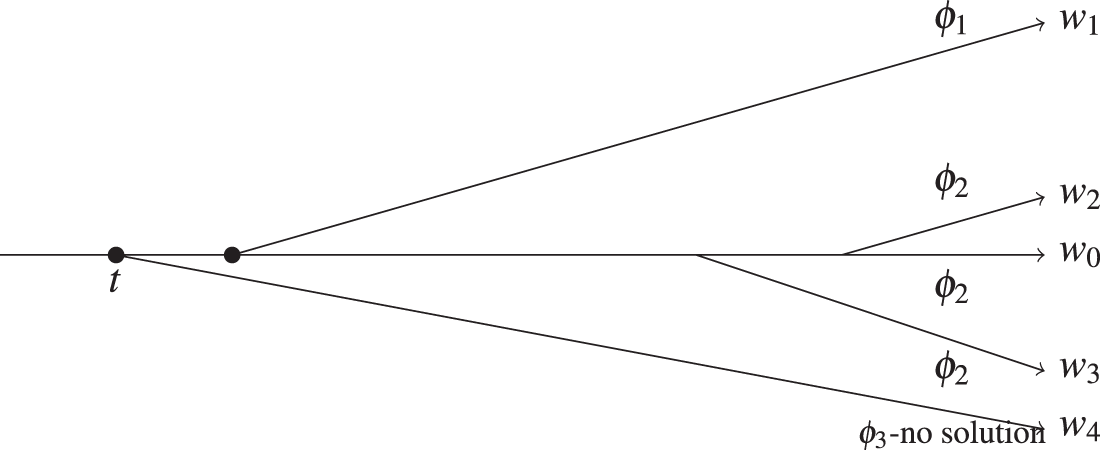
In the case depicted in Figure 1, the problem worlds at  $t$ are the set given in (26).

 $\mathcal{P}(t)$.

In the problem worlds, different outcomes are possible regarding the problem. For example, if the problem is that the dishes are dirty, the epistemically possible outcomes might include that  $\phi_1 =$ I do the dishes,
 $\phi_2 =$ you do the dishes,
 $\phi_3 =$ the dishes are never done and rot forever, etc. Suppose for simplicity that {
 $\phi_1$,
 $\phi_2$,
 $\phi_3$} are all the possible outcomes. The first two of these count as solutions to the problem, in some practical sense, while the last one,
 $\phi_3$, is not a solution.
We now introduce an ordering source that (A) defines a partition on the outcome worlds and (B) orders cells of the partition according to practical commitments of the speaker (to use a term borrowed from Bratman Reference Bratman1987).
(A) Let  $\pi(\mathcal{P}(t))$ be a partition of
 $\mathcal{P}(t)$, where for each cell
 $ u \in \pi (\mathcal{P}(t))$ there is a set of worlds in which there is a specific outcome
 $\phi$ related to the problem. In the case depicted in Figure 1, these subsets are
 $u1$,
 $u2$, and
 $u_3$: the set
 $u_1$ comprises only
 $w_1$; the set
 $u_2$ comprises
 $w_2,w_0,w_3$; and the set
 $u_3$ comprises only
 $w_4$.

This defines three possible outcomes:  $\phi_1$ that is carried out in
 $w_1$,
 $\phi_2$ which is carried out in
 $w_2,w_0,w_3$, and
 $\phi_3$ that happens in
 $w_4$. We call
 $\phi(u)$ an outcome that is carried out in a cell
 $u$ of the partition of the outcome worlds.
(B) Practical commitments are a set of propositions that describe a state of affairs or actions according to which the speaker evaluates one outcome as preferable to the others. For instance, if we suggest to our colleague that we do the dishes, it is because we prefer that the dishes are done rather than not and we know that we want her to go to an important lab meeting that she cannot miss. The outcome suggested is the most preferred one according to the speakers’ commitments in the context of utterance  $c$. So defined, these practical commitments are the ordering source
 $g(s,c)$.
Our lexical entry for offer-can is as follows:

This states that in order to issue an offer, some conditions must be met. We are reticent to assume that these are lexically defined conditions (i.e., lexical presuppositions) since, as we have noted, some of this content can be more or less foregrounded or backgrounded according to the context. These conditions are that  $\alpha$ has to have the ability to carry out
 $\phi$ (the action that solves the problem) and that
 $s$ has to have authority over
 $\alpha$. If these conditions are met, the offer
 $\alpha \ can \ \phi$ states that there is an outcome
 $\phi$, preferred by the speaker to the other possible outcomes, in which the action is carried out; that is, in all worlds in the cell of preferred outcome, there is a future time such that, if the addressee (
 $\mathcal{H}$) agrees, the action
 $\phi$ is performed by
 $\alpha$.
As we see in the lexical entry in (28), the abilitative reading of the modal remains in the lexical presuppositions. Furthermore, offer-can differs from offer-will in presupposing diversity or non-veridicality (Condoravdi Reference Condoravdi2002; Giannakidou and Mari Reference Giannakidou and Mari2021): the modal space is a partition of the outcome worlds into cells for different outcomes.
As mentioned previously, we conceive of the branching futures in  $\mathcal{P}(t)$ as epistemic alternatives: the speaker conceives of possible outcomes relating to an issue or a problem. Within these epistemically available alternatives, the speaker takes into account those where
 $\alpha$ has the ability to carry out
 $\phi$ and where
 $s$ has authority over
 $\alpha$. A secondary modal background orders these epistemic alternatives according to the practical commitments of the speaker, which include desirable outcomes as ranked higher. In proposing to do the dishes, rather than using the dishwasher, the speaker considers her commitments to protect the environment, to lower the electricity bill, to let her mom rest, etc.
4. Comparison with Copley (Reference Copley2009)
Copley (Reference Copley2009) assumes that some elements expressing the future have (i) presuppositional, (ii) modal, and (iii) aspectual components.Footnote 5 Let us discuss the first two here.
(i) First, futures have a presupposition that someone or something controls the future. Copley (Reference Copley2009) calls this entity a director. Animate (mostly human) directors have commitments, and these commitments – together with some aspects of the world – are assumed to make an outcome inevitable:

The semantics of commitment in turn require modality.
(ii) The modal component of elements expressing the future is a universal metaphysical modal. Copley (Reference Copley2009) assumes that speaking of the future involves reference to future possibilities that are a subset of the metaphysically accessible worlds, namely those worlds that are possible continuations of the actual worlds. These are the worlds that agree with the commitments of the director, in other words, the entity that is presupposed to have control over the state of affairs. Thus the worlds quantified over are a subset of all the metaphysically accessible worlds. The modality in futures and futurates (be going to) bears on this commitment modality and not on epistemic modality.Footnote 6
With this background, we can look at the example of offer discussed by Copley, repeated below:

Offers are special compared to other future meanings in that they convey that the outcome depends not only on the presupposed director, but also on the hearer. This second condition, Copley argues, is not a presupposition of the utterance, but rather an elided antecedent of a silent conditional.Footnote 7 As a result of this antecedent, the following result obtains:

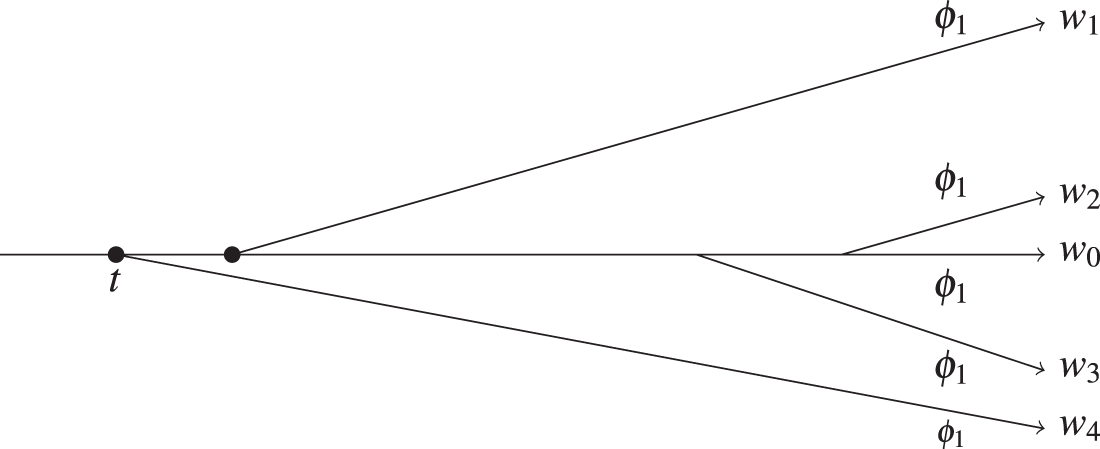
The meaning of (offer)-will is represented in Figure 2 below. Time  $t$ represents the actual world at
 $t$, and the lines branching off represent the worlds maximally consistent with the director’s ability and their commitments as well as the elided conditional antecedent. If, for some
 $d$,
 $\phi_1$, all
 $_b$(
 $d$)(
 $\phi_1$)(
 $w$)(
 $t$) is true, that means that all the worlds branching off at time
 $t$ are
 $\phi_1$ worlds.
Future reading of will.

Our analysis of offer-can shares certain assumptions with Copley’s (Reference Copley2009) approach to offer-will: similarly to her, we assume that there is an elided conditional that spells out the acceptance condition of the hearer and also that a number of presuppositions have to be met in order to interpret the construction. Yet our assumptions differ in that Copley (Reference Copley2009) presupposes that there is a director that has the ability to ensure that some outcome  $\phi$ happens, while we assume an authority relation between the speaker and the subject of the sentence
 $\alpha$. The authority relation does not guarantee that the action offered will be carried out by
 $\alpha$, but only that the speaker assumes that they are in a position to make
 $\alpha$ carry out the action.Footnote 8
We crucially differ also in that offer-can introduces existential quantification over a set of alternative options that are each a possible outcome related to a problem at hand, while (offer)-will denotes universal quantification over alternative options. As a result, offer-can and offer-will can be seen as duals of each other. A similar duality of can and will can be observed with quantificational modals (cf. Portner Reference Portner2009: 210):Footnote 9

A third difference lies in the nature of the modality that we assume, which is epistemic, while Copley’s (Reference Copley2009) semantics are based on metaphysical modality. Our choice is guided by the fact that we do not use a notion of director, understood as an entity that ensures that  $\phi$ will be brought about. Therefore, we can only consider future branches as envisioned, hence epistemic alternatives, rather than possible futures controlled by an individual or a force.Footnote 10
To conclude the comparison with Copley (Reference Copley2009), we note with an anonymous reviewer that, while with offer-can the conditional can always be silent, there is a preference for a non-silent conditional with offer-will. We advance that the overt conditional ensures that the director presupposition is leveled, and, with it, the homogeneous/universal interpretation of will.
5. Comparison with non-standard conditionals
Our analysis – similarly to that of Copley (Reference Copley2009) – incorporates a silent conditional into the analysis of offer-can. The offer is valid on the condition of acceptance by the hearer. The antecedent of this conditional spells out the pragmatic condition for the realization of the offer. In this sense, our construction is similar to some other non-standard conditionals (see Geis and Lycan Reference Geis and Lycan1993). Offer-can shares several characteristics with non-standard conditionals: the incompatibility of the consequent with then (see Iatridou Reference Iatridou1993), the mobility and optionality of the antecedent, and the loose causal link between the two propositions. COs are particularly similar to biscuit conditionals (BCs) (see Franke Reference Franke2009; Csipak Reference Csipak2018; Rawlins Reference Rawlins2020, a.o.).
5.1. Biscuit conditionals
So-called biscuit conditionals are sentences which have the surface appearance of a conditional, but whose logical form is not conditional:

Accordingto Geis and Lycan (Reference Geis and Lycan1993), biscuit conditionals are a special type of what they call non-conditional conditionals. Such sentences have the syntactic form if A, B, but differ from “standard” conditionals with respect to some core principles. Some of them are replicated below:

We can observe that sentences with offer-can (b-examples below) seem to pattern like biscuit conditionals (a-examples below):

Biscuit conditionals and offer-can seem to have a common point with respect to H: the illocutionary act crucially relies on the propositional content of the consequent, and not on the whole sentence.
Thus, in both cases, the antecedent primarily makes explicit the felicity conditions of the consequent: the latter is added to the common ground, while the former has a discourse-structuring function.

Biscuit conditionals also share with offer-can an aversion to first-person antecedents, but only when they have the illocutionary force of an offer: (39a) cannot be interpreted as such. When biscuit conditionals describe ability or opportunity (see Leclercq and Depraetere Reference Leclercq and Depraetere2022 for the distinction), as in the attested example (39b), they seem to systematically accept speaker reference in the antecedent, with an interpretation similar to (11).

However, a modal in the consequent of a BC, as in (38), only seems to have an epistemic interpretation, which is not the case in the examples we are concerned with. Thus sentences with offer-can cannot be reduced to biscuit conditionals, despite some similarity in the function of the antecedent of the conditional.
5.2. Discourse-structuring conditionals
Discourse-structuring conditionals are a type of conditional very close to biscuit conditionals. They have been described by Csipak (Reference Csipak2018), who suggests the following examples:

Discourse-structuring conditionals, biscuit conditionals, and offer-can have in common that the truth of their consequent seems independent of the antecedent: the consequent can be taken for granted as soon as the conditional is uttered. As close as they are to biscuit conditionals, discourse-structuring conditionals seem to display some properties that differ from these. Some of these are also instantiated by COs: for example, both types of conditional are incompatible with the past tense, and the truth of the antecedent seems to be settled immediately by the participants:


Properties such as (in)compatibility with past tense and relevance of the antecedent might indicate that COs have a discourse-oriented meaning. Csipak (Reference Csipak2018), building on Franke’s (Reference Franke2009) notion, assumes that biscuit conditionals and discourse-structuring conditionals are just conditionals instantiating a peculiar link between the antecedent and the consequent. Notably, they fail to undergo any Ramsey-test-like evaluation:

Yet a major distinction between offer-can and discourse-structuring conditionals is that the former are not in themselves self-verifying utterances. In the case of discourse-structuring conditionals, this property leads to the incompatibility with past tense, because such a temporal setting prevents the self-verification of the utterance.
With respect to offer-can, the incompatibility with past tense could be because such utterances are essentially designed to solve a problem. The speaker is asking for information regarding the preferences of the hearer before committing herself to a proposed resolution of the matter.
5.3. Anankastic conditionals
Anankastic conditionals are a special type of conditionals, notably studied by Von Fintel and Iatridou (Reference Fintel, Kai and Iatridou2005); von Stechow et al. (Reference von Stechow, Krasikova and Penka2006); Condoravdi and Lauer (Reference Condoravdi and Lauer2016), among (many) others. They can be exemplified by a sentence like (44a), and have a structure like (44b).

Anankastics are famously puzzling because the desire report in their antecedent seems to be absent from their paraphrase, a characteristic which blocks a straight-forwardly compositional analysis. They also share some features with offer-can: they both are (unconventional) conditionals; they have a desiderative attitude in their antecedent and a modal in their consequent, and there seems to be an imbalance between the former and the latter.
Anankastic conditionals, however, are easily distinguishable from offer-can. First, anankastics require a strong modal like must in the consequent, while, as discussed above, COs do not allow it. Second, the antecedent of an anankastic is also mobile, but not optional: if it’s not realized, there is simply an assertion of necessity, which is not exactly the same thing. Third, anankastics do seem to respect some criteria of standard conditionals discussed above:

Moreover, the anankastic reading isn’t disturbed by the first person in the antecedent or the consequent:

Thus, overall, sentences with offer-can cannot be reduced to anankastic conditionals.
5.4. Eparkastic conditionals
Nissenbaum (Reference Nissenbaum2005) discusses the problems of “existential anankastic” conditionals, dubbed eparkastic.

The surface structure of eparkastic conditionals is very similar to that of COs: a preference is described in the antecedent, and a weak modal is found in the consequent. Nevertheless, there are some contrasts between COs and eparkastic conditionals that make the latter look more like a special case of anankastic conditionals and the former much more particular. For example, the pronoun then is allowed in eparkastic conditionals, and first person utterances are acceptable:

Moreover, anankastic and eparkastic conditionals have a “rational” paraphrase that is absent from offer-can. This is presumably because the former are closer to standard conditionals than the latter, and also because the modals don’t play the same role.

Hence, COs do not seem teleological in the same sense as eparkastic and anankastic conditionals. That, however, doesn’t mean that the prejacents of an offer-can antecedent or consequent are causally unrelated.
6. Extensions
Once we acknowledge that there is no such thing as a speech act can, but that the commissive interpretation arises from the interplay of several meaning components (that most notably include authority as a parameter), we can shed new light on a series of phenomena, leveling the possible doubt that offer-can is idiosyncratic.
There are at least two other uses of the modal that can be accounted for in a similar manner: the use of can in Austinian pass-me-the-salt type questions (Austin Reference Austin1975) and permission-can.
6.1. Pass-me-the-salt and interrogative flip of authority
Questions like (50) are requests for action that have been described as the speaker questioning someone’s ability to do an action as a way of asking for the action to be done (Gordon and Lakoff Reference Gordon and Lakoff1975).

We submit here the idea that the question is built out of (28), but that the question speech act flips the authority anchor, like in questions with evidentials, where the interrogative flip anchors the addressee as the source of the evidence needed to answer the question (San Roque et al. Reference Roque, Lila and Norcliffe2017; Bhadra Reference Bhadra2020).
Insofar as the interrogative flip proceeds in questions with evidentials, in a nutshell, it has been said what follows (we use the Italian future to illustrate the proposal). Under the assumption that the Italian future has an inferential evidential component, the impossibility of (51) is explained by the fact that the addressee has direct evidence for the answer rather than inferential evidence, as expected by the future.Footnote 12

In other words, the question flips the source of the evidence.
Importantly, this is not a specificity of evidentials. Epistemic modals can be analyzed in exactly the same manner. Example (52) is odd because the addressee has knowledge about her own age, and she is not in a state of epistemic uncertainty, which the modal would expect. There is a flip, and the flip is available with modals as well.Footnote 13

We propose here a more general rule, according to which questions can shift any individual parameter to the addressee, including the authority parameter.

In (50) the speaker has an issue: she needs more salt. She could go downstairs and buy it at the supermarket, but given her practical commitments (to keep on sharing the meal with her family), she prefers to choose the solution whereby her addressee passes her the salt. The question confers authority to the addressee in such a way that, if the addressee agrees, then the addressee performs the passing of the salt (in this case,  $\mathcal{H} = \alpha$). The question serves the purpose of flipping the authority, and because the addressee is in charge of ratifying the offer, she can refuse to act.
6.2. Permission-can
The interplay between core modal meaning and conditional modal meaning giving rise to a speech act-like interpretation is not a peculiarity of offer-can in the assertive case, either. Exactly the same design applies to permission-can.
The permission reading of can is generally categorized under the label deontic, and permission-can is considered to be the counterpart of deontic must (see Portner Reference Portner2009 for extended discussion).

Issuing a permission, however, is also a directive act (Bach and Harnish Reference Bach and Harnish1979). When Flavio asks whether he can go sailing while it rains, and he is allowed to do so, there is nothing properly deontic at stake. Flavio’s parent issues a permission thereby allowing him to go sailing.

Permission-can is very similar to offer-can insofar as the architecture of the semantic core component and the at-issue conditional component are concerned. The main difference, or at least the main point that we want to emphasize here, is the shift in the anchoring of the conditional antecedent in the at-issue component.
At the core semantic level, there is no doubt that the modal bases of permission-can and of offer-can are different. With permission-can, the set of worlds at stake are not issue worlds but goal worlds. However, just as with offer-can (and indeed any modal; see Condoravdi Reference Condoravdi2002; Giannakidou and Mari Reference Giannakidou and Mari2021), the modal base is non-homogeneous: the reaching of the goal might fail.Footnote 14
Important for our comparison is that, as with offer-can, the speaker must have the authority to issue the permission to  $\alpha$.
The main shift is that the conditional is first-person oriented and is akin to If I want to.

This states that on the assumption that  $\alpha$ (the addressee, when the sentence is in the second person) has a telos, that
 $s$ has authority over
 $\alpha$ and that
 $\phi$ is the preferred outcome for
 $\alpha$ (or telos, in this case), then, if the speaker wants,
 $\alpha$ performs
 $\phi$. In other terms, if the speaker agrees, the permission is realized in future worlds by
 $\alpha$. In Geurt’s Reference Geurts(2019: 7) terms, “the basic function of permissives is to remove a potential obstacle on the speaker’s part to a potential action on the part of the addressee.”
We are aware that (56) is only an attempt to account for permission as a notion at the intersection between core modality and speech act uses of modal sentences. What we want to emphasize here is that in the speech act uses of modal sentences, flavours (commissive vs. directive) can be derived by manipulating the anchoring of the authority and of the person responsible for the ratification or the agreement.
7. Conclusion
In this article we have attempted to disentangle a variety of semantic components that play a role in the interpretation of offer-can in commissive statements. We have identified a set of assumptions that can be foregrounded or backgrounded across contexts, as well as a conditional meaning that gives rise to the commissive speech act. We have compared and contrasted this conditional with a variety of non-conditional conditionals, and we believe that it is of a special sort that deserves the dedicated label of conditional offer.
Our analysis shares some important properties with Copley’s (Reference Copley2009) view of offer-will, most notably the ability and authority preconditions. We have diverged in assuming an epistemic modal base rather than a metaphysical one and in elaborating on the notions of goal and solution worlds rather than commitment worlds.
We have suggested the hypothesis that the layered structure distinguishing some modal core components on one hand and a conditional on the other is shared by those modal statements that function as injunctions and directives. The main differences that cut across these uses lie in the anchoring of the authority relation and in the identification of the individual in charge of agreeing that  $p$ comes about. Relatedly, we have also tentatively proposed that questions can flip any individual parameter, including authority. We expect this tentative idea to be the starting point for future research on a larger class of performative statements with modals.
Future work will also ultimately tell whether this layered approach is fruitful enough to reconcile the so-called modal and speech act uses of modals, or whether an ambiguity account – wherein modals are able to be interpreted at the sentential or at the sub-sentential level – is, after all, preferable.
Acknowledgements
We are very grateful to the two anonymous reviewers for their insightful and precious comments. Marta Abrusan and Alda Mari gratefully thank ANR-17-EURE-0017 FrontCog. The order of the authors is purely alphabetical.