


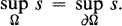
 and subharmonic on Ω, then



Crossref Citations

This article has been cited by the following publications. This list is generated based on data provided by Crossref.
Gardiner, Stephen J.
1993.
The Dirichlet problem with non-compact boundary.
Mathematische Zeitschrift,
Vol. 213,
Issue. 1,
p.
163.
Gauthier, Paul M.
1994.
Complex Potential Theory.
p.
235.
Armitage, D. H.
and
Gauthier, P. M.
1996.
Recent Developments In Harmonic Approximation, With Applications.
Results in Mathematics,
Vol. 29,
Issue. 1-2,
p.
1.
Bonilla, A.
Pérez-González, F.
and
Trujillo-González, R.
1996.
Mergelyan sets for certain classes of harmonic functions.
Complex Variables, Theory and Application: An International Journal,
Vol. 31,
Issue. 1,
p.
9.
Jin, Zhiren
and
Lancaster, Kirk
2002.
A MAXIMUM PRINCIPLE FOR SOLUTIONS OF A CLASS OF QUASILINEAR ELLIPTIC EQUATIONS ON UNBOUNDED DOMAINS.
Communications in Partial Differential Equations,
Vol. 27,
Issue. 7-8,
p.
1271.
Gardiner, Stephen J.
2004.
Completeness of Spaces of Harmonic Functions under Restricted Supremum Norms.
Computational Methods and Function Theory,
Vol. 4,
Issue. 1,
p.
43.
Gardiner, Stephen J.
2008.
Asymptotic Maximum Principles for Subharmonic Functions.
Computational Methods and Function Theory,
Vol. 8,
Issue. 1,
p.
167.
Defant, Andreas
García, Domingo
Maestre, Manuel
and
Sevilla-Peris, Pablo
2018.
Dirichlet series from the infinite dimensional point of view.
Functiones et Approximatio Commentarii Mathematici,
Vol. 59,
Issue. 2,
p.
285.
Meda, Stefano
and
Veronelli, Giona
2022.
Local Riesz Transform and Local Hardy Spaces on Riemannian Manifolds with Bounded Geometry.
The Journal of Geometric Analysis,
Vol. 32,
Issue. 2,