Hostname: page-component-7b7567c8c-2jgqx Total loading time: 0 Render date: 2026-11-19T08:29:27.559Z Has data issue: false hasContentIssue false

The Heat Equation for the -Neumann Problem, II

Published online by Cambridge University Press:  20 November 2018

Richard Beals
Affiliation:
Yale University, New Haven, Connecticut
Nancy K. Stanton
Affiliation:
University of Notre Dame, Notre Dame, Indiana
Rights & Permissions [Opens in a new window]

Extract

Core share and HTML view are not available for this content. However, as you have access to this content, a full PDF is available via the 'Save PDF' action button.

Let Ω be a compact complex n + 1-dimensional Hermitian manifold with smooth boundary M. In [2] we proved the following.

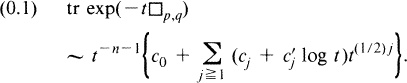
THEOREM 1. Suppose satisfies condition Z(q) with 0 ≦ q ≦ n. Let □p,q denote the -Laplacian on (p, q) forms onwhich satisfy the -Neumann boundary conditions. Then as t → 0;,

(0.1)

(If q = n + 1, the -Neumann boundary condition is the Dirichlet boundary condition and the corresponding result is classical.)

Theorem 1 is a version for the -Neumann problem of results initiated by Minakshisundaram and Pleijel [8] for the Laplacian on compact manifolds and extended by McKean and Singer [7] to the Laplacian with Dirichlet or Neumann boundary conditions and by Greiner [5] and Seeley [9] to elliptic boundary value problems on compact manifolds with boundary. McKean and Singer go on to show that the coefficients in the trace expansion are integrals of local geometric invariants.

Information

Type
Research Article
Copyright
Copyright © Canadian Mathematical Society 1988