






Hostname: page-component-7b7567c8c-2n9c9 Total loading time: 0 Render date: 2026-11-16T20:00:17.227Z Has data issue: false hasContentIssue false

Optimal Polynomial Recurrence

Published online by Cambridge University Press:  20 November 2018

Neil Lyall
Affiliation:
Department of Mathematics, The University of Georgia, Athens, GA 30602, USA, e-mail: lyall@math.uga.edu
Ákos Magyar
Affiliation:
Department of Mathematics, University of British Columbia, Vancouver, BC V6T 1Z2, e-mail: magyar@math.ubc.ca
Rights & Permissions [Opens in a new window]

Abstract

Core share and HTML view are not available for this content. However, as you have access to this content, a full PDF is available via the 'Save PDF' action button.

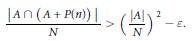
Let $P\in \mathbb{Z}\left[ n \right]$ with $P(0)\,=\,0\,\text{and}\,\varepsilon \,>\,0$ . We show, using Fourier analytic techniques, that if $N\ge \exp \exp \left( C{{\varepsilon }^{-1}}\log {{\varepsilon }^{-1}} \right)\,\text{and}\,A\,\subseteq \,\left\{ 1,\,.\,.\,.\,,\,N \right\}$ then there must exist $n\in \mathbb{N}$ such that

$$\frac{\left| A\cap \left( A+P\left( n \right) \right) \right|}{N}>{{\left( \frac{\left| A \right|}{N} \right)}^{2}}-\,\varepsilon $$
.

In addition to this we show, using the same Fourier analytic methods, that if $A\subseteq \mathbb{N}$ , then the setof $\varepsilon $ -optimal return times

$$R\left( A,P,\varepsilon\right)=\left\{ n\in \mathbb{N}:\delta \left( A\cap \left. \left( A+P\left( n \right) \right) \right)> \right.\delta {{\left( A \right)}^{2}}-\varepsilon\right\}$$

is syndetic for every $\varepsilon >0$ . Moreover, we show that $R\left( A,\,P,\,\varepsilon\right)$ is dense in every sufficiently long interval, in particular we show that there exists an $L=L\left( \varepsilon ,P,A \right)$ such that

$$\left| R\left( A,P,\varepsilon\right)\cap I \right|\ge c\left( \varepsilon ,P \right)\left| I \right|$$

for all intervals $I$ of natural numbers with $\left| I \right|\,\ge \,L\,\text{and}\,c\left( \varepsilon ,\,P \right)\,=\,\exp \exp \,\left( -C\,{{\varepsilon }^{-1}}\,\log {{\varepsilon }^{-1}} \right).$

Information

Type
Research Article
Copyright
Copyright © Canadian Mathematical Society 2013