Contents
Research Article
A Construction in General Radical Theory
-
- Published online by Cambridge University Press:
- 20 November 2018, pp. 1097-1100
-
- Article
-
- You have access
- Export citation
-
Given an arbitrary associative ring R we consider the ring R[x] of polynomials over R in the commutative indeterminate x. For each radical property S we define the function S * which assigns to each ring R the ideal

of R. It is shown that the property SA (that a ring R be equal to S *(R)) is a radical property. If S is semiprime, then SA is semiprime also. If S is a special radical, then SA is a special radical. SA is always contained in S. A necessary and sufficient condition that S and SA coincide is given.
The results are generalized in the last section to include extensions of R other than R[x], One such extension is the semigroup ring R[A], where A is a semigroup with an identity adjoined.

Commutative Self-Injective Rings
-
- Published online by Cambridge University Press:
- 20 November 2018, pp. 1101-1108
-
- Article
-
- You have access
- Export citation
Remarks on Op and Towber Rings
-
- Published online by Cambridge University Press:
- 20 November 2018, pp. 1109-1117
-
- Article
-
- You have access
- Export citation
A Generalization of Final Rank of Primary Abelian Groups
-
- Published online by Cambridge University Press:
- 20 November 2018, pp. 1118-1122
-
- Article
-
- You have access
- Export citation
Equivalence Locale des Structures de Contact de Codimension Un
-
- Published online by Cambridge University Press:
- 20 November 2018, pp. 1123-1128
-
- Article
-
- You have access
- Export citation
Suspension of the Lusternik-Schnirelmann Category
-
- Published online by Cambridge University Press:
- 20 November 2018, pp. 1129-1132
-
- Article
-
- You have access
- Export citation
-
Let cat be the Lusternik-Schnirelmann category structure as defined by Whitehead [6] and let
 be the category structure as defined by Ganea [2],
We prove that

and

It is known that w ∑ cat X = conil X for connected X. Dually, if X is simply connected,

1. We work in the category
 of based topological spaces with the based homotopy type of CW-complexes and based homotopy classes of maps. We do not distinguish between a map and its homotopy class. Constant maps are denoted by 0 and identity maps by 1.
We recall some notions from Peterson's theory of structures [5; 1] which unify the definitions of the numerical homotopy invariants akin to the Lusternik-Schnirelmann category.
 be the category structure as defined by Ganea [


 of based topological spaces with the based homotopy type of CW-complexes and based homotopy classes of maps. We do not distinguish between a map and its homotopy class. Constant maps are denoted by 0 and identity maps by 1.
Algebraic Extensions of Commutative Regular Rings
-
- Published online by Cambridge University Press:
- 20 November 2018, pp. 1133-1155
-
- Article
-
- You have access
- Export citation
Growth and Decay Estimates near Non-Elementary Stationary Points
-
- Published online by Cambridge University Press:
- 20 November 2018, pp. 1156-1167
-
- Article
-
- You have access
- Export citation
-
Local growth and decay estimates near the stationary point at the origin are derived in § 3 for solutions of the vector system,
(1)

where A(x) and B(y) are homogeneous of degree m > 1 in the components of x and y, respectively, and f* and g* are of order greater than m in ‖(x, y)‖ near the origin. It is assumed that x = 0 is asymptotically stable and y = 0 is asymptotically unstable for the homogeneous systems of first approximation,
(2)
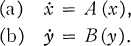
In order to derive the estimates in § 3, various results are needed concerning solutions of a homogeneous system such as (2) (a). These are derived in § 2 and are based on work of Hahn [4; 5], Lefschetz [8], and Zubov [12].
Ideal Extensions of Topological Semigroups
-
- Published online by Cambridge University Press:
- 20 November 2018, pp. 1168-1175
-
- Article
-
- You have access
- Export citation
On Quasi-Essential Subgroups of Primary Abelian Groups
-
- Published online by Cambridge University Press:
- 20 November 2018, pp. 1176-1184
-
- Article
-
- You have access
- Export citation
-
All groups considered in this paper are abelian. A subgroup N of a group G is said to be a quasi-essential subgroup of G if G = 〈H, K〉 whenever H is an N-high subgroup of G and K is a pure subgroup of G containing N. We started the study of such subgroups in [5]; in particular, we characterized subsocles of a primary group which were both quasi-essential and centres of purity. In this paper we show that quasi-essential subsocles of a primary group are necessarily centres of purity answering thus in the affirmative a question raised in [5].
We obtain the following theorem: A subsocle S of a p-group G is quasi-essential if and only if either S ⊂ G 1or (pnG)[p] ⊃ S ⊃ (p n+1 G)[p] for some non-negative integer n. The notation is that of [1]. If G is a group, then

where p is a prime integer.
Some Addition Theorems of Group Theory with Applications to Graph Theory
-
- Published online by Cambridge University Press:
- 20 November 2018, pp. 1185-1195
-
- Article
-
- You have access
- Export citation
Full-Completeness in Weighted Spaces
-
- Published online by Cambridge University Press:
- 20 November 2018, pp. 1196-1207
-
- Article
-
- You have access
- Export citation
Perfect Mappings and Spaces of Countable Type
-
- Published online by Cambridge University Press:
- 20 November 2018, pp. 1208-1210
-
- Article
-
- You have access
- Export citation
-
In [1, p. 41, Theorem 3.10] Arhangel'skiï proved that the perfect image of a completely regular space of countable type is of countable type, and he asked [1, p. 60, problem 4] if a similar result held for regular or Hausdorff spaces. In this paper, it is proved that the perfect image of a space of countable type is of countable type, provided that the image is Hausdorff or regular. An affirmative answer to both of Arhangel'skiï's questions follows immediately from this. Arhangel'skiï made use of the Stone-Čech compactification in the proof of his result, but the proofs below are of a different nature.
Let X be a topological space and let K ⊂ X. A collection
 of open sets is called a base at K provided that for every open set W ⊃ K there exists
 such that K ⊂ U ⊂ W. Clearly, we may assume that every member of contains K.
 of open sets is called a base at K provided that for every open set W ⊃ K there exists
 such that K ⊂ U ⊂ W. Clearly, we may assume that every member of
On the Nilpotency of Nil Subrings
-
- Published online by Cambridge University Press:
- 20 November 2018, pp. 1211-1216
-
- Article
-
- You have access
- Export citation
Homology of Deleted Products of Contractible 2-Dimensional Polyhedra. III
-
- Published online by Cambridge University Press:
- 20 November 2018, pp. 1217-1223
-
- Article
-
- You have access
- Export citation
A Difference-Differential Basis Theorem
-
- Published online by Cambridge University Press:
- 20 November 2018, pp. 1224-1237
-
- Article
-
- You have access
- Export citation
-
Our aim in this paper is to extend to difference-differential rings the beautiful theorem of Kolchin [5, Theorem 3] for the differential case. The necessity portion of Kolchin's result is not obtained.
What might well be called the Ritt basis theorem states that if a commutative ring R with identity is finitely generated over a subring R 0, then the ascending chain condition for radical ideals of R 0 implies the ascending chain condition for radical ideals of R. (This is indeed a basis theorem. If we define a basis for a radical ideal A to be a finite set B such that
 then every radical ideal of a ring R has a basis if and only if the ascending chain condition for radical ideals holds in R.) It is the Ritt basis theorem rather than the Hilbert basis theorem which has appropriate generalizations in differential and difference algebra, where in fact it originated.
 then every radical ideal of a ring R has a basis if and only if the ascending chain condition for radical ideals holds in R.) It is the Ritt basis theorem rather than the Hilbert basis theorem which has appropriate generalizations in differential and difference algebra, where in fact it originated.
Higher Monotonicity Properties of Certain Sturm-Liouville Functions. III
-
- Published online by Cambridge University Press:
- 20 November 2018, pp. 1238-1265
-
- Article
-
- You have access
- Export citation
-
A Sturm-Liouville function is simply a non-trivial solution of the Sturm-Liouville differential equation
(1.1)

considered, together with everything else in this study, in the real domain. The associated quantities whose higher monotonicity properties are determined here are defined, for fixed λ > –1, to be
(1.2)

where y(x) is an arbitrary (non-trivial) solution of (1.1) and x 1, x 2, … is any finite or infinite sequence of consecutive zeros of any non-trivial solution z(x) of (1.1) which may or may not be linearly independent of y(x). The condition λ > –1 is required to assure convergence of the integral defining Mk , and the function W(x) is taken subject to the same restriction.

Ideals in Rings of Analytic Functions with Smooth Boundary Values
-
- Published online by Cambridge University Press:
- 20 November 2018, pp. 1266-1283
-
- Article
-
- You have access
- Export citation
-
Let A denote the Banach algebra of functions analytic in the open unit disc D and continuous in
 . If f and its first m derivatives belong to A, then the boundary function f(eiθ) belongs to Cm(∂D). The space Am of all such functions is a Banach algebra with the topology induced by Cm(∂D). If all the derivatives of/ belong to A, then the boundary function belongs to C∞(∂D), and the space A∞ all such functions is a topological algebra with the topology induced by C∞(∂D). In this paper we determine the structure of the closed ideals of A∞ (Theorem 5.3).
Beurling and Rudin (see e.g. [7, pp. 82-89; 10]) have characterized the closed ideals of A, and their solution suggests a possible structure for the closed ideals of A ∞.
 . If f and its first m derivatives belong to A, then the boundary function f(e
On Existence of Distinct Representative Sets for Subsets of a Finite Set
-
- Published online by Cambridge University Press:
- 20 November 2018, pp. 1284-1292
-
- Article
-
- You have access
- Export citation