Contents
Research Article
Finite Groups Admitting an Automorphism Trivial on a Sylow 2-Subgroup
-
- Published online by Cambridge University Press:
- 20 November 2018, pp. 889-896
-
- Article
-
- You have access
- Export citation
A Characterization of Starshaped Sets
-
- Published online by Cambridge University Press:
- 20 November 2018, pp. 673-680
-
- Article
-
- You have access
- Export citation
Green's Potentials with Prescribed Boundary Values
-
- Published online by Cambridge University Press:
- 20 November 2018, pp. 681-686
-
- Article
-
- You have access
- Export citation
-
Let U, C denote the open unit disk and unit circumference, respectively and G(z, w) be the Green's function on U. We say v is the Green's potential of a mass distribution v on U if


Weak q-Rings
-
- Published online by Cambridge University Press:
- 20 November 2018, pp. 687-695
-
- Article
-
- You have access
- Export citation
Systems that are Purely Simple and Pure Injegtive
-
- Published online by Cambridge University Press:
- 20 November 2018, pp. 696-700
-
- Article
-
- You have access
- Export citation
Complex Approximation and Simultaneous Interpolation on Closed Sets
-
- Published online by Cambridge University Press:
- 20 November 2018, pp. 701-706
-
- Article
-
- You have access
- Export citation
A Topological Characterization of Conjugate Nets
-
- Published online by Cambridge University Press:
- 20 November 2018, pp. 707-721
-
- Article
-
- You have access
- Export citation
CPI-Extensions: Overrings of Integral Domains with Special Prime Spectrums
-
- Published online by Cambridge University Press:
- 20 November 2018, pp. 722-737
-
- Article
-
- You have access
- Export citation
A Canonical Factorization for Graph Homomorphisms
-
- Published online by Cambridge University Press:
- 20 November 2018, pp. 738-743
-
- Article
-
- You have access
- Export citation
Changes of Variables Preserving Fourier-Stieltjes Transforms on Simply Connected Nilpotent Lie Groups
-
- Published online by Cambridge University Press:
- 20 November 2018, pp. 744-755
-
- Article
-
- You have access
- Export citation
-
In [1] Beurling and Helson prove the following theorem.
THEOREM. Let φ: R → R be a continuous map such that

Then φ is affine. (Here
 denotes the space of Fourier-Stieltjes transforms on R.)

 denotes the space of Fourier-Stieltjes transforms on R.)
Cyclic Transformations of Polygons and the Generalized Inverse
-
- Published online by Cambridge University Press:
- 20 November 2018, pp. 756-770
-
- Article
-
- You have access
- Export citation
The Caratheodory Metric and its Majorant Metrics
-
- Published online by Cambridge University Press:
- 20 November 2018, pp. 771-780
-
- Article
-
- You have access
- Export citation
-
One of the main purposes of the present paper is to provide a proof for the following statement:
Theorem A. Let M be a complex manifold of a complex dimension n. Let
 be a fixed point in M such that there exists a square integrable holomorphic n-form a(z) on M with
 .
 be a fixed point in M such that there exists a square integrable holomorphic n-form a(z) on M with
 .
Best Trigonometric Approximation, Fractional Order Derivatives and Lipschitz Classes
-
- Published online by Cambridge University Press:
- 20 November 2018, pp. 781-793
-
- Article
-
- You have access
- Export citation
-
Let C 2π denote the space of 2π-periodic continuous functions and πn the set of trigonometric polynomials of degree ≦ n, where n ϵ P = {0, 1, … } . Given θ > 0, the well-known theorem of Stečkin and its converse state that the best approximation of an ƒ ϵ C 2π with respect to the max-norm satisfies

Rice Theorems for ∑n -1 Sets
-
- Published online by Cambridge University Press:
- 20 November 2018, pp. 794-805
-
- Article
-
- You have access
- Export citation
On Upcrossing Probabilities
-
- Published online by Cambridge University Press:
- 20 November 2018, pp. 806-818
-
- Article
-
- You have access
- Export citation
On the Distribution Modulo 1 of the Sequence αn 2 + βn
-
- Published online by Cambridge University Press:
- 20 November 2018, pp. 819-826
-
- Article
-
- You have access
- Export citation
-
Dirichlet's Theorem says that for any real α and for N ≧ 1, there exists a natural n ≦ N with

where || || denotes the distance to the nearest integer. Heilbronn [2], improving estimates of Vinogradov [3], showed that for α, N as above and for ϵ ≧ 0, there exists an n ≦ N with


Certain Integral Equalities which Imply Equimeasurability of Functions
-
- Published online by Cambridge University Press:
- 20 November 2018, pp. 827-844
-
- Article
-
- You have access
- Export citation
-
1.1. Two complex measurable functions/ and g on complex measure spaces (X, η) and (Y, v) are equimeasurable, abbreviated ƒ ∼ g, if

for every Borel set E ⊆ C. If Φ is a continuous complex function on C, then we make the following standing hypothesis (HI) which relates Φ, f, and g:
(HI) For all α, β ∊ C, we have
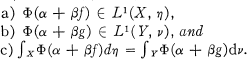
On Rank 3 Groups Having λ = 0
-
- Published online by Cambridge University Press:
- 20 November 2018, pp. 845-847
-
- Article
-
- You have access
- Export citation
A Sufficient Condition for Solvability in Groups Admitting Elementary Abelian Operator Groups
-
- Published online by Cambridge University Press:
- 20 November 2018, pp. 848-855
-
- Article
-
- You have access
- Export citation
On Some Classes of Primary Banach Spaces
-
- Published online by Cambridge University Press:
- 20 November 2018, pp. 856-873
-
- Article
-
- You have access
- Export citation