


Hostname: page-component-7b7567c8c-7pwfn Total loading time: 0 Render date: 2026-11-16T17:31:10.212Z Has data issue: false hasContentIssue false

On a New Exponential Sum

Published online by Cambridge University Press:  20 November 2018

Daniel Lieman
Affiliation:
Department of Mathematics University of Missouri Columbia, Missouri 65211 USA, email: lieman@math.missouri.edu
Igor Shparlinski
Affiliation:
Department of Computing Macquarie University NSW 2109 Australia, email: igor@comp.mq.edu.au
Rights & Permissions [Opens in a new window]

Abstract

Core share and HTML view are not available for this content. However, as you have access to this content, a full PDF is available via the 'Save PDF' action button.

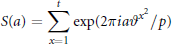
Let $p$ be prime and let $\vartheta \,\in \,\mathbb{Z}_{p}^{*}$ be of multiplicative order $t$ modulo $p$ . We consider exponential sums of the form

$$S\left( a \right)\,=\,\sum\limits_{x=1}^{t}{\exp \left( 2\pi ia{{\vartheta }^{{{x}^{2}}}}\,/\,p \right)}$$

and prove that for any $\varepsilon \,>\,0$

$$\underset{\gcd (a,\,p)\,=\,1}{\mathop{\max }}\,\,\left| S\left( a \right) \right|\,=\,O\left( {{t}^{5/6+\varepsilon }}\,{{p}^{1/8}} \right)$$

Information

Type
Research Article
Copyright
Copyright © Canadian Mathematical Society 2001