



Hostname: page-component-7b7567c8c-8p88z Total loading time: 0 Render date: 2026-11-19T12:21:04.969Z Has data issue: false hasContentIssue false

Small Prime Solutions to Cubic Diophantine Equations II

Published online by Cambridge University Press:  20 November 2018

Zhixin Liu*
Affiliation:
Department of Mathematics, School of Science, Tianjin University, Tianjin 300072, P. R. China e-mail: zhixinliu@tju.edu.cn
Rights & Permissions [Opens in a new window]

Abstract

Core share and HTML view are not available for this content. However, as you have access to this content, a full PDF is available via the 'Save PDF' action button.

Let ${{a}_{1}},\,.\,.\,.\,,\,{{a}_{9}}$ be non-zero integers and $n$ any integer. Suppose that ${{a}_{1}}\,+\,.\,.\,.\,+\,{{a}_{9}}\,\equiv \,n$ $\left( \bmod \,2 \right)$ and $\left( {{a}_{i}},\,{{a}_{i}} \right)\,=\,1$ for $1\,\le \,i\,<\,j\le \,9$ . In this paper we prove that

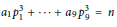
  • (i) if ${{a}_{j}}$ are not all of the same sign, then the cubic equation ${{a}_{1}}p_{1}^{3}\,+\,.\,.\,.\,+\,{{a}_{9}}p_{9}^{3}\,=\,n$ has prime solutions satisfying ${{p}_{j}}\,\ll \,{{\left| n \right|}^{{1}/{3}\;}}\,+\,\max {{\left\{ \left| {{a}_{j}} \right| \right\}}^{8+\varepsilon }}$ ;

  • (ii) if all ${{a}_{j}}$ are positive and $n\,\gg \,\max {{\left\{ \left| {{a}_{j}} \right| \right\}}^{25+\varepsilon }}$ , then ${{a}_{1}}p_{1}^{3}\,+\,.\,.\,.\,+\,{{a}_{j}}p_{9}^{3}\,=\,n$ is soluble in primes $Pj$ .

These results improve our previous results with the bounds $\max {{\left\{ \left| {{a}_{j}} \right| \right\}}^{14+\varepsilon }}$ and $\max \,{{\left\{ \left| {{a}_{j}} \right| \right\}}^{43+\varepsilon }}$ in place of $\max {{\left\{ \left| {{a}_{j}} \right| \right\}}^{8+\varepsilon }}$ and $\max {{\left\{ \left| {{a}_{j}} \right| \right\}}^{25+\varepsilon }}$ above, respectively.

Information

Type
Research Article
Copyright
Copyright © Canadian Mathematical Society 2016