





No CrossRef data available.
Article contents
Subproducts of small residue classes
Published online by Cambridge University Press: 13 January 2021
Abstract
Core share and HTML view are not available for this content. However, as you have access to this content, a full PDF is available via the 'Save PDF' action button.
For any prime p, let  $y(p)$ denote the smallest integer y such that every reduced residue class (mod p) is represented by the product of some subset of
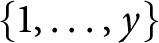 $\{1,\dots ,y\}$. It is easy to see that
 $y(p)$ is at least as large as the smallest quadratic nonresidue (mod p); we prove that
 $y(p) \ll _\varepsilon p^{1/(4 \sqrt e)+\varepsilon }$, thus strengthening Burgess’ classical result. This result is of intermediate strength between two other results, namely Burthe’s proof that the multiplicative group (mod p) is generated by the integers up to
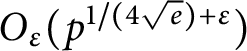 $O_\varepsilon (p^{1/(4 \sqrt e)+\varepsilon })$, and Munsch and Shparlinski’s result that every reduced residue class (mod p) is represented by the product of some subset of the primes up to
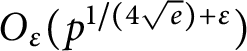 $O_\varepsilon (p^{1/(4 \sqrt e)+\varepsilon })$. Unlike the latter result, our proof is elementary and similar in structure to Burgess’ proof for the least quadratic nonresidue.
MSC classification
Secondary:11L40: Estimates on character sums
Information
- Type
- Article
- Information
- Copyright
- © Canadian Mathematical Society 2021
References
Booker, A. R. and Pomerance, C.,
Squarefree smooth numbers and euclidean prime generators
. Proc. Amer. Math. Soc. 145(2017), no. 12, 5035–5042. MR3717934.CrossRefGoogle Scholar
Burgess, D. A.,
The distribution of quadratic residues and non-residues
. Mathematika 4(1957), 106–112. MR0093504.CrossRefGoogle Scholar
Burthe, R. J. Jr.,
Upper bounds for least witnesses and generating sets.
Acta Arith. 80(1997), no. 4, 311–326. MR1450926.10.4064/aa-80-4-311-326CrossRefGoogle Scholar
Montgomery, H. L. and Vaughan, R. C., Multiplicative number theory. I. Classical theory. Cambridge Studies in Advanced Mathematics, 97, Cambridge University Press, Cambridge, 2007. MR2378655.Google Scholar
Munsch, M. and Shparlinski, I. E.,
On smooth square-free numbers in arithmetic progressions
. J. Lond. Math. Soc. (2) 101(2020), no. 3, 1041–1067. MR4111934.CrossRefGoogle Scholar
Parvardi, A., Various problems on subproducts of residue classes modulo a prime. Master’s thesis, University of British Columbia, 2019.Google Scholar
Pollack, P.,
The average least quadratic nonresidue modulo m and other variations on a theme of Erdos
. J. Number Theory 132(2012), no. 6, 1185–1202.10.1016/j.jnt.2011.12.015CrossRefGoogle Scholar
 You have Access