Anatomic considerations
Pulmonary regurgitation is not usually found as an isolated congenital lesion, although a small degree of pulmonary regurgitation can be a common echocardiographic finding in otherwise structurally normal hearts. Instead, most cases of pulmonary regurgitation are an undesirable result of surgical or catheter interventional procedures to relieve obstruction of the right ventricular outflow tract. The most common situations are after repair of tetralogy of Fallot, or after surgical or balloon valvoplasty of a stenotic pulmonary valve. The absent pulmonary valve syndrome is a rare manifestation that comprises a wide range of congenital anomalies of the pulmonary valve, and which may lead to pulmonary regurgitation. There can be faulty development of one, two or all three leaflets of the valve, typically with dysplastic nodules, which are remmants of the valvar leaflets, formed in annular fashion at the ventriculo-arterial junction. It is very rare for the valvar leaflets to be completely absent. The syndrome is usually associated with tetralogy of Fallot or ventricular septal defect, although it also can be found in isolation.1
Most patients have an excellent prognosis after successful repair of tetralogy of Fallot.2, 3 Use of a transjunctional, usually called a transannular patch, more liberally practiced in an earlier era to relieve the obstruction across the right ventricular outflow tract, has been shown to correlate in many patients with the development of residual pulmonary regurgitation. Furthermore, transjunctional patching, reconstruction of the right ventricular outflow tract, and/or aggressive infundibulectomy, may also lead to the formation of aneurysmal or akinetic regions in the right ventricular outflow tract. The presence of these aneurysmal and akinetic regions, in combination with chronic pulmonary regurgitation, may further contribute to the development of right ventricular dysfunction.4 As a result, routine and generous transjunctional patching has been abandoned, and a limited transannular patch, combined with preservation of pulmonary valvar function, has become the current surgical goal while obviously still seeking adequately to relieve any obstruction within the right ventricular outflow tract.
Balloon valvoplasty is the treatment of choice for patients with moderate or severe pulmonary stenosis, with the exception of patients with dysplastic valves or those with primarily subvalvar or supravalvar pulmonary stenosis. For these patients, surgical relief of the obstruction is often required. Some degree of valvar incompetence occurs in more than seven-tenths of the patients after both procedures,5–9 although it appears to be less frequent after balloon valvoplasty.10 In the Second Natural History Study of Congenital Heart Defects, almost nine-tenths of the patients undergoing surgery had pulmonary regurgitation on echocardiography, which was more than moderate in over one-quarter of the population.7 There are some discrepancies between the echocardiographic and the clinical findings. When using clinical criterions, just over half of the patients had clinical evidence of pulmonary regurgitation, but only less than one-tenth were classified as having severe regurgitation.7
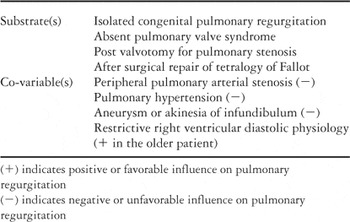
Basic pathophysiology (Table 1)
Table 1.
The pathophysiology of chronic pulmonary regurgitation.
The adaptative response of the right ventricle to volume overload resulting from pulmonary regurgitation depends on the degree and duration of the regurgitant flow.11 More than moderate chronic pulmonary regurgitation produces right ventricular volume overload, with increased end-diastolic volume followed in time by an increase of end-systolic ventricular volume, and progressive deterioration of myocardial systolic function. It is of interest that immediate postoperative pulmonary regurgitation is well tolerated after repair of tetralogy of Fallot in infancy. In contrast, postoperative pulmonary regurgitation is poorly tolerated in the adult following late repair. This may relate to poor adaptation of a hypertrophied and poorly compliant right ventricle, further compromised with acute volume overload in case of significant postoperative pulmonary regurgitation. Adults, therefore, usually require implantation of a pulmonary valve at the time of surgical repair.
Marked dilation of the right ventricle can lead to the development of secondary tricuspid regurgitation, which contributes to further dilation of the right ventricle and right atrium. Furthermore, the stretch and dilation of the right ventricle slows interventricular conduction, and creates a mechanoelectrical substrate for re-entry circuits, which may lead to sustained ventricular tachycardia. There is a correlation between prolongation of the QRS complex and right ventricular dilation. A duration of 180 milliseconds or more is shown to be a highly sensitive predictor of life-threatening ventricular arrhythmias in patients who have undergone previous surgical repair of tetralogy.12 While lengthening of the complex seen soon after repair reflects a surgical injury to the myocardium or the right bundle branch, a late progressive prolongation relates to right ventricular dilation, usually due to pulmonary regurgitation. Progressive prolongation may have a greater prognostic effect than the absolute values of the duration of the QRS complex, both for sustained ventricular tachycardia and sudden cardiac death.
Different conditions leading to high pulmonary arterial pressure, such as distal pulmonary arterial stenosis, pulmonary vascular disease, acquired bronchopulmonary disease or left ventricular dysfunction, will increase the degree of pulmonary regurgitation. In patients who have undergone surgical repair of tetralogy of Fallot, the presence of residual distal pulmonary arterial stenosis, or residual shunts, accelerates the development of right ventricular dilation.13
A significant number of patients subsequent to surgical repair of tetralogy of Fallot have restrictive right ventricular diastolic dysfunction, with decreased compliance of the right ventricle. Right ventricular diastolic physiology is defined with Doppler as anterograde laminar diastolic flow in the pulmonary trunk during atrial systole, present throughout the respiratory cycle. In these patients, a stiff right ventricle is acting as a conduit between the right atrium and the pulmonary arterial tree at the end of the diastole, and the anterograde flow of blood to the lungs during late diastole contributes to cardiac output by shortening the duration of pulmonary regurgitation. These patients, therefore, have a smaller right ventricle, and better exercise tolerance.14
The pathophysiology of valvar insufficiency
The diagrams (Fig. 1) depict stages of progressive valvar insufficiency and volume load on the ventricle. The pathophysiology illustrated is in the setting of mitral regurgitation, but the changes in ventricular dimension are similar with aortic insufficiency, and even with right-sided valvar insufficiency for the right ventricle.
Figure 1.
Diagram showing the consequence of valvar regurgitation, shown here in the setting of the mitral valve. Reproduced, with permission, from Carabello BA, Crawford FA. Valvular heart disease. N Engl J Med 1997; 337: 36.
Figure 1a shows the normal situation. As shown in Figure 1b, acute mitral regurgitation leads to increase in end-diastolic volume with reduction in afterload and end-systolic volume. While the ejection fraction is increased, the forward stroke volume is decreased due to the regurgitant volume. Hence, the left atrial pressure is acutely elevated. As shown in Figure 1c, chronic compensated mitral regurgitation leads to eccentric hypertrophy, and even further increase in end-diastolic volume. This increased end-diastolic volume results in increased afterload and increased end-systolic volume. Both the total and forward stroke volumes are increased. The left atrial pressure falls and, in keeping with this, the ejection fraction is above normal. The chronic decompensated mitral regurgitation, as seen in the lower panel of Figure 1c, leads to ventricular failure and an increase in end-systolic volume. Forward stroke volume is decreased, and the ejection fraction becomes normal or lower. The overall progression, therefore, is to produce an increase in end-diastolic volume, followed by increase in end-systolic volume, and finally decrease in ejection fraction. In addition, right ventricular dysfunction also impacts on left ventricular performance. This phenomenon is considerably re-studied with lesions that lead to chronically-dilated right ventricles, such as atrial septal defect and Ebstein's malformation.
Clinical course
Pulmonary regurgitation is usually well tolerated for many years. Patients remain free from symptoms until further right ventricular dilation and systolic dysfunction develop. Some patients with right ventricular dysfunction can be asymptomatic, although some degree of objective exercise intolerance can be found on exercise testing.15 When patients become symptomatic, right ventricular dysfunction is usually well established, and may be irreversible.
In patients with isolated congenital pulmonary regurgitation, and otherwise normal hearts, symptoms are rare before the age of 30 years. After 40 years of age, however, patients develop right ventricular dysfunction and symptoms of right heart failure16 (Fig. 1). Symptoms appear at a younger age in patients subsequent to surgical repair of tetralogy of Fallot. This may relate to the associated lesions, early cyanosis, and the effect of surgery. Clinical manifestations comprise exercise intolerance, congestive heart failure,15 atrial and ventricular arrhythmias,17 and sudden cardiac death.
Clinical assessment
Elevated jugular venous pressure, hepatic enlargement, and peripheral oedema can all be present when there is right ventricular dysfunction with clinical heart failure, albeit that this is uncommon. Most patients would have a right ventricular heave, reflecting right ventricular dilation, best felt in the left sternal border. A dilated pulmonary trunk can be palpated as a systolic expansion in the second left intercostal space.
Auscultation reveals a normal first heart sound. The second sound can be single if there is no pulmonary component to it, reflecting an absent, defective, or stenotic pulmonary valve. If the pulmonary component is present, there is usually wide splitting of the second sound because of delayed pulmonary valvar closure. Splitting characteristically increases with inspiration. Congenital pulmonary valvar regurgitation has a typical murmur, reflecting regurgitant flow at low pressure and low velocity.18 It is a diamond shaped diastolic murmur of low to medium frequency, best heard with the bell of the stethoscope at the second and third left intercostal spaces. The onset of the murmur is delayed after the second sound, and its length is related to the degree of the pulmonary regurgitation. This way, a relatively short diastolic murmur reflects the presence of severe regurgitation.19 There is often also an ejection systolic murmur, reflecting augmented right ventricular stroke volume.
Investigative studies
The electrocardiogram can be normal when the pulmonary regurgitation is mild to moderate. Most patients are in sinus rhythm, although atrial arrhythmias can be present. In patients with isolated pulmonary regurgitation, prolongation of the QRS complex, with rSr' morphology in the right precordial leads, reflects volume overload of the right ventricle. Right bundle branch block is very common, particularly in older patients with tetralogy of Fallot who underwent ventriculotomy. Its presence can make evaluation of right ventricular hypertrophy difficult. The duration of the QRS complex increases with time, reflecting right ventricular enlargement and potentially dysfunction. As discussed before, the duration and change in the QRS complex have prognostic implications for malignant arrhythmia and sudden cardiac death.
Patients with severe pulmonary regurgitation characteristically have dilation of their pulmonary trunk on the chest X-ray, which can reach aneurysmal dimensions in patients with absent pulmonary valve syndrome. There is also right ventricular enlargement, usually proportional to the degree of the pulmonary regurgitation.
Echocardiography permits the evaluation of the morphology of the pulmonary valve and right ventricular outflow tract, and the presence and degree of pulmonary regurgitation. When evaluated by Doppler, regurgitation of more than half,20 and the presence of retrograde colour flow from the distal pulmonary artery or its branches, usually indicates severe regurgitation. A shorter duration of pulmonary regurgitant flow, expressed as a percentage of the total diastolic time on continuous wave Doppler, and a pulmonary regurgitant jet with a diameter of greater than 1 centimeter on color Doppler, both indicate independently severe pulmonary regurgitation.19 The size and function of the right ventricle should also be evaluated. Right ventricular systolic function in the presence of severe pulmonary regurgitation is often normal, but deteriorates with time after prolonged exposure to volume overload. The motion of the muscular ventricular septum is usually abnormal during diastole, reflecting again volume overload. Adults who have undergone surgical repair of tetralogy of Fallot may have restrictive right ventricular physiology. As discussed above, this can easily be detected with pulsed wave Doppler as forward flow of blood to the lungs during diastole coincident with atrial systole. The finding has prognostic implications.
Exercise testing is a useful adjunct for the evaluation of the severity of pulmonary regurgitation and the degree of right ventricular dysfunction. The test objectively documents the functional capacity of the patient, and may reflect overall cardiac output. Changes in exercise capacity documented with serial testing may precede the onset of symptoms, and could be used for defining the optimal timing for surgery on the pulmonary valve.
Magnetic resonance imaging has become the gold standard for the evaluation of the volume and function of both ventricles, as well as the detection of aneurysmal or akinetic regions of the right ventricular outflow tract. The technique also permits the quantification of pulmonary regurgitant fraction, and the identification of residual stenosis in the pulmonary trunk, its branches, and conduits placed between the right ventricle and the pulmonary arteries.4, 21, 22
Cardiac catheterization nowadays is reserved for patients whose hemodynamic assessment cannot accurately be obtained with non-invasive imaging, such as those patients with a pacemaker, or for patients undergoing transcatheter interventions, or as a prelude to surgery, if the latter intervention is deemed necessary.
Strategies for management in hospital and as outpatients
Diuretics are useful when patients develop symptoms of right-sided heart failure. There is evidence that patients with tetralogy of Fallot have neurohormonal activation and impaired cardiac autonomic nervous activity.23, 24 In this setting, therefore, administration of drugs that block neurohormonal activation, such as inhibitors of angiotensin converting enzyme, and beta-blockers, and non-surgical interventions such as physical conditioning, known to impact on the autonomic nervous system, may have prognostic and symptomatic benefits, and even delay the need for further surgery. The potential benefits of these therapies, however, still need to be discerned with controlled trials.
In the setting of perioperative intensive care, there are several strategies to augment cardiac output with or without concomitant improvement in right ventricular function. First, any means of decreasing mean airway pressure in the presence of positive pressure ventilation can be helpful. Second, measures to minimize pulmonary vascular resistance can decrease the afterload burden on the right ventricle. Thus, inhalation of nitric oxide, even in the absence of elevated pulmonary vascular resistance, has been found to improve right ventricular performance. Third, conventional pharmacological agents, such as isoproterenol and milrinone, can be initiated to improve right ventricular performance, but newer agents such as thyroid hormones, vasopressin, B-type natriuretic peptide, and steroid rescue can also be considered. Lastly, more aggressive therapies can be considered, such as resynchronization pacing, extracorporeal support, or even insertion of a right ventricular assist device.
Interventional strategies
It is claimed that replacement of the pulmonary valve because of pulmonary regurgitation is required in about one-sixth of patients after surgical repair of tetralogy of Fallot.25 Replacement can be carried out at low risk, with a perioperative mortality of between 1 and 4 percent,26 and with good midterm survival at 10 years of up to 95 percent.26–28 Patients are likely to require further surgery, as the inserted prostheses have a limited lifespan. Optimal timing of implantation, therefore, is important to preserve right ventricular function. The valve needs to be inserted not too late so as to preserve function, yet not too early to avoid the need for early subsequent implantation of a new valve. Perioperative risk is higher in patients with established ventricular dysfunction at the time of implantation.26 While such patients may still benefit from implantation of a valve, they require optimal perioperative care. In one series, the rate of freedom from replacement at 5 years was 81 percent, 58 percent at 10 years, and 41 percent at 15 years.29 The lifespan of the inserted prostheses is longer in adults. Replacement is best performed with bioprosthetic valves, either homograft or porcine, with a lower rate of overall complications compared to mechanical prostheses, which should no longer be employed for replacement of the pulmonary valve.30,31
Implantation should be considered for symptomatic patients with moderate to severe pulmonary regurgitation, for patients with clinical arrhythmia or progressive right ventricular dilation accompanied by early right ventricular dysfunction and/or new tricuspid regurgitation. Such symptomatic patients with normal or mildly impaired right ventricular function improve clinically. In addition, these patients benefit in terms of ventricular function and their propensity to arrhythmias.28 Asymptomatic patients with right ventricular dilation may also benefit from replacement of the valve by reducing their ventricular volumes and preventing right ventricular dysfunction.32 This approach, however, needs further assessment.
There are contradictory results regarding the recovery of right ventricular function after pulmonary valvar replacement. When replacement is performed in a timely manner, echocardiography usually reveals a reduction of the size of the right ventricle and an improvement in systolic function.28, 33, 34 In contrast, implantation if performed late may fail to lead to improved right ventricle dimensions and systolic function as measured with radionuclide angiography.35 In another study when ventricular dimensions were evaluated with echocardiography in a larger number of patients, the investigators found an improvement in functional status and a decrease in right ventricular dimensions after implantation of a pulmonary valve.28 Differences between imaging modalities may account in part for this discrepancy. In a more recent study, where right ventricular function and degree of pulmonary regurgitation were evaluated with magnetic resonance imaging, right ventricular volumes improved following pulmonary valvar implantation.32 We would argue that, to preserve right ventricular function, replacement of the pulmonary valve should be considered in adults before right ventricular dysfunction ensues.
After valvar replacement, symptomatic patients experience a subjective and objective improvement of their exercise tolerance and overall clinical status relating to recovery of right ventricular function.32–35 The progression of the duration of the QRS complex is stabilized, which can be interpreted as a reduced risk of sustained ventricular tachycardia and sudden cardiac death. When valvar replacement was combined with intraoperative cryoablation, the incidence of atrial and ventricular arrhythmia was also reduced.28
Recently, it has been demonstrated that it is possible to implant a bovine valve mounted in a stent in the pulmonary position percutaneously, albeit with relatively large sized sheaths.36 So far, the technique has been shown to be useful in relieving the obstruction in conduits without major complications, and in restoring competence of the right ventricular outflow tract. Follow-up is short, however, and patients with marked dilation of the right ventricular outflow tract may not be suitable for this approach. Furthermore, the issue of aneurysms or akinesia in the right ventricular outflow tract, which in turns relates to sustained ventricular tachycardia, cannot be addressed solely with a transcatheter approach. Nevertheless, this is an important therapeutic advance, which may also prove to be applicable to other valvar prostheses.
Conclusions
The best strategy for preparing the patient with right ventricular dysfunction is to avoid the situation. This can be achieved by meticulous follow-up of the end-systolic and end-diastolic dimensions of the right ventricle, since these increase before there is a fall in the right ventricular shortening fraction. It is the interaction between the right and left ventricles, along with other anatomic and physiologic parameters, which determines the clinical significance of right ventricular dysfunction.