


Introduction
In the early Cold War, thousands of Greek or Macedonian and North Korean child refugees sought shelter in the Eastern Bloc countries—including in socialist Czechoslovakia—from the Greek Civil War (1946–1949) or the Korean War (1950–1953), respectively. Children made up a significant portion of the approximately 56,000 total refugees from Greece. Specifically, in the case of Czechoslovakia, children accounted for about 5,200 of the 12,100 refugees. Most arrived between April 1948 and December 1949.Footnote 1 Of the 30,000 North Korean orphans relocated to the countries of the Eastern Bloc, approximately 1,800 were hosted by Czechoslovakia, consisting of children, students, as well as about two dozen teachers. They arrived between October 1951 and August 1954.Footnote 2 Besides them, Czechoslovakia also welcomed a group of one hundred Vietnamese children, who arrived in 1956 to receive education, as well as individual children of other nationalities, who mostly settled in the country along with their asylum-seeking families.Footnote 3
The Greek Civil War and the Korean War have been perceived as battlefields for geopolitical clashes between great powers. However, the two conflicts not only determined areas of political friction but also established new platforms for cooperation, solidarity, and empathy. Although the rapprochement between Czechoslovaks and the affected Greek and North Korean populations took place without any extraordinary prior tradition of mutual relations, the newly fostered contact between the populations was far from superficial. While influenced by communist narratives, these relations were also shaped by a humanitarian commitment to assist those who were suffering unjustly.Footnote 4 The prenegotiated arrival of refugee children in Czechoslovakia was thus not merely a political gesture; it was a tangible manifestation of the obligation to help, prompting the domestic population to engage and interact, locally and on a personal level in real time, with the refugee children. Conversely, the refugee children, who represented more than symbols of a proclaimed internationalist solidarity, communicated with the receiving society through their physical presence, articulating their needs and expectations.
These everyday encounters initially occurred primarily at children’s homes, which housed most refugee children, whether orphaned, unaccompanied, or arriving with their families. In contrast to the interwar Czechoslovak residential child care system, which relied primarily on churches and private associations, state-run nurseries and children’s homes experienced significant growth from April 1947 onward.Footnote 5 First established to help orphaned and abandoned children in the context of postwar population displacement and homelessness, these institutions—as emphasized by historian Tara Zahra—played a crucial role in national reconstruction and rehabilitation efforts in areas affected by ethnic cleansing.Footnote 6 These facilities were often established in former German and/or aristocratic properties, seized in acts of postwar retribution, such as the child Holocaust survivors who were accommodated at confiscated châteaus, researched by Rebecca Clifford.Footnote 7 Alongside vacant sanatoria, recreational buildings, and countryside mansions, châteaus as places of residential child care stood at the center of the Czechoslovak humanitarian endeavor as well. The educator Přemysl Pitter, an anti-communist and a pacifist, rescued over 800 children of Jewish, German, Czech, and mixed origin through a relief campaign, and then he housed them in nationalized châteaus near Prague, the Czechoslovak capital.Footnote 8 Châteaus continued hosting children in residential care, including refugees from Greece and North Korea, following the communist transformation of Czechoslovakia after 1948. The same was true for some other Eastern Bloc countries, as shown, for instance, by Eszter Varsa, focusing on Romani and non-Romani children in socialist Hungary.Footnote 9
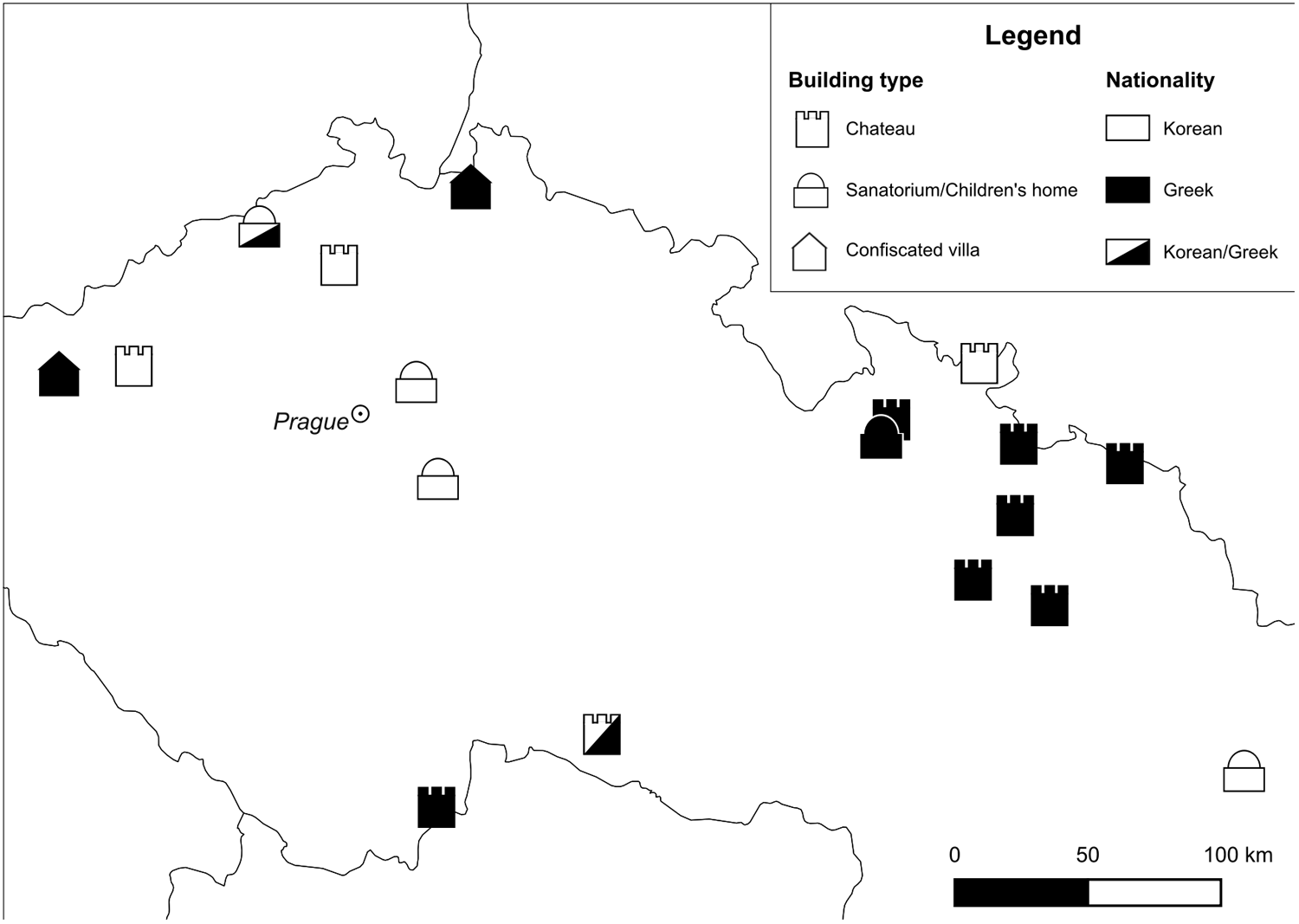
The first Greek and Macedonian children arrived suddenly, and their stay was also originally intended to be temporary. Consequently, the initial accommodations were in dozens of smaller and often hastily constructed facilities dispersed throughout the country, with only a few of them—mostly sanatoria—located in its Slovak part. Some arrangements lasted only for several months.Footnote 10 From January 1952 to December 1954 (for North Koreans, from May 1952 onward), most refugee children were concentrated in eighteen facilities under the administration of the Czechoslovak Red Cross, which was subordinate to the Ministry of Health: ten of them were inhabited by children from Greece, six of them housed North Korean children only, and two of them were ethnically mixed (see Figure 1). Two of these facilities, in Branky and in Budkov, were dedicated to care for infants and preschoolers; the other homes took care of children until the age of fifteen or longer, based on individual cases.Footnote 11 Not segregated by gender and initially educated on the premises at these homes, the children were gradually integrated within the country’s education system and merged into classes for Czechoslovak children. The homes for child refugees themselves became incorporated within the Czechoslovak residential care system, and as of January 1955 they were merged into the Administration of Special Children’s Facilities, an agency of the Ministry of Education overseeing facilities for Czechoslovak children.Footnote 12
Homes for refugee children from Greece and North Korea permanently or temporarily operational under the administration of the Czechoslovak Red Cross, 1952–1954, reduced in number compared to the original situation. Credits: Aneta Plzáková.

During these formative years, with the educational sphere being forged by the principles of socialist collectivism, any forms of foster care other than residential care were effectively marginalized.Footnote 13 Researchers have frequently conceptualized childhood in state socialism as a means of radical social transformation: “a construction related to the socialist utopian ideal,” in which children represented the “embodiment of a new social order.”Footnote 14 Socialist children’s homes, like other types of institutional care, became a tool for this transformation, or for the “engineering” of new socialist citizens as part of a novel educational experiment.Footnote 15 These facilities sought to establish themselves as superior to parental involvement, imposing social control through the ideological shaping of the beliefs and behaviors of both children and their parents, ensuring political loyalty, conformity, and engagement. The children’s homes were thus charged not only with raising orphaned and abandoned children but also those coming from presumably nonfunctional families.Footnote 16
Refugee children’s homes in Czechoslovakia did not fundamentally differ from facilities housing non-refugees, as they were guided by the same educational principles of collectivism, productivity, political loyalty, and patriotism.Footnote 17 Still, they were marked with certain social exclusivity, related to their temporary character as well as their spatial seclusion in areas resettled by adult refugees and affected by ethnic cleansing in the aftermath of the Second World War. The initial ethnic segregation of refugee children from Czechoslovak children was primarily perceived as a matter of security and practicality, yet it soon loosened up due to joint schooling as well as common administration of all children’s facilities.Footnote 18 Thus, what mainly differed were the child residents themselves, the framing of their refugee status and their unique collective and personal experience. From the narrative perspective, the refugee children were expected to export and build communism in their homelands, which imbued the idea of raising loyal comrades with a broader transnational perspective.Footnote 19 As their parents were fighting and fallen partisans, and thus symbolized the imagined heroism and self-sacrifice of the communist struggle, the refugee children themselves were regarded as the future of global communism. For the ruling political elite, helping these children constituted a political mission: it entailed assuming responsibility for the children’s evacuation, medical and social well-being, and education. Although the homes for refugee children raised them to maintain a strong national identity and enforced militarism, the everyday practice of refugee children closely resembled care for non-refugees, providing for their future integration through labor and discipline.
This article thus departs from a strictly ideological interpretation and instead approaches the socialist children’s homes as refugee spaces, but also as socialist spaces symbolizing state socialist approaches to refugee and humanitarian aid.Footnote 20 In so doing, it confronts the top-level policy objectives for the aid provided with everyday humanitarian practices on the ground. It therefore eschews an institution-oriented approach in favor of reconstructing the lived experiences of the child refugees accommodated in these facilities. The article is based on a qualitative analysis of archival documents to delimit these refugee spaces, which it combines with the children’s memories, voiced through oral history interviews and memoirs.Footnote 21 These sources were selected to highlight recollections of places, space, and time, to reflect on the diverse, subjective, and emotional, but also very characteristic and complex perception of state socialist residential child care.Footnote 22 They include the memories of eight Greek and Macedonian refugees (six men and two women): one of whom was a pedagogical supervisor tasked with inspecting children’s homes, while the others were children at the time of their displacement. Although it was already possible, to a certain extent, for these refugees to publicly reflect on their experiences during the communist era; the post-1989 liberalization of Czechoslovakia and later Czech Republic enabled an unrestricted, less politicized, and more independent presentation of their views.Footnote 23 In terms of gender, male refugees have tended to be more vocal about their experiences. They published their memoirs and participated in oral history projects more often than their female counterparts. However, considering this existing imbalance, this analysis could not detect any significant patterns of gender-specific differences in the narratives of female refugees related to their childhood experience.
In contrast to refugees from Greece, North Korean refugees are represented in this article solely through an institutional lens found in the available archival material. Their story is thus mediated by their teachers, caregivers, and external observers. While this methodological approach is no substitute for their personal reflections, the inaccessibility (if not the nonexistence) of similar documents leaves researchers with no other choice. As a result of their forced repatriation in the early 1960s and later social exclusion in authoritarian North Korea, the refugees were not only separated from their former host country, but also were denied the opportunity to reflect on their experience in a public setting. While the voices of Greeks and Macedonians cannot speak for their North Korean counterparts, they do provide insight into the general child refugee experience in socialist Czechoslovakia.
Notwithstanding these constraints, this analysis endeavors to explore the refugee children’s agency through their comprehension of space, place, and temporality, thereby offering microhistorical insights into the phenomenon of early Cold War child refugeedom.Footnote 24 In doing so, it also reflects on the ongoing calls to illuminate “the migrant child[ren]” amid the continuing social processes in which children often remain invisible, seen as mere “appendages” of their parents or simply as “statistics.”Footnote 25 Since the 1970s, children’s agency has been the subject of sustained interest within the fields of psychology and sociology.Footnote 26 In a recent contribution to this area of research, the sociologist David Oswell proposed that the twentieth century might be characterized as “the age of children’s agency”; He posits that children should be understood as “not simply beings” but as “more significantly doings,” that is, as “actors, authors, authorities and agents.”Footnote 27 The interdisciplinary field of childhood studies also became significantly engaged with the concepts of spatiality and temporality.Footnote 28 Abigail Hackett, Lisa Procter, and Julie Seymour emphasized that “agency exists within and between the spaces where children’s lives happen” and that “examining the entanglements between children and the worlds in which they are situated offers new perspectives on how spaces affect and shape children’s experiences and frame how they choose to navigate their lives.”Footnote 29 Elisabeth Curtis then conceptualized children’s temporal experiences and ideas of the past as “a way which recognizes that through living, working, and learning together people simultaneously create and are created by the places in which they live.”Footnote 30
Children’s agency and its spatial and temporal perspective has also become an increasingly important topic when researching the past.Footnote 31 Historians have highlighted the prevalence of misconceptions surrounding children and childhood across a range of historical contexts. In her analysis, Julia Grant characterized children as “unruly, unpredictable, [and] complex,” suggesting that they “cannot easily be encapsulated in a historical narrative.”Footnote 32 Similarly, Nelli Piattoeva, Iveta Silova, and Zsuzsa Millei have critiqued the misrepresentation of socialist childhood as associated negatively with the “East” in public memory. This public memory has failed to decentralize the binary Cold War divide by largely ignoring everyday life, the local level, and children’s agency.Footnote 33 Such discrepancies in understandings of children and childhood were frequently the result of an underlying ideological bias. Lisa A. Kirschenbaum identified a tendency among Russian Bolsheviks “to conflate (or confuse) the ‘real’ children who had to be fed, clothed, and educated and the metaphorical children who stood as icons of the revolution’s future.”Footnote 34 As she affirmed, the Eastern understanding of children as “independent, rational, and powerful agents of revolution” thus developed in opposition to Western emotionally charged visions of childhood as “vulnerable, innocent, dependent, and weak.”Footnote 35 Zsuzsa Millei, Iveta Silova, and Susanne Gannon, too, have proposed that children in state socialism, a key topic of this article, were not regarded as mere objects of political education but as political actors. Socialist society expected them to demonstrate political awareness by participating in children’s and young people’s political associations and volunteer activities. However, as the authors elaborate, these children were not “malleable tabula rasa onto which new political ideals, norms, values, knowledge, and behaviors could be written by adults.”Footnote 36 Instead, they “skillfully navigated the paradoxes of everyday life while experiencing mixed feelings of attachment, optimism, dullness, and alienation towards state expectations.”Footnote 37
With these points in mind, this article examines the everyday experiences of refugee children in Czechoslovakia to highlight their individualism when confronted with the programmatic collectivism of socialist education. It illuminates their daily personal choices, cherished experiences of joy and togetherness, and moments of resistance and escape from a tedious reality bound with discipline. The socialist children’s homes are conceptualized as socially constructed spaces. In the first two sections, the article emphasizes the presumption of a healthy political and physical environment as a prerequisite for the children’s successful development. Such a requirement, however, correlates with the broader claim of state socialist education to discipline the society along the lines of its gendered, socially conservative, and labor-conditioned policies.Footnote 38 The text situates these places geographically and spatially, contextualizing them historically within a broader continuum of care. The final section focuses on children’s experiences of the time spent in these facilities, which they perceived as distinct, self-contained worlds—microcosms of rules and relationships—in contrast to the real and imagined life outside.
Exceptional, or Just Normal Children? The Political Health of Socialist Refugee Children’s Homes
The internal regulations in children’s homes for refugees from Greece aged six to fourteen stated that “the purpose of the homes is to provide a temporary shelter for Greek children, to replace family upbringing, to develop their abilities, and to raise them to become democratic citizens of their homeland.”Footnote 39 These regulations, which were similar to those for children from North Korea, outlined the significant social and political role of these facilities. Additionally, they determined that the core function of these facilities was to provide “accommodation, food, clothing, healthcare, and education.”Footnote 40
Despite the importance attributed to care for refugee children, especially the children from Greece were first housed in improvised, makeshift facilities hastily set up by the central and local authorities in cooperation with the Czechoslovak Red Cross. The dozens of children’s homes were scattered over a vast area of the Czechoslovak countryside. While some children’s homes were located closer to large Czechoslovak cities, most of them were situated in the rural borderland areas that were annexed in October 1938 by Nazi Germany and returned to Czechoslovakia after the Nazi defeat. Therefore, most children were housed in the geographical areas that neighbored socialist Poland and East Germany, as the children were deemed safer if well away from the border with the West.Footnote 41 In the Second World War’s aftermath, the region experienced social turmoil and underwent massive demographic changes that included the expulsion of its German population and a new Czechoslovak colonization as part of the reconstruction process. Thus, the refugee children settled there amid an ongoing social transformation that aimed to make the residents of these areas ethnically homogeneous and politically loyal.Footnote 42
For refugees, it was common knowledge that their new homes used to belong to Germans and members of the aristocracy. Lysimachos Papadopoulos arrived in Czechoslovakia as an adult and regularly visited the refugee children’s homes as a pedagogical supervisor. In his account, many of these buildings had been taken from people “who collaborated with Hitler” or wealthy industrialists, as was the case with the Šilheřovice home, which had been confiscated from the owner of a coal mine.Footnote 43 While the expropriated houses now served a presumably meritorious purpose, the conduct of the Czechoslovak authorities was linked closely to reprisals enacted against the perceived enemies of state socialism, driven by class revenge. In this sense, the children’s aid organized by Czechoslovak communists was distinct from the aforementioned idealist humanitarian mission of Přemysl Pitter, who dreamed of building bridges between the war-ridden European nations, although he raised his children in confiscated property as well. Such bitter reflections can be traced in the memories of the Czech clinical psychologist and author of several books, Eliška Vlasáková, who lived in the evangelical children’s home in the North Moravian village of Sobotín in 1949 and 1950. This home was disbanded “for political reasons” to start serving the children of Greek and Macedonian communists.Footnote 44 This group of refugee children was able to discern and later apprehend the underlying social tensions. A Greek refugee, Petros Cironis, recollected how—during his childhood in the North Bohemian village of Lesná near the East German border—a medic assigned to their children’s home protected them with his shepherd dog from “unwelcomed guests.”Footnote 45 He assumed these were Germans who came “in the dark of night and under gunfire” to collect their belongings from their former homes.Footnote 46
While the Czechoslovak authorities made a pragmatic decision to use the vacated buildings in the borderland for the Greek and Macedonian relief campaign, they were alarmed by the persistently tense social climate, perceiving it as an obstacle to raising refugee children in a politically healthy, pro-communist environment. In her report on the children’s home in Bílá Voda, near the Polish border, Milena Fňouková, as an employee of the Ministry of Education, Science, and Arts, noted that the village was “strongly exposed to the influence of reactionaries.”Footnote 47 She named local Germans, people of “mixed” origin, nuns residing in the local monastery, and opponents of the agricultural collectivization (kulaks—affluent peasants) as examples of disloyal populations, describing their attitude to refugee children as “inimical.”Footnote 48 The authorities strove to turn the children’s homes into safe zones, free of harmful social influences, in which they could cater to the children’s needs and best interests. For instance, the director of the Veselíčko home in Central Moravia faced dismissal for his alleged incompetence and was also accused of cooperating with kulaks. The recruitment of a new cook from a “working-class family” was deemed, by virtue of her class alone, to improve radically the previously mismanaged kitchen.Footnote 49
The North Korean children appeared to be less affected by the postwar ethnic tensions, perhaps due to their later arrival or the fact that many of the children’s homes in which they were placed were closer to the Czechoslovak capital. These children, however, faced a social environment that was highly ideologically structured, and they also had to handle ordinary people’s reactions to them. Rather than being hostile, these reactions ranged from indifference to highly positive responses, shaped by either pro-communist political viewpoints or simple empathy, occasionally resulting in personal engagement through donations and volunteering.Footnote 50 The administrations at the children’s homes actively strove to provide the children with role models to emulate. To achieve this, they attempted to bring talented and “politically mature” teachers to the geographical periphery of the children’s homesFootnote 51 and to motivate their employees to keep up to date with the country’s political and economic life to understand better “the political significance of the entire [humanitarian] action.”Footnote 52 Children were introduced to members of local military and firefighting crews, industrial and agricultural collectives, and various mass communist organizations that extended their support to individual homes. As a result of the assistance received from these “ideological and material helpers,” as documented in the Ministry of Education’s report, the children were able to receive toys and clothing for Christmas and to make trips across the country. However, the authorities condemned the practice of individuals lavishing attention on specific children, such as offering them personalized gifts or inviting them to their homes during holidays, as an “educational mistake.”Footnote 53
Nevertheless, the objective of establishing contact between refugee children and mainstream society involved more than merely ensuring material provision. The ministerial employee Fňouková stated that the children were “to become acquainted with the typical Czech environment and to gain insight into the construction efforts of our workers and peasantry.”Footnote 54 Setting aside the quote’s ideological context, the broader idea here emphasized the repeatedly articulated need to socialize the children and integrate them into socialist society, thus making them equal to Czechoslovak children. The task was to do away with their presumed “exceptional” status and “challenge early enough the adverse consequences of [their] isolation” and their “sense of social exclusivity.”Footnote 55 The refugee children were expected to align themselves with the socialist norms and reproduce them in their daily lives. They participated in socialist competitions in which they had to maintain the cleanliness and orderliness of the premises and facilities, work in the gardens to produce their own fruits and vegetables, and improve their table manners. These activities were perceived as more than mere paths to personal development; they involved the children becoming aware of collective goals and taking responsibility for the shared space.Footnote 56
Political education was the fundamental element in the curriculum.Footnote 57 Nevertheless, the refugee children were both the recipients and active producers of this education. They received political education at school, during after-school lectures at children’s homes, and through regular exposure to radio broadcasts and their reading the communist children’s press, which collectively shaped their worldview. As a child, Georgia Zerva, a Greek refugee, became informed about developments in Greece through weekly reports provided by her caregivers.Footnote 58 The children, however, also became agents of political education, touring the country with musical and dance performances that included political motifs, featuring in the national press. For example, the Czechoslovak daily Lidové Noviny reported on the joint appearance of Czech and Greek children on a theater stage in Prague. The children sang national anthems and a song about Stalin, presented their drawings portraying the “horrors of the war,” and performed national dances.Footnote 59 By setting a clear example, the children conveyed a political message of support for the Greek and North Korean communists to the Czechoslovak public. Furthermore, the children derived enjoyment from participating in these cultural ensembles, as they afforded them the opportunity to travel to different cities and become an exotic attraction to many people.Footnote 60
While the public attention was flattering to the children, it did not align with their caregivers’ expectations. One ministerial observer expressed discontent with the behavior of the performing Greek and Macedonian children, whom he described as “primadonnas who reject work and study … [the children claimed that] they came to Czechoslovakia to spread culture.”Footnote 61 Furthermore, the official characterized the children as immodest and embarrassing, citing their expectation of receiving great applause and sweets as a source of concern. Another alarming report regarding North Korean children demanded a stop to the practice of “overloading children with appearances at various public … meetings, overindulging them and showering them with gifts from the public.”Footnote 62 A children’s home in Liběchov, which initially specialized in arts education, was shut down because of similar objections.Footnote 63 Yet, an entire state-funded photobook was published, featuring North Koreans in the Jindřichov home in Silesia, with a preface signed by the minister of education, again problematizing the proclaimed aim not to treat refugee children as exceptional.Footnote 64 When filmed for a short movie in the home in Central Bohemian Houšťka, North Koreans missed nearly an entire week of schooling, much to the disquiet of their caregivers, who strove to adhere to the school curricula.Footnote 65
Many children, however, experienced the political reality personally and emotionally. They tended to associate the national communist leaders, and the personality cults linked to them, with the prospect of returning home and reuniting with their families. A Greek refugee, Georgios Karadzos, vividly recalled the desperation and surrounding silence that pervaded the atmosphere when the school intercom announced Joseph Stalin’s death in March 1953. “There was a certain mystique surrounding Stalin that our teachers fostered in us,” he noted, recalling how he and his Greek friends later stood guard at Stalin’s monument, which was adorned with flowers.Footnote 66 The 1948 Soviet–Yugoslav split left a profound imprint on Kosta Škoklev’s Macedonian identity. Prior to this event, he had considered Stalin and Tito to be his greatest heroes. Suddenly, he learned from his Czech caregiver Zdeněk, using simple language, that while Stalin was “kind and good,” Yugoslavs were “not good and not okay” because they had failed the Greek partisans.Footnote 67 This experience later resurfaced in his mind when he observed Titoist books being burned in the garden of his children’s home in the East Bohemian village of Běstvina, despite the fact that most of them only consisted of Russian classics in Macedonian and folk songs. He cherished the memory of meeting several Yugoslavs who gifted him Macedonian books before their departure.Footnote 68 Thus, ideology and politics influenced the refugee children’s life trajectories and educational paths, but the children themselves perceived their role as being integral to the political fabric of the society.
Like Princes? Socialist Refugee Children’s Homes as Places of Recovery
As if representing the notional “palaces for the people” and a sort of compensation stemming from the presumed class justice, the châteaus housing refugee children provided an unusual daily environment for the personal growth of the future “heroes” of socialism. As a pedagogical supervisor, Papadopoulos described them as “splendid” and “luxurious,” with rooms “decorated with rare murals” and “surrounded by large parks with centuries-old trees.”Footnote 69 Karadzos especially admired the dining hall of the Veselíčko home, situated in a former manor chapel. As he recalled: “I used to love going there simply for the distinctive sense of divine tranquility. There were religious motives painted all around the dome … To the right of the main entrance was a fine organ, which was later used by musical children for practice; no one maintained it.”Footnote 70 Referring to how extraordinarily they felt as children, another Greek refugee, Sotiris Joanidis said, “We were like princes.”Footnote 71
The reality of these homes was more complex. Individual buildings were selected according to their availability, technical criteria, and capacity (ranging from dozens to hundreds of children, with the largest five-building complex of the Sobotín home accommodating up to 500 of them). The facilities separated small children (below the age of six) from older children, and they also raised refugees from Greece separately from those from North Korea (except for the Jindřichov home and the Budkov home for infants, in which they were together). The home in Liběšice was reused for North Korean children after children from Greece moved out,Footnote 72 in the same way as the Chrastava home was reused for the small group of Vietnamese children residing in Czechoslovakia.Footnote 73 Under the pressure of incoming refugees, the organizational convenience, accessibility, and social connectedness of these places was often of secondary importance. As a result, many homes suffered from deficiencies, such as distance from healthcare,Footnote 74 insufficient sanitary facilities,Footnote 75 irregular supplies of fresh food,Footnote 76 and general discomfort.Footnote 77 The châteaus were unfit for modern life and child residential care in particular. Their vast spaces required costly maintenance and appeared impractical. The kitchen was typically separated from the dining room by a significant distance, and the historic, worn-out, internal furnishings were hard to clean.Footnote 78
While the living conditions improved significantly over time, the first months were especially challenging. Škoklev recollects how, as children, they had to move out from the château in Horní Vikštejn in the winter of 1948–1949 because it was unbearably cold inside, with temperatures dropping to zero at night. A spa facility in Budišov, located some fifteen kilometers away, provided them with a shelter and warm water, central heating, and tasty food, “probably better than most Czech families had.”Footnote 79 The Sobotín home was initially overcrowded, meaning that eighteen local children were forced to sleep two per bed.Footnote 80 The very first shelter for North Korean children, the Líšno château in Central Bohemia, only served them for a couple of months in the summer of 1952. It was swiftly ruled out by the Czechoslovak Red Cross as “absolutely unsuitable” as it “would barely suffice to accommodate half of the overall number of children staying there.”Footnote 81 The château lacked sufficient drinking water and sanitary facilities and failed to provide “any possibilities for educating children and keeping them busy.”Footnote 82 The unavailability of suitable buildings was perceived as a significant obstacle to the humanitarian campaign, along with the language barrier between the children and their caregivers.Footnote 83
In the autumn of 1952, the first North Korean children found their new home in a spa building in Central Bohemian Houšťka, perceived as conveniently spacious, in good condition, and well-located, socially linked to the town of Stará Boleslav.Footnote 84 The spa complex, which dates back to the nineteenth century, can be seen as a symbol of historical continuity in the provision of care, transcending the boundaries of various political regimes and reflecting changes in the social groups deemed deserving of care. It was originally constructed to accommodate members of the aristocracy, including the Austrian Emperor Francis I and his spouse, and then it was redesigned in 1917 by the celebrated architect Jan Kotěra to serve an important social function in the emerging Czechoslovak Republic. During the socialist era, one part was initially used as a preparatory school for workers pursuing higher education at Czechoslovak universities. Afterward, the building opened its doors to North Korean children and was renamed after Kim Il Sung on the occasion of his 1953 visit. In the 1970s, the facility became a dormitory for students from the Global South, and the Czechoslovak ally Fidel Castro visited it. Currently, the building is in a state of disrepair and is awaiting a new social welfare purpose.Footnote 85
However, other facilities displayed similar long-lasting perspectives of care as well, uncovering the switching allegiances of those caring and of those being taken care of. Before it opened its doors to North Koreans, the former sanatorium in Chocerady served the Hitlerjugend during the Nazi occupation of Czechoslovakia, later became a hospital for TB patients, and, more recently, a center for handicapped children.Footnote 86 Or, for instance, the Unčín home temporarily hosted Greek and North Korean children, but also Arab students who attended Czechoslovak universities as part of the Czechoslovak development program.Footnote 87
The situation in children’s homes was commented on, not only by the Czechoslovak authorities and the Czechoslovak Red Cross but also by the national communist representatives. The North Korean deputy minister of education, referred to in the archival sources as “Comrade Lisen-Chvao,” was allegedly very pleasantly surprised with the quality of care provided, noting that the children seemed satisfied.Footnote 88 Indeed, the children from Greece and North Korea had endured a dreadful wartime situation and a week-long and exhausting journey, and so they often needed prolonged treatment for medical issues, including severe infectious and parasitic diseases. The initial condition of most North Korean children, who were particularly ailing, was described as “bleak”Footnote 89 but still apparently better than the state of the physical and mental health of their older counterparts who were destined to study at Czechoslovak secondary schools and universities.Footnote 90 The children’s homes were thus supposed to provide a safe and healthy environment in the bodily sense, too, for the children to heal and prosper. The local staff seemed to be instructed in this manner, as the letter written by the Czech caregiver Karel Kantor suggests with unhindered enthusiasm. In Prostřední Bečva, near today’s Czech–Slovak border, he had just helped to transform a recreational facility for children from miners’ families “in a feverish rush” into a home for refugee children. He underlined the healthiness of its space, referring to it poetically as “a clean large building among the hills of the Moravian Wallachia, under whose windows winds the rapid and clear Bečva River with its eternally singing weir.”Footnote 91
Descriptions of the surrounding beautiful landscapes—spectacular noble parks and forests—permeate numerous local reports, emphasizing their “suitability in terms of health” and the “abundance of space for children to spend the day outdoors.”Footnote 92 The park and gardens of the Valeč home for North Korean children were exactly like this: the children participated in growing their own fruit and vegetables, and they kept a few farm animals.Footnote 93 Two signatures, carved in 1956 into the ancient obelisk placed between trees, remain visible until the present day and suggest the child residents managed to make the place their own.Footnote 94 A Greek refugee, Michalis Theodorou, remembered his stay in Lesná, recollecting that the location in the woods was a beautiful place for them—the children—to come round and recover their physical and psychological equilibrium. Closely engaging with nature through trips, outdoor games, and even a personal encounter with a baby roe deer, Theodorou recalled sleeping in “spotlessly clean beds, in feathers,” something he almost certainly did not experience in his childhood, which was affected by the civil war. Despite that, his nights were often sleepless as he could hear other children crying, terrified and homesick.Footnote 95
The children were orphaned or set apart from their families, and they displayed their grief through silence or, as Karadzos remembers, by rejecting the unfamiliar food provided upon arrival, ignoring the scolding of their teachers.Footnote 96 Cironis tended to visualize the distance separating him and his siblings from their parents as a journey “over rivers and mountains, and several countries.”Footnote 97 To these children, receiving a letter from Greece felt like a bolt of lightning. For a long time, letters were the only connection between children and their parents, even after their parents arrived in Czechoslovakia. The letters were censored out of fear that the enemy could learn information if they intercepted them.Footnote 98 Škoklev once caused an uproar when, unaware of this measure, he attempted to send a letter to his Bulgarian grandma at the local post office without telling anyone.Footnote 99 Children from Greece were generally luckier than their North Korean counterparts, who mostly had lost their families in the war. Even after family reunifications, family visits remained limited to prearranged hours, further hindered by distances separating them, which ranged from dozens to hundreds of kilometers. The early socialist educators challenged the role of parental care and intimate relationships as being part of the children’s recovery.
Physically Present, Mentally Escaping? The Role of Time within the Spatial Experiences of Refugee Children’s Homes
“Until then, they consoled us that partisans would win and, for sure, we would return home in the same year.”Footnote 100 Soon after learning about the 1949 defeat of Greek communists in the civil war, Škoklev and other children received new Czech textbooks. This marked the moment in which they realized they now had to stay abroad indefinitely. In an instant act of resistance, they refused to attend Czech classes and only relented after it was explained that Greek and Macedonian courses would resume soon.Footnote 101 The everyday life of child refugees contrasted sharply with the general sense of time linked to their situation as refugees which was constructed by narratives of exile and repatriation and framed by their life trajectories. Everyday experiences of time often felt boundless while dragging, but the monotony of their situation meant that time also passed by quickly in the long term. Their stay usually began with quarantining. During the first few months, they had little to do other than learn their first Czech words from their Czech caregivers, while waiting for their future teachers and translators. Even they could often only communicate basic points with them in their mother tongue (with Korean being the most challenging language).Footnote 102 Local caregivers whose confidence was shaken by the unprecedented pedagogical experience restlessly awaited their arrival. Karel Kantor, employed by the home in Prostřední Bečva, complained that “the days have been passing by quickly, and the Greek interpreter and teacher still haven’t come, while the children are eager to learn.”Footnote 103 The caregivers entertained the children with songs, sports, and games in the woods, quickly proceeding with Czech lessons to ensure better mutual understanding.Footnote 104
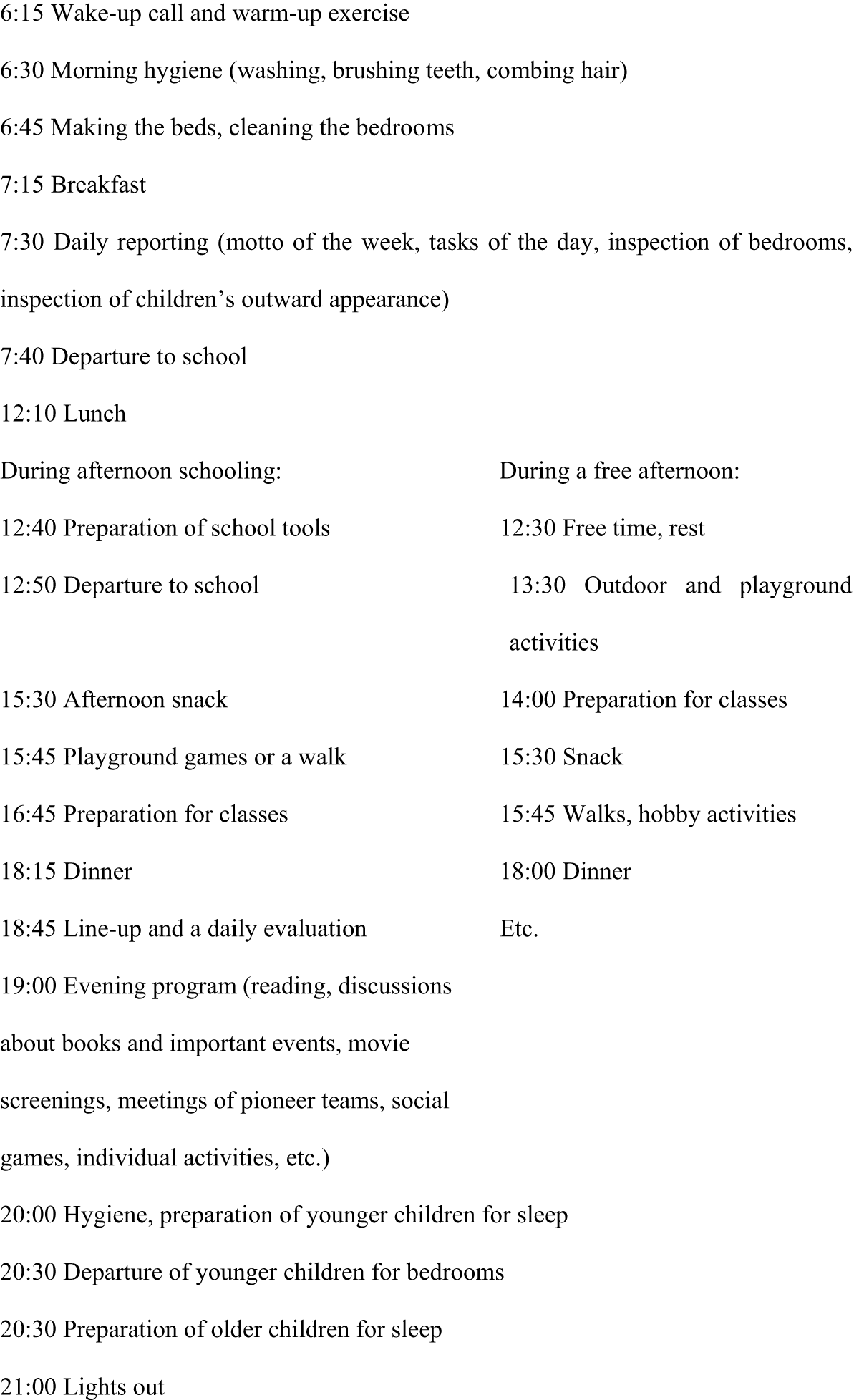
While Greek and Macedonian children were integrated only gradually into classes with Czechoslovak pupils and students after a few years of separate schooling, North Korean children joined Czechoslovak schools several months after their arrival. Although graded more leniently than their Czechoslovak classmates, such practice subjected them to significant pressure.Footnote 105 Their teachers praised them for improving their language skills and “appreciated their great diligence and tenacity rather than their actual knowledge.”Footnote 106 With the start of full-time schooling, the daily life of child refugees became marked by discipline and a strict schedule. Their daily schedule was divided into slots, divided by four to five meals, which did not leave much space for individual activities (see Figure 2).Footnote 107 While the children aged two to six were given more free time, which involved a combination of games, physical exercise, and additional rest, they were also responsible for their hygiene and toys.Footnote 108 Children older than fourteen, if employed, spent most of the day outside the home but were still expected to participate in educational activities in the evening.Footnote 109 The list of after-school activities included classes in arts, literature, dance, music, woodwork and metalwork, model-making, sewing, photography, gardening, and various other hobbies. The Czechoslovak Red Cross attempted to secure the best equipment, for instance, by acquiring authentic musical instruments for Korean folk dances.Footnote 110
A typical daily schedule for children aged six to fourteen. Source: NACR, 1169 ČSČK, box 26, Regulation of the Ministry of Education regarding school-age children in the children’s homes, 14.

Karadzos described this schedule as military-like. In particular, he despised the morning outdoor exercise, which happened “in every season … regardless of the weather.”Footnote 111 He added that Aram Khachaturian’s Sabre Dance, used as a wake-up call, “still creeps me out to this day when I hear it.”Footnote 112 After their hygiene routine and getting dressed for breakfast, their caregivers inspected the children, who would potentially face punishment: “They would immediately mess up any bed not properly made for us to make it again.”Footnote 113 Another Greek refugee, Martha Elefteriadu, described their mornings as “dreadful.” She recalled with amusement how, during the inspection of their clothing, they used to roll up their beloved yet worn-out sweatpants and hide them from the eyes of caregivers under their coats, showing just the “horrible” tights underneath.Footnote 114 Karadzos said their daily program frustrated them: “It did not matter if [we] wanted to or not. Did [we] want to play football? Or did [we] want to play guerrilla with the other kids? No, [we] were out of luck, [we] had to work in the garden. Did [we] want to cry? No, [we] could not, [we] had to sing in the choir and rehearse the dances.”Footnote 115
Training to do productive work constituted a pivotal element of educational curriculum in state socialist institutions. However, as Eszter Varsa has highlighted, it was primarily the children’s homes, unlike primary and secondary schools, for instance, that fully integrated the children’s participation in work activities into the everyday educational practice.Footnote 116 Moreover, as Eleonora Teszenyi, Anikó Varga Nagy, and Sándor Pálfi concluded in their research, socialist caregivers, inspired by Anton Makarenko’s pedagogical principles, did not tolerate individualism to the extent that they “paid no heed to … how individual children experienced education and care in state-funded institutions.”Footnote 117 According to the authors, the strict observation of schedules “both exploited and drew on young children’s vulnerabilities and dependence on adult support.”Footnote 118 The atmosphere in individual homes, however, depended on their staff. Upon arriving at Lázně Bludov, Škoklev noticed that the local education appeared more “ideological” than that in other homes. Children were allegedly only allowed to move between activities in lined-up groups, and the political speeches on Sundays at noon took so long that “our soup went completely cold.”Footnote 119 Besides differences in internal regimes, individual approaches mattered. Zerva remembered with gratitude that her children’s home employed Greek cooks to make them happy by preparing their favorite dishes, while a Macedonian refugee, Konstantin Miovský, pictured in his mind the cultural shock of being served dumplings with dill sauce (“there was something green floating in the sauce”); the staff could not comprehend his shock.Footnote 120
Children took advantage of various opportunities to escape the dull reality. In their minds, they sought solace in memories of their homeland, envisioning a return to their native villages and reunions with their families. St. Nicholas Day, Christmas, and Easter were times when they found distraction through festive food, sweets, exotic fruits, and gifts. After each holiday, they would wait impatiently for the next one.Footnote 121 They wished to spend more time with their parents. For example, children from the Neklanovice boarding school sent their demands to the director of their children’s home and even the Ministry of Education.Footnote 122 Yet, because of economic and logistical constraints, Zerva’s mother, like other parents, could only take her and her three siblings home for holidays and summer vacations in the later years.Footnote 123
The children found consolation within the walls of the children’s homes, and they loved weekly movie screenings. Watching Soviet and Albanian partisan movies, for Karadzos,Footnote 124 were “the only moments we were alone in the room, and sometimes we had fun.”Footnote 125 A ban on joining these screenings was also a frequent punishment. The time spent at children’s homes became more bearable if children could leave their premises for a moment, such as through participation in sports tournaments, cultural performances in other cities, or volunteer work. They perceived taking up seasonal jobs in agriculture and factory production surprisingly positively, making it a popular means of escape and even of earning some money.Footnote 126 The scale of emotions related to these types of socialist “voluntary” activities is addressed by Helga Lenart-Cheng and Ioana Luca, ranging from fun to boredom and including both optimism and meaninglessness.Footnote 127
In their dependency, the children relied on the quality of their relationships. Many shared fond memories of their caregivers, with Škoklev describing one of them as “pretty, kind, devoted, spoke beautiful Czech, and would never get angry.”Footnote 128 They were also ready to speak up in defense of their favorites. In February 1950, forty-six Greek children from the children’s home in Prostřední Bečva petitioned against the earlier-mentioned Karel Kantor quitting his job. “All of us children, we love Karel, and Karel loves us and works for us, and for that reason, we want Karel to stay,” states the text, in which children suggested another teacher leave instead.Footnote 129 However, their testimonies also contain numerous mentions of strict punishment, including corporal punishment. Zerva claimed she held the “best memories” of children’s homes and kept returning to the premises of the Šilheřovice home during her adulthood for reunifications with her former mates. Still, she admitted laconically, “[i]n short, the beating was present.”Footnote 130 Despite the efforts of the Ministry of Education and the Czechoslovak Red Cross to discourage the use of corporal punishment, which could result in the dismissal of personnel, the majority of employees lacked the requisite pedagogical training, a fact that contributed to frequent misconduct.Footnote 131
Such professional failures occasionally took a heavy toll. Most tragically, two North Korean boys attempted suicide due to mistreatment linked to the director of the Jindřichov home, which ultimately led to her removal. The Czechoslovak Red Cross representative Marie Baranová emphasized in her report the vulnerability of these “children with a nervous shock after the endured horrors, who have not yet got accustomed to our country and have only a small vocabulary of Czech words” and may therefore misinterpret events, coming to grievous conclusions.Footnote 132 Unlike North Koreans, the parents of Greek and Macedonian children—even if disadvantaged—could intervene on behalf of their children. For instance, Karadzos’s father negotiated the relocation of his son to another home after his Greek teacher assaulted him.Footnote 133 The authorities, however, tended to downplay the complaints made by parents. For example, Mr. Galanopulos was allegedly “unjustifiably” critical of the situation in the Budišov home. Similar correspondence was documented in relation to the other facilities.Footnote 134 The offended personnel of the Branky home for infants disrespected the opinions of mothers housed there along with their babies, as the words of one employee suggested: “[the mothers] did not trust us, that we would give the children all they needed, and came to check on us all the way to the kitchen and returned the [ready] food to our nurse four times.”Footnote 135
Children supported one another and, as Zerva claimed, they were like siblings; she would do her best to help anyone facing injustice. For that matter, the Greek language became the children’s secret communication mode at children’s homes and schools.Footnote 136 The children moved between homes many times (with Zerva residing in eight or nine distinct locations), and they voiced objections to the disruption of their relationships. It was a “victory” for children in the Hukvaldy home when they successfully prevented their departure, having refused to board the bus for another home in September 1948 and staying hidden in the attic.Footnote 137 Four North Korean children were discovered in the Albrechtice railway station, having departed from the Jindřichov home. They tried to obtain tickets to return to their original home in Valeč where they had been told they could return anytime should they not like the new facility.Footnote 138 Sharing similar experiences, the children from Greece and North Korea could empathize with one another and occasionally team up.Footnote 139 Their contacts with Czechoslovak children were affected by a multitude of aspects, including both inclusion and exclusion, shyness as well as greater competitiveness on the side of refugees, and a sense of curiosity as well as incomprehension of Czechoslovak children.Footnote 140
Their lives in children’s homes were often abruptly interrupted. These children continued with their vocational training, high schools, and universities, and they eventually left these homes for dormitories or lodgings provided by their future employers. With their specializations greatly relying on the presumed needs of the state-planned economy, the children’s paths mostly followed the production quotas. The cooperation between the Czechoslovak authorities and the Greek and North Korean communists in determining their future careers was ponderous: children often learned about their next destination shortly before departing, or even at the last minute. On top of that, even before their eventual return in the early 1960s, one group of North Koreans in 1957 faced sudden repatriation, triggered by worsened political relations in times of destalinization, while the departure of another group was called off overnight.Footnote 141 Such insensitive treatment underlined the significant dependency of these children, challenging their agency on a larger scale. Even within this system, many children could benefit from their talents and study results and live up to their expectations. In this way, the Macedonian refugee Aneta Stankovičová graduated from the business academy—a school of her choice—and Georgios Karadzos became a respected surgeon.Footnote 142 Although the absence of parental care appeared painful and even traumatizing, many were grateful for their experiences in children’s homes, an unanticipated opportunity for those rescued from war and a lack of prospects. The Greek refugee Nikolaos Dumalas harshly uttered that “[children’s] homes gave us a lot; I do not understand how some people can make excuses for themselves because of the absence of parental care.”Footnote 143
Conclusion
For refugees from Greece and North Korea, the children’s homes in socialist Czechoslovakia became places of aid, stability, education, personal development, and social integration. As institutions, they were able to successfully maintain the national identity of their residents while simultaneously introducing them to the domestic cultural environment. They established a regime of care that focused on the collective well-being of refugee children, constructing around them a protective environment aimed at their presumably healthy development, both bodily and socially (politically). Czechoslovak society, in a process typical for the postwar transformative process, witnessed a restructuring of the institutional care system and a reframing of the criteria for social eligibility. The prioritization of communist refugee children within the state’s humanitarian agenda, alongside other privileged groups such as the working class, resulted in the marginalization of those the communist ruling elite perceived as adversarial.
Such an alteration to the system of care, among other factors, had a profound impact on its spatial distribution. First, it encompassed regions where ethnic cleansing had occurred, which imposed a novel social structure at the local level. Second, it reshaped the existing institutions in accordance with the politically conditioned parameters of care by changing their administrations and internal regimes, while preserving the continuity of care. However, the territorial distribution of refugee children’s homes in the geographical and social peripheries, especially in the initial stages, was at odds with the symbolic value of humanitarian action and the tenets of socialist education. On the one hand, the refugee children were regarded as exceptional due to their background. On the other hand, they were expected to embrace the socialist ideal of childhood, which emphasized collectivism and egalitarianism. The coexistence of these assumptions gave rise to internal tension in these children’s education.
Furthermore, the collectivist approach imposed from above conflicted with the children’s everyday agency on the ground. The way the authorities imagined the children’s homes as suitable places to raise the “new socialist people” collided with how children perceived them as spatially and temporally accommodating but still highly restrictive. Not only did these facilities shape them and their life trajectories, but the children themselves interacted with, formed, and recreated these institutions through their presence and individual and collective actions. In order to overcome this challenging experience, the children employed a variety of strategies by constructing their own perceptions of the refugee spaces, attributing meanings to events, and generating responses. Through manifestations of their nature and in an attempt to fulfill their interests, the children performed independent acts and protests to rebel against the established spatial and temporal order, mitigate its effects, and transform the children’s homes to make them their own.
Acknowledgements
This article was written as part of the ERC Consolidator project “Unlikely Refuge? Refugees and Citizens in East-Central Europe in the 20th Century” under the European Union’s Horizon 2020 research and innovation program (grant agreement No 819461).
Funding information
None.
Competing interests
The author declares none.
Nikola Tohma is a postdoctoral researcher at the Masaryk Institute and Archives of the Czech Academy of Sciences. She focuses on migration and refugeedom in socialist Czechoslovakia with an emphasis on citizenship, social rights, labor, and education.

 Open access

