

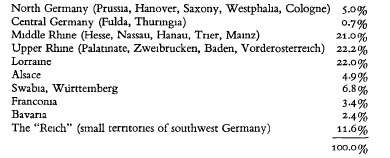
 Of these 80,519 Germans, 4,535 came from north and central Germany. This distribution resulted from the fact that Vienna only wanted Catholics (only Joseph II accepted Protestants too); since north Germany was predominantly Protestant, it was not interesting as an area for recruiting state settlers.

Crossref Citations

This article has been cited by the following publications. This list is generated based on data provided by Crossref.
Hochstadt, Steve
1983.
Migration in Preindustrial Germany.
Central European History,
Vol. 16,
Issue. 3,
p.
195.
Johnson, Eric A.
1988.
Quantitative German History in the United States and the United Kingdom.
Central European History,
Vol. 21,
Issue. 4,
p.
396.
Fogleman, Aaron
1989.
The Peopling of Early America: Two Studies by Bernard Bailyn. A Review Article.
Comparative Studies in Society and History,
Vol. 31,
Issue. 3,
p.
605.
Bade, Klaus J.
1995.
From Emigration to Immigration: The German Experience in the Nineteenth and Twentieth Centuries.
Central European History,
Vol. 28,
Issue. 4,
p.
507.
King, Peter
2016.
Immigrant Communities, the Police and the Courts in Late Eighteenth and Early Nineteenth-Century London1.
Crime, Histoire & Sociétés,
Blum, Matthias
Krauss, Karl‐Peter
and
Myeshkov, Dmytro
2022.
Human capital transfer of German‐speaking migrants in eastern Europe, 1780s–1820s.
The Economic History Review,
Vol. 75,
Issue. 3,
p.
703.
Moch, Leslie Page
2022.
Demographic Dynamics and Development.
p.
147.
Pérez-Schmid Fernández, Francisco José
Delgado Barrado, José Miguel
and
Castillo Martínez, Juan Manuel
2022.
Los colonos de Navas de Tolosa en Sierra Morena: los primeros pasos de una nueva población agrícola en el siglo XVIII.
Historia Agraria Revista de agricultura e historia rural,