Over the past three decades, owing to concerns about potential uprisings against its authoritarian rule against the backdrop of waves of democratization around the world and a rise in popular protest in China,Footnote 1 the Chinese party-state has gradually evolved into a stability-maintenance regime under which social stability has taken priority over everything else (wending yadao yiqie 稳定压倒一切).Footnote 2 Although there is no official definition of social instability and the concept changes from time to time, it is commonly accepted that any popular protest involving five or more people could be regarded as a case of social instability by the party-state.Footnote 3 To maintain social stability, the party-state employs a “two hands” strategy. On the one hand, an implicit agreement has been promoted between the party-state and Chinese citizens under which citizens can pursue any non-political goal.Footnote 4 To maintain such an agreement, individualism and consumerism are strongly pursued at the individual level,Footnote 5 while the developmental state ensures continuous, strong economic development in order to maintain legitimacy at the state level.Footnote 6 On the other hand, those who challenge the implicit agreement are met with a sophisticated and ever-evolving stability maintenance regime under which both hard-line suppressionFootnote 7 and soft-line tactics of buying stability are used.Footnote 8
In order to keep a lid on any instability, the Chinese party-state has constantly expanded its infrastructural power through both technological innovation and institutional building. Surveillance cameras (some with facial recognition function) are widely deployed through the “sky-net project” (tianwang gongcheng 天网工程) in the cities and the “snow-crystal project” (xueliang gongcheng 雪亮工程) in rural areas.Footnote 9 New institutions have also been established at various levels of government. For example, at the national level the Central Stability Maintenance Office (zhongyang weiwen ban 中央维稳办) was established in 2000 and the Central National Security Commission (zhongyang guoan wei 中央国安委) in 2014.Footnote 10 At the lowest level, grid governance (wanggehua zhili 网格化治理) was established as one of many new instruments to maintain social stability at the grassroots.Footnote 11
Under grid governance, the smallest de-facto geographic and administrative units of governance within neighbourhood communities (shequ/juwei 社区/居委) in urban areas and villages in rural areas are divided into small grids for intelligence gathering. Government employees called grid workers (wangge yuan 网格员) are assigned to each grid to identify any potential risks to social stability and to prevent them from posing a possible threat to the regime. As explained by Chen Jianhua 陈建华, then mayor of Guangzhou, at a grid governance conference in 2016:
A grid worker is responsible for 200 households. They can basically name all householders in their grid within one month and know the fundamental state of each household within three months. After six months of patrolling, grid workers can identify all family members of each household. They can even master quantitative intelligence about migrant workers, rental houses and the rent per household (in the grid jurisdiction).Footnote 12
Grid governance forms part of the strategy aimed at achieving the Chinese party-state's broad goal of stability maintenance. Over the past decade, grid governance has been widely adopted by local governments to monitor ethnic minorities in sensitive areas such as Tibet and Xinjiang.Footnote 13 The model was first launched in urban China in 2004 in Beijing and is currently expanding nationwide including in rural areas.Footnote 14 Grassroots governments use the system to collect first-hand intelligence on social instability in an attempt to pre-empt it from escalating.Footnote 15 During the Covid-19 pandemic, it was reported that grid governance also played an important role in population control.Footnote 16 However, empirical data on how the system exactly works and what problems arise during the actual operation of the system are rather limited.
This study is based on four months’ participant observation in a street-level grid governance office located in a second-tier city in southern China. It explores how grid governance was used for stability maintenance and how in practice the system become alienated from its initial goals. We reveal that the current model of grid governance has evolved through three main mechanisms: intelligence gathering, case coordination and real-time reporting. However, we also find that the effectiveness of grid governance may not be as strong as has been claimed by the government owing to the occurrence of various forms of employee alienation and resistance. Our data show that the pressures of performance evaluation have led to grid governance sometimes deviating from its original goal, and that the grassroots government itself may also actively manipulate intelligence regarding stability. In addition, grid governance is also used by grassroots government to manage problems with supervision by upper-level tiers of government. We argue that although grid governance has provided the party-state with an important infrastructural power to penetrate grassroots society, its realization has been heavily dependent on the interaction and relations between different government agencies.Footnote 17 Although the manipulation of official statistics and collusion among local government officials are nothing new, they have nevertheless significantly diminished the power of grid governance.Footnote 18
Research Questions, Data and Methods
Research questions
The purpose of this research is to provide empirical data on how grid governance works at the grassroots social level and to what extent it serves the function of stability maintenance through intelligence gathering for the Chinese party-state. Our case study of grid governance in W Street seeks to address two questions. First, what are the actual mechanisms through which grid governance works to maintain social stability? Because the realization of infrastructural power will necessarily be affected by the way in which grid governance is implemented, the second question must be what factors appear to influence the realization of the power of grid governance?
Research site
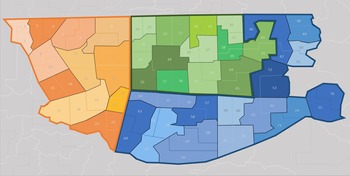
The site for fieldwork was located in what we call W Street (jiedao 街道) (Figure 1), which is located in a second-tier city in southern China. The selection of this site was based on the logic of purposive sampling and accessibility. First, grid governance in W Street was a pilot project in the studied city. The city government hoped to pioneer the project and roll it out across the rest of the city after accumulating some experience. Although our findings on the grid governance in this particular street may not be generalizable for all grid governance across China, our study provides one of the very first empirical explorations of the mechanisms through which the system may work and also the problems that may arise. As with most ethnographic research, accessibility to the research site played an important role in the study.
The W Street Grid
Notes:
W Street was divided into three sub-streets (outlined by thick lines). The three sub-streets were divided into 37 residential communities/villages (outlined by solid lines), and then further divided into 76 grids (indicated by the dashed line).

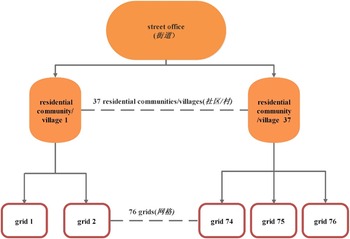
A street is officially the lowest administration unit in urban China. In 2018, W Street covered an area of 28 square kilometres and was home to a population of 300,000 who lived across 11 urbanizing villages and 26 neighbourhood communities. Grid governance further divides a neighbourhood community or urbanizing village into two or three grids. Altogether, W Street was divided into 76 grids (Figure 2). On average, each grid covered an area of 0.37 square kilometres and housed around 4,000 residents. A grid could include a school, a hospital, a bazaar, a wholesale market or a residential quarter. All grids are directly administered by the office of comprehensive management for public security (shehui zhian zonghe zhili bangongshi 社会治安综合治理办公室), the department responsible for maintaining social stability within the Party system.
Organizational Structure of Grid Governance in W Street

In W Street, one full-time grid worker was assigned to each neighbourhood community/urbanizing village, and one or two extra community/village officers were also assigned on a part-time basis so that each grid had one worker. Out of 37 full-time grid workers, 7 had a vocational or high school education, 26 had tertiary education and 4 had a college education. On average, W Street grid workers were aged 32 and were paid a monthly income of roughly 4,500 yuan before tax. There were only two migrant grid workers; the other 35 workers were local citizens. All full-time grid workers were recruited through a company and employed as outsourced workers for the grid governance project. Their status was somewhat similar to that of auxiliary police officers: they were not civil servants and their payment and social status were much lower than those of formal government officials.Footnote 19
Data collection
Three sets of data were collected for analysis during the research team's four months of fieldwork conducted between September and December 2018. The first set comprised all items of intelligence reported by the grid workers in these four months. One item was regarded as a case and altogether 15,112 cases were collected for analysis. It would have been optimum to have analysed cases for a year; however, the research team was only given access to four months’ data during the fieldwork. In spite of this limitation, we are reasonably confident that the data may provide reliable information for our argument. The number of cases is large enough to avoid a potential bias. On the other hand, the pattern of the data is clear enough to serve the main argument that there is a severe problem with data inflation (92 per cent self-resolved cases versus 8 per cent referred cases).
The second set of data was derived from interviews with personnel directly involved in grid governance. A total of 77 people were interviewed, including 37 frontline grid workers, 4 grid work managers, 12 grassroots government officials and employees, and 24 non-frontline employees who worked in other stability control departments. Interviews were conducted during a later stage of the fieldwork after the research team had become familiar with interviewees. For the sake of confidentiality, all names used in the paper are pseudonyms. The third set of data comprises detailed field notes kept during four months of fieldwork in the W Street grid governance office. In total, roughly 190,000 words of field notes in Chinese were written for analysis. Interviews and field note data were coded with the assistance of Nvivo, the qualitative data software for analysis. One advantage of using data collected through different methods is that the different methods can “enrich the other” and “keep the other honest.”Footnote 20
How Grid Governance Works: Identifying “Broken Windows” for the Regime
Grid governance aims to proactively collect early signs of what the Chinese party-state defines as social instability in order to stop episodes escalating into a big political crisis. Although there is no evidence to show that this new model of social control is inspired by the “broken windows” theory in criminology, which argues that minor incidents of public disorder may lead to serious violent crimes if not handled in a timely manner,Footnote 21 the spirit of grid governance is nevertheless in line with its logic. For the Chinese party-state, early signs of social instability such as popular protest or petitioning are the equivalent of “broken windows” for the regime. However, little empirical knowledge exists on how the system works in practice.Footnote 22 Based on our fieldwork in W Street, we identified three working mechanisms underpinning grid governance: intelligence gathering, case coordination and real-time reporting.
Intelligence gathering
In W Street, in addition to the 756 high resolution surveillance cameras on the streets, one grid worker was assigned to each grid to actively collect intelligence on social instability. While surveillance cameras were fixed in certain specific locations to monitor the jurisdiction, grid workers functioned as “mobile eyes” (liudong de yanjing 流动的眼睛), collecting information on events occurring outside the scope of the cameras.
Patrolling the grid gathering intelligence was the grid workers’ main task. Each worker was required to carry a smart phone with an App designed for intelligence reporting – a so-called “cloud-platform system.” The App not only worked to assist workers to collect intelligence but also allowed the command centre to trace workers’ activities in a real-time manner. A big screen in the command centre displayed the position of each worker, and video calls from the centre could be made to report the street situation if necessary. One grid worker, Ming, wrote in his work log that:
On the morning of 30 July, at 8:30, I logged into my mobile cloud platform account and waited for the command centre to check the online status of the grid workers. Starting at 9:16, I went out to patrol the street and reported three cases, including one unauthorized advertisement posting, one minor damage to city facilities and one example of minor unauthorized construction work.Footnote 23
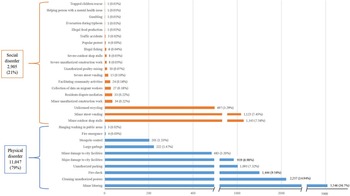
Two basic types of intelligence were reported by grid workers according to pre-existing categories listed in the reporting App. The first was information on any existing social disorder. Popular protests such as workers’ collective actions over unpaid salaries or protests against pollution were key targets for intelligence gathering. While such protests may happen on a daily basis in democratic countries, they were banned by the Chinese party-state in the aftermath of the student demonstrations in 1989.Footnote 24
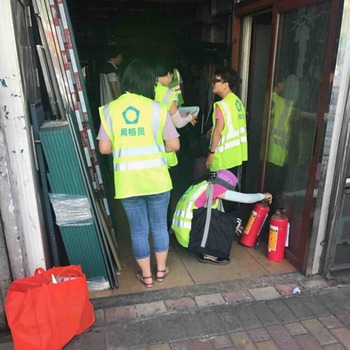
The other type of information regarded any physical disorder such as missing drain covers or falling electricity cables. The rationale behind reporting such issues is that some may cause accidents or develop into incidents if not handled in a timely manner. For example, citizens may fall into the drains if the missing covers are not dealt with (Figure 3).
Grid Workers Checking Fire Safety in a Shop
Source:
Authors' photo.
Notes:
The grid workers are identifiable by the Chinese characters 网格员 on the back of their “high viz” jackets.

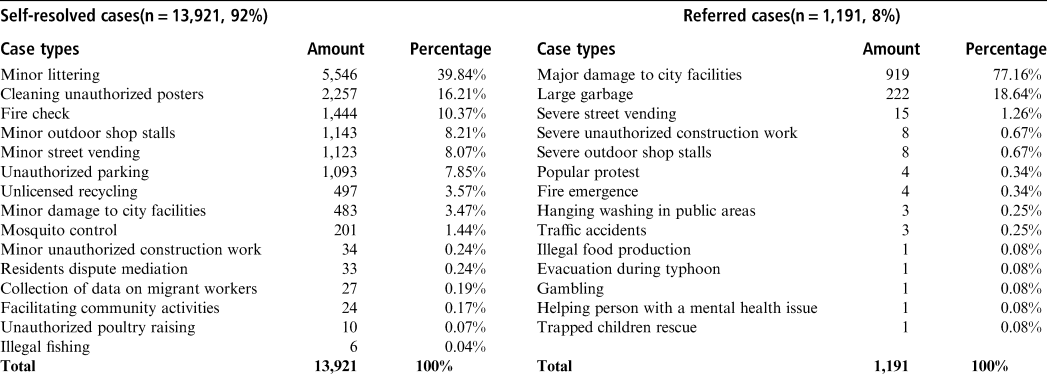
All intelligence was further divided into self-resolved cases (qianzhi anjian 前置案件) and referred cases (liuzhuan anjian 流转案件). Self-resolved cases referred to those that could be resolved by grid workers themselves on site, for example by finding cleaners to deal with some litter on the street. After the issue was dealt with, the grid worker would record the case and outcome on the cloud platform. Referred cases were more complicated “cases” that required the input of specific government departments. Grid workers needed to record these cases in detail, with words and pictures, and report them via the App to the command centre.
Case coordination
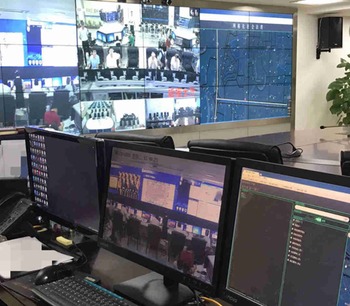
Referred cases were reviewed by the command centre and referred to the relevant government departments. Five members of staff worked as case coordinators in the W Street grid command centre (Figure 4). Their job was to first identify the responsible departments and then refer the cases to them via the cloud platform system. Upon receiving the cases, the corresponding departments needed to confirm whether it was their responsibility to resolve them. If the answer was yes, they were required to sort out the issue and report the result back on the cloud platform system. If they were not the relevant party to resolve the case, they would return it to the cloud platform and the coordinators would refer it to other departments. Out of the 15,112 cases reported to the cloud system between September and December 2018, 8 per cent were referred for further handling while the vast majority – 92 per cent – were resolved by grid workers on site who would carry out such tasks as picking up rubbish from the street (Figure 5).
W Street Grid Governance Command Centre
Source:
Authors' photo.
Notes:
The screens show the real-time positions of the grid workers.

Distribution of Types of Intelligence Gathered by Grid Governance (n=15,112)

However, in some cases, the coordination took on a different form. For instance, in case #7021, some residents reported pollution and the obstruction of traffic by a lamb BBQ shop. Following the regular procedure, the cloud platform initially sent grid workers to the community to confirm details of the case and gather further intelligence. Soon after, the case was referred to the joint law enforcement team. Usually, the team would then shut down the BBQ shop and demand that it rectify the problem. However, the team failed to do so because the owner of this shop was from Xinjiang, and so the case needed to be handled with political sensitivity as it involved an member of an ethnic minority that is often treated leniently.Footnote 25 The grid governance office responded to complaints as follows:
After investigation, we found that the owner of this shop is from Xinjiang. When law enforcement officers arrived at the scene, they asked the shop owner to clean the sidewalk. The owner refused and violently resisted law enforcement. Considering the case involved a sensitive ethnic minority issue, for the sake of social stability, law enforcement officials did not enforce the law forcefully.Footnote 26
As the BBQ shop was allowed to continue to operate, local residents grew dissatisfied with the government's inaction and repeatedly shared the case on social media. A few days later, at around 10:00 p.m., the cloud platform received intelligence from grid workers that a dozen residents had gathered at the entrance to the Xinjiang BBQ shop to protest with banners and slogans saying “We hope that the government can pay attention to citizens’ grievances” (qingyuan zhengfu, zhongshi minsheng 请愿政府,重视民声) and “Oil and smoke pollution may cause cancer and respiratory diseases” (zhiai youyan wuran, yinfa huxi jibing 致癌油烟污染,引发呼吸疾病). Grid workers were required to stay on site to gather up-to-the-minute intelligence on the situation. The case coordinator constantly forwarded the updated intelligence to the WeChat group of W Street officials while summoning several police officers to the site to maintain order.
By 11:00 p.m., the crowd had grown to around 100 protestors. The coordinator requested the police department to send more police officers and mobilized personnel from the environmental protection department, urban management department, social work bureau and residential community to address the citizens’ grievance on site. A clear division of labour was then brought into play: the police worked to maintain order; the environmental protection department and the urban management department negotiated with the owner of BBQ shop to temporarily close the shop; and the staff from the social work bureau and the residential community persuaded the gathered crowd to disperse. The strategy of emotional control commonly observed in the party-state's response to popular protests was in full play.Footnote 27 At midnight, the Xinjiang BBQ shop was finally temporarily closed and the protesters were demobilized.
Distribution of Referred and Self-resolved Cases (n = 15,112)

Real-time reporting
The third mechanism used in grid governance is real-time reporting. W Street grid workers were required to patrol their grids most of their working hours so as to respond quickly to any tasks. For instance, in case #4090, grid worker Tao arrived at the scene of an incident for the second time within 15 minutes after receiving a tip-off from residents about a group of construction workers who had gathered to demand their unpaid salaries. Upon arrival, Tao took panoramic photos of the protesters and posted them to a working WeChat group to report the real-time situation to the government. After that, Tao, donning a “high viz” jacket displaying the characters for “grid worker,” tried to appease the protesters. He told them that government officials were aware of their demands and asked them to express their grievance in a lawful manner – i.e. not by publicly protesting. Earlier that day, the construction workers had gathered to protest but dispersed when the police arrived. After that, Tao asked the owner of a nearby auto repair shop to act as an informant for him in case the workers gathered again.
The local government of W Street preferred to resolve any popular protest without having to involve upper-level government departments and was more interested in demobilizing protesters than in addressing their grievances. If the construction workers promised to leave, the grid worker Tao would report the intelligence to the government and continue to monitor the situation. However, if they refused to disband, Tao needed to notify the government to send more personnel to communicate with them. Local government responded to these cases based on real-time intelligence reported by grid workers.
Alienation of Grid Governance
The Chinese party-state developed grid governance as an important instrument in its stability maintenance toolbox, and it has undoubtedly proved to be a powerful component of China's social control infrastructure. However, the realization of infrastructural power is largely dependent on how it is devolved to, and enacted by, various agents.Footnote 28 In the next sections, we examine how various forms of alienation and resistance occurred to complicate the practical workings of W Street's grid governance.
Inflating minor risks for political achievement
Grid governance is a grassroots intelligence-gathering mechanism for the exercise of political control. The purpose is to have a quick response to any potential political threats and forestall their escalation. In order to motivate its grid workers to be alert to potential risks, the W Street grid officials established a quota for each grid worker who had to report five pieces of intelligence every working day, or else his or her salary could be docked. The amount of gathered intelligence could then be presented by the local government as a measure of its achievements in grid governance. According to Zhou, the government official from W Street, “Grid governance is where we can make political achievements! This is beyond doubt!”Footnote 29
Every month the W Street grid governance department had to submit two or three examples of its achievements in the promotion materials it submitted to the district government. The overall number of these cases and stories would then be published in a WeChat official account (weixin gongzhong hao 微信公众号). As a result, many self-resolved cases were reported as intelligence to boost the numbers and achievements. According to the official statistics shown in Figure 5, 13,921, or 92 per cent, of the 15,112 pieces of intelligence gathered in four months were described as self-solved cases. Only 1,191, or 8 per cent, were referred on to other relevant departments for handling. In other words, in W Street, around 10 cases per day were reported by grid workers as having been addressed by the relevant government departments, while over 90 per cent were reported for the purpose of political achievements. Yi, the manager of the W Street grid workers, pointed out the reasons for reporting self-resolved cases:
This work is not for us to really solve social risks, but to earn political achievements for the government. The most important thing is propaganda … It's important to prove that we are doing something! The most important thing is to get the “show” done. Asking us to do fake things is more true than real.Footnote 30
Grid workers mainly used three strategies to increase the volume of intelligence collected and thereby fulfil their quota requirement. The first was to report a large number of minor signs of physical disorder – littering, unauthorized advertisements and illegal parking, for instance – to meet the required quota of intelligence reports. As a result, the vast majority of so-called intelligence comprised “self-resolved cases,” which had already been “resolved” by grid workers on site but recorded on the cloud platform. A typical self-resolved case included minor littering such as a grid worker picking up a banana skin off the street and throwing it into a bin.
The second strategy was to repeatedly report the same case. For instance, a worker in the LS community grid reported the same case of “goods being piled up at the door of *** restaurant, negatively affecting the city's appearance” multiple times within a single week. He complained to his supervisor after having been criticized for having done so:
LS grid is a very quiet neighbourhood, and it is very close to the government, I can't even find any street vendors [who were believed to have been affecting the urban image and environment] here. Every day, except for reporting picking up garbage, I can only report these restaurants for piling up materials that affect the city environment!Footnote 31
The third strategy was to fabricate risks first and then purport to solve them. Following an earlier accident in which a citizen had fallen into the river, the director of the W Street grid office believed that if he could manage to find a case in which grid workers had persuaded anglers to move away from the banks of a dangerously fast-flowing river, it could serve as a piece of useful fake news. In a response, a grid worker from the JT grid commented:
If you need this type of case, I can let my friend come to the river to pretend he is a fisherman. During this process, I will take a photo of him, showing that I advised him to leave, so we can later use this case as the promotion of our programme!Footnote 32
During one special operation, the W grid governance department fabricated the news that grid workers had driven away street vendors in order to create a hygienic city. When discussing how grid workers could remove vendors, the government official emphasized that grid workers must succeed in creating “achievements” even if they have to cheat:
I am not saying that you have to actually drive [the vendors] away, the most important thing is to make materials that can be promoted! You can handle it “flexibly”! You don't need to drive them away, you have to “make” it look like they are gone!Footnote 33
Inspired by this idea, one of the grid workers shared his experience in driving away street vendors around schools:
Don't worry, isn't it just propaganda? We can first photograph vendors and the buildings behind them. Then, let the vendor move a little bit and clear the place where he was standing. After that, we can take photos at the same angle against this cleared space without the vendors. A “perfect” drive-away action can be created in this way. In fact, vendors will not be driven away, but grid workers have evidence of “driving them away.” When I reported the case of a vendor, I reported it like this!Footnote 34
However, while the overall volume of intelligence collected by grid workers was seriously inflated to demonstrate political success in achieving grid governance, the actual number of “social instability” cases was underreported to give the appearance of peaceful local governance.
Deflating serious cases for seemingly good governance
Since the intelligence input on the cloud platform at the street level could be reviewed and supervised by officials in district- and city-level governments, those working on W Street had a strong incentive to hide the real scale of popular protest. During four months’ field work between September and December 2018, only three of 66 popular protests were reported into the system. Instead, the grid governance team used various strategies to make cases disappear, including resorting to euphemistic terms to hide incidents under other headings or completely ignoring some protests.
Sometimes, a popular protest was described euphemistically with less politically sensitive vocabulary. It was an unwritten rule that grid workers use terms such as “dispute among workers” (gongren jiufen 工人纠纷) to describe workers’ protests over unpaid salaries instead of the phrases “demands for unpaid salary” (taoxin 讨薪) or “rights protection” (weiquan 维权). This was because a “dispute among workers” would mean the target of the dispute lay with the workers themselves; the target of “demands for unpaid salary” or “rights protection” would be the government. The manager of the cloud system explained:
The words “demands for unpaid salary” and “rights protection” indicate sensitive topics. We cannot let the leaders of the upper-level government think that there are so many “instabilities” in our region. If the word “instability” is frequently used, the leaders will feel that there are so many sensitive issues in this place. Is it that the grassroots government in this place does not work properly? This is what we should avoid.Footnote 35
By diminishing the level of popular protest to a mere dispute among workers, grassroots governments could “hide” the presence of social unrest within their jurisdictions – a crucial measure for cadre performance evaluations. Stability maintenance has increasingly become a priority target with veto power (yipiao foujue 一票否决) in these assessments, meaning that all other achievements would not be counted if local government officials performed poorly in this area.Footnote 36
Some cases, however, were completely wiped from the record. Grid workers would be expected to ignore cases that threated to affect the interests of local government officials. For instance, one grid worker, Tao, found that some local government officials at the village level were involved in selling gasoline without a licence, an illegal business operation posing a danger to public safety. The grid governance team reported this case to the grassroots government. Upon learning about it, He, the director of the grassroots government command centre, was initially very pleased that such a rare and serious case could be used to demonstrate the success of intelligence gathering. But after learning that the case involved a member of the village committee, He waved his hand and shook his head, saying:
We can't intervene in the affairs of the village committee. The case, which involves the interests of the village committee, is not something we dare touch. The grid worker should realize that this issue is complicated, and how can he dare to report it to the command centre? Why doesn't he report it to the director of the village committee first? The village committee's affairs should be solved by themselves! Let Tao be cautious later, don't be a thorn in our side!Footnote 37
Indeed, the successful operation of the grid governance project required cooperation and support from all 11 urbanizing villages and 26 neighbourhood communities in W Street. Otherwise, grid workers might not have been accepted by residents when collecting personal and household intelligence. After this incident, Tao was further summoned to write a self-criticism report to W Street government officials to acknowledge the “mistakes” in his work and to ensure that similar issues related to the village’ s interest would not be reported in the future. Tao was extremely frustrated with this outcome, saying:
I will not report these cases [cases involving sensitive issues] anymore. I only report cases of unauthorized parking of bicycles and littering. Doing that, I will not be criticized, and my work can be done much easier.Footnote 38
Grid governance was created by the party-state to collect intelligence on social instability. However, the manipulation of intelligence was widely observed at W Street, which may significantly affect the effectiveness of the system. The cadre performance evaluation often leads to the manipulation of data,Footnote 39 and although the infrastructural power of the system might be curtailed by bureaucracy and corruption, it was also sometimes manipulated to resist supervision by the upper-level governments.
Turning the gaze on the supervisor
While grid governance is an important resource for the gathering of intelligence on social instability at the grassroots level, the system may also be used by local government officials to manage and even block supervision from the higher levels. For instance, the grid governance system in W Street was mobilized to cope with the demands placed upon it by a review of the city's title of “National Civilized City.” This designation is regarded as a major political achievement for the local government and it has great political significance.Footnote 40 A week before the review tour by the central government, all grid workers under the command of the W Street government were sent to the streets to prepare for what was to come. In addition, all grid workers were required to work overtime the day before the review. In their internal working WeChat group, grid worker Jun took a selfie with a garbage bag and said:
We drove away vendors and informed all shopkeepers to remove the materials obstructing the road. All the construction projects affecting traffic in the area were suspended. We took long grippers and large black bags to pick up waste. All rat holes are sealed with cement. I can guarantee that even a feather cannot be found in my grid on the street today!Footnote 41
On the morning, Lang, a grid worker in the FL community, put up more than 50 posters promoting the idea of a “civilized” city. He said:
Some illegal posters and paintings (niupi xian 牛皮藓) cannot be removed. We use these posters to cover them. Make sure there are no unauthorized posters and paintings on walls along the street.Footnote 42
Tao took a picture of a cement bucket and joked that he worked as a maintenance worker all day, and that all the mouse holes and snake holes on the street were fixed by him. Since the arrival time of the inspectors from the upper-level government was uncertain, the grid workers were required to prepare a week early. The W Street government had several “rehearsals” for the inspection.
On the day of the “National Civilized City” review itself, a taxi was pre-arranged to wait in front of the hotel where the four-member inspection team was staying. At half past seven in the morning, the inspection team left the hotel. Through its real-time reporting system, the command centre of the W Street grid governance instructed:
All people be ready!The “guests” [inspectors] are departing the hotel and are currently taking a taxi. The licence plate number is ****. The female guest is wearing a white shirt and black trousers today. The male guest is wearing a brown shirt and blue jeans. From their current driving route, we predict that this group of the inspection team will go to the ** community, colleagues in the ** community please get ready.Footnote 43
Once the members of the inspection team were in the taxi, the W Street officials used the cloud platform to predict where they might possibly go. By the time the team arrived at a predicted location, the people on the street had long been driven away by grid workers who would then pretend to be ordinary pedestrians walking around. Ironically, the command centre's leading video communication system reminded grid workers to pretend to be “natural” pedestrians:
The grid workers should not be too enthusiastic. Don't go around the inspection team when they arrive. Don't be too enthusiastic, you may scare them. We must pretend to be ordinary pedestrians, scattered around the inspection team, not taking the initiative to say hello to them. Keep in mind that you are normal pedestrians, you are pedestrians!Footnote 44
Through the “fixed eyes” of the surveillance cameras on the street, it was discovered that the four-member inspection team had divided itself into two small teams, each composing of two inspectors. One team decided to take the subway to their next inspection site. Grid workers at that site were immediately dispatched to the subway to prepare for the arrival of those inspectors. Meanwhile, the other team planned to take a bus. Taken by surprise, the grid workers following them could not keep up with them. They immediately informed the command centre of the number of the bus so that another team of grid workers could board the bus at the next stop.
At around 11 o'clock, the command centre speculated that the inspection teams might wish to stop for lunch, so some grid workers went to the nearby restaurants to remind owners to maintain a good standard of hygiene. When one inspection team seemed to be lost, the on-site grid workers asked the command centre whether they should point out the way for the inspection team. The director of the command centre nervously responded:
Don't! If the inspectors come over to ask you, you can lead the way. But if they don't, you should pretend to be pedestrians while keeping a close eye on them.Footnote 45
After a long walk, the inspectors found their way via a navigation App on their smart phones.
Discussion and Conclusion: Can Grid Governance Fix the Chinese Party-state's Broken Windows?
China has gradually developed its stability-maintenance regime over the last three decades.Footnote 46 A considerable body of literature has explored how the regime has managed this through, for example, the overall principle of political absorption and pre-emptive control,Footnote 47 and specific tactics such as social welfare provision, land reform and intervention in grassroots politics.Footnote 48 While the existing literature has largely focused on how to prevent potential social instability, relatively little attention has been paid to how social instability is identified at an early stage in order to prevent its further escalation. Grid governance is designed exactly for the purpose of identifying the early signs of what is called social instability. To a large extent, it works like a fire alarm system: when smoke is detected, alarm bells alert the firefighters. The grid governance was piloted in Beijing in the first decade of the 21st century and is now being rolled out nationwide including in rural areas.Footnote 49 Despite its importance, empirical evidence on how the system works remains rather limited. Using data collected from four months’ participant observation in the W Street grid governance office and extensive interviews with personnel who worked on stability maintenance at the grassroots in a second-tier city in southern China, this paper contributes to the existing literature in the following ways.
First, it provides one of the very first attempts to gain an empirical understanding of how the system may actually work in practice. Focusing on the grid governance in W Street, this paper finds three stability-maintenance mechanisms used in grid governance: intelligence gathering, case coordination and real-time situation reporting. Although the findings are based on one case study in a particular geographic site and may not be generalizable, they nonetheless enrich our understanding of the working mechanisms of grid governance and provide a basis for future research.
Second, this paper unravels the theoretical logic behind grid governance. The system aims to proactively collect intelligence of social instability at an early stage and prevent it from escalating into a significant political crisis. This logic resonates with the “broken windows” theory in criminology, which claims that public disorder, such as graffiti, garbage, abandoned cars and drunkenness, may lead to serious crimes if it is not handled in a timely manner.Footnote 50 Understanding grid governance through the lens of the “broken windows” theory can shed light on the operational logic behind this new model of stability maintenance in grassroots China.
Third, this paper contributes to the ongoing debate on rethinking the coercive capacities of the Chinese party-state. Despite the rise of the security state, scholars have urged a reassessment of claims about the authoritarian resilience and coercive apparatus of the Chinese party-state, the discussion of “authoritarian resilience” having shifted to “authoritarian impermanence.”Footnote 51 Some have pointed out that some insiders in the party-state, such as street-level police officers, former military officers, bullied cadres, teachers, hospital workers and state-owned enterprise employees, who were mobilized as tools of emotional repression of dissent, have expressed their frustration about the regime.Footnote 52 Others have argued that there exist “deep flaws in what looks like a well-oiled and highly capable machine” in the police, the corner-stone of the regime's coercive power.Footnote 53 While the police can be zealous in the discharge of some duties, they can also be selective, lazy and even deceitful in the discharge of others.Footnote 54 One of the key motivations for the literature on the reassessment of the coercive power of the party-state is that although both physical facilities and social institutions offer important sources of infrastructural power for the state,Footnote 55 the realization of that infrastructural power can be affected by many factors such as culture and politics.Footnote 56 A recent example of the failure of the realization of the infrastructural power is China's early handling of the Covid-19 pandemic. Learning from its painful lack of transparency and emergency planning for diseases during the 2003 SARS outbreak, the Chinese government has since spent millions on a rigorous testing and reporting system for communicable diseases.Footnote 57 However, the infrastructural power of the system was not actualized to report Covid-19 cases in their early stages owing to the bureaucratic and political reasons underpinning the maintenance of social stability.Footnote 58 By the same token, although grid governance may provide important infrastructural power to identify the so-called “broken windows” and for the regime to increase social control, the alienation of the system in practice may severely undermine the effectiveness of the control. Indeed, resistance to control even under the most despotic of regimes can often be observed,Footnote 59 and China is no exception in this regard.Footnote 60
This paper has mainly examined the working mechanisms of grid governance and the alienation in their operation in W Street. Several issues could be further explored in future research. First, the analytical angle of this paper is from an administrative and organizational perspective. Future research can explore how the system is built in and operated among citizens. The living experiences of citizens under grid control is important as well when examining the power and limit of the control system. Second, the relationship between grid governance offices and existing bureaucratic institutions could be further explored. The practice of grid governance is part and parcel of the overall grassroots governance. It supplements rather than replaces existing mechanisms. Grid governance aims to identify the “broken windows” so that the regime can exercise more social control. If too many “windows” were found to be broken, the departments responsible for fixing them would come under great pressure. In addition, since one grid worker is assigned to each neighbourhood community or village to collect intelligence, the relationship between grid office and these communities and villages could also be complicated. Third, the management and control of grid workers could be further studied. In W Street, the daily operation of grid governance was outsourced to a private company. However, grid workers were supervised by and reported their duties to the office of comprehensive management for public security, the department responsible for maintaining social stability within the Party system at the street level. How market forces contribute to the regime's social control and stability maintenance measures in general and the grid governance in particular will be of interest to the scholarly community.
Acknowledgements
We are grateful to Paul Rock, Ieong Meng U, Huiquan Zhang and members of the weekly research meetings at the department of sociology, University of Macau, for their constructive suggestions on earlier drafts of the paper. Comments from two anonymous reviewers were particularly useful.
Conflicts of interest
None.
Biographical notes
Jianhua XU is an associate professor in the department of sociology, the University of Macau (UM). He is also an adjunct associate professor at the Center for Macau Studies, UM; an affiliate at the Institute of Collaborative Innovation, Centre for Data Science, UM, and an honorary fellow in the Center for Criminology at the University of Hong Kong. His research interests include sociology of crime and deviance, policing, victimology, urban sociology and Macau studies.
Siying HE is a MA graduate from the department of sociology, the University of Macau. Her research interests include grassroots governance and law and society in China.