Sources
The principal sources of information on which this chronicle is based are British Broadcasting Corporation, Monitoring Global News line − Asia-Pacific Political and British Broadcasting Corporation, Monitoring Global News line − Asia-Pacific Economic. These sources, now only available electronically, do not have reference numbers and are only identifiable by date of publication of material. The inclusion of each of these dates would unnecessarily clutter the text and such dates have therefore been omitted, except, at many points, for the original sources from which the BBC reports themselves are taken.
Abbreviations
- XHNA
Xinhua (New China) News Agency
- CNA
Central News Agency (Taipei)
- RTHK
Radio-Television Hong Kong
- ZTS
Zhongguo tongxun she (China Reporting Agency), Hong Kong
- ZXS
Zhongguo xinwen she (China News Agency), Beijing
- RMRB
Renmin ribao (People's Daily)
- SCMP
South China Morning Post
- KNA
Kyodo News Agency
- KCNA
Korean Central News Agency
1. Internal Developments
a National Day Celebrations
b 11th and 12th Sessions of the National People's Congress Standing Committee
c Party and Political Affairs
d Economic Affairs
e Health and Swine Flu Pandemic
f Tibet and Xinjiang
g Human Rights
h Media and Information
i Hong Kong and Macau Special Administrative Regions
2. Foreign Relations
a Diplomatic Tours
b Multilateral Conferences
c Countries, Territories and Regions
d Climate Change
1. Internal Developments
a National Day Celebrations
The 60th anniversary of the founding of the People's Republic of China was celebrated with a military parade in central Beijing. The parade involved some 8,000 military personnel and a display of every type of military equipment. More than 150 jet-fighters, bombers, helicopters and other aircraft in 12 echelons made a flight over Tiananmen Square which was packed with some 200,000 people. President Hu Jintao, “dressed in a high collar Mao suit,” reviewed the troops. After the parade a gala party with spectacular fireworks was held in the square, attended by 80,000 people. A massive security operation ensured that no incidents marred the celebrations; 50,000 police officers were on patrol assisted by 1.12 million security volunteers throughout the capital (XHNA, 1 and 2 Oct.).
President Hu delivered a speech (text in XHNA, 1 Oct.). He declared that
[i]n the past 60 years, under the leadership of the three generations of the central leading collective with Comrade Mao Zedong, Comrade Deng Xiaoping, and Comrade Jiang Zemin as the core, and the party Central Committee since the 16th Party Congress, the diligent and wise Chinese people of all ethnic groups have worked hard with one heart and one mind, withstood the tests of all kinds of difficulties, twists and turns, and risks, made attention-grabbing great achievements, and written a brilliant and triumphant song of striving constantly to become stronger. Today, a socialist China that is oriented to modernization, to the world, and to the future is standing toweringly in the Eastern world.
He pledged that
[w]e will unswervingly adhere to the road of socialism with Chinese characteristics, comprehensively implement the party's basic theory, basic line, basic programme, and basic experience, continue to emancipate the mind, persist in reform and opening up, promote scientific development, promote social harmony, push forward the process of building a well-off society in an all-round way, continuously open up a new situation for the cause of socialism with Chinese characteristics, and write a new chapter in the happy lives of the people. We will unswervingly adhere to the principle of “peaceful reunification, one country, two systems,” maintain long-term prosperity and stability in Hong Kong and Macau, promote peaceful development of cross-Strait relations, and continue to work hard for the complete reunification of the motherland - the common wish of the Chinese nation. We will unswervingly adhere to an independent foreign policy of peace, adhere to a peaceful development road, pursue a mutually beneficial and win-win open strategy, develop friendly co-operation with all countries on the basis of the five principles of peaceful coexistence, continue to promote the noble cause of peace and development for humankind together with the people of all countries, and push forward the construction of a harmonious world with a lasting peace and common prosperity.
b 11th and 12th Sessions of the National People's Congress Standing Committee (NPCSC)
The 11th Session of the NPCSC of the 11th National People's Congress was held from 27 to 31 October, and was presided over by Wu Bangguo, Chairman of the Standing Committee. The Session adopted a new law on diplomatic personnel, which aims to clarify the duties and responsibilities of China's diplomatic service (Text of the Law in XHNA, 31 Oct.). It also considered draft amendments to the Electoral Law which would give equal representation in the congresses to rural and urban residents. This followed a proposal in Hu Jintao's report to the Party Congress in 2007 along the same lines. It appointed Yang Guiren as Minister of Education in place of Zhou Ji, and also appointed Li Xiaofeng as Chief Procurator of the Military procuratorate (XHNA, 31 Oct.).
The 12th Session of the NPCSC was held from 22 to 26 December. It was announced on 14 December that the session would consider revisions of the Organic Law on Villagers' Committees, to improve the level of self-governance. The session would also consider draft laws on tort liability, island protection, social insurance and military mobilization, as well as amendments to the law on renewable energy. It would ratify the UN supplementary protocol on prevention and cracking down on human trafficking, as well as an agreement on criminal judicial assistance with Malta. The session would also hear reports from the General Office of the NPC Standing Committee and from the Ministry of Health (XHNA, 14 Dec.). Wu Bangguo, Chairman of the NPC Standing Committee, presided over the session. The final session appointed Han Changfu as Minister of Agriculture to replace Sun Zhengcai who had been made Party Secretary of Jilin province earlier. Han Changfu was previously Governor of Jilin province. The session also appointed a number of recently resigned provincial leaders, who had passed the accepted retirement age, to posts as vice-chairmen of its special committees. They were Xu Guangchun (formerly Party Secretary of Henan), Chu Bo (formerly Party Secretary of Inner Mongolia), Wang Hongju (formerly Mayor of Chongqing) and Zhang Wenyue (formerly Party Secretary of Liaoning) (XHNA, 26 Dec.). A full text of the amended renewable energy law can be found in XHNA, 26 Dec.
c Party and Political Affairs
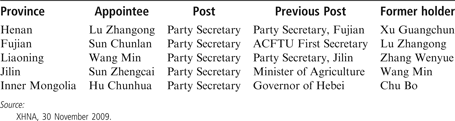
A reshuffle of provincial party leaders was announced on 30 November. The main changes are in Table 1.
Main Changes of Provincial Party Leaders

Source: XHNA, 30 November 2009.
Attention centred in particular on Sun Zhengcai and Hu Chunhua, both of whom are in their mid-forties, and are seen as potential future leaders (see for example KNA, 30 Nov.). In Jilin, the Governor was also replaced on 2 December. Wang Rulin was appointed Acting Governor in place of Han Changfu. Wang had previously been a Vice Governor of the province (XHNA, 2 Dec.).
d Economic Affairs
Policy Direction
The Politburo met on 27 November to analyse and review economic work to be undertaken in 2010 and to prepare for the annual central economic work conference. The meeting confirmed that there would be continuity and stability in macroeconomic policy in 2010 with the continuation of an active fiscal policy and an “appropriately loose” monetary policy. The meeting set out “five greater emphases” for economic work in the coming year. They were defined as:
Put greater emphasis on improving the quality and returns of economic growth, put greater emphasis on expediting the change in the economic development model and economic restructuring, put greater emphasis on pressing ahead with reform, opening, and independent innovation and on enhancing the vitality and energy of economic growth, put greater emphasis on improving the people's lives and maintaining social harmony and stability, and put greater emphasis on making comprehensive plans to handle the domestic and international situations. China would focus on the encouragement of private investment, the development of emerging strategic industries, and the mounting of an active response to climate change (XHNA, 27 Nov.).
The Central Economic Work Conference was held from 5 to 7 December, and was attended and addressed by President Hu Jintao and Premier Wen Jiabao. It was agreed that the government should continue to maintain stable and relatively fast economic growth and speed up the transformation of the economic development model. It would focus on structural adjustment in 2010 and on improving the quality and efficiency of economic growth. The proactive fiscal policy and a “moderately easy” monetary policy would be continued. More efforts would be made to promote the transformation of economy (XHNA, 7 Dec.). This was portrayed as a central theme of the meeting which “brooked no delay.” In the words of a report of 8 December,
People have come to understand more and more soberly that investment has accounted for an excessive percentage in the economic growth of our country, domestic demand is insufficient, and the impacts of the inertia of extensive development, surplus production capacity and other issues have become more and more conspicuous in some localities. The issues of a high degree of dependence on foreign trade, a high degree of dependence on investment and a high degree of energy consumption have reached such a stage that it is impossible to make sustainable development without changing this situation and the crucial opportune period stored up in the crisis will be forfeited. The fundamental way out to resolve these issues lies in changing the mode of economic development (XHNA, 8 Dec.).
Immediately after the conference, the State Council, under Wen Jiabao, held a meeting on 9 December to study policy measures aimed at boosting consumption. It discussed a number of practical measures to do so: 1) continue subsidies to rural households for electrical appliances; 2) extend the policy of supplying rural residents with automobiles for another year; 3) extend the policy of replacing old household electrical appliances with new ones; 4) continue and increase subsidies for the purchase of agricultural equipment; 5) provide new energy-saving products; 6) continue the reduction of purchase tax on cars of 1.6 litres or less, and raise the subsidy for replacing an old vehicle with a new one; 7) extend the exemption of business tax on house sales from two to five years; and 8) extend for one year support for certain enterprises in financial difficulties (XHNA, 9 Dec.).
Xinhua carried an exclusive interview with Premier Wen Jiabao on the economy. Wen said that he was much comforted by the fact that China had stabilized economic growth and employment and maintained social stability over the year. He warned, however, that it was too early to come to a final judgment as the global financial crisis was not yet over. China would stick to the pro-active fiscal policy and moderately easy monetary policy in 2010, and the stimulus package would remain in place as to withdraw macro-economic policies too early would be likely to ruin the efforts made before and reverse economic development. He noted that the economy would have been better if bank lending had been more balanced and not on such a large scale. He said that the problems of industrial overcapacity were not related to the stimulus package, and stated unequivocally that none of the 1.18 trillion of investment by the central government would go into any industrial project. He said that preventing inflation and maintaining stable and rapid economic growth were the top priorities for 2010. Responding to complaints of a property bubble, he acknowledged that house prices in some places were rising too fast and promised to maintain the property market while cracking down on illegal activities which had driven up house prices. He promised to reform the household registration system to help migrant workers and others who had moved to the cities. He acknowledged that China needed to change its growth pattern, which “is still unbalanced, uncoordinated and unsustainable,” and said that science and technology would pay a key role in this process. Internationally, he made it clear that China would not yield to foreign pressure to revalue the yuan, saying that a stable Chinese currency was good for the international community. He said that China would fight for its rights for development, and urged the world to understand that this was the top priority for developing countries. He urged the world to recognize the hard-won results at Copenhagen and to build consensus for future action on climate change (XHNA, 27 Dec.).
Statistics
A State Council Executive meeting on 21 October pronounced that China's economic and social development had been better than expected with “consolidated” growth recovery. The economy had picked up speed in the first three quarters and the contribution of domestic demand to growth had increased. In the coming months, China would concentrate on ensuring a stable and relatively fast pace of growth, adjusting the economic structure and controlling inflation (XHNA, 21 Oct.). The National Bureau of Statistics announced on 22 October that the Chinese economy had grown in the third quarter by 8.9 per cent year on year, and by 7.7 per cent year on year in the first nine months. This followed growth in the first and second quarters of 6.1 per cent and 7 per cent (XHNA, 22 Oct.). Figures for unemployment in the third quarter were equally encouraging. The Ministry of Human Resources and Social Security announced that 8.5 million new jobs had been filled in urban areas in the first nine months, 94 per cent of the annual target. The spokesman described the employment situation as “generally stable” over the year. At the end of the third quarter 9.5 million people were registered unemployed in the urban areas, a rate of about 4.3 per cent (XHNA, 23 Oct.). On 2 November, the Minister of Industry and Information said that he expected China's industrial output to continue to accelerate in the last quarter following a 12.4 per cent growth rate in the third quarter. He said that industrial production had “surmounted the most difficult time” and should be growing by 15 to 16 per cent in the last quarter, bringing the annual growth rate up to around 10 to 11 per cent. He said that China now stood a fair chance of reaching its 8 per cent GDP growth target, although uncertainties and complexities remained, as global demand was weak and unemployment still high (XHNA, 2 Nov.). Similar optimistic hopes were expressed by the China Construction Bank in a report issued on 3 November which forecast that GDP would grow by 8.3 per cent in 2009, on the back of a projected increase of over 10 per cent in the last quarter. The Purchase Management Index (PMI) had risen to 55.2 per cent in October, and third quarter growth had been 8.9 per cent (XHNA, 3 Nov.).
China announced that its foreign trade fell 10.7 per cent year on year in October (the fall in the first ten months was 19.9 per cent). Imports totalled US$86.8 billion (down 6.4 per cent). and exports dropped to US$110.8 billion (down 13.8 per cent). Some signs of improving demand from overseas were detected, while imports of key raw materials increased because of the large investments in fixed assets. The National Bureau of Statistics announced that urban and fixed asset investment had increased by 33.1 per cent year on year in the first ten months (XHNA, 11 Nov.).
On 10 December, the National Bureau of Statistics announced that house prices in 70 cities had risen 5.7 per cent in November (an increase of 1.8 over the previous month) (XHNA, 10 Dec.). Premier Wen Jiabao chaired an executive meeting of the State Council on 14 December to study ways to promote the healthy development of the real-estate market. Government policy had successfully revived the market, but as the recovery proceeded a problem of excessive growth in house prices had emerged in some cities. The meeting called for a mixture of land, financial and taxation means to improve regulation and control over the market. There was a need to increase the supply of houses for low-income families (XHNA, 14 Dec.). The Hong Kong press reported that a popular television drama about modern urban life and soaring house prices had been suspended. The show “Snail House” could continue to be shown where it was already being programmed but no other stations were being allowed to start it (SCMP website, 3 Dec.).
The Ministry of Commerce announced on 24 December that China's overall foreign trade was expected to fall by 16 per cent in 2009 to about US$2.2 trillion. Domestic retail sales were expected to increase by more than 15 per cent to 12.5 trillion yuan (XHNA, 24 Dec.).
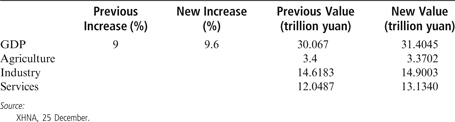
The National Bureau of Statistics announced on 25 December that it had revised the figures for GDP growth in 2008 from 9 per cent to 9.6 per cent (see Table 2).
Revised GDP Figures for 2008

Source: XHNA, 25 December.
e Health and Swine Flu Pandemic
China's first death from A/H1N1 strain of influenza was reported on 6 October, an 18-year-old woman from Lhasa. As of 5 October, China had reported 21,453 confirmed cases of which 78.7 per cent had so far shown full recovery (XHNA, 6 Oct.). As of 31 October, Chinese official statistics for the spread of A/H1N1 influenza stood at 44,981 confirmed cases, of which 33,184 had fully recovered. The number of deaths from the disease was six. Premier Wen Jiabao was reported to have visited a children's hospital in Beijing and to have urged the country to take even more effective measures to combat the disease at a time when seasonal flu was on the increase as well. He said that sharp increases in the numbers affected were likely but that no effort would be spared to help patients recover, especially those with severe symptoms (XHNA, 31 Oct.). An official from the Ministry of Health said on 1 November that the disease was spreading rapidly but remained under control. Most cases were mild and there was no evidence of virus mutation. He said that China's preventive measures had been effective in slowing down the spread of the virus (XHNA, 1 Nov.). As the first country in the world to issue a production license for vaccines against the flu, China had inoculated more than 3.78 million people as of 31 October, with no reports of serious adverse reaction, according to the Ministry. On 9 November, Vice Premier Li Keqiang inspected the National Institute for the Control of Pharmaceutical and Biological Products to highlight the importance of the vaccination campaign as the infection rate spread. By 9 November, confirmed cases had risen to about 60,000 with 30 deaths. 8.75 million doses had been administered by 9 November, concentrating on high risk groups including schoolchildren, medial quarantine and transport workers, and the elderly (XHNA, 9 Nov.). As of 30 November the national vaccination campaign had inoculated 27 million people against A/H1N1, nonetheless the number of deaths attributed to the disease increased in the previous week to 74 (XHNA, 2 Dec.).
f Tibet and Xinjiang
Tibet
On 16 October the Chinese press carried the text of an interview carried out by the German magazine Focus with Zhu Weiqun, Executive Director of the Party's United Front Work Department and lead negotiator on the Chinese side with the Tibetans. Zhu said that if the Dalai Lama really wanted talks, he must create a favourable atmosphere for them instead of making it worse. Zhu claimed that it was the Dalai Lama who had broken off the talks, and that the central government had all along been generous and broad minded. If talks were to resume, the Dalai Lama must provide an explanation of why the talks were broken off. Secondly, the Tibetans needed to reconsider and rectify their political programme. In particular, they needed to think again about the Memorandum on autonomy that they had presented in November 2008 which was totally unacceptable to the Chinese. Thirdly, the Dalai Lama should “restrain himself from performing acts that displease the central authorities and are unfavourable to the relations between China and the relevant country” (ZTS, 16 Oct.).
Despite strong Chinese protests the Dalai Lama paid a nine-day visit to Japan from 29 October. He was reported to have said during a press conference in Tokyo that his proposed visit to the Tawang Monastery in Arunachal Pradesh was not a political gesture and should not upset the Chinese government. He reiterated his concerns about the situation of Tibetans and other ethnic minorities in China and urged the media and other members of the international community to go there and judge the situation for themselves (KNA, 31 Oct.).
China said that it was strongly dissatisfied by an EU statement denouncing the death penalties handed down to two Tibetans convicted of murder during the disturbances in Lhasa in 2008. The Foreign Ministry spokesman said that the trials were fair and open and that the EU was interfering in China's internal affairs (XHNA, 30 Oct.).
In response to a question about a potential meeting between President Obama and the Dalia Lama, the Chinese Foreign Ministry spokesman said on 12 November that the US should respect China's core interests regarding Tibet. He said:
China is firmly opposed to the Dalai Lama's acts in international arena and opposed to any contact between the Dalai Lama and leading officials of foreign governments in whatever name or capacity.
The spokesman added that since President Obama had expressed his respect for President Lincoln's achievements in the Civil War and his signing of the emancipation proclamation, he was sure that he would equally understand China's position in opposing Tibetan independence and the Dalai Lama's attempts to split the country (XHNA, 12 Nov.).
The Dalai Lama visited Australia from 1 to 10 December. He had no meetings with federal government leaders, although he did meet the leader of the opposition.
The Tibetan government announced that local GDP was likely to grow by 12.1 per cent in 2009, as a result of “huge investment” aimed at boosting the economy. Fixed-asset investment would rise by 22 per cent to 37.8 billion yuan. Tibet would also benefit from a substantial rise in tourism to 5.56 million visitors (up 147 per cent) (XHNA, 17 Dec.).
The Chinese press denounced the “Han Chinese Tibetan Friendship Association” as a new trick by the Dalai Lama to try to divide China. It claimed that the idea had originally been proposed by “anti-China activists” in the US but had really taken off after the disturbances in Lhasa in 2008, when the Dalai Lama had given it his personal backing (XHNA, 27 Dec.).
Xinjiang
The SCMP reported on 8 October that a leading Al-Qaeda figure had appeared in a post on an Islamist website urging Uyghurs in Xinjiang to launch a holy war against “oppressive” China (SCMP website, 8 Oct.).
Xinhua reported on 9 October that 11 people had been put on trial in Shaoguan, Guangdong, on charges arising out of the incident that led to death of two young Uyghurs on 26 June, which apparently was one of the sparks for the rioting in Urumqi (XHNA, 9 Oct.). One of the defendants was sentenced to death and another to life imprisonment for their part in the incident. Nine others were given prison terms from five to eight years (XHNA, 10 Oct.).
Six men, all Uyghurs, were sentenced to death on 12 October for murder and other crimes arising from the riots in Urumqi on 6 July. Another defendant was sentenced to life imprisonment (XHNA, 12 Oct.). On 30 October, the Higher Court of Xinjiang Uyghur Autonomous Region pronounced judgments on its review of six cases relating to the riots in Urumqi on 6 July. Four cases had been appealed and the original sentences were upheld, and the Court reviewed two other cases where no appeal had been lodged and found them to be in order. Guilty verdicts were imposed on 21 defendants for crimes ranging from intentional homicide to the destruction of property. Death sentences were imposed on eight individuals, three were given suspended death sentences, four were sentenced to life imprisonment and five others were sentenced to various fixed terms of imprisonment. The death sentences would be subject to final review by the Supreme People's Court (XHNA, 30 Oct.).
The Xinjiang authorities announced the launch of a further “strike hard” campaign from 1 November. All local security authorities were ordered to intensify their investigations into the circumstances surrounding the Urumqi riots (the “7.5 Case”), and to hunt down all those involved. They were also to collect information on terrorist-related activity and to guard against any further terrorist outbreaks. A further target of the campaign would be criminal gangs and “roving and serial criminals.” This campaign was itself to be linked with others on the kidnapping and trafficking of women and children, the illegal production and sales of explosives, criminal activities involving firearms, and money counterfeiting. Thus the campaigns could “complement and promote one another” (XHNA, 2 Nov.). It was announced that 94 of those wanted for their part in the July riots had been detained among 382 individuals seized during the campaign (XHNA, 9 Dec.).
The Chinese press reported that three central investigation groups had inspected Xinjiang since 4 November. They were led by Liu Yunshan, member of the Central Secretariat and director of the Central Propaganda Department; Ma Kai, State Council secretary general; and Du Qinglin, Director of the Central United Front Work Department (ZTS, 20 Nov.).
A further five persons were sentenced to death on 3 December for crimes committed during the 5 July riots. All five were Uyghurs. Two others were given life sentences and another six jail terms. The court report stated that the case had been heard in Uyghur, with translations provided for those present at the trial (XHNA, 3 Dec.). Death sentences were handed down to four more people on 4 December, one of whom was apparently Han Chinese (XHNA, 4 Dec.).
Kyodo News Agency reported that 20 ethnic Uyghurs who had sought political asylum in Cambodia had been returned to the Chinese authorities on 19 December. The Interior Ministry spokesman said that “they are criminals who fled China. They were involved with a terrorist organization in China.” He denied that it had been done to please China in the light of Vice President Xi Jinping's visit (KNA, 19 Dec.).
China announced a slight easing of the ban on internet access in Xinjiang which had been in place since July, by allowing access to People's Daily online and Xinhuanet.com. It said restrictions on other websites would gradually be lifted and that mobile phone text messaging and international phone calls would be resumed with effect from 28 December (People's Daily online, 29 Dec.).
The Xinjiang Regional People's Congress passed legislation on ethnic unity on 31 December. It obliges all citizens to work towards national unity and to oppose secession. Individuals and organizations were banned from promulgating speech detrimental to national unity, and from gathering, providing, producing and spreading information to that effect (XHNA, 31 Dec.).
g Human Rights
It was reported from Hong Kong that the Hong Kong authorities had handed over Zhou Yongjun, a student leader in the 1989 democracy protest, to China. Zhou had arrived in Hong Kong from the US in 2008. He had intended to visit China using a fake Malaysian passport as applications in his own name had been turned down. While in Hong Kong, he was detained by the police following allegations of financial fraud. According to his lawyers, he had been cleared of the fraud but had then been turned over to the Immigration Department which had in turn handed him to the mainland authorities in Shenzhen on 30 September 2008. He had since been held secretly on the mainland. He was said to be due to stand trial in Sichuan for fraud (KNA, 12 Oct.).
The SCMP reported that the well known dissident Liu Xiaobo was expected to be formally charged in December with inciting subversion, for his part in the publication of Charter 08, a call for greater democratization and human rights in China (SCMP website, 9 Dec.). The decision was widely deplored and the US and the European Union both issued statements calling for his release. The Chinese government expressed strong dissatisfaction over foreign countries' criticism of the trial describing it as a gross interference in China's internal affairs. He was put on trial on 23 December and found guilty of subversion on 24 December and sentenced to 11 years imprisonment. Foreign observers were denied access to the hearings (KNA, 24 Dec.).
Despite pleas from his family and from the British government, Akmal Shaikh, who had been convicted of drug smuggling by a court in Urumqi, was executed on 29 December. There had been doubts raised about his mental health and capacity but these were not taken into account by the Chinese courts. Akmal Shaikh was the first western European citizen to be executed in China for over 50 years. The Chinese press said that he had been convicted on 29 October 2008 and two subsequent appeals had been turned down. In reviewing his case, the Supreme People's Court determined that the evidence against him was clear, and the sentence appropriate. Officials from the British Embassy and from a British organization had proposed that his mental health be examined. The Supreme People's Court determined that these documents did not prove that either he or his family had a history of mental disease. Nor had he himself provided any relevant material, and therefore “there is no reason to cast doubt on Akmal Shaikh's mental status” (XHNA, 29 Dec.).
h Media and Information
It was reported that China had now built the world's largest internet structure with 95.6 per cent of towns connected to broadband and 99 per cent of villages with access to the internet. China's web users numbered 360 million, and broadband users numbered 99.33 million (People's Daily online, 3 Nov.). The Hong Kong SCMP reported on 6 November that China had softened its policy on so-called internet addiction. The term had apparently been dropped and the Ministry of Health had banned any type of physical punishment or surgery to deal with the problem. This decision followed the death of a teenager at an internet rehabilitation camp in Guangxi which had attracted wide attention. Previously Ministry guidelines had suggested that anyone who stayed on line for more than six hours a day over a three-month period should be classified as having an addiction. Draconian measures including electro shock treatment were being used to deal with the condition (SCMP website, 6 Nov.).
The Supreme People's Court issued a draft regulation on 3 November requiring government officials who sought to withhold information on areas such as budgets on the grounds that they were national or business secrets should provide evidence to support their claims. The regulation was based on the Code of Practice on Access to Government Information and the Administrative Procedure Law (XHNA, 3 Nov.). This followed a number of cases where individuals had sought access to local budgetary information and had been denied it by official on the grounds of state secrecy.
China Daily reported that the search engine Google was facing accusations that its employees had illegally and without authorization scanned Chinese writers' works into its digital library. A government spokesman said China would be pushing the US government to handle this issue properly. The report noted that Google had offered a copyright settlement in the US on this issue, but this was unacceptable to Chinese writers (XHNA, 21 Oct.). The Hong Kong press subsequently reported that the government had been misleading in talking about copyright infringement when what was actually at issue was reproduction rights. The original reports had sparked a massive response in China condemning Google (SCMP, 23 Oct.).
The Chinese government rejected as fabrication a report by the US–China Economic and Security Review Commission published on 22 October which had claimed that China was ratcheting up cyber espionage operations against the US (XHNA, 23 Oct.).
The highly successful financial newspaper Caijing went through a complete reorganization when first its management team and then its editorial team, under its original founder and inspiration, Hu Shuli, resigned en masse. This followed a number of occasions when Caijing's reporting appeared to be sailing too close to the wind. It was reported that Hu Shuli would be founding a new publication (Hong Kong Ming Pao website, 29 Oct.). The official Chinese news agency reported on 9 November that she had resigned, along with the deputy editor in chief, Dai Xiaojing. It noted that she might be taking up an invitation to teach at Sun Yatsen University in Guangzhou (XHNA, 9 Nov.). The Hong Kong press reported on 31 December that Hu had teamed up with the China Institute for Reform and Development, based in Hainan, to launch a new magazine, based on the institute's former publication News Magazine. The new publication would be called Century Weekly. Hu Shuli would be the editor and her deputy would be a former Caijing staff member (SCMP website, 31 Dec.).
China hosted the World Media Summit in Beijing on 8–10 October, which offered opportunities for China's media leadership to engage with many senior media figures from around the world. President Hu Jintao delivered a keynote speech to the Summit on 9 October. He promised that China would continue to make government affairs public and enhance information distribution, while calling on news media to uphold their social responsibilities. He said that the Chinese media are encouraged to play a key role in beefing up healthy trends, reflecting social conditions and public opinion, orienting public focuses, soothing public dissatisfaction, ensuring supervision by public opinion, and safeguarding public rights to information, participation in public affairs, expression and supervision. He promised that China would safeguard the legitimate rights and interests of foreign news media and continue to facilitate foreign media coverage of China in accordance with the law (XHNA, 9 Oct.).
The All China Journalists' Association issued a revised code of professional ethics for journalists on 27 November (full text in XHNA, 27 Nov.). The document enjoined journalists to “serve the people wholeheartedly and be faithful to the Party, the motherland and the people.” They should “manifest the Party's views while also reflecting the people's wishes.” They were also expected to “uphold the principle of enduring the truthfulness of news” and refrain from distorting the facts. The following day the SCMP reported that ten journalists had been charged with colluding in hushing up reports of a coal mining accident in Hebei that killed 35 people in July 2008 just before the Olympics (SCMP website, 28 Nov.).
i Hong Kong and Macau Special Administrative Regions
Macau
The Chief Executive of the Macau Special Administrative Region announced on 5 October the appointment of seven new appointed members of the Macau Legislative Council, to complete the formal process of constituting the Council. Twelve directly elected members and ten indirectly elected ones were produced by elections on 20 September (XHNA, 5 Oct.). Their appointments were formally confirmed by the State Council on 24 November (XHNA, 24 Nov.).
President Hu Jintao travelled to Macau on 19 December for the celebrations of the tenth anniversary of the return of Macau to China. Before the ceremony he had a meeting with the Chief Executive, Edmond Ho, and praised him for the pioneering work he had done in successfully implementing “one country, two systems” in Macau. President Hu announced that China would be presenting Macau with a pair of pandas to mark the anniversary. He also inaugurated the Macau Science Centre and paid a special visit to the eco-friendly Macau Incineration Plant on Taipa Island (XHNA, 19 Dec.). At a dinner in his honour, he undertook that China would give full support to Macau in promoting economic development, people's welfare, harmony and democracy. He said that the principles of “one country, two systems” and “Macau people governing Macau” had been fully implemented (XHNA, 19 Dec.). On 20 December, President Hu presided over the swearing-in ceremony for the new Chief Executive of Macau, Fernando Chui Sai On (XHNA, 20 Dec.). The Hong Kong press reported that the Macau authorities had denied entry over the celebration period to a number of journalists and political activists from Hong Kong who were considered a security threat (Hong Kong Sunday Morning Post, 20 Dec.).
Hong Kong
The Hong Kong government published its proposals for political reform in 2012 on 18 November. The main elements were an expansion of the election committee which chooses the Chief Executive from 800 to 1,200 members; a quarter of the new members would be filled by directly elected district councillors. In the legislature, it was proposed that ten new seats should be added, five of which would be directly elected, and five from directly elected district councillors, bringing the overall number of seats in the legislature to 70 (RTHK, 18 Nov.). The proposals were a disappointment to those who had been seeking more substantive moves towards universal suffrage.
The Chief Executive, Donald Tsang visited Beijing in late December. He had meetings with President Hu Jintao and with Premier Wen Jiabao on 28 December. President Hu was quoted as urging “the Hong Kong SAR government and people of all walks of life to work with one heart and one mind, keep up the good work, and continue to make unremitting efforts to stabilize the financial situation, develop the economy, and improve the people's living conditions; properly handle the problems concerning the development of Hong Kong's political system to safeguard social harmony and stability and consolidate and develop the current good situation; and join hands to create for Hong Kong an even better tomorrow” (XHNA, 28 Dec.).
2. Foreign Relations
a Diplomatic Tours
Hu Jintao to South East Asia
President Hu Jintao paid a state visit to Malaysia from 10 to 11 November. He met the Supreme Head of State, Mizan Zainal Abidin, and had talks with Prime Minister Najib Tun Razak. The leaders exchanged views on the development of their strategic and co-operative partnership, and other issues of common concern. They pledged to make joint efforts to deepen bilateral co-operation, so as to benefit their peoples and make contributions to peace and development in the region (XHNA, 11 Nov.). President Hu and the Prime Minister then witnessed the signature of five Memoranda of Understanding: on banking supervision co-operation, co-operation in higher education; co-operation in sewerage services industry; supplementary agreements to the general loan agreement on the utilization of preferential buyers credit; and the preferential buyers credit loan agreement for the Penang second bridge project (Bernama news agency website, 11 Nov.). Bilateral trade reached US$53.47 billion in 2008, achieving the target of US$50 billion two years ahead of schedule (XHNA, 11 Nov.).
President Hu arrived in Singapore on 11 November for a state visit. He met the Singapore President Sellapan Rama Nathan, the Prime Minister Lee Hsien Loong, the Senior Minister Goh Chok Tong and the Minister Mentor Lee Kwan Yew. In his talks with the Prime Minister, Hu put forward a six-point proposal for further strengthening the co-operation between the two countries. These included: frequent high-level contacts, using the bilateral co-operation mechanism effectively, deepening economic and trade co-operation (including he Suzhou Industrial park and Tianjin Eco City), expanding cultural and people-to-people exchanges (and China would give Singapore two pandas), improving defence and security co-operation especially in non-traditional security areas, and promoting mutual co-operation and co-ordination in multilateral arenas (XHNA, 12 Nov.). After their meeting, the two leaders attended the signing ceremony of co-operation agreements between the two countries. Bilateral trade reached US$52.4 billion in 2008 (XHNA, 11 Nov.).
Hu Jintao's Visit to Kazakhstan and Turkmenistan
President Hu Jintao visited Kazakhstan for a working visit from 12 to 13 December. He had talks with President Nazarbaev and the two leaders attended the inaugural ceremony for the China–Kazakhstan natural gas pipeline. Bilateral trade between the two countries in 2008 was US$17.5 billion (XHNA, 13 Dec.). Hu paid a two-day working visit to Turkmenistan on 13 and 14 December. He had talks with President Gurbanguly Berdymukhmanedov. He said China would expand co-operation with Turkmenistan in their long-term strategic partnership and suggested drafting a plan for middle- and long-term co-operation in non-energy areas. Following the talks, soft loan agreements were signed to help finance the supplies of oil and gas, telecommunications equipment and railway passenger carriages. They also signed an agreement on double taxation. On 14 December Hu joined the Presidents of Kazakhstan, Uzbekistan and Turkmenistan for the formal inauguration of the China–Central Asia Pipeline. He also had talks with President Karimov of Uzbekistan (XHNA, 14 Dec.).
Xi Jinping's Tour of Belgium, Germany, Hungary, Bulgaria and Romania
Vice President Xi Jinping arrived in Belgium on 7 October on the first leg of his European tour. He met the Prime Minister of Belgium, Herman Van Rompuy, on 7 October for talks on the bilateral relationship. Xi said that China would further promote exchanges with Belgium in various sectors including culture, education and tourism. After the talks, they attended the signing ceremony for a number of agreements on science, finance and trade co-operation. Bilateral trade was worth US$20.2 billion in 2008 (XHNA, 7 Oct.). Xi had an audience with the Belgian King, Albert II, on 8 October, and said that the development of Sino-Belgium relations was enjoying good momentum, and that his visit was aimed to improve political trust and substantial co-operation to make new progress in bilateral ties (XHNA, 8 Oct.).
On 8 October, he met the President of the European Commission, José Manuel Barroso, and told him that China and the EU have formed a pattern of comprehensive, wide-ranging and multilevel co-operation and have become two important forces to help shape the future international structure into a multi-polar world. He put forward a three-point proposal for improving relations: First, to firmly stick to the strategic direction of their bilateral ties; second, to always adhere to the belief of mutual benefit and win–win co-operation; third, to always adhere to the principle of equality and mutual trust (XHNA, 8 Oct.).
Xi travelled to Germany on 10 October, arriving in Dresden before travelling on to Berlin. On 12 October he met the Chancellor, Angela Merkel, and put forward a five-point proposal for boosting bilateral relations. He also had a meeting with President Koehler, a meeting with the Chairman of the Free Democratic Party (a coalition partner), addressed a gathering of business leaders, and attended the signing ceremony for nine agreements on economic co-operation, education, solar energy and other areas (XHNA, 12 Oct.). He then attended the Frankfurt Book Fair on 13 October (XHNA, 13 Oct.).
Xi arrived in Bulgaria on 14 October. He met Angel Marin, Vice President of Bulgaria. The two leaders undertook to further cement the traditional friendly relations between the two countries. Vice President Marin noted that Bulgaria was ready to work with China to build mutual trust and intensify co-operation on trade, investment, tourism, culture and education. After the meeting they witnessed the signature of a number of co-operation agreements. Xi later met the Bulgarian President (XHNA, 14 Oct.).
Xi Jinping met the President Solyom of Hungary on 16 October. He noted that the bilateral relationship had entered a new stage of comprehensive and rapid development. Trade had increased markedly. He put forward a standard four-point proposal for improving relations. In response, President Solyom looked forward to strengthening co-operation in the economy, trade, culture, education, science, technology and environmental protection (XHNA, 16 Oct.). He met Prime Minister Bajnai on 17 October.
Vice President Xi arrived in Romania on 18 October. He had talks with Parliamentary leaders on 19 October. He had talks with the Romanian Prime Minister, Emil Boc, on 20 October. Xi noted that bilateral relations were now at their best. Trade had risen to US$3.2 billion in 2008. A number of agreements were signed on economy, finance, technology, agriculture, culture and other fields (XHNA, 20 Oct.).
Xi Jinping's Tour of Japan, South Korea, Burma and Cambodia
Vice President Xi Jinping visited Japan from 14 to 16 December. He had talks with Prime Minister Hatoyama on 14 December, an audience with Emperor Akihito, talks with the Foreign Minister Katsuya Okada, and meetings with party leaders, parliamentarians and representatives of friendship groups. His meetings strongly stressed the theme of friendship and co-operation. According to the Kyodo News Agency, his audience with Emperor Akahito on 15 December raised some controversy in Japan. There was some speculation that Mr Ozawa, Secretary General of the DJP, had pressured the government into arranging it, which critics claimed was political exploitation of the Emperor, who should be above politics (KNA, 14 Dec.).
In South Korea on 17 December, Vice President Xi had meetings with President Lee Myung-bak and Kim Hyong-o, Speaker of the National Assembly. He said that the exchange of Head of State visits last year had lifted their relationship to a co-operative strategic partnership. Bilateral trade in 2008 was US$180 billion. The leaders also discussed climate change and the situation on the Korean peninsula (XHNA, 17 Dec.).
Vice President Xi arrived in Burma for a two-day visit on 19 December. Xi said that his purpose was to cement traditional friendship, reciprocal co-operation and common prosperity and to exchange views with the leaders of Myanmar. He met Tan Shwe, Chairman of the Peace and Development Council and had talks with Maung Aye, Vice Chairman of the Council. Bilateral trade was US$2.6 billion in 2008, and China had invested US$866 million in mining, 281 million in electric power and 124 million in oil and gas in Burma by 2008 (KNA, 19 Dec.). In his meeting with Tan Shwe, Xi said that China had always considered Burma as an old friend and good friend. He said that they were good and friendly neighbours with a “baobo” (cousin) relationship. He put forward a four-point proposal for developing relations further. Xi said that China wished to see a stable political situation in Burma, with economic development and national reconciliation. He welcomed the “seven-point road map” to democracy and national reconciliation that the government had drawn up (XHNA, 21 Dec.).
Xi Jinping then visited Cambodia from 20 to 21 December where he had talks with the Prime Minister Hun Sen on 21 December. Xi described the relationship as a “good example of sincere co-operation between countries with different social systems.” He put forward a four-point proposal to cement relations with Cambodia, including keeping high-level contacts, strengthening exchanges on country governance, deepening economic and trade co-operation and promoting co-ordination in international and regional affairs. After the talks the two leaders witnessed the signature of 14 agreements on preferential loans (XHNA, 21 Dec.). He met King Norodom Sihanmoni on 22 December to discuss bilateral relations.
b Multilateral Conferences
Asia-Pacific Economic Co-operation (APEC)
In advance of the APEC meeting, Vice Foreign Minister He Yafei told a press conference that China had four expectations of the meeting: that it would put forth a concrete co-operation plan to deal with the international financial crisis and resume economic growth; show clear opposition to trade protectionism and support to the Doha Round negotiations; make fresh progress in promoting regional economic integration, improving investment environment and realizing the Bogor Goals; and continue to advance APEC's organizational reform and mechanism building (XHNA, 7 Nov.).
President Hu Jintao gave a speech to the APEC CEO Summit entitled “Strengthen confidence in cooperation and revive world economy,” in which he called for a multipronged approach to turn the crisis into an opportunity and lay a solid foundation for the full recovery of the world economy. He made a strong pitch for promoting trade and economic liberalization and facilitation, saying that protectionism, especially the unreasonable trade and investment restrictions imposed on developing countries, should be opposed. He called for the speeding up of the Doha Round negotiations, and said that the developed members of APEC should take measures to ensure that the Bogor Goals for trade liberalization were met on time. He also called for the advancement of regional economic integration and the promotion of economic structural reform with a focus on regulatory reform. He said renewed efforts were needed to reform the international financial system to work for a fair, just, inclusive and well-managed international financial system and an environment conducive to the sound development of the world economy. He said that the international financial crisis had brought unprecedented difficulties and challenges to the Chinese economy, prompting the Chinese government to modify its macroeconomic policies and to introduce a proactive fiscal policy and a moderately easy monetary policy. Hu noted that the series of measures China had adopted to counter the international financial crisis were conducive to the steady and relatively fast growth of the Chinese economy and the international effort to alleviate the impact of the crisis and restore world economic growth (XHNA, 13 Nov.).
The leaders' summit focused on countering the international financial crisis, climate change, opposing trade protectionism, supporting a multilateral trading regime, furthering regional economic integration and the APEC's future. In his address to the meeting Hu made a four-point proposal on promoting sustainable development: make unremitting efforts to fully restore world economic growth; take a long-term perspective and promote sustainable growth; follow a holistic approach and advocate inclusive growth; engage in comprehensive co-ordination and pursue balanced growth. He declared that “China is committed to the path of peaceful development and a win-win strategy of opening-up, and will always pursue development that is peaceful, open and co-operative and making unremitting efforts towards a harmonious world of enduring peace and common prosperity” (XHNA, 15 Nov.).
Association of the Southeast Asian Nations (ASEAN)
Premier Wen Jiabao visited Thailand from 23 to 25 October to attend the 12th summit between ASEAN and China (10 + 1), the 12th summit between the ASEAN and China, Japan and the Republic of Korea (10 + 3), and the fourth East Asia Summit, at the invitation of Thai Prime Minister Abhisit Vejjajiva. Hu Zhengyu, Assistant Minister of Foreign Affairs, said that China hoped for three major outcomes from the meetings: first, to strengthen confidence and gather strength; second, to discuss ways for deepening pragmatic co-operation among all sides, share opportunities and work to inject new vitality into sustained development in East Asia; third, to enhance communication and expand consensus on global issues such as international economic and financial system reform, climate change, food security, energy security, public health security and natural disasters, among others (XHNA, 22 Oct.).
Premier Wen put forward a six-point proposal to the 12th China ASEAN Summit on 24 October. He described ASEAN as a close neighbour and strategic partner of China, and proposed that steps be taken to enhance the relationship in the following areas:
• bring into play the role of the China–ASEAN Free Trade Area. China was willing to hold a China–ASEAN Free Trade Area forum next year and jointly establish a commercial portal website with the ASEAN nations. He also proposed building an economic co-operation zone in the ASEAN nations to further expand Chinese investment in the region;
• accelerate the construction of infrastructure facilities: agreement should reached on the projects under the China–ASEAN co-operation in transportation, and on the MOU on Customs Co-operation. The China–ASEAN regional air traffic agreement should be concluded;
• deepen agricultural and rural co-operation;
• promote sustainable development: expand co-operation in protection of bio-diversity, environmental protection, clean production, environmental industries, new energy and renewable energy. China offered to help train 100 environment officials for ASEAN;
• strengthen social and cultural exchanges in the following areas: disease control, culture, education, tourism and cross-border crimes;
• further advance regional co-operation at various levels: China supports the process of integration of ASEAN and a leading role for ASEAN in regional co-operation. China will establish a permanent representative office in ASEAN (XHNA, 24 Oct.).
Foreign Minister Yang Jiechi said that China had played a major role at the ASEAN-related meetings, putting forward proposals to tackle the financial crisis and enhance regional co-operation. China plans to offer US$15 billion of credit to ASEAN countries and 270 million yuan in special aid to less-developed ASEAN countries. China was among the first countries to promote and support co-operation among East Asian nations. China hoped the Chiang Mai Multilateralization Initiative could be launched by the end of the year. Premier Wen had also held bilateral meetings with leaders from India, Australia, Thailand, New Zealand and Burma (XHNA, 25 Oct.).
Shanghai Co-Operation Organization
The eighth Prime Ministers' meeting of the Shanghai Co-operation Organization (SCO) was held in Beijing on 14 October, chaired by Premier Wen Jiabao, with the Prime Ministers of Russia, Uzbekistan, Kazakhstan, Kyrgyzstan and Tajikistan as well as representatives from SCO observer nations, and Afghanistan.
In a press conference after the meeting Wen Jiabao said that the meeting had made remarkable achievements. The attendees had set down joint measures to increase economic co-operation, cope with the global financial crisis and ensure steady economic growth. They had agreed to set up a monitoring mechanism for the SCO economy. Second, they supported the increase of the financial dialogue and agreed to improve the investment environment. Third, they agreed to promote trade facilitation and to improve port infrastructure and customs procedures. Fourth, they agreed to expand agricultural co-operation and to co-operate in science and technology (XHNA, 14 Oct.). A full text of the joint communiqué issued at the end of the meeting was published by Xinhua (XHNA, 14 Oct.).
c Countries, Territories and Regions
Africa (China–Africa, Egypt, Djibouti, Cote d'Ivoire)
In advance of Premier Wen Jiabao's trip to Egypt for the Fourth Ministerial Meeting of the Forum on China Africa Co-operation (FOCAC), Assistant Foreign Minister Zhai Jun and Vice Commerce Minister Chen Jian gave a press briefing. Chen noted that China–Africa trade had been growing rapidly, and the total trade volume reached US$106.8 billion in 2008, exceeding the target of US$100 billion by the year 2010 set by Premier Wen at the previous summit. Volume had dropped in the first three quarters of 2009, but the rate was slowing rapidly. Chinese investment in Africa reached US$7.8 billion by the end of 2008, and rose again by 77.5 per cent in the first three quarters of the year. Over 1,600 Chinese companies were operating in Africa, in agriculture, telecommunications, energy, processing and manufacturing. China had provided assistance to 53 African countries over the last 50 years. It was based on Africa's needs, with no political strings attached. Emphasis was placed on helping develop African infrastructure, increase agricultural production and improve standards of medial care, education and so on. China had doubled its assistance since the last summit, and set up the China–Africa Development Fund. It had reduced many tariffs and basically completed debt relief operations, cancelling the debts of 33 heavily indebted poorer countries (XHNA, 2 Nov.).
Premier Wen, accompanied by the Foreign Minister, Yang Jiechi, and the Minister of Commerce, Chen Deming, arrived in Egypt on 6 November. He was received at the airport by the Egyptian President and met Prime Minister Ahmed Nazef the following day. Wen put forward a five-point proposal for further developing the relationship. They witnessed the signature of agreements on economic, cultural and customs co-operation (XHNA, 7 Nov.). Premier Wen then had talks with President Mubarak to discuss bilateral relations, global challenges and Middle East peace. Wen said China supported a solution based on UN relevant resolutions, the “land for peace” principle and the Arab Peace Initiative. The Palestinian–Israeli conflict should be solved through dialogue and political negotiation, the Middle East peace process should be promoted.
Premier Wen attended the opening ceremony of the Forum on China Africa Co-operation and delivered a speech. He had meetings in the margins with a number of African leaders including Zimbabwean President Robert Mugabe, Sudanese President Omar al-Bashir, Liberian President Ellen Johnson Sirleaf, Comoran President Ahmed Abdallah Mohamed Sambi, Republic of Congo President Denis Sassou Nguesso, Ethiopian Prime Minister Meles Zenawi and Democratic Republic of Congo Prime Minister Adolphe Muzito.
Wen's speech (full text in XHNA, 8 Nov.) was entitled “Building the new type of China Africa Strategic Partnership.” He said that since its founding FOCAC had played a major role on in guiding and promoting relations between China and Africa. He noted that
[t]he Chinese government and people respect the right of African countries to independently choose their social systems and support the African people in exploring development paths that suit their national conditions. We firmly believe that Africa is fully capable of solving its own problems in an African way. The economic co-operation and trade between China and Africa are based on mutual benefit, win-win progress, openness and transparency. China has never attached any political strings to its support and assistance to Africa, and nor will it do so in the future. China welcomes the active involvement of other countries and international organizations in Africa's development so that we can jointly promote peace, development and progress in Africa.
China was ready to deepen its practical co-operation with Africa and to push forward the new type of China Africa strategic partnership. He put forward eight concrete proposals for doing this:
• the establishment of a China–Africa partnership in addressing climate change, with senior level official consultations and co-operation in satellite weather monitoring, development and utilization of new energy sources, prevention and control of desertification, and urban environment protection. China would build 100 clean energy projects in Africa;
• science and technology co-operation would be increased, with the launch of a China–Africa science and technology partnership, joint demonstration projects on scientific and technological research, and the training of 100 post-doctoral students in China;
• China would provide US$10 billion in concessional loans, and support Chinese financial institutions in setting up a US$1 billion special loan for small- and medium-sized African businesses. China would cancel debts associated with interest-free loans due to mature in 2009 for the heavily indebted poor countries in Africa;
• China would open its markets further, aiming for zero tariffs for the products from the least developed African countries having relations with China, starting with 60 per cent of these products in 2010;
• Agricultural co-operation would be increased, building 20 agricultural technology demonstration centres, sending 50 agriculture technology teams to Africa and training 2,000 agriculture and technology personnel;
• Health co-operation would be increased, with the provision of 500 million yuan worth of medical equipment and anti-malaria material to the 30 hospitals and 30 anti-malaria treatment centres already built by China, and the training for 3,000 doctors and nurses;
• Education would be developed with the building of 50 China–Africa Friendship Schools, and the training of 1,500 school principals and teachers. By 2012 the number of Chinese government scholarships would be increased to 5,500, and 20,000 professionals in various fields would be trained for Africa over the next three years;
• Cultural exchanges would be increased, and China–Africa joint research and exchange programmes would be launched to enable more scholarly exchanges and the development of the intellectual support for better co-operation policies in the future.
The Foreign Minister of Djibouti, Mahamoud Ali Youssouf, visited China from 28 to 30 December. He had meetings with Vice President Xi Jinping and the Foreign Minister Yang Jiechi (XHNA, 29 Dec.).
Premier Wen Jiabao had a short meeting with Soro Guillaume, the Prime Minister of Cote d'Ivoire, in Chengdu on 16 October. They agreed to increase trade and economic links, particularly in transport, telecommunications and electricity. Prime Minister Guillaume was in Chengdu for the opening of the International Trade Fair.
Americas (Canada)
The Canadian Prime Minister, Stephen Harper, visited China from 2 to 6 December, his first visit in office. He was accompanied by the International Trade Minister and the Agriculture Minister. He met President Hu Jintao and then Premier Wen Jiabao on 3 December (XHNA, 3 Dec.). Canadian press reports of the meeting noted that Mr Harper had been publicly rebuked by Premier Wen for not having visited China earlier despite having been in office for five years. They also pointed to the change of approach of the Canadian administration which had previously made a point of promoting human rights causes in China (The Globe and Mail website, Toronto, 3 Dec.). Xinhua reported that Premier Wen had said that relations had experienced twists and turns which were not in accordance with the interest of either side. He added that the visit had a great mission and special significance, and that there were no conflicts of fundamental interests. Wen called for the speeding up of the negotiation of an investment protection agreement and said that China was ready to participate in Canada's “Asia-Pacific Gateway Plan.” Following the meeting the two sides issued a Joint Statement (full text in XHNA, 3 Dec.), in which they agreed to respect each others' sovereignty and territorial integrity, core interests and major concerns. Canada reiterated its “consistent and long standing one-China policy.” The leaders also witnessed the signature of four Memoranda of Understanding on climate change, mineral resources, culture, and science and technology (XHNA, 3 Dec.). Prime Minister Harper met Wu Bangguo, Chairman of the National People's Congress Standing Committee, on 4 December. Prime Minister Harper announced that Canada would be opening four new trade offices in China. Bilateral trade had reached US$53 billion and China had become Canada's second largest trading partner (XHNA, 4 Dec.). Following his visit to Beijing, Prime Minister Harper visited Shanghai and Hong Kong.
East Asia (Japan, Republic of Korea, Mongolia)
The second trilateral meeting of leaders from China, Japan and South Korea was held in Beijing on 10 October. Premier Wen Jiabao chaired the meeting which was attended by Prime Minister Hatoyama of Japan and President Lee Myung-bak of South Korea (XHNA, 10 Oct.). According to Kyodo News Agency the leaders agreed to work with other participants to resume the six party talks soon. They also agreed to strengthen co-operation to promote the development of regional and sub-regional co-operative mechanisms (KNA, 10 Oct.; for the full text of their joint statement, see Yonhap, 10 Oct.). That evening they both had dinner with President Hu Jintao. Hu said that the trilateral meeting had been a success and that he hoped that the three countries could facilitate co-operation in East Asia and jointly respond to regional hot issues and global challenges to unveil a new era for peace (XHNA, 10 Oct.).
Prime Minister Hatoyama had a separate meeting with Premier Wen on 10 October. Wen noted that their strategic partnership of mutual benefits had entered a new phase thanks to the joint efforts of both countries. Wen said that China appreciated Hatoyama's long-term commitment to strengthening bilateral ties, and he proposed four points for developing the relationship:
• strengthen high-level exchanges and maintain timely communication on bilateral ties and important issues. The East China Sea issue should be addressed according to the consensus reached in June 2008 whereby they would select areas for joint development by mutual agreement;
• give full play to the bilateral high level economic dialogue;
• increase cultural exchanges;
• strengthen co-ordination on regional and international issues to advance regional co-operation in East Asia.
In his meeting with President Lee, Premier Wen noted that their trade had reached US$100 billion in first nine months of the year, “despite the financial crisis that has brought difficulties to the two economies” (XHNA, 10 Oct.).
The Mongolian Minister of Foreign Affairs and Trade, Sukhbaartaryn Batbold, visited China from 11 to 13 October. He had talks with Foreign Minister Yang Jiechi and a meeting with Vice Premier Li Keqiang (XHNA, 12 Oct.).
Europe (EU, France)
The French Prime Minister, François Fillon, visited Beijing from 20 to 22 December. He had talks with President Hu Jintao, Wu Bangguo, Chairman of the National People's Congress Standing Committee, Premier Wen Jiabao and Vice Premier Li Keqiang. He brought with him an entourage of over 40 cultural figures, legislators and entrepreneurs. Xinhua News Agency noted that the visit “would further improve bilateral ties that were frozen in 2008 due to frictions over issues relating to Tibet and other affairs concerning China's core interests.”
Prime Minister Fillon had talks with Premier Wen Jiabao on 21 December in which they agreed to continue to promote their comprehensive strategic partnership. Premier Wen said that he hoped the two countries would consider and take care of each other's core interests and major concerns. He suggested reinforcing their strategic dialogue and elevating their economic and trade relations to a new level (including opposing protectionism, developing co-operation in nuclear, aviation and transport industries, and expanding mutual investment). He urged France to play a positive role in pressing the EU to lift the arms embargo and grant China market economy status.
After the talks, a number of agreements were signed, on aviation co-operation (where the French aerospace company CFM International would build an assembly line in China for engines for the Chinese jetliner C919) and in nuclear energy utilization, culture, science and technology, finance, information and water resource utilization (XHNA, 21 Dec.). Prime Minister Fillon and Vice Premier Li Keqiang also unveiled the Guangdong Taishan Nuclear Power Joint Venture Company Ltd, marking the establishment of the biggest Sino-French new energy joint venture (XHNA, 22 Dec.).
In his meeting with Prime Minister Fillon, President Hu was quoted by the Chinese media as saying that a proper handling of sensitive issues was crucial to stronger ties (XHNA, 22 Dec.). Separately, AFP reported that Prime Minister Fillon had said that one must not “disregard the progress made in China over the course of years” in the sphere of human rights, thanks, in particular, to its “policy of economic development.” He added that France was supporting this policy by dialogue and co-operation consolidating the law-based state, which was much more useful than statements that lead nowhere. China did not need the visit to be aware of France's position on human rights. This was very regularly “expressed on our behalf by the European Union” (AFP, 22 Dec.).
Middle East (Iran)
The Iranian First Vice President, Mohammed Reza Rahimi, visited Beijing for the Shanghai Co-operation Organization meeting. He also met Premier Wen Jiabao separately. Premier Wen said that China would maintain high-level exchanges with Iran, enhance mutual understanding and trust, promote bilateral practical co-operation and co-ordinate closely in international affairs. He said that China would continue to play a constructive role in seeking a peaceful solution to the nuclear issue (XHNA, 15 Oct.).
A Chinese Foreign Ministry spokesman said on 1 December that the resolution on Iran passed by the IAEA on 27 November had been aimed at early resumption of dialogue and negotiation. China had voted for the resolution and said that “all sides should step up diplomatic efforts for a comprehensive, long-term and appropriate solution to Iran's nuclear issue.” He added that sanctions should be seen as “the purpose in itself” (XHNA, 1 Dec.). On 24 December China reiterated its position that the Iran nuclear issue should be solved through dialogue and negotiations, and that sanctions could not solve the root issues (XHNA, 24 Dec.).
North Korea (Democratic People's Republic of Korea [DPRK])
Premier Wen Jiabao visited North Korea from 4 to 6 October to attend commemorations for China–North Korea Friendship year on the 60th anniversary of relations between the two countries. He was accompanied by the Foreign Minister Yang Jiechi, the Head of the Party's International Liaison Department, and three other ministers. He was received at the highest level, being met at the airport by Kim Jong Il (XHNA, 4 Oct.).
He had talks with the Premier, Kim Yong Il. They were reported to have reaffirmed the strong traditional ties of friendship between the two countries, and Premier Wen was told that the US was to blame for the nuclear issue. After the talks, the two sides signed a series of co-operation agreements which included a “protocol on the adjustment of treaties between the governments of the DPRK and China,” the “agreement on economic and technological co-operation between the governments of the DPRK and China,” exchange documents on economic assistance and other agreed documents in the field of economy. They also signed an accord on exchange and co-operation between educational organs of the two countries, a MOU on exchange and co-operation in the field of software industry, a protocol on common inspection of export and import goods between the state quality-control organs of the two countries, a MOU on tour of the DPRK sponsored by the tourist organizations of China and an accord on strengthening co-operation in protecting wild animals (KCNA 4 Oct.).
Premier Wen met Kim Yong Nam, President of the Supreme People's Assembly, on 5 October for a formal exchange of friendly remarks. He then had talks with Kim Jong Il. The Chinese press described these as producing an important consensus on Sino-North Korean relations and a vital consensus on achieving denuclearization of the Korean peninsula, and noted that Kim Jong Il had said that North Korea was ready for nuclear talks. After mutual pledges of good neighbourliness, friendship and co-operation, Kim Jong Il was quoted as saying that realizing the denuclearization of [the Korean] Peninsula was the behest of late President Kim Il Sung, and that the North Korean side's goal of devoting itself to peninsula denuclearization had not changed. North Korean–US hostile relations must change into peaceful relations through North Korea–US bilateral talks. North Korea was willing to conduct multilateral talks, including the Six-Party Talks, by taking into account the status of North Korean–US talks. Wen responded that China appreciated North Korea's efforts to uphold the goal of denuclearization and achieve that goal through multilateral talks including the Six-Party Talks. He said that China was willing to work jointly with the North Korea and other concerned parties and actively contribute to achieving denuclearization on the peninsula (XHNA, 5 Oct.).
Foreign Minister Yang Jiechi, perhaps responding to the perception that China had achieved little movement on the nuclear issue, said that the visit had been rich in content, weighty in outcome, and significant in meaning. He stated that China, as an important country in Southeast Asia and host of the Six-Party Talks, had played its due role and shouldered its due responsibility (XHNA, 6 Oct.).
Russia
The Chinese, Russian and Indian Foreign Ministers met for their ninth meeting in Bangalore on 27 October. They reached “important consensus” having discussed international and regional issues of common concern. Foreign Minister Yang Jiechi said that the three countries had made positive progress in practical co-operation. The Foreign Ministers agreed that their countries should deepen and strengthen co-operation in the fields of disaster relief and rescue, agriculture, the progress of medical, pharmaceutical, sanitation and health services, infrastructure, telecommunication, energy, trade and investment, for the benefit of the people of the three countries. They welcomed the role played by the G20 in international economic co-operation, and highlighted the importance of the issue of climate change. They issued a joint communiqué at the end of their meeting (XHNA, 27 Oct.).
Prime Minister Putin visited Beijing from 12 to 14 October. He had meetings with President Hu Jintao, Premier Wen Jiabao, and Wu Bangguo, Chairman of the National People's Congress Standing Committee. After the talks with Premier Wen, they issued a joint communiqué. Highlights included increased co-operation in oil, gas, coal and nuclear technology. In his meeting with Prime Minister Putin, President Hu said that Russia was right at the top of China's diplomatic agenda. Hu said that China wanted to work more closely with Russia to enhance political trust and strategic co-operation, and suggested taking their strategic partnership of co-ordination to a higher level (XHNA, 14 Oct.).
South Asia (India, Nepal, Pakistan)
China said that it was strongly dissatisfied with the decision by the Indian Prime Minister to visit Arunachal Pradesh and address an election rally there. The Chinese Foreign Ministry spokesman said on 13 October that: “We demand the Indian side address China's serious concerns and not trigger disturbance in the disputed region so as to facilitate the healthy development of China–India relations” (XHNA, 13 Oct.).
The Chinese and Indian Prime Ministers met in the margins of the ASEAN meetings in Thailand in late October. According to the Indian press, they agreed that bilateral issues should be properly handled through discussions, and should not be allowed to become an impediment to the development of friendly ties. The leaders did not discuss the question of Arunachal Pradesh though they agreed to try to ensure peace and stability in the border area (Press Trust of India, 24 Oct.).
A further dispute broke out of the Indian treatment of Chinese migrant workers. China called on India to “provide convenience” for Chinese workers applying for employment visas by following the MOU the two sides had agreed on simplifying visa procedures. Approximately 25,000 Chinese workers in India had been caught out by new rules introduced in July and were liable to repatriation (XHNA, 3 Nov.).
The Indian press reported that China had begun issuing visas to residents of Kashmir on separate sheets rather than being stamped directly into passports. This was interpreted as being an indication that China was questioning Kashmir's status as part of India. The Indian Home Ministry subsequently banned travel to China on such visas, and strong protest was made to China (PTI News Agency, 20 Dec.).
The Prime Minister of Pakistan, Yousuf Raza Gilani, visited Beijing from 12 to 15 October. He met President Hu Jintao on 13 October and the two leaders promised to deepen their bilateral links. Hu said they had developed an all-weather friendship and had all-dimensional co-operation. The relationship had a solid social foundation and vigorous vitality, and China was ready to work with Pakistan to enhance mutual strategic trust (XHNA, 13 Oct.) He also met Premier Wen Jiabao on 15 October. Wen noted that their strategic co-operative partnership was maintaining good momentum, and said that China was willing to boost co-operation in the fields of finance, hydro-electricity, education, culture, railways, road transport and the fishing industry (XHNA, 15 Oct.). Gilani also had meetings with officials in charge of overseas investment, coal mining and water conservation.
The Prime Minister of Nepal, Madhav Kumar, visited China from 26 to 31 December. He arrived in Lhasa on 26 December, and included Xi'an, Beijing and Shanghai on his visit. He met Premier Wen Jiabao on 29 December and they agreed to raise the level of their relationship to that of comprehensive and co-operative partnership. Premier Wen said that China would help the export of Nepali products to China and would encourage Chinese firms to invest in Nepal's infrastructure. He suggested co-operation in the areas of mountain agriculture and animal husbandry, and animal and plant quarantine, and personnel training. Prime Minister Kumar reiterated that Nepal believed Taiwan and Tibet were inalienable parts of Chinese territory and that Nepal would never allow any force to use Nepali territory to conduct anti-China activities. Prime Minister Kumar also met President Hu Jintao and Wu Bangguo, Chairman of the NPC Standing Committee (XHNA, 29 Dec.; full text of their joint statement in XHNA, 30 Dec.).
South East Asia (Laos, Vietnam, Philippines)
The Prime Minister of Laos, Bouasone Bouohavanh, visited southern China to attend the sixth China–ASEAN Expo in Nanning. He met Vice Premier Li Keqiang on 19 October, and they agreed to strengthen economic exchanges and deepen their strategic relationship. They singled out co-operation in agriculture, mining and infrastructure (XHNA, 19 Oct.).
Vice Premier Li Keqiang met the Deputy Prime Minister of Vietnam, Nguyen Sinh Hung, on 19 October in Nanning. They agreed that they would improve co-operation in their all round strategic partnership and settle the South China Sea issue properly in order to promote the stable development of bilateral ties (XHNA, 19 Oct.).
Foreign Minister Yang Jiechi visited the Philippines on 28 and 29 October for talks with the Filipino Foreign Secretary and a call on the President. He was also scheduled to sign agreements on strategic co-operation and foreign affairs (XHNA, 28 Oct.).
Taiwan
President Hu Jintao met Lien Chan in Singapore on 14 November, during the APEC meeting at which Lien Chan was Taiwan's senior representative. Hu said that cross-Strait relations had recently seen a historic turn. It was important to maintain the theme of the peaceful development of relations, adhere to a common direction, broaden the road ahead, and open up a new situation for the peaceful development of cross-Strait relations. Hu said that the two sides should move from the easy to the difficult and from economic to political issues, and strive to start a process of consultation of a cross-Strait economic framework agreement in the course of the year. Both sides should actively create conditions for jointly breaking through political difficulties (XHNA, 14 Nov.).
Chen Yunlin, Chairman of the Association for Relations across the Taiwan Strait (ARATS), visited Taiwan for the fourth round of negotiations between ARATS and its Taiwanese counterpart, the Straits Exchange Foundation (SEF), which were held in Taichung from 21 to 25 December. He was met by protests (from the opposition Democratic Progressive Party and from the falungong) and by well wishers (Central News Agency, Taiwan, 21 Dec.).
Preparatory talks agreed that main session would cover labour co-operation in the fishing industry, co-operation in inspection and quarantine of agricultural products, and co-operation in standard measuring, inspection and certification. They also achieved basic consensus on the avoidance of double taxation and strengthening co-operation in taxation matters (XHNA 21 Dec.). At the conclusion of the meeting agreements were signed on labour co-operation in the fishing industry, co-operation in inspection and quarantine of farm produce, and co-operation in standards measuring, inspection and certification. There was no formal discussion of the proposed Economic Co-operation Framework Agreement (ECFA), although they agreed that it would be on the agenda of the next session to be held in China next year. It was also agreed that expert talks would be arranged as soon as possible to prepare the ground (XHNA, 22 Dec.). The failure to reach agreement on double taxation was the subject of some speculation that it might have been due to issues relating to sovereignty, although this was denied by the Taiwan Premier, Wu Den-yih. Negotiators claimed that basic consensus had been reached and only some technical issues remained outstanding (Central News Agency, Taiwan, 22 Dec.).
United States of America
The Chinese Commerce Ministry stated that China was resolutely opposed to the US decision to start anti-dumping investigations into seamless steel pipes from China. It complained that the US was blaming China without any factual basis (XHNA 11 Oct.).
Xinhua reported that the US Department of Commerce had set preliminary anti-dumping duties on imports of Chinese-made oil pipes, in addition to the extra duties announced in September. The Chinese government made clear its strong opposition to the decision, calling it a protectionist move (XHNA, 6 Nov.). In retaliation China announced that it had launched anti-dumping anti-subsidy investigations into US-made off-road vehicles and sedans over 2 litres capacity. A Chinese commentary of 9 November outlined the “protectionist” actions the US had taken against China in recent days: on 3 November, the US Department of Commerce set preliminary countervailing duties on imports of steel wire decking from China; on 4 November the US requested the WTO to establish a dispute settlement panel on China's export restraints on raw materials; on 5 November the US Department of Commerce set preliminary anti-dumping duties on imports of oil country tubular products; and on 6 November the US International Trade Commission made three rulings on Chinese products and imposed punitive penalties on imports of coated paper and slats from China (XHNA, 9 Nov.).
General Xu Caihou, Vice Chairman of the Military Commission paid a visit to the US from 24 October to 3 November. He met US political and military leaders and visited the headquarters the Pacific Command of the US Military, US Strategic Command, Fort Benning Army Base, San Diego Naval Base, Nellis Air Force Base, Annapolis Naval Academy and other military units.
Previewing the visit, Qian Lihua, Director of the Foreign Affairs Bureau of the Ministry of National Defence, spoke to the media about military transparency. He said that China's position was that transparency on strategic intentions was the most important aspect; military transparency was based on mutual trust, and China always attaches great importance to the issue of military transparency. With regard to strategic intentions, China was completely transparent and its defence policy had been set out in numerous White Papers. He said transparency could not be resolved without mutual trust; the actions of the US in selling advanced weapons to Taiwan, and the activities of US vessels in Chinese exclusive economic zone had created obstacles in this respect. Qian said that the meetings of the two Presidents so far in 2009 had set a clear direction for the defence relationship and gradual steps had been taken to restore military relations. A number of US military delegations had visited China, but contacts needed to be in both directions and relations had not returned yet to normal. China appreciated US expressions of sincerity in wanting to restore the relationship, but the US needed to respect China's core interests and concerns, and handle issues appropriately, including the Taiwan issue, to solidify the political basis for the relationship (ZXS, 23 Oct.).
General Xu met US National Security Adviser James Jones and Deputy Secretary of State James Steinberg on 27 October for discussions on the military relationship, and to exchange views on the Korean peninsula, the Iran nuclear issue and other international and regional security issues (XHNA, 27 Oct.). General Xu met the US Secretary of Defence Robert Gates on 27 October and agreed to further the bilateral military relationship in a stable and healthy way. Xu said that the military relationship showed a positive momentum for development, and that China was willing to make further efforts to enhance strategic trust and strengthen practical exchanges and co-operation. General Xu visited President Obama on 28 October. President Obama was reported as saying that his administration was committed to building an active, co-operative and comprehensive relationship with China, which required strong bilateral diplomatic ties and strong military ties (XHNA, 28 October).
In advance of President Obama's state visit, US Commerce Secretary Gary Locke, Trade Representative Ron Kirk and Agriculture Secretary Tom Vilsak went to Hangzhou for the US–China Joint Commission on Commerce and Trade with Vice Premier Wang Qishan. The topics included market economy status for China, as well as some of the trade frictions that have emerged. US-China trade reached US$211.87 billion in the first nine months of 2009 (XHNA, 28 Oct.).
President Obama arrived in Shanghai for the start of his state visit on 15 November. In Shanghai he had meetings with city officials and then addressed Chinese students at the Shanghai Science and Technology Museum before taking questions from students on site and from the Internet. The event had been scheduled to be broadcast live in China but this did not happen as internet and satellite coverage was pulled at the last moment. Subsequent broadcasts cut some of his more pointed remarks on human rights. Chinese official commentary after the event was enthusiastic, pointing to the large number of questions submitted to the website and the friendly but tough questioning put by the audience. It concluded that 21st-century Chinese youth are opening up their arms widely and embracing the world fervidly and confidently (XHNA, 16 Nov.).
In Beijing Obama had talks with President Hu Jintao on 17 November to discuss bilateral issues and international issues of mutual interest. These talks were described by the Chinese as in-depth, productive and candid. At the conclusion of the talks they issued a comprehensive and detailed joint communiqué covering all aspects of the relationship under five main headings: bilateral relations; building and deepening bilateral strategic trust; economic co-operation and global recovery; regional and global challenges; climate change, energy and environment (full text in XHNA, 17 Nov.). On the perennially vexed issue of Taiwan the communiqué stated that “both sides reiterated that the fundamental principle of mutual respect for sovereignty and territorial integrity is at the core of the three Sino-US joint communiqués, which guide Sino-US relations. Neither side supports any attempts by any force to undermine this principle. The two sides agreed that respecting each other's core interests is extremely important to ensuring steady progress in Sino-US relations.” Tibet was not mentioned specifically in the joint communiqué but President Obama told the press conference that the US government recognized that Tibet was part of China and said that the US supported the early resumption of dialogue between China and the Dalai Lama.
After the meeting they held a joint press conference. Hu said that he had “very good talks” with the US President, that they conducted a deep exchange of views on the China–US relationship and major international and regional issues of common concern, and reached consensus on many important issues. He noted that the key to building the relationship was “to mutually respect and accommodate each other's core interests and major concerns while differences from different national conditions were normal” (XHNA, 17 Nov.).
President Obama also met Wu Bangguo, Chairman of the National People's Congress Standing Committee on 17 November. Wu spoke highly of the relationship noting that during his visit to the US in September, people from all walks of life had attached great importance to relations with China. He briefed the President on the reform of China's political system and the progress it had made in promoting democracy and the rule of law (XHNA, 17 Nov.).
President Obama met Premier Wen Jiabao for talks on 18 November. Premier Wen said that the visit had been a fruitful one of far-reaching significance, and that he hoped it would lift the comprehensive and co-operative relationship to a new level. The Chinese press noted that Premier Wen had specifically said that China disagreed with the notion of a G2. China was still a developing country and there was a long way to go before it was modernized, “we must always keep sober minded over it” (XHNA 18 Nov.).
d Climate Change
Su Wei, the leader of the Chinese delegation to the Barcelona preparatory meetings, said that China's position was that the Kyoto Protocol, with its clear illustration of the principle of common but differentiated responsibilities, must be adhered to. It was necessary that developed countries fulfil their obligations under the protocol. China felt that two elements were important for any agreement at Copenhagen: mid-term emission targets should be set for the developed countries (reaching levels 25–40 per cent below those of 1990 by 2020); and substantive arrangements should be made for the implementation of the UN Framework Convention on Climate Change in accordance with the Bali Roadmap (XHNA, 3 Nov.).
The Chinese Foreign Minister, Yang Jiechi, said at the APEC Summit that China was willing to work with other participants to achieve a fair and reasonable outcome at the Copenhagen Summit following the principle of common but differentiated responsibilities. China hoped to see balanced and positive results on climate change mitigation, adaptation, financing and technology support, four aspects of co-ordinated efforts outlined by the 2007 UN Climate Change Conference held in Bali, Indonesia (XHNA, 12 Nov.).
Premier Wen Jiabao chaired a State Council executive meeting on 25 November, which decided that by the year 2020 China will lower the emissions of carbon dioxide per unit of GDP by 40–45 per cent from the 2005 level. This goal is far higher than the 17 per cent emissions reduction announced by the US and the highest emissions reduction goal (30 per cent) proposed by the EU. The meeting also decided to increase the share of non-fossil fuels in primary energy consumption to around 15 per cent by 2020 by energetically developing renewable energy, actively promoting nuclear power construction and other actions. They decided to increase the area of forest cover by 40 million hectares and forest stock volume by 1.3 billion cubic metres from the 2005 levels by carrying out afforestation and strengthening forest management (XHNA, 26 Nov.). On 27 November, the Politburo met and decided to deal with climate change in 2010 by implementing measures to cut carbon intensity and improve energy efficiency (XHNA, 27 Nov.).
Premier Wen Jiabao said at the EU–China Summit on 30 November that China was willing to work with other countries to achieve a “fair, reasonable and realizable” outcome at Copenhagen. He said that the key to a successful negotiation was the principle of “common but differentiated responsibilities,” and he called on the EU to show greater political willingness to take the lead in cutting carbon intensity and supporting developing countries' calls for funds and technology. He said that China had taken a series of measures to deal with climate change (XHNA, 30 Nov.). The Foreign Ministry spokesman said on 1 December that China hoped that Copenhagen would achieve fair and reasonable results. He said that “[t]he developed nations should honour their commitment to accomplishing or establishing medium-term emission reduction targets on the one hand, and provide the developing nations with financing, technology transfer, and capability building support on the other hand” (XHNA, 1 Dec.).
Copenhagen Climate Summit
At a press conference in Copenhagen on 7 December, Xie Zhenhua, Vice Minister of the National Development and Reform Commission and China's top negotiator at the Conference, said that, “as a responsible country, China takes a serious attitude towards combating climate change. It has always wielded positive and constructive influence on climate change negotiations, and wishes this latest conference a success.” He noted that China had voluntarily tabled its own emissions cut target for 2020 despite the fact that as a developing country it was not obliged to do so (XHNA, 7 Dec.). Xie noted that there were four major obstacles to the conference. First, developing countries insisted on “double-track” negotiations on the basis of the Convention, the Protocol and the Bali Roadmap, while some of the developed countries wanted to combine the two tracks and repeal the Kyoto Protocol, a move to which China was opposed. Second, there was argument over exactly what the obligation on developed countries to reduce their emissions “significantly” meant in the mid-term targets for 2010–20. Third, there was a problem over how much money and exactly what technologies were needed to be given by the industrialized states to developing countries. Despite years of negotiations, developed countries had made no substantial commitments and taken no practical actions. The final problem was that developed countries now wanted developing countries to make emission reduction commitments which were “measureable, reportable and verifiable” which China felt was not necessary (XHNA, 8 Dec.).
On 11 December, He Yafei, Vice Minister of Foreign Affairs, told reporters that the key to success of the negotiations was for the developed countries to face up to and fulfill their historical responsibility for global climate warming. The developed countries accounted for 80 per cent of emissions from 1900 to 2005. They needed to commit substantial medium-term quantified emission reduction targets and to providing developing countries with support in funding, technology transfer and capacity building. He claimed that climate change was essentially a developmental issue and that the developing countries were the victims of climate change. He criticized “some developed countries” for failing to make reduction commitments or provide support to developing countries. He said that
[a]ccording to a series of international agreements concluded in recent years on dealing with climate change, developed countries should reduce emissions on a mandatory basis and developing countries take mitigative and adaptive actions on a voluntary basis. There is a qualitative difference between the two and it is utterly unjustifiable to put mandatory emission reduction responsibilities on the shoulders of developing countries as well (XHNA, 12 Dec.).
On 16 December, the Chinese negotiator Su Wei told a press conference that China was protesting against the Danish Presidency's decision to put forward draft outcome texts without proper consultation. He said: “[t]his is a party-driven process. You can't just put forward some texts from the sky,” and asserted that the move “would very much endanger the successful outcome in Copenhagen” (XHNA, 16 Dec.).
Wen Jiabao travelled to Copenhagen on 16 December. On 17 December he met the Danish Prime Minister, Lars Rokke Rasmussen, and said that all countries should show a broad perspective, act on the basis of reality, respect each other's concerns, stick to the principle of common but differentiated responsibilities, and reach consensus quickly. He said that China would support Denmark in what it was doing and work with all for a best result. He also met the UN Secretary General and, according to the Xinhua News Agency, pledged that China would support his work. He had meetings with several world leaders on 17 December including the British, German and Japanese leaders. He stuck firmly to China's position of common but differentiated responsibilities. He portrayed China as always true in word and resolute in deed, and claimed that China's work in this regard was open and transparent. He also had meetings with leaders of the Maldives, Ethiopia, Bangladesh, Grenada and Sudan. He sympathized with the pressing tasks they faced of economic development and eliminating poverty, and said that China understood their particular situation and needs (XHNA, 17 Dec.). On 18 December, Wen met the Indian Prime Minister, Manmohan Singh, to exchange ideas on conference. Wen said that China understood and supported India's self-initiated reduction targets and both sides agreed on the principle of common but differentiated responsibilities (XHNA, 18 Dec.). Indian press reports noted that India and China shared a “common perception” on the outcome of the climate meeting as both were wary about a secret draft of the developed countries. The two leaders had decided that any political document coming out on the last day of negotiations must be based on “transparency” and an “inclusive process” (PTI News Agency, New Delhi, 18 Dec.). He also met President Obama and the official Chinese report of their meeting described a careful exchange of formal positions (XHNA, 18 Dec.).
Foreign Minister Yang Jiechi described Premier Wen's participation in the conference as having brought hope and confidence to the world in its fight against climate change. He said that the conference had yielded significant and positive fruits. It had upheld the principle of common yet differentiated responsibilities. It had made a solid step forward in promoting developed countries' binding emissions cuts and developing countries voluntary mitigation actions. Finally, it had produced an important consensus on the key issues of long term global emissions cut targets, funding and technology support to developing countries and transparency. Contrary to other reports of China having played a troublesome role at the conference, Yang said that Premier Wen had adopted a principled but flexible attitude, broken his back to move the climate talks forward on the right track, and played a pivotal role in the climate talks.
Yang noted that the conference had got off to a slow start, and that with only one day left before the close “the situation had become so severe that the public almost lost confidence in whether any consensus could be reached.” Premier Wen had conducted intensive negotiations even before his arrival at the conference. Once there he had engaged in “an intense agenda of shuttle diplomacy and persuaded all parties to reach consensus with pragmatism, meticulousness and patience.” Yang noted in particular Wen's meetings with the Indian Prime Minister and the Presidents of Brazil and South Africa – where he had stressed that these BASIC countries shared common interests and should enhance their co-operation. He expressed sympathy and support for small island states, least developed countries and African countries, those most affected by climate change. In his meeting with President Obama and other Western leaders, Wen was reported to have urged them to fulfil their promises and obligations and enhance mutual trust.
Yang said that many developing countries hailed China's example to international society in tackling climate change. Some developed countries also said China had set up ambitious and impressive targets on controlling the emissions of carbon dioxide. Some foreign experts even pointed out that no matter how it was evaluated, China's promise to reduce greenhouse gas emissions was strong and vigorous and the rebuke to China was “dishonest.”
Yang said that heavy responsibilities lay ahead and there was a long way to go in tackling climate change. The Copenhagen conference was not a destination but a new beginning. Each country should comply with the principle of “common but differentiated responsibilities,” honour their word and fulfil their obligations. China would consistently stick to the policy of sustainable development and be fully committed to achieving and even exceeding its emission cut target, and China was also willing to join hands with international society to promote the historic process to tackle climate change (XHNA, 19 Dec.).
In a similar vein, the Foreign Ministry spokesman on 20 December refuted foreign media claims that China's communications with other developing countries had not been open and transparent, because the accord had been agreed secretly between BASIC countries and the US and submitted to the conference without consulting others, especially small island states. These were untrue and irresponsible allegations, he said. China had taken part with a co-operative, responsible and constructive attitude, and its position and proposition were widely supported and appreciated by other developing countries (XHNA, 20 Dec.). On 22 December the Foreign Ministry Spokeswoman attacked the article published in the UK Guardian by the Climate Change Secretary, Ed Milliband, which had accused China of hijacking the Copenhagen Conference. She claimed that China had made huge efforts to facilitate the Copenhagen processes and went on to say that
[t]he remarks made by an individual British politician against China have obvious political motives. The aim of doing this is to shirk obligations to developing nations and to sow discord among developing nations. Their attempts are doomed to fail. We urge them to correct mistakes, earnestly fulfil their obligations to developing nations, and refrain from doing anything that hinders the efforts of the international community in tackling climate change (XHNA, 22 Dec.).