Sources
The principal sources of information on which this chronicle is based are British Broadcasting Corporation, Monitoring Global News line–Asia-Pacific Political and British Broadcasting Corporation, Monitoring Global News line –Asia-Pacific Economic. These sources, now only available electronically, do not have reference numbers and are only identifiable by date of publication of material. The inclusion of each of these dates would unnecessarily clutter the text and such dates have therefore been omitted, except, at many points, for the original sources from which the BBC reports themselves are taken.
Abbreviations
- XHNA
Xinhua (New China) News Agency
- CNA
Central News Agency (Taipei)
- RTHK
Radio-Television Hong Kong
- ZTS
Zhongguo tongxun she (China Reporting Agency), Hong Kong
- ZXS
Zhongguo xinwen she (China News Agency), Beijing
- RMRB
Renmin ribao (People's Daily)
- SCMP
South China Morning Post
- KCNA
Korean Central News Agency
1. Internal Developments
aThe National People's Congress and the Five-Year Programme
bParty and Political Affairs
cSocial Affairs
dEconomic Affairs
eStatistical Communiqué on National Social and Economic Development in 2010
fMilitary Matters
gXinjiang and Tibet
hHong Kong and Macau Special Administrative Regions
2. Foreign Relations
aDiplomatic Tours
bCountries and Regions
cTrade Matters
dDefence Diplomacy
1. Internal Developments
a The National People's Congress and the 12th Five-Year Programme
Wu Bangguo, Chairman of the National People's Congress Standing Committee, spoke on 26 January to a seminar on the development of China's legal system, and called for the effective enforcement of the constitution and China's laws. He said that: “No organization or individual is above the Constitution and the nation's laws. All acts that violate the Constitution or the law must be punished.” The report noted that China had enacted 236 national laws, and more than 690 administrative regulations, together with over 8,600 local laws and regulations (XHNA, 26 Jan.)
The 19th meeting of the Standing Committee of the National People's Congress (NPC) was held in Beijing from 23 to 25 February. It was presided over by Wu Bangguo and attended by 158 members. It adopted a number of laws: on vehicle regulation and taxation; on the preservation of intangible cultural heritage; and an amendment to the Criminal Law which reduced the number of crimes subject to the death penalty from 68 to 55. The session also formally dismissed Liu Zhijun from his post as Minister of Railways and appointed Sheng Guangzu in his place. The meeting also conducted preparatory work for the forthcoming full NPC Session, voting through the draft report on the work of the NPC Standing Committee for Wu Bangguo to present to the Congress, and determining the Congress draft agenda, and draft name list for the Presidium and Secretary General of the Congress. Four members of the National People's Congress were dismissed for law-breaking and economic crimes. All four were businessmen.
The amendment to the Criminal Law concerned the following offences: economic-related non-violent offences, including smuggling cultural relics, gold, silver and other precious metals and rare animals and their products out of the country; carrying out fraudulent activities with financial bills; carrying out fraudulent activities with letters of credit; the false issuance of exclusive value-added tax invoices to defraud export tax refunds or to offset taxes; the forging or selling of forged exclusive value-added tax invoices; the teaching of crime-committing methods; and robbing ancient cultural ruins. The amendment also exempted those over 75 from the death penalty (except in cases of murder with exceptional cruelty). Xinhua noted that the amendment implemented the principle of tempering justice with mercy and added that since 2007 the Supreme Court had overturned 10 per cent of death sentences (XHNA, 25 Feb.).
The Fourth Session of the National People's Congress
The fourth Session of the 11th National People's Congress (NPC) was held in Beijing between 5 and 14 March, and was presided over by Wu Bangguo. In addition to the standard annual agenda, the main item on the agenda was the passing of the 12th Five-Year Programme on National Social and Economic Development. The final session approved the Premier's report on the work of the government, the Outline of the 12th Five-Year Programme, the report on the work of the NPC Standing Committee, the report on the execution of the 2010 National Economic and Social Development Plan and on the 2011 National Economic and Social Development Plan, the reports of the Supreme People's Court and the Supreme People's Procuratorate, and the report on the central and local budgets (XHNA, 14 Mar.).
Premier Wen Jiabao's report on the work of the Government
Premier Wen's report on the work of the government departed from the normal format of a review of the work of the past year, concentrating instead on the Five-Year Programme. It contained three main sections: a review of the 11th Five-Year Programme, an outline of the main tasks and objectives for the forthcoming 12th Five-Year Programme, and the more usual setting of the tasks for the coming year.
The 11th Five-Year Programme
Premier Wen noted that the last five years had been extraordinary ones in China's development: against a background of complex situations at home and abroad and a series of major risks and challenges, China's social productivity and comprehensive national strength had significantly increased. He highlighted (amongst other things) annual growth of 11.2 per cent over the period, major breakthroughs in science and technology, major achievements in national defence and military modernization, finding jobs for 57.71 million people in the cities, increases in per capita annual income of 9.7 and 8.9 per cent in the rural and urban areas, new progress in reform and opening up, a significant rise in China's international standing and the important and constructive role it played in international affairs.
He said that China had strengthened and improved its macroeconomic regulation and control. In the early years of the Programme they had dealt successfully with overheated investment, large trade surpluses, excess liquidity and inflation. The last two years had been dominated by the international financial crisis to which China had reacted with calmness and had resolutely implemented active financial polices and moderate easing money polices. They had kept to the strategic aim of expanding domestic demand, and seen increased consumer spending. This demand had been greatly supported by increased government spending of four trillion yuan, the central government portion of which had gone on housing and social programmes (43.7 per cent), infrastructure (23.6 per cent), innovation and energy conservation (15.3 per cent), and disaster reconstruction (14.8 per cent). They had paid special attention to agricultural development and spent nearly three trillion yuan on it, with an average growth rate of 23 per cent. Agricultural tax had been abolished, and a subsidy system for grain growers had been established with a system of minimum guaranteed prices. Grain output had risen continuously for seven years, and rural incomes had reached 5,919 yuan per capita. The government had promoted economic structural readjustment and improved the quality and efficiency of economic growth through: speeding up the pace of industrial restructuring and independent innovation (including rapid development of service industry and large scale infrastructure work); pushing forward energy conservation and emission reduction (bringing new clean energy on line and shutting down many backward heavy industry facilities), so that unit GDP energy consumption fell by 19.1 per cent; promoting of the development of regional economies, and introducing new measures for leapfrog development in Tibet and Xinjiang. The government had deepened reform and opening and enhanced internal drives for economic and social development, concentrating on improving fiscal and monetary institutions. The reform of the exchange rate for the yuan had been pushed forward in an orderly manner. Trade had risen by nearly 16 per cent a year and the trade surplus had fallen in the last two years. China had actively participated in global economic governance reform. High priority had been given to training and employment. The minimum wage had been raised and they had achieved breakthroughs in providing a social insurance system for both urban and rural areas. New measures had been taken to improve care for the elderly. Spending on education had risen at an annual rate of 22.4 per cent. Health services had been greatly improved. Finally, Wen noted the reforms that had been made to the administrations, promoting law-based and service-type government, promoting transparency and persisting in opposing corruption.
Wen said that these achievements had not come easily, and could be attributed to the correct leadership of the Party Central committee with Hu Jintao as General Secretary. He then covered, briefly, a number of outstanding problems noting that the process of development was still unbalanced, unco-ordinated and unsustainable. He listed the main difficulties as: resource and environmental constraints; loss of balance between investment and consumption; a relatively large gap in income distribution; poor science and technology; an irrational industrial mix; a weak agricultural foundation; lack of co-ordination over urban and rural development; pressures on employment; and many structural obstacles that still impeded scientific development. He also acknowledged that the government had failed to address properly a number of issues close to people's hearts: inadequate and uneven provision of education and medical resources; increasing inflation especially of house prices; increases in social tensions caused by illegal land acquisition; “glaring” food safety issues and serious corruption.
He then proceeded to draw a number of lessons for the future. Firstly, China should adhere to the path of scientific development. China was still in the initial stage of socialism and would remain there for a long time. It was therefore necessary to take economic development as the centre of their work. Second, it was necessary to “uphold organic unification of the government's regulation and market mechanisms.” Sound market mechanism and effective macroeconomic control were essential. China's response to the international financial crisis through strengthening and improving macroeconomic control, correcting market distortions and compensating market failure had prevented big ups and downs in the Chinese economy. Third, it was necessary to maintain co-ordination between the domestic and international situations. China and the world were becoming increasingly integrated and it was essential to strengthen their strategic thinking in order to be able to properly grasp development opportunities amid the changes in the international situation. Fourthly, they should continue to use reform and opening up as the basic driving force for social and economic development. They needed to be more resolute and courageous in pushing forward reforms and comprehensively carrying out economic, social, cultural and political reforms. These reforms should promote harmony and stability and make sure that the people were happy with their lives, and that society enjoyed peace and order.
Main Objectives and Tasks for the 12th Five-Year-Programme Period
Premier Wen described the period as crucial period for building a well-off society in an all-round way. The impact of the financial crisis was far reaching and was resulting in accelerated changes to global economic governance mechanisms, and breakthroughs in technological and industrial transformation. Developing countries, in particular the newly emerging market economics, were experiencing an increase in their comprehensive power. Over the next five years, China would grow at an annualized rate of 7 per cent based on significantly improving quality and efficiency of output. They would improve macro control to ensure price stability, and keep to the policy of expanding domestic demand. The transformation of the economic structure would be accelerated. Service industries would grow by four percentage points of GDP. The urbanization rate would rise from 47.5 per cent to 51.5 per cent. Modern agriculture would be vigorously developed.
On the social side, education would be prioritized to improve levels of education for all, and they would reach a level of expenditure on education of 2.2 per cent of GDP. Culture and physical education would be developed, and the medical and health systems would be further improved. There would be improvements in “social management” to ensure social harmony and stability as well as vitality. There would be great attention paid to resource saving, environmental protection and climate change. The use of non-fossil fuel in primary energy consumption would go up to 11.4 per cent; the energy consumption per unit of GDP would fall by 16 per cent, carbon dioxide emissions would fall by 17 per cent and other key pollutants would fall between 8 and 10 per cent. There would be measures to improve people's livelihood. Forty-five million new jobs would be generated in the urban areas; incomes would be improved and made fairer and per capita incomes would rise by more than 7 per cent annually. Basic medical and pension systems would be extended to all. The family planning policy would be continued.
There would be further improvements in the economic system with room for various types of ownership of the means of production in accordance the law. Tax and fiscal reform would be speeded up. Prices would be reformed, especially those of resource-type products to reflect supply and demand, the scarcity of resources and the cost of environmental damage. The government would be further reformed to allow for more supervision by the people, and it was essential to change the situation in which power was excessively concentrated and not subject to checks.
Work for 2011
The third and most substantive section of the report dealt with the tasks for the coming year. China had laid good foundations through last year's achievement, but the conditions facing China remained extremely complex, and the foundations of the global economy remained weak, although a slow recovery was expected. Developed economies would see sluggish growth and high unemployment, some nations still had to eliminate sovereign debt worries, and the US's loose monetary policy was causing fluctuations in global commodity prices and exchange rates. Emerging markets faced pressures from real estate bubbles and inflation, and international market competition was intensifying. Against this background the main targets for the year were: GDP growth of around 8 per cent; controlling of consumer price rises to around 4 per cent; adding nine million jobs in the cities and keeping urban unemployment to fewer than 4.6 per cent; further improvement in the external payments situation. To achieve these it was necessary to maintain macroeconomic policies that are stable but make them more flexible, specific and effective. The proactive fiscal policy would continue but the overall deficit rate would be down by 2 per cent. General expenditure needed to be controlled, especially government administrative expenses and perks. Structural tax cuts would continue, and there would be a comprehensive audit of local government debts. There would be prudent monetary policy, with a reasonable scale of social financing and a target for broad money growth of 16 per cent. The credit structure would be improved and the lending to the “two high” industries and industries with excess capacity would be strictly controlled.
He listed key aspects for the work in 2011:
(i) To maintain basic stability in the general level of prices. This issue bore on the people's livelihood and therefore directly affected social stability. It was necessary to eliminate the effects of structural and imported inflation, correctly guide market expectations, and curb the momentum of rising prices. The production and supply of major agricultural products would be ensured. Price regulation and market order would be strengthened.
(ii) To further expand domestic demand and household consumption. Expanding domestic demand was a long term strategic principle and the basic starting point of country's economic development. Government expenditure for improving and expanding consumption would continue to increase. Markets would be rectified and standardized to protect consumer rights and interests. More private capital would be encouraged. Capital demands for the big Five-Year Programme projects must be handled sensibly; “blind investment and redundant construction” must be prevented.
(iii) To consolidate and expand agriculture's status. It was necessary to increase farmers' income through many channels, while ensuring grain security was the primary target. The policy of a minimum grain purchase price would continue to be implemented, with the minimum prices being raised. More efforts must be made to alleviate poverty. There needed to be more focus on irrigation and water conservation.
(iv) To push forward the strategic adjustment of the economic structure in an accelerated manner. It was necessary to push the economy on to a path of internally generated growth, driven by innovation, as soon as possible. The establishment of a modern industrial system must be speeded up, through transforming existing industries, accelerating the development of new strategic industries, vigorously developing the service industry, strengthening the development of modern energy industries and comprehensive transport systems.
(v) To make greater use of science and technology, and improve the development of talented personnel. Education should remain a high priority, and spending on education would reach 4 per cent of GDP. Education should develop in an all-round way with special focus on schools for areas in which migrant workers lived, and the development of special education. Science and technology would be vigorously promoted, and new science and technology projects implemented.
(vi) To improve the building of society and protect the people's livelihood. There would be a strong focus on employment, with 42.3 billion yuan allocated for this purpose. College graduate employment and vocational and skill training would be enhanced. Labour laws should be better enforced, and the dispute handling mechanisms needed to be improved. Income distribution needed to be improved, there would be an increase in the pay of the low paid in both urban and rural areas, income tax would be used to adjust income distribution, and there would be a crackdown on illegal income. Work on the social security systems in urban and rural areas would be accelerated. The real estate market would be controlled, and more low-income housing would be built (with the person in charge being held responsible for the delivery of results). Health would be further reformed, through the implementation of the national drugs system, raising insurance coverage for basic care, and building a better health network. “Societal capital” would be encouraged to set up medical institutions. “Social management” would be improved giving the people more ability to seek redress and to oversee government administration. Public order would be improved. Food safety oversight systems would be overhauled.
(vii) To strengthen cultural construction. “We must strengthen the building of civic virtue, build shared ideals and beliefs of socialism with Chinese characteristics in the whole society, and accelerate the construction of ethical standards and codes of conduct that can pass on traditional Chinese values and meet the needs of socialist spiritual civilization.”
(viii) To promote reform in all fields. “We will continue to promote strategic adjustments of the state owned economy to perfect a mechanism for state capital to inject and withdraw in a rational flow.” There would be better supervision of state-owned assets, a pilot reform on value added tax, and reforms in resource tax. Budget management would be improved. There would be market orientated reforms in interest rates, and the use of the renminbi in international transactions would be expanded. Pricing mechanism for oil products, natural gas and all electricity would be perfected. Water price reform would be looked into carefully.
(ix) To open further to the outside world. China would continue to promote the Doha Round and oppose protectionism. The “foreign trade development mode” would be “earnestly transformed,” and China would look to rise up the value chain, and expand the export of brand-name products. Service trades would be developed. The “Go Global” strategy would be pursued and overseas investment greatly encouraged.
(x) To strengthen the work or good governance and oppose corruption. The issue of abuse of power and dereliction of duty by government workers would be the main target.
He concluded with brief passages on Hong Kong and Macau, on Taiwan and on international relations which added little to well-known positions.
The Outline of the 12th Five-Year Programme for National Economic and Social Development
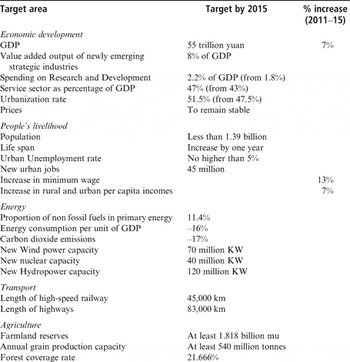
The 12th Five-Year Programme for the National Economic and Social Development of the People's Republic of China was presented to the NPC in draft on 5 March and approved on 14 March, with 2,778 out of 2,875 deputies voting in favour. The final document contained 16 sections divided into 62 chapters. Its main features were outlined in Premier Wen Jiabao's report on the work of the government (see above), and the period was described as a crucial phase in building a well-off society in an all-round way, and a highly significant period for deepening reform and accelerating the transformation of economic growth modes. Some of the key targets are shown in Table 1 (XHNA, 14 Mar.)
Principal Targets of the Five-Year Programme

Source: collated from XHNA, 5 March and Wen Jiabao's report
The Budget and the Economic Plan for 2011
On 5 March, the Finance Minister, Xie Xuren, reported on the budget outturn for 2010 and the draft budget for 2011 (text in XHNA, 17 Mar.). He was in relatively upbeat mode. He said that the economy had developed steadily and rapidly and that society had remained harmonious and stable. Steady progress had been made in fiscal development and reform, the basic framework of a government budget system that comprised budgets for public finances, government-managed funds and state capital operations had been put in place, budgets for social security funds had been compiled on a trial basis and government budgets were successfully implemented. Revenues had increased to 8.958 trillion yuan (up 21.3 per cent) and national expenditure had been 9.318 trillion yuan (up 17.4 per cent), with a deficit of just over 1 trillion yuan.
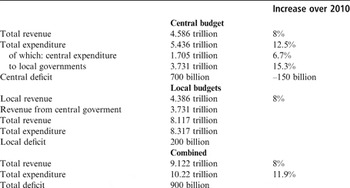
Like Premier Wen, Xie set the coming budget against a background of an extremely complex situation domestically and a slow international recovery. The trends remained basically positive for China's economy, and the financial situation was healthy although there was still a significant imbalance between revenue and expenditure. He announced that the projected total revenue (central and local revenues together with a transfer of 150 billion yuan from the central budget stabilization fund) would be 9.112 trillion yuan, and expenditure was projected at 10.022 trillion with a total estimated deficit of 900 billion yuan, corresponding to 2 per cent of GDP in 2011, and a significant fall from the previous year's rate of 2.5 per cent of GDP. Revenues would rise at a slower rate than in 2010, and the need to complete on-going government-financed projects, improve and ensure the people's well-being, respond to inflationary pressure, and increase subsidies for those on low incomes would put considerable pressure on expenditure. Table 2 gives a more detailed breakdown of the overall figures.
Central and Local Budgetary Estimates for 2011 (figures in yuan)

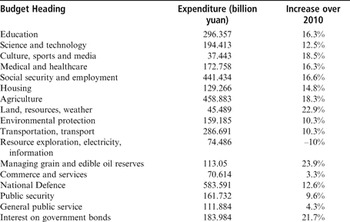
The Minister said that China would continue to implement a proactive fiscal policy which would be manifested through: a) raising the incomes of urban and rural residents and expanding consumer demand; b) optimizing the investment structure and strengthening weak links in economic and social development; c) adjusting and improving tax policies; d) further optimizing the structure of government expenditures and ensuring and improving the well-being of the people; and e) vigorously supporting economic restructuring and balanced regional development. Table 3 gives a breakdown of the major items of budgeted expenditure.
Major Budgeted items of Expenditure, 2011

b Party and Political Affairs
Issues of “social management” and the need to ensure stability were very much on the leadership's mind. President Hu Jintao addressed a meeting of high-level officials on social management and innovation held in the Central Party School on 19 February. He spoke of the need to
firmly grasp the general requirements of stimulating social vigour to the greatest extent, maximizing factors of harmony and minimizing factors of disharmony, take resolving conspicuous issues affecting social harmony and stability as a breakthrough point, raise the level of scientific social management, improve the social management pattern with the leadership of the party committee, the responsibility of the government, the co-operation of the society and the participation of the public, strengthen the building of laws, structures and capabilities for social management, protect the rights and interests of the people, promote social fairness and justice, maintain a good social order, build a socialist social management system with Chinese characteristics and ensure that the society is full of vigour, harmonious and stable.
He added that:
The fundamental purpose of our strengthening and innovating social management is to maintain social order, promote social harmony, ensure that the people can live and work in peace and contentment and create a favourable social environment for the development of the cause of the party and the country. The basic tasks of social management include coordinating social relationships, standardizing social behaviours, resolving social contradictions, promoting social fairness, dealing with social risks and dangers and maintaining social stability (XHNA, 19 Feb.).
Zhou Yongkang, the senior Politburo member in charge of security matters, addressed a follow-up seminar attended by provincial and ministerial level officials on “social management” on 20 February. He said it was necessary to detect conflicts and problems in time and to take forward looking, active and effective measures to improve social management, so as to ensure the country's long-term peace and stability. His remarks followed a similar message by President Hu on 18 February when he called for the need to maximize factors conducive to harmony and minimize those detrimental to it. He said that the country would give play to the advantages of its political system and mechanism while learning useful experience from foreign countries to improve the structure of social management comprising party committee leadership, government responsibility, nongovernmental support and public participation. Zhou stressed that it was significant to improve the residence permit system and build a national database of basic information of the country's population so as to offer better service and management for the public (XHNA, 20 Feb.). Zhou reiterated his calls for tighter controls on 25 February. Addressing a meeting of the Central Committee for the Comprehensive Management of Public Security, he called for measures to sustain public order and stability by enhancing social management and firmly preventing accidents and incidents which might harm social order (XHNA, 25 Feb.).
There was a widespread perception that the Chinese authorities had decided to exercise stricter control over any form of political dissent, partly in response to the events in the Middle East, but also as part of a regular tightening of security in the run up to the March meeting of the National People's Congress. Over 100 people in Beijing, Shanghai and the provinces of Zhejiang, Sichuan, Guizhou and Hunan were reported to have been taken away, prevented from leaving home, or gone missing (Kyodo News Service, 20 Feb.). Attempts, if they were ever serious, at organizing a “jasmine revolution” of quiet protest every Sunday came to nothing. This started with a posting on the website “Boxun” on 19 February calling for people to gather in 13 cities across the country. The authorities made very sure that they had the events covered. Xinhua reported that crowds that attempted to gather in downtown Beijing and in People's Square in Shanghai on 20 February were quickly dispersed (XHNA, 20 Feb.). But arrests, detention and harassment of political and other non-conformist activists continued, and the internet and other communication services were regularly interrupted or censored. By 28 March, the Hong Kong Information Centre for Democracy and Human Rights had identified nine persons who had been detained because of their association with the “jasmine revolution” activities (Hong Kong Information Centre for Democracy and Human Rights, 28 Mar.). The official line remained very firmly that there could be no cross over from the Middle East to China. Responding to question on the “jasmine revolution,” the Foreign Ministry spokesman said that the Chinese people's common aspiration to safeguard stability and maintain harmony was unswayable by any person or force. China had achieved huge development and progress under reform and opening up and it was the shared will of the Chinese people to devote their full attention to the country's development and building socialism with Chinese characteristics (XHNA, 22 Feb.). In similar vein, Zhao Qizheng, of the Chinese People's Political Consultative Conference, told foreign news reporters on 24 February that that the idea of such a revolution in China was ridiculous and unrealistic. While acknowledging that problems existed in China, such as widening income gaps, he said that the government was constantly investigating and solving them (XHNA, 24 Feb.). Premier Wen Jiabao acknowledged in his press conference after the National People's Congress that China was concerned about the political turbulence in the Middle East, but he declared that any analogy between China and the Middle East was not right. China had embarked on a development path that fitted its national conditions (XHNA, 14 Mar.).
The tougher attitude of the authorities towards dissent had been in evidence even before the Middle East events. The Hong Kong Information Centre for Human Rights and Democracy reported on 2 February that a number of pro-democracy activists had been warned by the authorities not to try to contact each other over Spring Festival. Qin Yongmin, who had been released in November 2010 after serving a 23-year term, was detained again for ten days over the festival (Information Centre for Human Rights and Democracy, 2 Feb.). The South China Morning Post reported that eight lawyers had been assaulted and beaten by court officials in Daoli District People's Court in Harbin for trying to attend a trial on 24 January. One of the lawyers was pregnant and lost her child because of the beating (SCMP website, 11 Feb.).
The Fourth Plenum of the 16th Central Committee of the Communist Youth League of China was held in Beijing on 12 January. Wang Zhaoguo, a member of the Politburo, addressed the session (XHNA, 12 Jan.)
Premier Wen Jiabao paid a Spring Festival visit to the State Bureau for Letters and Calls on 25 January. It was reported to have been the first time since 1949 that a Chinese Premier had had face to face communication with petitioners in Beijing. He called on officials to be responsible and to be dedicated in addressing people's complaints (XHNA, 25 Jan.). During the Spring Festival, Premier Wen Jiabao visited an old revolutionary base area in Anhui and drought-stricken regions in Shandong province, including Confucius's birthplace of Qufu. The press reports highlighted his concerns for the well-being of local people (XHNA, 3 Feb.). In a similar vein, President Hu Jintao visited Baoding in Hebei which was also badly affected by drought (XHNA, 2 Feb.).
In a written interview before his visit to the United States, President Hu Jintao answered questions on political development in China. He said that China was committed to the development of socialist democracy, and that without democracy there could be no socialist modernization, as people's democracy was the life of socialism. China's reform was comprehensive, covering economic, political, cultural and social restructuring. He said that China's rapid growth and social harmony proved that its political system fitted its national requirements and needs. He added that “[p]olitical restructuring must deepen in the course of economic and social development and meet people's growing enthusiasm for participating in political affairs” and that “[w]e will continue to expand people's democracy and build a socialist country under the rule of law in keeping with China's national conditions.” He continued:
We will ensure that all work of the state is based on the law and that the lawful rights and interests of the people are safeguarded. We will define the institutions, standards and procedures for socialist democracy, expand people's orderly participation in political affairs at each level and in every field, mobilize and organize the people as extensively as possible to manage state and social affairs as well as economic and cultural programmes in accordance with the law, and strive for continued progress in building socialist political civilization (XHNA, 17 Jan.).
Chinese leaders continued to emphasize the need for officials to listen to complaints from ordinary people in order to help them solve practical problems and ensure a harmonious society. The Ministry of Public Security issued a notice to all police officers to listen to the public more and to invite legislators, the media and others to visit police stations and comment on their work. Vice President Xi Jinping told officials studying at the Central Party School that they should pay more grassroots visits and listen to opinions from the people (XHNA, 6 Jan).
The Central Commission for Discipline Inspection met from 9 to 11 January to determine its priorities on anti-corruption for 2011. Party General Secretary Hu Jintao addressed the session on 10 January and urged them to “carry out the idea of governing for the people in a people-centred spirit in improving party conduct, promote clean government, and combat corruption.” Hu noted that there were still “some prominent issues in improving Party conduct … and that the situation with the fight against corruption remains grave and the tasks formidable” (XHNA, 10 Jan.). A formal communiqué was released on 11 January (text in XHNA, 11 Jan.), and highlights of a circular calling for the study of Hu's speech and improved work against corruption were published in XHNA, on 12 January.
The Minister of Railways, Liu Zhijun, who had overseen a massive expansion of China's high-speed rail network was suddenly removed from his Party posts and put under investigation by the Party's Central Discipline Inspection Committee for alleged “severe violation of discipline” (XHNA, 12 Feb.). He was replaced by Sheng Guangzu who immediately promised that he would not become personally involved in construction contracts which had apparently been the downfall of his predecessor. Liu was alleged to have been involved in a construction materials tender for a high-speed rail project, and for his links to businesswoman, Ding Shumiao (SCMP website, 15 Feb.).
Sun Zhigang was appointed Deputy Director of the National Development and Reform Commission on 6 January; Du Yubo, Du Zhanyuan and Liu Limin were appointed Vice Ministers of Education; Chen Xiaoya was appointed Vice Minister of Science and Technology; Han Jun was appointed Deputy Director of the Development Research Centre of the State Council; and Yin Xiaojing was appointed Deputy Director of the Liaison Office of the Chinese Central Government in Hong Kong (XHNA, 6 Jan). Liu Tienan, aged 57, was appointed Head of the National Energy Administration on 20 January. Zhou Mubing was named Vice Chairman of the China Banking Regulatory Commission (XHNA, 20 Jan.). 0n 2 March the State Council announced a further set of central government appointments. These included Li Dongsheng as Vice Minister of Public Security, replacing Liu Jing; Su Bo and Liu Lihua as Vice Ministers of Industry and Information Technology; and Zhang Jianguo as Vice Minister of Human Resources and Social Security and concurrently Director of the State Foreign Experts Bureau, replacing Ji Yunshi (XHNA, 2 Mar.).
Liu Weiping was elected Governor of Gansu Province on 17 January. He had been appointed acting Governor in July 2010. He is an alternate member of the Central Committee, and was born in 1953 (XHNA, 18 Jan.). Zhao Jianyong was elected Governor of Shaanxi province on 22 January. Zhao was born in 1951, and trained in metallic physics. He worked in the Ma'anshan Iron and Steel company for a number of years, before working as a local government and Party official in Anhui. He was transferred to Shaanxi in 2001 and eventually rose to acting Governor (XHNA, 22 Jan.). Li Xueyong was elected Governor of Jiangsu province on 14 February; he had been appointed acting Governor in 2010 (XHNA, 14 Feb.). Wang Guosheng was formally elected Governor of Hubei Province on 26 February. Wang was born in 1956 and had been transferred from Jiangsu as acting Governor in December 2010 (XHNA, 26 Feb.).
The Hong Kong South China Morning Post reported that Liu Yuan, son of the late President Liu Shaoqi, had been appointed Political Commissar of the PLA General Logistics Department. This was one of a number of new military appointments revealed at the same time: Wei Fenghe, a missile expert from the PLA Second Artillery, was appointed Deputy Chief of the General Staff, and Liu Guozhi was appointed Deputy Chief of the Armaments Department. In the Navy, the Chief of Staff, Su Shiliang, was promoted to Deputy Commander, and replaced by Du Jingchen, former Commander of the East China Sea Fleet. Liang Weilie, formerly head of the Navy Armaments Department, was transferred to become Commander of the South China Sea Fleet and a Deputy Commander of Guangzhou Military Region. In the Air Force, Jiang Jianzheng was transferred from Nanjing Military Region to become Deputy Commander of Beijing Military Region and Commander of its Air Force, Yi Xiaoguang was appointed Deputy Commander of Nanjing Military Region and Commander of its Air Force, and Zhang Jianping was appointed Deputy Commander of Jinan Military Region and Commander of its Air Force. Other appointments included Zhu Yimin (formerly Head of the Political Department of Nanjing Military Region), promoted to Political Commissar of Shenyang Military Region, Wang Xiaojun (formerly Head of Logistics for Guangzhou Military Region), promoted to Deputy Commander of Shenyang Military Region, and Zhang Guodong, promoted to Deputy Political Commissar of Lanzhou Military Region (Wen Wei Po website, 20 Jan.).
c Social Affairs
House prices in 70 major cities rose 6.4 per cent over the year, slowing down in the latter part of the year, and investment in property rose by 33 per cent over the year. Land prices in cities increased at a rate of 8.62 per cent. The State Council held an executive meeting on 26 January to discuss the housing price issue amongst other things. Following the meeting, China raised the minimum down payment on the purchase of a second home to 60 per cent (from 50), in an attempt to further control market speculation. Tighter controls on residency and other new tax policies were also announced (XHNA, 26 Jan.). One of these was the trial of a property tax on owner occupiers to be conducted in Shanghai and Chongqing. Based on the value of the property, the rates would be between 0.4–0.6 per cent in Shanghai and 0.5–1.2 per cent in Chongqing (XHNA, 27 Jan.). The authorities continued to add new restrictions on house purchases in a continuing effort to control the perceived property bubble, tightening the residency requirements in many places (XHNA, 17 Feb.). New rules tightening controls on expropriation and demolition of properties were published in January, including putting an end to forced demolitions in cities without due process and fair compensation, at no lower than market price for similar properties. The regulations were intended in part to respond to growing discontent within China over forced evictions and demolitions in the rush to develop. The regulations had been under consideration since 2007 and had been widely discussed during the drafting process (XHNA, 27 Jan.)
AFP reported that a number of foreign journalists, French ones in particular, had been roughly treated and driven away when they tried to visit the village in Shandong where the human rights activist, Chen Guangcheng, was being held under house arrest (Agence France Presse, 17 Feb.). On 27 February foreign journalists were again reported to have been violently handled by police as they attempted to cover gatherings associated with the “jasmine revolution” in Beijing. The Foreign Ministry spokeswoman said that any alleged incidents should be reported, but she stressed that foreign journalists should abide by China's rules and regulations, and that it was important to maintain normal order (Singapore Straits Times website, 2 Mar.). On 7 March, the Foreign Minister Yang Jiechi dismissed reports of Chinese police officers beating foreign journalists saying that there were no such issues, that China was a country under the rule of law, and that the Chinese had always followed relevant rules and regulations in managing affairs relating to foreign journalists (XHNA, 7 Mar.).
The Ministry of Foreign Affairs rejected comments on China's internet censorship made by the US Secretary of State, Hillary Clinton, on 17 February. The spokesman said that China administrates the internet according to the relevant laws and regulations which were in line with international practice. He added that China was strongly opposed to foreign interference in its domestic affairs, using internet freedom as a pretext (XHNA, 17 Feb.).
At a national meeting on health work on 6 January, the Health Minister, Chen Zhu, announced that China was aiming to eliminate measles over the next five years through an intensive vaccination campaign, and to “basically control” malaria. He also announced improvement to the food safety provisions and plans to train 10,000 pharmacists to work in grassroots health institutions (XHNA, 6 Jan.).
The student who famously claimed immunity after killing a young woman in a hit-and-run accident on the grounds that “My father is Li Gang” was tried on 26 January in Baoding City, Hebei. His father, Li Gang, was a local police chief. Li Qiming and his family paid substantial compensation to the families of the young woman killed and another injured in the incident. The Prosecution called for a sentence of seven years (XHNA, 26 Jan.). He was sentenced to six years imprisonment on 30 January, having pleaded guilty to drunk driving and manslaughter (XHNA, 30 Jan.).
d Economic Affairs
The Politburo met on 21 February to discuss the economic situation and the drafts of the Five-Year Programme. It decided that China should maintain stable and consistent macro-economic policies while improving the accuracy, flexibility and efficiency of the policies. China would continue an active fiscal policy and prudent monetary policy, while trying to balance steady economic growth with economic restructuring and management of inflation. It would work to maintain stable commodity prices, expand domestic consumption, increase investment in agriculture, speed up industrial restructuring, promote education and development of science and technology, and improve people's livelihoods and cultural services (XHNA, 21 Feb.).
The People's Bank of China raised the one-year borrowing and lending rates. The one-year deposit rate was raised to 3 per cent and one-year loan interest rates to 6.06 per cent. The rise was explained as a renewed effort to cool prices and tighten liquidity in the face of rising inflation. The Consumer Price Index (CPI) fell back slightly to 4.6 per cent in December after reaching a 28-month high of 5.1 per cent in November, and the overall rate was 3.6 per cent in 2010, above the 3 per cent target (XHNA, 8 Feb.). The CPI rose again in January to 4.9 per cent, although this was said to be lower than expected. Much of the inflationary pressure came from rising food prices, but China was also experiencing rises in the prices of commodity imports (XHNA, 15 Feb.). Inflation was a continuing concern throughout the period. The CPI rose 4.9% again in February, and the Producer Price Index driven by rising raw material and energy costs rose by 7.2 per cent, the highest since 2008. It was expected that the CPI rate of increase would rise to around 6 per cent by the middle of the year (XHNA, 27 Mar.).
The development of agricultural, and in particular grain production, was a key focus of agricultural work. Central Document No. 1 of 2011, which regularly sets out the main lines of agricultural policy over the year, called for efforts to improve China's water conservancy over the next five to ten years. China aimed to limit the scale of water exploitation, improve the efficiency of water usage and to curb water pollution. Ten per cent of the land transfer fees would be used each year for agricultural water conservancy. Overall water consumption would be controlled to within 670 billion cubic metres by 2020 (XHNA, 30 Jan.). The State Council announced on 9 February that it would increase the minimum purchase price for grain by up to 21.9 per cent in an effort to encourage farmers to plant more and increase production (XHNA, 9 Feb.). On 10 February, the State Council held a national video and telephone conference on grain production which was addressed by Premier Wen Jiabao. He said that the steady development of grain production and agricultural production was the foundation for the proper management of inflation expectations and stabilization of the general consumer price level. It was also a foundation for achieving smooth, steady and relatively fast development of the economy and social harmony and stability (XHNA, 10 Feb.).
China initially indicated that it would not be changing its plans for developing nuclear power projects following the disaster in Japan. The Vice Minister of Environmental Protection, Zhang Lijun, said on 12 March that China had 13 nuclear installations in operation, and tests had shown that all of them were safe. He said China would learn some lessons from Japan in the making of its plans for nuclear power but would not change its determination and plan developing nuclear power – the Five-Year Programme calls for the building of 40 million kW of new nuclear capacity (XHNA, 12 Mar.). The State Council decided on 16 March to suspend the approval process for nuclear power stations so that safety standards could be revised in the light of the Japanese experience, and all existing plants were required to undergo new safety checks (XHNA, 16 Mar.).
Officials from Inner Mongolia and other producer areas called for a national strategy on rare earths to set the pace for exploration of reserves, establish a national reserve system and policy incentives to improve technological innovation and application. The Ministry of Land and Resources announced that 280 illegal mines had been closed over the last two years, and said that the number of licenses granted for exploitation had fallen from 400 to 116 last year (XHNA, 21 Jan.). An official of the Ministry said that there were three big problems facing the industry: extensive mining methods leading to waste of resources; weak environmental protection awareness; and rampant smuggling (in 2009 cases of smuggling of over 10,000 tonnes of rare earths were uncovered, mainly from the Baiyun Ebo mine near Baotou) (ZTS, 17 Jan.). China announced that it was setting 11 state-planned rare-earth mining zones intended to protect resources and the environment in Ganzhou, Jiangxi, covering an area of 2,500 square kilometres and an estimated reserve of 760,000 tonnes of rare earths. China exported 35,000 tonnes of rare earths in the first 11 months of 2010, up over 14 per cent from 2009 (XHNA, 10 Feb.). China announced that it would cap the output of rare earths at 93,800 tonnes in 2011, 5.16 per cent higher than in 2010, and that no new mining licenses would be granted before 30 June 2012 (XHNA, 31 Mar.).
A severe drought affected northern China over the winter with rainfall down between 20 and 90 per cent in the provinces of Hebei, Shandong and Shanxi. South and south-west China was hit by a spell of intensive icy rain and snow (XHNA, 21 Jan.). Premier Wen Jiabao visited drought-hit areas in Henan on 23 January (XHNA, 23 Jan.). The drought was discussed by the State Council on 27 January and it decided to allocate a further 2.2 billion yuan in relief funds (on top of the 4 billion already allocated for grain production and water conservancy projects) (XHNA, 27 Jan.). As of 28 January, 5.16 million acres of cropland were affected and 2.57 million people faced drinking-water shortages. Forecasts suggested that the drought would continue for at least two months (XHNA, 30 Jan.). The drought began to ease in late February and early March.
An earthquake of magnitude 5.8 occurred in Yingjiang County in Yunnan on 10 March, with at least 25 reported killed and more than 250 injured (XHNA, 10 Mar.). The Ministry of Finance allocated 50 million yuan in emergency repair relief on 12 March, and the central government also gave 55 million yuan for resettling local residents after 127,000 people had to be evacuated (XHNA, 12 Mar.).
e Statistical Communiqué on National Social and Economic Development in 2010
The statistical communiqué was issued by National Bureau of Statistics (NBS) on 28 February (http://www.stats.gov.cn/english/newsandcomingevents/t20110228_402705764.htm). The brief introductory remarks noted that national economic performance had maintained steady and rapid development despite being faced with a complicated and volatile domestic and international economic environment.
The main features of China's economic performance in 2010 are summarized below, with comparable figures for the previous year in square brackets.
Overview
Preliminary estimates indicated that in 2010, GDP rose by 10.3 [8.7] per cent in terms of comparable prices to reach 39,798.3 billion yuan. Agricultural growth remained steady at 4.3 [4.2] per cent. Primary sector growth was significantly lower than that of both industry (12.2 [9.5] per cent) and services (9.5 [8.9] per cent) which both increased perceptibly over the previous year. Sectoral shares of GDP were 10.2 [10.6] per cent (primary), 46.8 [46.8] per cent (secondary) and 43.0 [42.6] per cent (tertiary).
Agriculture
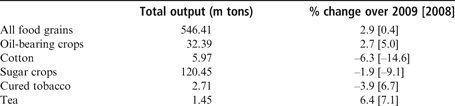
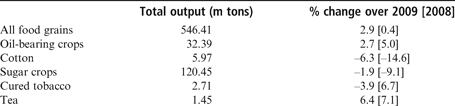
2009 saw a further modest expansion of the grain-sown area by 890 thousand hectares (ha) to 109.87 million ha; the sown areas to oil-bearing crops increased (by 0.32 million ha) while the area under cotton declined again (by 0.1 [0.0.8] million ha), and that under sugar rose marginally by 0.03 million ha after a fall the previous year [–0.11 million ha]. The output of major farm crops is shown in Table 4.
Output of Major Farm Products
Total meat output rose by 3.6 [5.0] per cent to 79.25 m tons. Output of pork, beef and mutton all increased (by 3.7 [5.8], 2.7 [3.6] and 2.2 [2.4] per cent respectively). Total output of aquatic products was 53.66 m tons, or 4.9 per cent more than in 2009. Timber production rose by 3.1 per cent after a sharp fall the previous year (–14.4) dropped sharply and reached 72.84 million cubic metres.
Effective irrigation was extended to an additional 1.634 [1.471] million ha of arable land, in addition to which an extra 1.975 [1.826] million ha were brought under guaranteed water-saving irrigation facilities.
Industry
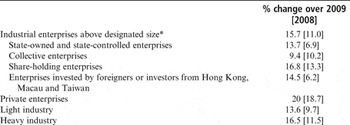
Industrial value-added grew by 12.1 [8.3] per cent in 2010. Further details are given in Table 5.
Rate of Growth of Industrial Value-added, 2010

Note
* i.e. all state-owned enterprises and those non-state-owned enterprises with an annual sales income over 5 million yuan.
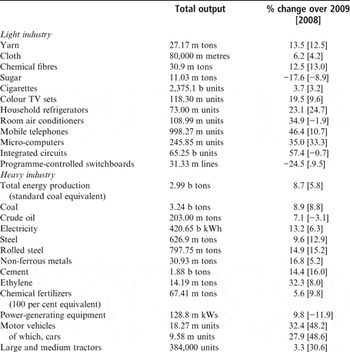
The outputs of important industrial products are shown in Table 6.
Output of Major Industrial Products, 2010

Industrial profitability improved at an extraordinary rate in 2010. The overall rate of increase in profits in enterprises of above-designated size was 49.4 [7.8] per cent (January–November only). Within this figure were the following increases in profitability by different enterprise ownership category during the same period:
• SOEs 49.4 [–4.5] per cent
• collective enterprises 34.6 [10.3] per cent
• share-holding enterprises 49.4 [4.2] per cent
• private enterprises 49.4 [17.4] per cent
• foreign (incl. Hong Kong, Macau and Taiwan invested enterprises) 46.3 [16.9] per cent
Construction industry growth remained high at 12.6 per cent compared to 18.2 the previous year, and construction enterprises generated profits of 342.2 billion yuan (25.9 per cent above the 2009 level).
Fixed investment
In 2009 the rate of expansion of fixed asset investment fell slightly to 23.8 per cent (from 30.1 per cent). Relevant disaggregated data are shown in Table 7.
Fixed Investment Growth by Sector and Region

Urban investment in the primary sector slowed to a mere 18.2 per cent (49.9 in 2009); the corresponding figures for urban secondary and tertiary fixed investment were 23.2 [26.8] per cent, and 25.6 [33.0] per cent. Regional levels and rates of fixed investment in 2008 were as follows:
• eastern regions: 11,597 billion yuan (up 21.4 [23.0] per cent)
• central regions: 6,289.4 billion yuan (up 26.2 [35.8] per cent)
• western regions: 6,187.5 billion yuan (up 24.5 [38.1] per cent)
• northeastern regions: 3,072.6 billion yuan (up 29.5 [26.8] per cent)
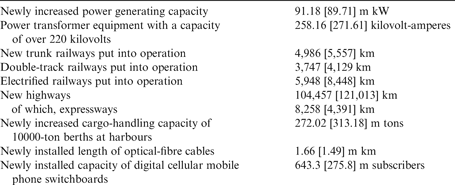
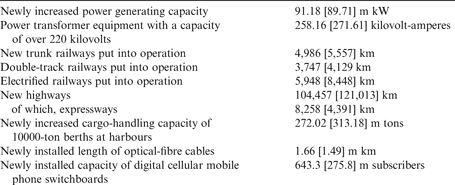
Table 8 summarizes the net impact of capital construction investment on production capacity in 2009.
New Increases in the Production Capacity of Selected Industries, 2010
Transport and telecommunications
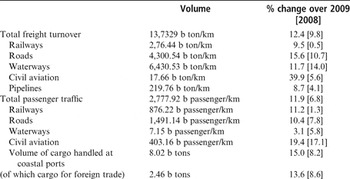
There was continued growth in both passenger and freight transport in 2010, as shown in Table 9.
Passenger and Freight Traffic in 2010

The turnover of post and telecommunication services increased by 20.6 [14.6] per cent. The total number of fixed-line subscribers fell again to 294.38 million [313.69]: 196.62 [211.787] million in cities, and 97.76 [101.9] million in rural areas. There were 111.97 [106.14] million new mobile phone subscribers, taking the total number of users to 859.00 [747.38] million at the end of 2010. Thus, the total number of telephone users reached 1,153 [1061.07] million; on average, telephone coverage reached 86.5 [79.9] for every 100 members of the Chinese population. The number of internet users rose from 380 to 457 million and broad-band users reached 450 [350] million.
China received 133.76 million international visitors in 2009 – up 5.8 per cent after a fall of 2.7 per cent. Of these, 26.13 [21.94] million were “foreigners” (an increase of 19.1 [–9.8] per cent) and 107.64 [104.54] million were “Chinese compatriots” from Hong Kong, Macau and Taiwan (up by 3.0 per cent). Foreign exchange earnings from international tourism totalled US$45.8 billion, up 15.5 per cent from 2009. Some 57.89 [47.66] million Chinese made overseas visits, of whom 51.51 [42.21] million undertook private visits (up 22 [5.9] per cent). Revenue from domestic tourism was 1,258 billion yuan (a rise of 23.5 [16.4] per cent).
Domestic trade
In 2009, real growth in the value of retail sales of consumer goods was 18.3 [15.5] per cent to reach 15,699.8 billion yuan (up by 18.7 [15.5] per cent in cities, and 16.2 [15.7] per cent in rural areas). More disaggregated estimates of sales growth are shown below (all figures in percentages):
Retail sales 18.4 [15.6]
- motor vehicles 34.8 [32.3]
- oil and grain 22.9 [13.0]
- meat and eggs 21.7 [8.3]
- “cultural” and office goods 23.5 [6.7]
- telecommunications equipment 21.8 [−1.3]
- household electrical and electronic equipment and audio-video-equipment 27.7 [12.3]
- building and decorating materials 32.3 [26.6]
- daily necessities 25.1 [15.6]
- furniture 37.2 [35.5]
- clothing 25.8 [20.8]
- cosmetics 16.6 [16.9]
- gold, silver and jewellery 46.0 [16.8]
Catering industry 18.1 [16.8]
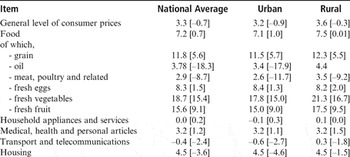
Consumer prices showed an accelerating upward trend over the year and overall prices increased by 3.3 per cent (compared to a fall of 0.7 per cent last year). Food prices went up by 7.2 per cent. After falls in 2009, the prices of manufactured goods rose by 5.5 per cent, raw materials fuels and power by 9.6 per cent, and agricultural goods by 10.9 per cent. Housing prices in 70 cities were described as “picking up first and then slowing down.” House prices were growing at 9.5 per cent in January, peaked at 12.8 per cent in April and then tailed off gradually to a rate of 6.4 in December.
Consumer price changes for specific goods, or categories of goods, are shown in Table 10.
Change in the Consumer Prices of Selected Goods, 2010 [2009] (%)

Foreign trade and external relations
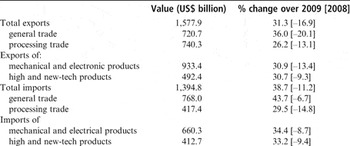
Foreign trade recovered dramatically (see Table 11) with exports up 31.3 per cent to US$1,577.9 billion, and imports up 38.7 per cent to US$1,394.8 billion. Overall, China enjoyed a merchandise trade surplus of US$183.1 billion, or US$12.6 billion less than in the previous year.
Levels of and Changes in Imports and Exports, 2010

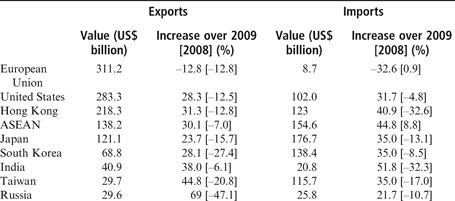
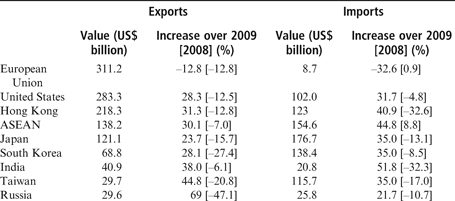
A geographical breakdown of China's exports is shown in Table 12.
The Direction of China's Foreign Trade, 2010
Foreign investment picked up. Inflows of utilized foreign direct investment (FDI) rose by 17.4 [–2.6] per cent to reach US$105.7 billion. Manufacturing absorbed US$49.59 billion – an increase of 6 per cent, and the next largest category was real estate at US$23.99 billion, up 42.8 per cent. Chinese overseas direct investment (non-financial sectors) was US$59 billion, an increase of 36.3 per cent.
At the end of 2010, China's foreign exchange reserves totalled US$2,847.3 billion – US$448.1 billion more than a year earlier. At the end of the year the exchange rate was 6.6227 yuan to the dollar, a modest appreciation of 3 per cent.
Banking and insurance
The NBS Communiqué noted that at the end of 2009, savings deposits lodged in all kinds of financial institutions totalled 73.3 [62.2 ] trillion yuan, 19.8 [27.7] per cent higher than at the end of 2009. Savings by enterprises reached 25.29 trillion yuan – a rise of 12.7 [36.5] per cent. Savings by urban and rural households totalled 30.72 trillion yuan (up 16 [19.5] per cent).
There were significant increases in the money supply. The volume of cash in circulation (M0) rose by 16.7 [11.8] per cent to 4.5 trillion yuan; the corresponding rates of increase for narrow (M1) and broad (M2) money were 21.2 [32.4] per cent, and 19.7 [27.7] per cent.
Welfare, living standards and employment
Per capita cash disposable income of urban households reached 19,109 [17,175] yuan in 2010 [2009] (a real rise of 7.8 [9.8] per cent over that of the previous year). Rural residents' average per capita net income was 5,919 [5,135] yuan: this represented a real increase of 10.9 [8.5] per cent. The number of rural residents living in poverty (i.e. with an annual net per capita income of less than 1,274 yuan) was estimated to be 26.88 [35.97] million.
There were also improvements in both urban and rural social security provision. By the end of 2010, 256.73 [234.98] million people (193.74 [177.03] million current employees and 62.99 [57.95] million retirees) were enrolled in basic pension programmes. Some 133.76 [127.15] million urban residents had joined unemployment insurance schemes, while 432.06 [400.61] million were covered by basic health insurance (including 45.83 [43.35] million migrant workers). Work accident insurance was provided for 161.73 [148.61] million people, including 63.29 [55.80] million migrant workers. Some 123.06 [108.6] million were enrolled in maternity insurance programmes. For the fourth year running, the number of people who received unemployment insurance payments fell – from 2.35 to 2.09 million. Finally, 23.11 [23.48] million urban residents were in receipt of minimum income relief from the government, while the corresponding figure for rural residents was 52.284 million up from 47.593 million in 2009.
Total employment in 2009 was 779.5 million (5.15 million more than in 2008). The net increase in urban employment was 11.68 [9.1] million, and total urban employment was 311.2 [302.1] million. The official rate of registered urban unemployment was 4.1 per cent – 0.2 per cent below that of 2009.
Population
China's total population at the end of 2010 was estimated to be 1,341.00 [1,334.71] million.
Resources and environment
The amount of agricultural land newly allocated to construction use rose by 18.4 per cent to 428,000 ha.
In 2010 the total stock of water resources rose by 17.7 per cent to 2,847 billion cubic metres, giving an average per capita availability of 2123 cubic metres [1,784.9]. At the end of the year, water storage in China's large reservoirs was 209.1 [180.5] billion cubic metres. Total water consumption increased by 0.4 [0.4] per cent to 599 billion cubic metres. Of this, consumption for living purposes increased by 2.9 [2.9] per cent, for industrial use it grew by 1.4 per cent [–0.6]; water consumption for farm use fell again after last year's rise by 0.6 per cent [0.6]. Per capita water consumption averaged 445.7 [440.9] cubic metres. Water consumption per 10,000 yuan of GDP and per 10,000 yuan of industrial value-added continued to decline by 9.1 [–7.6] and 9.6 [–8.2] per cent, respectively.
Based on monitoring of 408 sections of China's seven major water systems, 59.6 [57.1] per cent satisfied the national quality standard of Grades I–III for surface water, while 16.4 [18.4] per cent fell below Grade V level. There was a deterioration in the quality of oceanic water at the higher end of the scale with 62.8 per cent of stations meeting Grade I or II standards (down 10.1 per cent), and at the lower end there was an increase in the number at Grade IV or below now comprising 23.2 [21.1] per cent of all stations. Changes in the standards of air monitoring showed that 273 of 330 cities monitored had reached Grade II or above (previously 612 cities were monitored), and only four fell below Grade III.
Natural disasters caused 534 billion yuan worth of direct losses, up significantly from the previous year (252.4 billion yuan in 2009, 1,175.2 billion yuan in 2008, the year of the Wenchuan earthquake, and 236.6 billion yuan in 2007). A significant proportion of the losses were caused by flooding, and losses caused by droughts were down. There were 17 earthquakes of magnitude 5 and above.
The death tolls from both work accidents and traffic accidents were down, 4.4 and 11.1 per cent respectively. The death toll per million tons of coal fell 16 per cent to 0.749 persons.
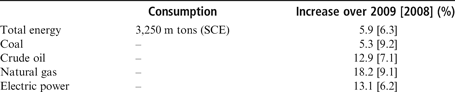
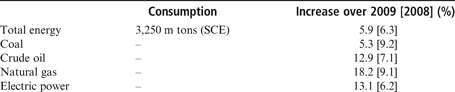
The preliminary 2010 estimates of energy consumption provided by the NBS communiqué are shown in Table 13.
Consumption of Energy, 2010
f Military Matters
China released a Defence White Paper on 31 March (text in XHNA, 31 Mar.). Its contents were:
I. The Security Situation
II. National Defence Policy
III. Modernization of the People's Liberation Army
IV. Deployment of the Armed Forces
V. National Defence Mobilization and Reserve Force Building
VI. Military Legal System
VII. Science, Technology and Industry for National Defence
VIII. Defence Expenditure
IX. Military Confidence-Building
X. Arms Control and Disarmament
Appendix I. Major International Exchanges of the Chinese Military (2009–2010)
Appendix II. Participation in Strategic Consultations and Dialogues (2009–2010)
Appendix III. Joint Exercises and Training with Foreign Armed Forces (2009–2010)
Appendix IV. China's Participation in UN Peacekeeping Operations (As of Dec. 31, 2010)
Appendix V. Participation in International Disaster Relief Activities (2009–2010)
Appendix VI. Imports and Exports of Seven Major Types of Conventional Arms of the PRC (2008)
Appendix VII. Imports and Exports of Seven Major Types of Conventional Arms of the PRC (2009)
Appendix VIII. Major Military Laws and Regulations Issued in 2009 and 2010 by China
The White Paper described an international environment undergoing profound and complex changes, with international strategic competition and contradictions intensifying, and security threats becoming increasingly integrated, complex and volatile. Nonetheless the current trend towards peace development and co-operation was seen as irresistible. The security situation in the Asia Pacific was described as generally stable, and the White Paper noted the increased economic co-operation and integration in the region. But regional pressure points remained with no solution in sight: there was intermittent tension on the Korean Peninsula, political turbulence persisted in some countries, ethnic and religious discords were evident, disputes over territorial and maritime flared up occasionally, and terrorist and separatist activities continued to run amok. “Relevant major powers are increasing their strategic investment. The United States is … increasing its involvement in regional security affairs.”
China faced threats from Taiwan independence forces which were the biggest obstacle to the peaceful development of cross-Strait relations; separatist forces working for East Turkistan independence and Tibet independence; pressure on preserving China's territorial integrity and maritime rights and interests; non-traditional security concerns such as terrorism threats, energy and resources concerns, finance, information and natural disasters. Suspicion about China and interference and countering moves against China from the outside were on the rise. The US continued to sell weapons to Taiwan. Against this background the main goals and tasks for China's national defence were: a) safeguarding national sovereignty, security and interests of national development; b) maintaining harmony and social stability; c) accelerating the modernization of national defence and the armed forces; and d) maintaining world peace and stability.
g Xinjiang and Tibet
Nur Bekri, Chairman (Governor) of Xinjiang Autonomous Region, was interviewed by Xinhua on 2 March. He said that “development is the master key to resolving all issues in Xinjiang,” and went into great detail about the achievement of the region in the last Five-Year Programme period. He said it had been the period of the fastest development in the history of the region and went into great detail about the government having provided housing and welfare for local people. Xinjiang's GDP had grown by an average of 10.6 per cent over the period, and per capita net incomes of urban and rural dwellers had increased by 11 and 12.7 respectively. 2.07 new jobs had been created in the region. Nur Bekri said: “Development is the master key to resolving all issues in Xinjiang.” Speaking of relations between development and stability, he said:
In Xinjiang, development is the top priority, while stability is our prime responsibility. The central authorities have entrusted Xinjiang with two major historical tasks, that is, facilitating a development by leaps and bounds in Xinjiang and ensuring long-term stability in the region. In this context, a united and stable social environment is essential, as it provides an important guarantee for facilitating a development by leaps and bounds in Xinjiang. Therefore, we need to persist in attending to the two types of work, attaching equal importance to both.
Nur Bekri said that the 5 July Incident had made it clear to all that national unity served as a lifeline and that the “the long-standing foundation built by the people of all ethnic groups across Xinjiang for sharing weal and woe, standing together through thick and thin, and for breathing the same air, sharing the same fate, and joining their hearts as one was actually firm and unbreakable” (XHNA, 2 Mar.). Some days later he told reporters in Beijing that Xinjiang was on the whole safe and stable but faced severe challenges in maintaining social stability. He added that there were no secret trials or internet controls in the region, but warned that “any person who breaks Chinese laws will be prosecuted and tried in public, while their legitimate rights will be protected” (XHNA, 8 Mar.). The Party Secretary, Zhang Chunxian, said that the region had heightened its alert against separatist forces following unrest in the Middle East, but Xinjiang had learned lessons from it. Unrest in the Middle East had been caused by high unemployment while the Xinjiang authorities were trying to improve employment (RTHK Radio 3, 8 Mar.).
The Chairman of the Tibet Autonomous Region, Padma Choling, noted that the economy had grown by 12.2 per cent in 2010, and that the central government had poured vast funding, personnel and resources into Tibet to assist its development. But he said that they were still “facing an arduous task to fight secessionists and maintain stability in the region,” and that the struggle against the “Dalai Lama clique” would be lasting, intense, complicated and sometimes fought vehemently (XHNA, 10 Jan.). There was no let up in the Chinese government's vociferous denunciation of the Dalai Lama. Qiangba Puncog, Chairman of Tibet Regional People's Congress, said that the death of the Dalai Lama would not exert any impact on the overall situation in Tibet. In an interview at the time of the NPC he said: “Of course there will be a little repercussion due to religious factors, but we will take that into consideration and will surely guarantee the long-term political stability in Tibet.” He dismissed the Dalai Lama's suggestion that the institution of the Dalai Lama might be abolished after his death: “What he says does not count … we must respect the historical institutions and religious rituals of Tibetan Buddhism. I am afraid it is not up to anyone to abolish the reincarnation institution or not.” The Party Secretary of Tibet, Zhang Qingli, was quoted as saying that the Dalai Lama was a “wolf in monk's robes,” and accused him of instigating the riots in Tibet three years ago. He dismissed the Dalai Lama as “a secessionist chief who fools simple believers under the guise of religion” (XHNA, 7 Mar.). On 10 March, the Dalai Lama announced that he had decided to retire from active politics saying that he should be succeeded by a freely elected leader in the exile community, and said that he would make the proposal formally at the forthcoming 11th session of the Tibetan Parliament-in-exile on 14 March (Press Trust of India, 10 Mar.). In China, Tibetan leaders described the decision as another lie or trick. Qiangba Puncog was quoted as saying: “Like before, that is merely another political show of Dalai Lama who attempts to arouse the attention of the international community and mould public opinion” which he claimed would not have any impact on the political stability of Tibet. He added that whatever the parliament-in exile did would be illegal and would not be recognized (XHNA, 10 Mar.). Qiangba Puncog led a delegation to the United States to put the official case for Tibet after the NPC session closed where he said that the Dalai Lama should apply himself to the study of Buddhism and stay aloof from worldly affairs if he really was a religious person. He added that: “The Dalai Lama's so-called government-in-exile has done more harm than good to Tibet's development. They have done nothing good for the people of Tibet, and Tibet could have developed much better without the Dalai Lama and his followers” (ZXS, 16 Mar.).
The US Ambassador to India visited Dharamsala on 24 February and had a closed-door meeting with the Dalai Lama, which he described as having had a positive outcome with several issues discussed (Press Trust of India, 24 Feb.).
A young Tibetan monk from the Kirti Monastery in Aba County of Sichuan set himself alight on 16 March and subsequently died of his injuries in hospital (XHNA, 18 Mar.).
h Hong Kong and Macau Special Administrative Regions
The veteran campaigner for democracy and one of the founders of the Hong Kong Democrats, Szeto Wah, died on 2 January (RTHK Radio 3, 3 Jan.). Two prominent Chinese dissidents in exile, Wang Dan and Wuer Kaixi requested permission to attend the funeral (RTHK Radio 3, 6 Jan.). Wang Dan said that he had been denied entry on 26 January to attend the funeral on 29 January. Wuer Kaixi also indicated that he had been refused. The Chief Executive, Donald Tsang, had earlier said that the decisions were a matter for the Immigration Department to decide (RTHK Radio 3, 26 Jan.).
Donald Tsang was assaulted by protestors, allegedly from the League of Social Democrats, while visiting the Hong Kong Museum of History on 1 March. A spokesman for the Hong Kong and Macau Office of the State Council expressed grave concern over the incident and said that perpetrators of such violent incidents should be punished (XHNA, 2 Mar.).
Guangdong province and Macau signed a framework agreement on co-operation on 6 March covering a wide range of issues in economic, social, welfare and cultural fields. The two regions will work together to develop Hengqin Island and the Guangdong Macau Co-operative Industrial Garden (XHNA, 6 Mar.).
2. Foreign Relations
a Diplomatic Tours
Vice Premier Li Keqiang's tour of Europe
Vice Premier Li Keqiang, accompanied by numerous “entrepreneurs” and businessmen, visited Spain, Germany and Britain from 4 to 12 January. A Xinhua commentary said that at a time when the world was gradually coming to terms with the aftershocks of the financial crisis and when recovery remained fragile, Li's tour would not only deepen the China–EU comprehensive strategic partnership and promote their co-operation in various fields, but cast a positive influence upon global economic recovery and development (XHNA, 3 Jan.).
Li visited Spain from 4 to 6 January, and had meetings with the Spanish Second Deputy Prime Minister and Minister of the Economy, Elena Salgado on 4 January. Li noted that the Spanish government had taken a number of measures to deal with the economic crisis and promised that China would buy more Spanish government bonds to help the country deal with market concerns. China and Spain established a comprehensive strategic partnership in 2005 (XHNA, 5 Jan.). The following day, he met the Spanish King, Juan Carlos. Li said that China had always held that Europe is an important force for ensuring world peace and promoting global growth, and that a united and strong Europe is beneficial for the world and in the interests of both China and Europe. The following day he met the Prime Minister Zapatero and the Foreign Minister, Trinidad Jimenez. He told the Prime Minister that they should co-operate in areas such as energy conservation and environmental protection, new energy and new materials. The two sides signed a series of agreements on economic and trade co-operation in the financial, petroleum and chemical, renewable energy, nuclear power equipment and food sectors worth US$7.5 billion (XHNA, 6 Jan.).
Li then travelled to Germany where he had talks with the Chancellor Angela Merkel, the President Christian Wulf, the Foreign Minister Guido Westerwelle and Economy Minister Rainer Bruederle. Li told a gathering of German businessmen that China welcomed more German companies to invest or establish new businesses in China, especially in areas like energy efficiency, environmental protection, high technology, modern agriculture and service industry, as well as new industries with strategic significance. He called for Germany to keep its market open and oppose trade protectionism along with China. He said that China would take a more open attitude to the outside world, and would continue to improve investment environment, and provide a fair, stable, orderly, transparent and predictable market environment for all foreign companies in China. He urged Germany to simplify visa procedures for Chinese businesspersons, and to help relax European Union (EU) restrictions on high-tech exports to China. China and Germany established their formal strategic partnership in 2010 and trade in 2010 was expected to reach US$140 billion (XHNA, 6 Jan.). During the visit, the two sides signed 11 agreements and commercial contracts worth some US$8.7 billion, covering such fields as automobile purchase, financial co-operation, energy and machinery (XHNA, 7 Jan.).
Vice Premier Li arrived in Britain on 9 January for talks with the Prime Minister David Cameron, the Deputy Prime Minister Nick Clegg, the chancellor of the Exchequer George Osborne, the Business Secretary Vince Cable and the Foreign Secretary William Hague. He first visited Edinburgh, where he met Scotland's First Minister, Alex Salmond, and then travelled down to London. Trade between Britain and China reached US$40.2 billion between January and October 2010 and was targeted to reach US$100 billion by 2015 (XHNA, 9 Jan.). The two sides signed 15 agreements and commercial contracts worth US$4.7 billion during the visit, covering such fields as low carbon, wildlife protection, deep-sea oil and gas exploration and development, as well as financial co-operation (XHNA, 11 Jan.).
Vice Premier Hui Liangyu's tour of Africa
Vice Premier Hui Liangyu visited Mauritius, Zambia, the Democratic Republic of Congo, Cameroon and Senegal from 6 January. In Mauritius he met the Prime Minister, Navinchandra Ramagoolam, and Deputy Prime Minister and Minister of Finance and Economic Development, Pravind Kumar Jugnauth. He signed an economic and trade co-operation agreement worth US$9 million, including a US$6 million grant and a US$3 million interest-free loan (XHNA, 8 Jan.). In Zambia he had meetings with Vice President George Kunda and President Rupiah Banda, and signed an agreement on Sino-Zambian economic and technological co-operation and a memorandum on agricultural co-operation (XHNA, 10 Jan.). In the Democratic Republic of Congo, he met Prime Minister Adolphe Muzito (XHNA, 11 Jan.). He met the Cameroon Prime Minister, Philémon Yang, on 13 January and witnessed the signing of four agreements including an economic and technological accord (XHNA, 13 Jan.). He also met President Paul Biya. He met the Senegalese Prime Minister, Souleymane Ndene Ndiaye, on 15 January and witnessed the signing of a number of bilateral co-operation agreements (XHNA, 16 Jan.).
Foreign Minister Yang Jiechi's tour of Africa
The Foreign Minister Yang Jiechi visited Zimbabwe, Gabon, Chad, Guinea, Togo and the United Arab Emirates (UAE) from 9 to 17 February. He visited the United Arab Emirates on 9 and 10 February and met the Abu Dhabi Crown Prince Shaykh Mohammed bin Zayed al Nahyan and the Foreign Minister. His visit to Zimbabwe was described as an endorsement of the relations between the two countries by the former Foreign Minister of Zimbabwe interviewed by Xinhua. He said that: “This is a visit which will mark a new diplomatic high watermark in Zimbabwe's international relations because to get the visit of an important and emerging super-power like China with such economic clout is a big vote of confidence on the part of Zimbabweans who have been pummelled by sanctions imposed by the West” (XHNA, 9 Feb.). On arrival in Harare on 10 February, Yang Jiechi said that China was committed to further improving its bilateral relations with Zimbabwe, and that the visit would produce positive results and take their friendship and co-operation to a higher level. He met President Mugabe and later publicly called on the West to lift the sanctions that they had imposed on Zimbabwe, saying that the Zimbabweans and other African peoples had the right to choose their own development path. A 50 million yuan grant was extended during his visit and Yang said that the two sides had agreed to on further co-operation in infrastructure, agriculture, water conservation and personnel training. Yang also met the Prime Minister, Morgan Tsvangirai, and the Foreign Minister (XHNA, 11 Feb.). He met the President of Gabon, Ali Bongo Ondimba, and the Gabonese Foreign Minister on 12 February, and they promised closer co-operation in trade, economy and infrastructure development (XHNA, 12 Feb.). In Guinea, he met President Alpha Conde and they discussed co-operation in water resources management, electricity generation, telecommunication, education, culture, mining, health and agriculture and infrastructure building. He also met his counterpart Edouard Niankoye Lama. China offered a grant of 150 million yuan, and an interest-free loan of 20 million yuan, as well as an increased number of scholarships to students (XHNA, 14 Feb.). In Togo, he met President Faure Gnassingbe and his counterpart, Elliot Ohin, and signed a loan agreement for about 4 billion CFA francs (Radio Togo, Lome, 15 Feb.). In Chad, he met President Idriss Deby Itno and discussed co-operation in infrastructure building, agriculture, health care and other fields. He also had talks with the Foreign Minister, Moussa Faki Mahamat (XHNA, 16 Feb.). On his way back home, he visited Armenia and had talks with President Serzh Sargasyan and the Prime Minister, Tigran Sargasyan. They agreed to develop co-operation in infrastructure, agriculture, telecommunications and trade. He also met the Foreign Minister Edouard Narbandian. They discussed co-operation in science, education, health, culture and tourism (XHNA, 17 Feb.).
b Countries and Regions
Africa (Cote d'Ivoire, Liberia, Somalia, Sudan, Zambia)
The Foreign Ministry spokesman said on 11 January that China supported the UN Operation in Cote d'Ivoire (UNOCI) in “peacefully solving the Cote d'Ivoire issue.” He confirmed that there were six Chinese military observers at UNOCI but would not say whether China planned to send any more forces (XHNA, 11 Jan.). The Foreign Ministry spokeswoman said on 1 March that China supported the mediation efforts by the African Union to resolve the crisis. She reiterated that: “We hope the involved parties can properly handle the differences through dialogue and negotiation to realize political reconciliation and safeguard peace and stability in Cote d'Ivoire” (XHNA, 1 Mar.). On 30 March, Liu Baodong, then President of UN Security Council, voted in favour of a resolution applying sanctions against Laurent Gbagbo, who was refusing to hand over power as President of the country. China's Permanent Representative expressed China's grave concerns and called on parties to immediately cease violence and armed confrontation and seek to settle their differences through dialogue and consultations. He also expressed China's support for the efforts of the African Union and the Economic community of West African States to achieve a political settlement (XHNA, 30 Mar.).
Foreign Minister Yang Jiechi met the visiting Liberian Foreign Minister, Toga Grayewea McIntosh, on 30 March. He noted that the two countries had achieved remarkable results in co-operation in economy, trade, culture, education and health, and said that China would continue to support the peaceful reconstruction of Liberia (XHNA, 30 Mar.).
Li Baodong, China's Permanent Representative to the UN Security Council, said that a comprehensive strategy for realizing peace, security and development in Somalia should be reached as soon as possible. China hoped the Somali transitional government would complete its constitutional process and other transitional tasks as scheduled within the framework of the Djibouti Agreement, and conduct dialogues with relevant parties on post-transitional arrangements with a view to achieving consensus at an early date. He called for more financial and material aid to be provided with Somalia having a greater say in the distribution of financial assistance (XHNA, 10 Mar.).
China announced that it would be sending a mission to observe the referendum in Sudan. The Foreign Ministry spokesman said on 4 January that: “China will work with the international community and continuously play a positive and constructive role in promoting peace, stability and development in Sudan and this region at large” (XHNA, 4 Jan.). The Chinese observers were reported to have described the voting as “orderly and peaceful” (XHNA, 11 Jan.). The results were announced on 7 February with 98.3 per cent of voters voting for the independence of southern Sudan. China's Foreign Ministry spokesman said that: “China respects the choice of Sudan people and appreciates the unremitting efforts of both the north and the south to promote the peace process between the two sides.” He said that China hoped that outstanding issues would be handled through dialogue and consultation and that: “China expects full implementation of the Comprehensive Peace Agreement (CPA) as well as long peace and stability in Sudan” (XHNA, 8 Feb.).
The Foreign Ministry spokesman denied on 6 January that arrest warrants had been issued for two Chinese diplomats in Zambia who were reported to have provided guarantees for two Chinese mine managers charged with attempted murder. He dismissed the reports as misleading following the failure of the two managers to appear in court in Zambia to face the charges against them (XHNA, 6 Jan.).
Australasia (Australia, New Zealand, Tonga)
Foreign Minister Yang Jiechi extended China's condolences over the floods to the Australian Foreign Minister, Kevin Rudd. The Chinese Red Cross gave US$50,000 in emergency aid to the Red Cross Society of Australia (XHNA, 6 Jan.).
China extended condolences to New Zealand over the earthquake in Christchurch (XHNA, 22 Feb.). It sent a rescue team to help at the request of the New Zealand government and the Chinese Embassy in New Zealand launched an emergency response for Chinese nationals caught up the disaster (XHNA, 24 Feb.). The Chinese Foreign Minister said on 28 February that he hoped that New Zealand could speed up its efforts to search for and rescue Chinese nationals still trapped in the rubble (23 were still missing). The Chinese also offered US$ 500,000 in disaster relief (XHNA, 28 Feb.). China sent a team of forensic specialists to help identify the bodies of victims on 2 March (XHNA, 2 Mar.).
Vice President Xi Jinping met King George Tupou V of Tonga on 25 January and promised that China would further its political and economic co-operation with Tonga on the basis of mutual respect and equality (XHNA, 25 Jan.).
Central Asia (Kazakhstan, Mongolia, Tajikistan)
The President of Kazakhstan, Nursultan Nazarbayev, visited China from 21 to 23 February. He had talks with President Hu Jintao, Premier Wen Jiabao and with Wu Bangguo, Chairman of the National People's Congress Standing Committee. He visited Tianjin after his meetings in Beijing. Presidents Hu and Nazarbayev undertook to boost their strategic partnership and bilateral co-operation, and witnessed the signature of a series of co-operation agreements on cross-border water resource protection, high-speed railway construction, and joint projects on petroleum, oil and gas resources. The high-speed rail would link Almaty and Astana, a distance of 1,050 kilometres, and was expected to be completed by 2015. Bilateral trade reached US$20 billion in 2010, an increase of 45 per cent (XHNA, 22 Feb.).
Foreign Minister Yang Jiechi visited Mongolia on 24 and 25 February. He had talks with President Elbegdorj Tsakhia on 24 February, and with the Mongolian Foreign Minister Gombojav Zandanshatar. He also witnessed the signature of three agreements involving fire prevention in border regions and an exchange of notes about Mongolia's establishment of a general consulate in Hong Kong. Yang said that the Chinese and Mongolian peoples shared a long history of friendly exchanges and that developing long-term friendly, mutually beneficial and co-operative ties was an important policy of China's (XHNA, 24 Feb.).
It was reported that Tajikistan and Xinjiang had signed an agreement allocating 2,000 ha of land in Tajikistan to Chinese farmers to grow rice. On 12 January, the Tajik parliament ratified the protocol on the delimitation of the border with China, which gave China 1,100 sq km of territory. This aroused considerable local opposition (Interfax News Agency, Moscow, 18 Jan.).
East Asia (Japan, North and South Korea)
Kyodo News Service reported that the Director General of the Asian and Oceanian Affairs Bureau of The Japanese Foreign Ministry had met a number of senior Chinese officials on 30 January for talks on the Korean Peninsula and the bilateral discussion on the joint development of gas fields in the East China Sea (Kyodo News Service, 31 Jan.). The Chinese Vice Foreign Minister, Zhang Zhijun, visited Tokyo for a round of strategic dialogue, the first since 2009, with Japanese Vice Foreign Minister, Kenichiro Sasae, on 28 February. They agreed to work towards repairing the relationship, deepen co-operation and settle sensitive issues appropriately (Kyodo News Service, 28 Feb.).
Following reports that the Japanese Coast Guard might be seeking damages from the Chinese fishing boat captain who rammed their vessel in September 2010, the Chinese Ministry of Foreign Affairs stated that Japan had no right to do so, and reiterated that the Diaoyu Islands had been an integral part of China's territory since ancient times and that the Japanese government should deeply reflect on its actions in the incident (XHNA, 12 Feb.). There continued to be regular reports of Chinese military and other activity in the vicinity of the Senkaku/Diaoyutai Islands and in the East China Sea, involving approaches by Chinese aircraft, helicopters, patrol boats (Kyodo News Service, 3, 7, 9, 28 Mar.). China denied reports that it had unilaterally started gas production in the Chunxiao field which is the subject of competing claims and a pending agreement between the two sides (Kyodo News Service, 9 Mar.).
The Chinese Foreign Ministry spokesman said that the dispute between Japan and Russia over the “Northern Territories” was a bilateral one between the two sides and that China hoped they would handle the issue properly through talks. He denied any knowledge of a joint investment by China and Russia in the islands (XHNA, 17 Feb.).
China reacted quickly to the news of the devastating earthquake in Japan on 11 March. Premier Wen Jiabao extended his condolences and offered help on 11 March. A Chinese rescue team started operating on 14 March and China provided US$4.57 million of emergency aid (XHNA, 14 Mar.). Chinese experts played down any possible effects that the nuclear leakage from Fukushima might have, although there was rush of panic buying of salt in the week following the earthquake. President Hu sent a message of condolence to the Emperor on 14 March. The Foreign Ministry spokeswoman said on 15 March that China would continue to provide necessary assistance and expressed the belief that the people of Japan would be able to “tide over the difficulty as this.” There were initially no reports any Chinese casualties, and some 3,000 Chinese were evacuated from the area (XHNA, 17 Mar.).
The Foreign Ministers of Japan, South Korea and China met in Kyoto on 19 March and discussed working together in response to the earthquake. They also discussed the North Korean nuclear issue (Kyodo News Service, 19 Mar.). According to Xinhua, the Foreign Ministers of the three countries maintained that Sino-Japanese-South Korean co-operation not only is conducive to the common development of the three countries, but also to the peace, stability and prosperity in the region and the world at large. The three sides discussed co-operation in political, economic, social, human and disaster control areas as well as in management of world affairs. They pledged that they would work hard together to ensure positive co-operation results and to explore new areas and new ways for co-operation (XHNA, 19 Mar.)
The Chinese press noted the visit of Stephen Bosworth, the US envoy on North Korea, to the region to discuss the North Korean issue. It said that his trip was expected to lay the foundations for the forthcoming meeting between Presidents Hu and Obama in Washington and came following a declaration by Pyongyang that it was interested in returning to the negotiating table while claiming at the same time that it had developed a new highly sophisticated uranium enrichment facility (XHNA, 4 Jan). He visited Beijing on 5 and 6 January for talks with Vice Foreign Minister Zhang Zhijun and Wu Dawei, China's special representative on Korean affairs, and the Chinese Foreign Ministry commented that: “The Six-Party Talks have been stalled for two years. We hope the parties concerned make concerted efforts to resume the talks as soon as possible” (XHNA, 6 Jan.).
The Chinese Minister of Public Security, Meng Jianzhu, visited North Korea as part of a wider Asian tour on 13 February. During the visit he had talks with his opposite number, Ju Sang Song, signed an agreement on co-operation between his Minister and the Ministry of People's Security of the National Defence Commission of the DPRK, and donated unspecified aid materials (KCNA, 13 Feb.). He met Kim Yong-nam, President of the Supreme People's Assembly on 14 February, as well as Ri Yong Ho, Chief of the Korean People's Army General Staff (XHNA, 14 Feb.). He met Kim Jong Il on 15 February.
The Chinese Foreign Minister, Yang Jiechi, visited South Korea on 23 and 24 February, and met South Korean President Lee Myung-bak for talks on the Korean peninsula. He said that China hoped to see positive outcomes from the inter-Korean dialogue and would continue to work with South Korea to contribute to maintaining peace and stability in the region. He said that China's starting points on the Korean question were based on principles, including achieving denuclearization of the Korean peninsula and long-term stability in northeastern Asia, as well as maintaining and promoting common interests of the countries in the region and their peoples. Yang also had talks with the Foreign Minister Kim Sung-hwan (XHNA, 23 Feb.). The Foreign Ministry spokesman said on 24 February that China participated in the resolution of the DPRK nuclear issue with a constructive attitude, including discussions at the UN Security Council, and efforts to promote relevant discussions that are conducive to easing the situation on the peninsula, and that are helpful to the diplomatic efforts towards holding peace talks. He added that: “We hope relevant parties will seize the positive momentum at present, head towards the same direction, take necessary measures, restart the Six-Party Talks at an early date, and resolve relevant issues under the Six-Party Talks framework” (XHNA, 24 Feb.).
Latin America (Brazil)
The Brazilian Foreign Minister, Antonio Patriota, travelling with the Minister for Development, Industry and Foreign Trade, visited China from 2 to 4 March. He had meetings with Premier Wen Jiabao, Vice Premier Wang Qishan and Foreign Minister Yang Jiechi. Premier Wen described Brazil as a sincere friend and strategic partner of China (XHNA, 3 Mar.).
Middle East (Bahrain, Egypt, Iran, Libya, Tunisia)
Commenting on the demonstrations in Bahrain, China's Foreign Ministry spokeswoman said that China welcomed its leaders' efforts to ease tension through dialogue and believed that they had the wisdom and ability to calm the situation down. She added that “All Middle Eastern nations are China's friends … China has always developed its friendly and co-operative ties with these nations based on mutual respect, equality and mutual benefit” (XHNA, 3 Mar.).
China's initial reaction to the events in Egypt was cautious. The Foreign Ministry spokesman said on 30 January that China had been watching the situation closely and that “we hope Egypt can restore social stability and normal order at an early date” (XHNA, 30 Jan.). Meanwhile it was successfully organizing the evacuation of its citizens from the area. China sent two planes to Egypt on 31 January to rescue stranded Chinese citizens, and dispatched a task force of officials from the Foreign Ministry, the National Tourism Administration, the Ministry of Public Security and the Civil Aviation Administration to help (XHNA, 31 Jan.). They returned to China on 1 February carrying 480 Chinese nationals. A further 424 were said to remain stranded at the airport and another 300 were still in Cairo and other tourist spots. Xinhua noted that mass anti-government demonstrations had broken out in Egypt on 25 January, and that many international flights had been cancelled (XHNA, 1 Feb.). By 3 February “almost all” Chinese citizens, a total of 1,848, had been repatriated (XHNA, 3 Feb.).
A People's Daily commentary on 31 January argued that Washington was quietly preparing to ditch its long-term ally, President Mubarak, in favour of a new secular leader who would promote democracy and modernization in Egypt. However, the paper suggested that the greater likelihood was that a radical and tightly knit organization like the Muslim Brotherhood would seize power, which would be Washington's worst nightmare. It concluded that “the US must be playing with fire if its long-term and desperate will to usher in political reforms to the region turn out to set a political stage for the radical and even extremist forces. And if Uncle Sam's cleverness overreaches itself, he will be hoisted with his own petard” (People's Daily, 31 Jan.).
Following the announcement of President Mubarak's decision not to seek re-election, Xinhua noted that mass protests had led to more than 100 people being killed and thousands injured. Opposition groups had reacted differently to the offer of negotiations with government with most agreeing to it, but the Muslim Brotherhood rejecting it, and Xinhua noted that it was unclear whether the promised constitutional reforms would take place before the elections in September and whether the new government could solve the problems of corruption, unemployment, poverty and rising prices. It also noted that President Obama had called for an orderly and immediate power transition (XHNA, 2 Feb.). Chinese commentary highlighted the danger of chaos. President Mubarak was quoted as saying that he wanted to resign but could not do so because of fear that the country would sink into chaos (XHNA, 3 Feb.). China's formal position remained that it supported Egypt's effort to maintain social stability and restore normal order, and it carefully avoided political prescriptions. The MFA spokesman said on 10 February that: “China holds that Egypt's affairs should be decided independently by the country without foreign interference” and that “We believe Egypt has the wisdom and capacity to find proper solutions and get through the current tough time” (XHNA, 10 Feb.). It held very much to this following the announcement of President Mubarak's resignation, repeating that China hoped that the “latest developments” would help restore national stability and social order at an early date. Xinhua commentary noted that Egypt faced an uncertain future, and that it was unclear what the opposition groups might now want. It noted that the protests had dealt a heavy blow to Egypt's economy, and suggested that Egypt's future hung on three big questions: would the paralyzing protests soon recede, would the military be able to control the situation, and would the Presidential elections take place as scheduled (XHNA, 12 Feb.). The theme of the serious impact that the disturbances had on the economy, society, and people's livelihoods in the areas concerned was a recurrent one in the Chinese media.
China took part in the in the talks between Iran and the UN Permanent Security Council Members and Germany in Istanbul on 20 and 21 January. China's negotiator, Wu Hailong, expressed optimism about the outcome, despite the lack of substantive progress in the December talks in Geneva (XHNA, 19 Jan.). On 9 March, Li Song, Director General of the Department of Arms Control of the Chinese Ministry of Foreign Affairs, told the International Atomic Energy Agency (IAEA) Board of Governors meeting in Vienna that China hoped that the IAEA would continue taking an objective, impartial position and play a constructive role in promoting a proper settlement of the Iranian nuclear issue. He said that the six countries and the EU had held two rounds of dialogue with Iran since last December. Although no substantial progress was made, all the parties confirmed the basic line of “seeking consensus through dialogue and co-operation,” deepened their understanding of one another's stands, and expressed an enthusiastic will to continue with the dialogue. This undoubtedly was of momentous significance to pushing forward the diplomatic settlement process. He stated that China was willing to work with all other parties to continue playing a constructive role in properly resolving the Iranian nuclear issue by proceeding from the overall interest of upholding the international non-proliferation regime and peace and stability in the Middle East (XHNA, 9 Mar.).
As the protests spread to Libya from 16 February, China issued warnings to its citizens about the disturbances which had led to some damage to Chinese businesses. Chinese businessmen were warned to pay greater attention to their security and those planning to visit Libya were advised to defer their plans (XHNA, 21 Feb.). The Chinese embassy in Egypt was put on alert to help Chinese nationals fleeing Libya, and the Foreign Ministry spokesman said that China hoped that Libya could restore social stability and political order as soon as possible. He noted that Chinese firms had been attacked and Chinese nationals injured in the unrest, and said that the Chinese embassy in Libya had been instructed to take every measure necessary to protect the safety of Chinese citizens and organizations in Libya (XHNA, 22 Feb.). A special operation under Vice Premier Zhang Dejiang was set up to evacuate Chinese nationals, which decided to send chartered aircraft and ships to Libya immediately (XHNA, 22 Feb.). This was an impressive operation involving evacuation by land, sea and air both directly to China and to neighbouring countries. It required considerable co-ordination with other countries, and the chartering of ships and aircraft. For the first time, China deployed military assets in the region to help with the evacuation. Four Ilyushin IL-76 transport planes were sent to evacuate people via Sudan, and the frigate Xuzhou, which had been on anti-piracy duty in the Gulf of Aden, was sent to Libya to oversee and protect the sea evacuation (XHNA, 28 Feb.). The operation lasted until 5 March and involved the biggest land, air and sea operation undertaken by the Chinese government since 1949. A total of 35,680 Chinese nationals were evacuated and all were repatriated to China by 5 March (XHNA, 5 Mar.).
At the political level, China voted in favour of Security Council Resolution 1970 on 26 February which expressed grave concern at the situation in Libya, imposed an arms embargo, imposed sanctions on Colonel Ghaddafi and members of his family, including a travel ban and asset freezes and gave the International Criminal Court jurisdiction over crimes committed in Libya after 15 February. The Chinese UN representative said that China was very concerned about the turbulent situation in Libya and thought the pressing tasks were to immediately cease the violence to prevent further bloodshed and civilian casualties, to restore social stability and normal order as quickly as possible, and to resolve the current crisis by peaceful means such as dialogue. He went on to explain that: “In view of the extremely special situation in Libya at the moment and the concerns and positions of Arab and African countries, the Chinese mission voted in favour of Resolution 1970, which was adopted a moment ago by the Security Council” (XHNA, 27 Feb.). China continued to be “highly concerned” about developments in Libya while holding to the line that the disputes should be settled peacefully, and that any further action by the international community hinged on whether it would help bring stability to Libya at an early date and whether it put an end to the violence. China abstained from the vote on UN Security Council Resolution 1973 on 17 March which had called for “all necessary measures” excluding ground troops to protect civilians and civilian populated areas under threat of attack. China explained that it and others had abstained “considering the concern and stance of Arab countries and the Africa Union as well as the special situation in Libya,” and had serious difficulties with parts of the resolution (XHNA, 18 Mar.). China continued to voice reservations and regret over multinational military action in Libya on the grounds that it did not agree with resorting to force in international relations, and that some of the strikes were causing civilian casualties. China called for immediate cease fire and for the problems to be resolved in a peaceful manner, and that the future of Libya should be determined by the Libyan people themselves (XHNA, 24 Mar.).
The Chinese Foreign Ministry spokesman responded to the downfall of the Tunisian President, Zine El Abidine Ben Ali, saying that “Tunisia is China's friend. China is concerned with what is happening in Tunisia and hopes stability in the country is restored as early as possible,” adding that “a stable society was in the fundamental interests of the people” (XHNA, 15 Jan.). Vice Foreign Minister Zhai Jun visited Tunisia in March and met the Prime Minister Beji Caid-Essebsi on 7 March. He said that China respected the choice of the Tunisian people and was willing to cement and develop the traditional bilateral relationship of friendship and mutually beneficial co-operation. He also thanked the Tunisian government for its assistance in evacuating Chinese citizens from Libya (XHNA, 7 Mar.).
Russia
State Councillor Dai Bingguo visited from 23 to 25 January for the fifth round of Sino-Russian Strategic Security talks, initiated in 2005 (XHNA, 23 Jan.). He met President Medvedev on 24 January. The dialogue was held with Russian Security Council Secretary, Patrushev, on 24 January. They agreed that it was an important channel for both sides to communicate promptly and effectively with each other and to co-ordinate their stands on major strategic and overall issues (XHNA, 24 Jan.)
The pipeline from Skovorodino to Daqing opened in January and delivered 1.318 million tonnes of crude oil in the first month of operation. It is designed to deliver 15 million tonnes a year from 2011 to 2030 (XHNA, 2 Feb.)
Chinese and Russian local authorities held discussions on the joint development of Heixiazi Island, in the Ussuri River (the scene of border clashes in 1969) and turning it into a visa-free eco-tourist zone (XHNA, 28 Feb.)
South Asia (Pakistan)
Following the assassination of the governor of Punjab, the Chinese Foreign Ministry spokesman said on 5 January: “China is shocked by the incident. We extend our sympathies to the family of Salman Taseer, the governor of Pakistan's Punjab, the country's largest province.” … “We believe the Pakistani government will properly handle the incident and maintain national stability and unity” (XHNA, 5 Jan.).
South East Asia (ASEAN, Burma, Cambodia, Philippines, Vietnam)
Chinese and ASEAN Foreign Ministers met in Kunming on 25 January to discuss bilateral strategic co-operation. They agreed to step up efforts to open road and sea routes, and strengthen telecommunications and other infrastructures; they agreed to increase people-to-people exchanges and China promised to give 10,000 government scholarships to ASEAN students by 2020. Foreign Minister Yang Jiechi addressed the meeting. He noted that China and ASEAN now co-operated in more than 20 areas and had 11 ministerial-level meeting mechanisms. Trade increased 38 per cent in 2010 following the establishment of the China–ASEAN Free-Trade Zone (XHNA, 25 Jan.).
Xinhua described the election of its President and Vice Presidents by the Parliament in Burma as marking the imminent transition from a military government to civilian rule and the entering of a new era. It noted that the new President, U Thein Sein, and the Vice Presidents were members of the Union Solidarity and Development Party formed in April 2010 and functioning as a “strong political party with high-ranking government officials playing the core of the leadership.” Xinhua said that: “this kind of political development possesses Myanmar characteristics and conforms to Myanmar's current political life which contributes to the transfer of power and the take-over and peaceful transition from the military government to a civilian one as well as the country's stability and the continuation of its state policy.” It noted that the West was still enforcing sanctions on Burma although “facts have proved that Western sanctions on Myanmar did not work” (XHNA, 4 Feb.).
China called for restraint in the border dispute between Cambodia and Thailand, which had seen clashes on 4–7 February resulting in a number of deaths. The Foreign Ministry spokesman said on 10 February: “Cambodia and Thailand are China's friendly neighbours. After clashes broke out, China has maintained close contact with the two sides and has persuaded them to resolve disputes through consultation” (XHNA, 10 Feb.). China made it clear that it supported mediation efforts made by ASEAN and called on the two sides to maintain calmness, exercise restraint, put an end to the military confrontation as soon as possible, and resolve their conflicts through consultation to prevent the further escalation of the situation (XHNA, 12 Feb.).
The Philippine press reported that China had agreed to postpone the execution of three Filipinos convicted of drug trafficking. Vice President Binay had visited China to secure a stay of execution. The Supreme People's Court had decided that the executions due to take place in Xiamen and Shenzhen would be postponed, within the scope of Chinese law. The report noted that: “Mr Aquino did not send a representative to the Nobel Peace Prize ceremony in December honouring a jailed Chinese dissident, and two weeks ago, the Philippines deported to Beijing 14 Taiwanese facing fraud charges in China despite protests from Taipei” (Philippine Daily Enquirer website, 19 Feb.)
The Vietnamese Foreign Ministry protested against China's exercises in the Paracels on 3 February saying that: “The military exercise of the Chinese Navy's South Sea Fleet at Hoang Sa archipelago seriously violated Vietnam's sovereignty over the archipelago, went counter to the ASEAN–China Declaration of the Conduct of Parties in the East Sea and negatively affected peace and stability in the region” (Vietnam News Agency, 17 Feb.). President Hu Jintao met the special envoy from Vietnam, Hoang Binh Quan, who had come to brief on the results of the Vietnamese Party Congress in January. Hu said that China wanted to improve exchanges and co-operation with Vietnam, and congratulated the Vietnamese on a successful Congress. He said that China viewed its relations with Vietnam from a strategic and long-term point of view (XHNA, 18 Feb.)
Taiwan
The “early harvest programme” of the Economic Co-operation Framework Agreement went into force on 1 January, with China dropping tariffs on 539 Taiwanese goods and Taiwan dropping tariffs on 267 Chinese goods (XHNA, 1 Jan.). Cross-Strait trade reached US$131.7 billion in the first eleven months of 2010, an increase of 39.7 per cent. China approved 2,727 Taiwanese investment projects and 47 Chinese corporations invested in Taiwan. US$4.68 million Taiwanese residents visited China and 1.16 million Chinese visited Taiwan in 2010 (XHNA, 11 Jan.). The spokeswoman for the Taiwan Affairs Office said on 26 January that China would support the government of Hong Kong seeking an economic co-operation agreement with Taiwan, which she said would conform to the common interests of people on both sides of the strait (XHNA, 26 Jan.). The first meeting of the Cross-Strait Co-operation Committee, the body set up to oversee the implementation of the Economic Co-operation Framework Agreement, was held in Taoyuan in Taiwan on 22 February. It decided to establish six working groups on trade in goods, trade in services, dispute settlement, investment, industrial co-operation and custom co-operation. It also announced the start of negotiations on agreements concerning trade in goods and services and a cross-Strait mechanism for settling disputes (XHNA, 22 Feb.).
A conference on Taiwan work was held in Beijing on 29 and 30 January. Jia Qinglin, Chairman of the People's Consultative Conference presided over the meeting and delivered the keynote speech. He told the delegates to study Hu Jintao's speech of 31 December, hold firm to the main theme of peaceful development of cross-Strait relations and create favourable conditions for the great cause of the motherland's peaceful reunification. He said that work last year had gone well and opened up a new situation for the development of relations. He noted that the Economic Co-operation Framework Agreement had paved the way for the normalization of relations and the institutionalization of economic co-operation. The conference noted that:
We should continue to follow the basic line of thought of proceeding from the easy to the difficult, from the economic issues to the political sector, and making further progress step by step, and push forward all aspects of work in a down-to-earth manner. On the political basis of opposing “Taiwan independence” and upholding the “1992 consensus,” there is a need to enhance mutual trust between both sides of the Strait and maintain virtuous interactions. It is necessary to continue to deepen cross-Strait economic co-operation, and earnestly put into effect all agreements between both sides of the Strait.
State Councillor Dai Bingguo also addressed the meeting and Wang Yi, Director of the Taiwan Affairs Office, made a work report (XHNA, 30 Jan.). The spokesman for the Taiwan Affairs Office said that China appreciated the remarks made earlier in the month by Ma Ying-jeou when he said that Taiwan would stick to the 1992 consensus and that the Taiwan authorities would replace “China” with “the Chinese mainland” in official documents (XHNA, 23 Feb.).
Taiwan protested strongly against the Philippine government's decision to deport 14 Taiwanese fraud suspects to China. Taiwan claimed that this was a violation of the jurisdiction principle of nationality and of the Philippine government's own procedures (CNA, 2 Feb.). Taiwan police officials went to Beijing on 24 February to discuss this case and joint investigations of fraud cases involving Chinese and Taiwanese suspects in which the victims were all Chinese citizens. The Taiwanese police were briefed on the progress of the case and shown evidence against the suspects. Relatives of the suspects were given permission to visit them in Beijing, in accordance with the cross-Strait agreement on joint efforts to fight crime and judicial assistance (CNA, 28 Feb.).
The Governor of Liaoning, Chen Jianguo, led a large provincial delegation of 800 businessmen and others to visit Taiwan in February for eight days. The Mayors of Nanjing and Kunming also visited in February (CNA, 15 Feb.). Chen Yunlin, President of the Association for Relations Across the Taiwan Straits (ARATS), led a trade delegation to Taiwan from 23 to 28 February to study Taiwan's trade and economic climate, and to hold talks with the relevant authorities and businessmen. The delegation visited port facilities, industrial parks, companies and farmers' association in Taipei, New Taipei City, Yunlin, Chiayi and Kaohsiung (CNA, 18 Feb.). Shao Qiwei, Head of China's National Tourism Administration, visited Taiwan in February. He said that he hoped co-operation over tourism would increase and that he hoped that five million mainland tourists would be soon visiting Taiwan every year (in 2010 there were 1.63 million visits) (CNA, 23 Feb.).
The Taiwan Minister of the National Science Council, Lee Lou-chang, visited China in January to discuss co-operation in new energy, disaster prevention, bio-resources and biomedical sciences and to take part in a cross-Strait forum on scientific technology and innovation. He was the first Science Minister to visit China (CNA, 14 Jan.).
Four Chinese fishermen were detained by the Taiwan coastguard after fishing illegally in waters of Lesser Kinmen on 13 January. A statement issued by the Fujian provincial authorities called for their immediate release and said that they had been fishing in a traditionally shared fishing area, and that the Chinese had often shown hospitality and assistance to Taiwanese fishing in the area (XHNA, 14 Jan.).
United States
Foreign Minister Yang Jiechi visited the United States from 4 to 7 January, as part of the preparations for Hu Jintao's visit later in the month. He met President Obama on 4 January for discussions on the visit and on bilateral relations. He also had meetings with Thomas Donilon, National Security Adviser, and Senators Richard Lugar and Charles Boustany (XHNA, 5 Jan.). The following day, he met Timothy Geithner, Secretary of the Treasury, and Gary Locke, Secretary of Commerce. He discussed bilateral relations further with Hillary Clinton Secretary of State, on 5 January (XHNA, 6 Jan.). He also visited New York and had a meeting with the UN Secretary General Ban Khi Moon on 6 January (XHNA, 6 Jan.).
The US Defence Secretary, Robert Gates, visited China from 9 to 12 January, a visit which had been postponed by the Chinese following the announcement last year of the US arms package to Taiwan. Gates had a meeting with President and Chairman of the Military Commission, Hu Jintao, Xi Jinping, Vice Chairman of the Military Commission, Xu Caihou Vice Chairman of the Military Commission, Liang Guanglie, Minister of Defence, and Yang Jiechi, Foreign Minister. It was widely seen as presaging a warming of military ties which had been difficult in the previous year, but Chinese academics warned that issues like US arms sales to Taiwan, and frequent reconnaissance by the US naval ships and aircraft in the waters and airspace of China's exclusive economic zones, remained obstacles in the relationship from a Chinese perspective (XHNA, 9 Jan.). Defence Minister Liang Guanglie, reiterated China's position on arms sales following his meeting with Secretary Gates saying that they “jeopardized China's core interests” and that China did not wish to see such things happening again or further damage the relations between the two countries and their armed forces. The two sides agreed to expand common interests, deepen dialogue and exchanges, and avoid misunderstandings and miscalculations, to bring military ties back onto a sound track (XHNA, 10 Jan.). Secretary Gates met President Hu Jintao on 11 January. The visit was overshadowed in some respects by foreign press reports of the first test flight of China's alleged new “stealth” fighter, the Jian-20, widely interpreted as a deliberate demonstration of China flexing its new military muscle. In the press conference during the visit, Defence Minister Liang Guanglie stated that “The security situation facing China cannot be ignored. Our development of weaponry is by no means targeted at any country and will by no means threaten any other country,” and the following day a Defence Ministry spokesman said that: “The development of China's military hardware is not aimed at any other country or any specific target and the timing was a matter of routine working arrangements,” and denied that there was anything other than routine to the timing of the test (XHNA, 11 Jan.). Secretary Gates was also taken to visit the Headquarters of the PLA Second Artillery, China's strategic missile force (XHNA, 12 Jan.). As a result of the visit, it was agreed that: (1) General Chen Bingde, member of the Central Military Commission and chief of the General Staff, would visit the United States at an appropriate time in the first half of 2011 at the invitation of US Navy Admiral Mike Mullen, chairman of the Joint Chiefs of Staff; (2) the armed forces of the two countries would carry out co-operation in counterterrorism, peacekeeping, escorting, humanitarian rescue, and other nonconventional security realms; (3) maritime security consultation and a work meeting of Chinese and US defence ministries would be held in the first half of 2011; (4) the two sides agreed to set up a joint working group to study the guiding principles and framework for developing relations between the armed forces of the two countries (Zhongguo Xinwen She, Beijing, 11 Jan.)
US Deputy Secretary of State James Steinberg, Jeffrey Bader, the National Security Council China Director, and Sung Kim, the US Special Envoy for the Six Party Talks, visited China for consultations with State Councillor Dai Bingguo on 28 January. They also met Foreign Minister Yang Jiechi and Vice Foreign Ministers Cui Tiankai and Zhang Zhijun. They discussed bilateral and other issues, including Korea, in a productive way. Steinberg was on his way home from visits to Japan and South Korea (XHNA, 28 Jan.)
President Hu Jintao paid a state visit to the United States from 18 to 21 January. In a written interview published in advance of the visit in the US press, President Hu put forward four points for the advancement of China–US relations:
First, we should increase dialogue and contact and enhance strategic mutual trust. Second, we should abandon the zero-sum Cold War mentality, view each other's development in an objective and sensible way, respect each other's choice of development path, and pursue common development through win-win co-operation. Third, we should respect each other's sovereignty, territorial integrity and development interests and properly address each other's major concerns. And fourth, we should make constant efforts to expand our converging interests so that China and the United States will be partners for co-operation in broader areas (XHNA, 17 Jan.).
He left for the US on 18 January accompanied by: Vice-Premier Wang Qishan; Ling Jihua, member of the Secretariat of the Chinese Communist Party (CCP) Central Committee and director of the General Office of the CCP Central Committee; Wang Huning, member of the Secretariat of the CCP Central Committee and director of the Policy Research Office of the CCP Central Committee; State Councillor Dai Bingguo; Foreign Minister Yang Jiechi; Minister in charge of the National Development and Reform Commission (NDRC) Zhang Ping; Finance Minister Xie Xuren; Commerce Minister Chen Deming; Vice Foreign Minister Cui Tiankai; director of the President's Office Chen Shiju (XHNA, 18 Jan.)
After arriving in Washington, he had a small private dinner with President Obama before the formal talks on 19 January. The two sides issued a joint statement following the talks, which covered a wide range of issues including strengthening bilateral relations, addressing regional and global challenges (noting specifically the problems of Korea, Iran and Sudan), building a mutually beneficial economic partnership, and co-operating on climate change, energy and the environment. The text noted their commitment to building a positive co-operative and comprehensive relationship. On Taiwan, the Chinese emphasized that it was an issue concerning China's sovereignty and integrity and called on the US to honour its commitments and appreciate and support the Chinese side's position. The US reiterated that it followed a one-China policy and abided by the principles of the three communiqués. President Obama added a reference to the Taiwan Relations Act when describing the US position in the press conference (text of the statement in XHNA, 19 Jan.).
Hu came up with a five-point prescription for improving relations in the talks. First, they should develop a political relationship of equality, mutual trust and seeking common ground while reserving differences. Second, they deepen their comprehensive, co-operative, mutually beneficial and win-win economic ties and he called on the US to relax restrictions on high-tech exports, and recognize China's market economy status. Third, they should jointly meet challenges through global co-operation. Fourth, they should further their friendship through the extensive involvement of both peoples. Fifth, they should establish a pattern of high level contacts featuring in depth communication and candid dialogue (XHNA, 19 Jan.)
In the press conference after the meeting, which President Hu described as having been conducted in a “candid, pragmatic and constructive atmosphere,” he went on to answer questions on human rights among other topics. He said that: “China recognizes and respects the universality of human rights. And at the same time, we do believe that we also need to take into account the different national circumstances when it comes to the universal value of human rights.” He also noted that China was a developing country with a huge population and in a crucial stage of reform, facing many challenges in economic and social development, and that a lot still needed to be done in China in terms of human rights (XHNA, 19 Jan.). In the context of the visit, China agreed to buy a large package of US goods worth US$45 billion, including 200 aircraft from Boeing. The two sides also agreed to extend the two Chinese pandas' stay in the US national zoo, under a new co-operative research agreement. President Hu also had talks with the Vice President, Joseph Biden, and Congressional leaders. He concluded by visiting Chicago.
Western Europe (Austria, France, Germany)
The Austrian Vice Chancellor and Finance Minister, Josef Proll, together with the Foreign Minister, Michael Spindelegger, visited China in February. They had talks with Premier Wen Jiabao on 23 February, and Spindelegger had talks with Foreign Minister Yang Jiechi on 22 February (XHNA, 22 and 23 Feb.). Vice Chancellor Proll met Vice Premier Zhang Dejiang on 24 February and they discussed co-operation in the fields of environmental protection, machine manufacturing and high technology (XHNA, 24 Feb.). The Foreign Minister made a point of having a meeting with the artist Ai Weiwei to hear at first hand the pressure he was subjected to by the authorities (Austrian Foreign Ministry website, 24 Feb.).
President Sarkozy paid a flying visit to China to attend a G20 seminar on the international monetary system in Nanjing on 31 March. He met President Hu on 30 March to discuss bilateral ties and regional and international issues of common concern. President Hu apparently voiced China's concerns that the military action being undertaken in Libya might harm civilians and violate the spirit of Security Council resolution 1973 (Agence France Presse, 30 Mar.). The Xinhua account of the meeting noted that President Hu had said that:
China is also deeply concerned about it [the situation in Libya]. We maintain that the purpose of the Security Council resolution on the situation of Libya is to stop violence and protect the civilians. If the military actions affect the lives of the innocent civilians and cause a more serious humanitarian crisis, they have violated the original intention of the Security Council resolution…. We have consistently held that every country's independence, sovereignty, unification and territorial integrity should be respected and we disagree to the use of force in international affairs. Historical experience has repeatedly proved that issues cannot be resolved by force, but they will only become more complicated with the use of force and that only dialogue and peaceful means are the way out to the final solution of problems (XHNA, 30 Mar.).
The German Vice Chancellor and Minister of Foreign Affairs, Guido Westerwelle, visited China from 31 March to 2 April to chair the first round of the ministerial-level China–Germany Strategic Dialogue with Foreign Minister Yang Jiechi. He also had meetings with Premier Wen Jiabao and Vice Premier Li Keqiang. Bilateral trade was US$140 billion in 2010 (about one third of China's trade with the EU). He also attended the opening of a major exhibition on the “Art of the Enlightenment” in the newly refurbished National Museum. In their talks the two sides agreed to set up a senior inter-governmental comprehensive dialogue mechanism to be co-chaired by Premier Wen Jiabao and Chancellor Angela Merkel in July (XHNA, 1 April).
c Trade Matters
China imposed anti-dumping duties on caprolactam, a precursor of nylon, from the EU and the United States on 24 January (XHNA, 24 Jan.). It imposed temporary anti-dumping duties on optical fibre imported from the EU and the United States on 9 February, following an investigation into dumping allegations launched in April 2010 (XHNA, 9 Feb.). The WTO's appellate body largely reversed a panel ruling over China's complaint about US anti-dumping measures imposed on Chinese steel pipe, tubing, sacks and tires. It declared that the US measures had been inconsistent with WTO agreements. China urged the US to immediately adjust its relevant measures on the four sets of Chinese exports, and demanded the US mend its current practices of unfairly overusing trade measures and ensure Chinese companies' rights to fair competition in US markets (XHNA, 12 Mar.).
The Chinese telecommunications giant Huawei announced that it would not be pursuing its bid to buy assets from a bankrupted US computer company 3Leaf Systems following a decision by the Committee on Foreign Investment in the US to get Huawei to relinquish some of the assets it had bought for security reasons. This followed earlier rebuffs in 2008 when Huawei had tried to buy 3Com, and in 2010 when it had tried to buy the mobile wireless network division of Motorola and 2Wire, both of which initiatives were blocked on security grounds. The Ministry of Commerce stated that it regretted that Huawei had been forced to withdraw and called on the relevant parties in the US to “abandon prejudice, avoid protectionist measures and treat properly investments from China and other countries” with a fair, just and open attitude. It said that Huawei's bid was a normal business move (XHNA, 21 Feb.). Meanwhile Huawei participated in a bid to be part of the consortium running the mobile phone network for London Underground (XHNA, 21 Feb.).
d Defence Diplomacy
China and Pakistan agreed to hold two joint military exercises in 2011 during the visit of General Khaleed Shameem Wynne, Pakistani Chief of Staff, to China. They would consist of one army drill and one air force drill (XHNA, 22 Feb.). Vice President and Vice Chairman of the Military Commission, Xi Jinping, met General Wynne on 24 February, as did the Defence Minister, Liang Guanglie. Liang noted that, in recent years, the two militaries had seen multi-dimensional co-operation in training, equipment and technology and humanitarian assistance, which had actively helped to enhance building of the two armed forces, promote bilateral relations and safeguard regional peace and stability (XHNA, 24 Feb.). The air force exercise, codenamed Shaheen (“eagle”), was held between 5 and 30 March (XHNA, 5 Mar.)
The Ministry of National Defence held a news conference on 11 March addressed by the Director of its Foreign Affairs Office, Qian Lihua. Qian said that China had conducted military contacts with more than 150 countries; and almost 400 Chinese and foreign military delegations have exchanged visits. It had established defence security consultations mechanisms with the United States, Russia, Germany and Britain, appropriately resolved the boundary disputes with most bordering countries, signed agreements with some countries on establishing military trust measures in the border regions, conducted joint border patrols and other defence co-operation; strengthened military exchanges and co-operation with developing countries, conducted training for various types of military personnel of developing countries, provided military material assistance within its capability. Under the Shanghai Cooperation Organization, ASEAN Regional Forum, ASEAN–China–Japan–ROK (10 + 3) frameworks, China had carried out security dialogue and co-operation and made contributions to regional harmony and stability.
China had joined 20 UN peacekeeping missions, and dispatched a total of 17,000 peacekeeping officers and soldiers. In the last ten years, China had dispatched six earthquake rescue teams and medical and epidemic control teams to disaster-hit countries, taken 26 emergency measures, and transported international humanitarian aid materials. Since the end of 2008, China had sent eight batches of 20 military vessels to perform escort missions for more than 3,000 Chinese and foreign ships and successfully rescued 33 civilian ships attacked by sea pirates. In 2010, Chinese Naval Hospital vessels travelled far to Djibouti, Kenya, Tanzania, Seychelles and Bangladesh to provide humanitarian medical rescue. China had invited foreign military observers or foreign embassies' military attachés to watch military exercises, and conducted some 40 joint military exercises and training with more than 20 countries (XHNA, 11 Mar.).