

Sources
The principal sources of information on which this chronicle is based are British Broadcasting Corporation, Monitoring Global News line – Asia-Pacific Political and British Broadcasting Corporation, Monitoring Global News line – Asia-Pacific Economic. These sources, now only available electronically, do not have reference numbers and are only identifiable by date of publication of material. The inclusion of each of these dates would unnecessarily clutter the text and such dates have therefore been omitted, except, at many points, for the original sources from which the BBC reports themselves are taken.
Abbreviations
- XHNA
Xinhua (New China) News Agency
- CNA
Central News Agency (Taipei)
- RTHK
Radio-Television Hong Kong
- ZTS
Zhongguo tongxun she (China Reporting Agency), Hong Kong
- ZXS
Zhongguo xinwen she (China News Agency), Beijing
- RMRB
Renmin ribao (People's Daily)
- SCMP
South China Morning Post
- KCNA
Korean Central News Agency
1. Internal Developments
aThe 14th and 15th Sessions of the 11th National People's Congress Standing Committee
bParty and Political Affairs
cMilitary Affairs
dEconomic Affairs
eSocial Affairs
fExpo 2010 Shanghai
gTibet and Xinjiang
hHuman Rights
iHong Kong and Macau Special Administrative Regions
2. Foreign Relations
aDiplomatic Tours
bMultilateral Conferences
cCountries, Territories and Regions
dClimate Change
1. Internal Developments
a The 14th and 15th Sessions of the 11th National People's Congress Standing Committee
The 11th National People's Congress Standing Committee (NPCSC) held its 14th Session in Beijing from 26 to 29 April. It adopted amendments to the State Compensation Law to allow citizens greater powers to obtain compensation when their rights are violated by the state, including bringing cases of negligence within the competence of the law. There were provisions to include the possibility of damages for psychological injury, and enhanced protection for the rights of detainees, requiring detention centres to compensate for inmates’ deaths if they fail to provide evidence that they were not at fault (XHNA, 29 Apr.). The Session also passed amendments to the State Secrets Law, which gave a slightly clearer and more detailed definition of state secrets, and more stringent procedures for the authority to classify information as state secret. There were also time limits for declassification ranging from 30 years for top-level secrets to ten years for ordinary ones. The changes were presented as considerable improvements in transparency and concessions to the public's right to know. There were also new provisions on internet leaks, and requirements on internet operators to co-operate with the authorities investigating leaks (XHNA, 29 Apr.).
The NPCSC held its 15th Session in Beijing from 22 to 25 June. Chairman Wu Bangguo addressed the closing session calling on NPC members to tighten and improve their supervision over the actions of the government (XHNA, 25 June). The Session passed the Law on the Protection of Oil and Natural Gas Pipelines and the amended Administrative Supervision Law (which included new provisions to protect whistleblowers). It ratified the Consular Treaty between the People's Republic of China and the Kingdom of Cambodia and discussed and approved the 2009 central final accounts submitted by the State Council. For the first time, senior officials of the Ministry of Finance were called before the Session to answer questions on accounts. The Session also further discussed amendments to the Organic Law on Village Committees and reviewed a draft law on mediation and draft amendments to the law on officers in reserve service. The Session heard an audit report on the budget and reports on the implementation of the laws on women's rights protection and science and technology progress (XHNA, 11 June). Li Liguo was appointed Minister of Civil Affairs in place of Li Xueju, and a number of other appointments were made (XHNA, 26 June).
b Party and Political Affairs
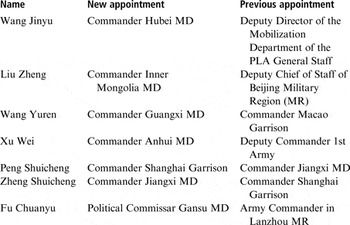
A number of changes to the leadership in China's Military Districts (MD) were revealed on 27 April in the Hong Kong Wen Wei Po (Wen Wei Po website, 27 Apr.):
It was reported that Zhang Chunxian had taken over Wang Lequan's post as First Political Commissar of the Xinjiang Production and Construction Corps (ZXS, 6 May).
Zhou Qiang, another strong contender for future senior leadership positions, was appointed Party Secretary of Hunan on 25 April. He had previously been Party Secretary of the Communist Youth League. He was born in 1960 (XHNA, 25 Apr.). Further changes in the provincial Party leadership were announced on 31 May. Zhang Baoshun was transferred from Shanxi to Anhui as Party Secretary. He was replaced as Party Secretary in Shanxi by the incumbent Governor, Yuan Chunqing (XHNA, 31 May). Both were identified as protégés of Hu Jintao by the South China Morning Post. Zhang had served in the leadership of the Communist Youth League at the time that Hu Jintao was Secretary of the League. He later worked in the Xinhua News Agency and then in the provincial leadership of Shanxi. He holds a Master's degree in economics. Yuan Chunqing also comes from a Party background having worked in the Youth League and in the Discipline Inspection Commission. He studied law at Beijing University and has a PhD in economics from Hunan University (SCMP website, 1 June).
On 1 April, the central Party authorities issued a series of four documents on improving the procedures whereby Party and Government officials are appointed. These were: “The Procedures for Claiming against those Responsible for Mistakes in the Work of Selecting, Promoting and Appointing Leading Cadres of the Party and the Government (Trial)”; “The Procedures for Reporting Issues Regarding the Work of Selecting, Promoting and Appointing Leading Cadres of the Party and the Government (Trial)”; “The Procedures under which the Standing Committee of Local Party Committees Report to the Plenary Session about and accept Democratic Assessments (Trial)”; and “The Procedures for Pre-Resignation Inspections on how Secretaries of Party Committees of Municipalities and Counties Fulfilled their Duties for the Work of Selecting, Promoting and Appointing Leading Cadres of the Party and the Government (Trial)” (RMRB, 1 Apr.). Xinhua reported that Shenzhen was proposing to start selecting top officials for Party and government posts through competitive elections, according to the new Party Secretary, Wang Rong, in his report to the municipal Party congress. The initial idea was to have the top official in each party or government unit elected from several candidates. Thereafter the system might be extended to their deputies (XHNA, 25 May).
There was much speculation about the significance of an article published in the People's Daily by Premier Wen Jiabao on the late Party leader Hu Yaobang, who had been removed from power in 1987 for being too liberal and whose death in 1989 had been one of the catalysts of the demonstrations that culminated in Tiananmen. Wen had praised Hu for his sincerity and his populist touch when conducting investigations into the poorer areas of southwest China. Wen at the time had been part of Hu's entourage and described in a moving and personal way his recollections of Hu and his behaviour (Hong Kong Ming Pao website, 21 Apr.). A diary, purporting to be that of Li Peng, was going to be published in Hong Kong by Bao Pu, son of Bao Tong, who had been one of Zhao Ziyang's closest aides. It covered the period leading up to the military crushing of the student demonstrations in Tiananmen in 1989 and contained new information on the struggles within the leadership that led to the downfall of Zhao Ziyang (SCMP website, 4 June). It did not eventually appear and was apparently withdrawn for copyright reasons.
In advance of the anniversary of the founding of the Party on 1 July, it was announced that all 11 central Party departments would appoint official spokesmen (two of whom were women) to take questions from reporters. The intention was to increase the transparency and accessibility of the Party. The report noted that “promoting openness in party affairs” is an important measure for fostering inner-Party democracy that was explicitly put forward in the report to the 17th Party Congress (XHNA, 30 June). As is customary, figures for the total membership of the Party were also released on 28 June. At the end of 2009, membership stood at 77.995 million. Twenty million people had applied to join the Party in 2009 of whom two million were admitted. Amongst the current members, 18.5 million were under 35 and almost 28 million held a college degree or above (XHNA, 28 June).
c Military Affairs
General Xu Guangyu was quoted by the Hong Kong press as saying that China's neighbours should get used to the presence of the Chinese navy in Asian waters. Speaking in response to Japan's protests over a Chinese vessel chasing one of its survey ships, he said:
China's long absence in its exclusive economic waters over the past decades was an abnormal historical accident and now it is just advancing to normal operations… We kept silent and tolerant over territory disputes with our neighbours in the past because our navy was incapable of defending our economic zones, but now the navy is able to carry out its task.
He said that the maturing of the Chinese navy was driven by its continuation of national interests abroad over the past decade, including its oil investments in Africa and energy transport route from the Middle East and Africa, as well as its duty to protect Chinese nationals (SCMP website, 6 May).
General Ma Xiaotian attended the IISS Shangri-La Dialogue in Singapore. In his address to the meeting he said that the development of China's national defence capabilities was not aimed at challenging, threatening or invading any other country, but to maintain its own security. Ma said that the solution to problems related to maritime affairs, cyberspace, outer space, climate and environment ultimately lies in further development and co-operation, and these issues should neither be politicized nor used as excuses to put pressure on other countries in pursuit of one's own interest. Xinhua also reported that he had said that both China and the United States should work to a sustained and reliable military-to-military relationship. He said that China much valued the relationship but it had entered a strange circle of “development, standstill, another development, another standstill.” He noted that were still some obstacles such as the US arms sales to Taiwan, frequent reconnaissance by the US naval ships and aircraft in the waters and airspace of China's exclusive economic zones, and that the barriers were not built by China. He said that relations had not been suspended as the US Secretary of Defence had claimed, but only paused in certain areas such as high-level visits. He made no reference to reports that China had indicated that a visit by Secretary Gates would not be convenient at the moment (XHNA, 5 June).
China held live fire exercises in the East China Sea off the coast of Zhejiang from 30 June to 5 July. The exercise coincided with an imminent joint exercise by the US and South Korea in the West Sea. Hong Kong press had suggested that the exercise was being timed to counter the US–South Korean one. The Chinese Foreign Ministry had formally objected to that exercise saying that it created new tensions in Northeast Asia (Chosǒn ilbo website, 28 June). Announcing the commencement of the exercise, the Ministry of Defence said that it involved naval vessels shooting targets in eight fishery zones within China's Exclusive Economic Zone where the US military had repeatedly sent ships and aircraft for reconnaissance missions. The Ministry denied that the exercise had anything to do with the US–South Korean manoeuvres (XHNA, 30 June).
d Economic Affairs
The State Council discussed the state of the economy at one of its regular executive committee meetings on 14 April. It found that the national economy was heading towards the goal of macroeconomic regulation with a strong foundation for economic recovery. It noted that the fast pace of economic growth could largely be attributed to the stimulus package, and that, as the economy recovered, old difficulties remained and new ones were appearing. These include the rise of trade protectionism and uncertainties in the global economy, the drought in southwest China, growing inflation expectations (especially the rise in house prices), the management of financial risks and the pressure of increasing unemployment (XHNA, 14 Apr.). On 31 May, the State Council announced that it would gradually push forward property tax reforms in the coming year. The government would deepen fiscal and taxation system reforms by gradually advancing property tax reform, reforming resource and environment taxes, researching and implementing the personal income tax reforms, and improving consumption tax systems. The government would also deepen reform of state-owned enterprises and further encourage the development of the private sector (XHNA, 31 May). On 29 June, the Agricultural Bank of China announced that it was seeking to raise up to US$23.2 billion by listing on the Shanghai Stock Exchange and in Hong Kong (XHNA, 29 June).
The National Bureau of Statistics announced that GDP grew by 11.9 per cent year on year in the first quarter. The spokesman said these results laid a solid foundation to meet the annual economic target. He explained the rate of growth as being due to last year's poor performance (6.2 per cent) and the stimulus package. But he said economic conditions remained very complicated, as the world economy reheated in an unbalanced way and commodity prices rose steeply. The drought and the rapid increase in the prices of industrial products would be serious challenges. He confirmed that the proactive fiscal policy and moderately easy industrial policy would continue. Urban per-capita incomes rose by 9.8 per cent (7.5 per cent after adjusting for inflation) and rural incomes were up 11.8 per cent (9.2 per cent after inflation) (XHNA, 15 Apr.). China's tax revenue rose 33.2 per cent year on year in the first four months of the year to 2.63 trillion yuan, with taxes collected by local government up 31.9 per cent and that by central government up 34 per cent (XHNA, 12 May).
The Chinese government continued to be concerned about the dangers of a major bubble in the housing market. On 11 April, the China Banking Regulatory Commission ordered that banks should not give loans to buyers who intended to use them for speculative purposes. It also ordered that down payments on mortgages for second homes should be no less than 40 per cent (XHNA, 11 Apr.). House prices rose again substantially in March, going up 11.7 per cent year on year (XHNA, 14 Apr.). Wen Jiabao chaired an executive meeting of the State Council on 14 April on the house price question in order to study and map out policy measures to control the situation (XHNA, 15 Apr.). Beijing municipal authorities issued a new set of measures to restrict house price rises on 30 April. Families were prevented from buying more than one apartment in the city, and tough restrictions on mortgages for third homes or for non residents (XHNA, 30 Apr.). On 7 May, the Vice Minister of Housing and Urban Rural Development announced that China had succeeded in curbing the excessive rise in house prices in some cities (XHNA, 7 May). Nonetheless house prices in 700 major cities rose by 12.4 per cent year on year in May (just 0.4 points lower than in Apr.). Floor space sold in the first five months was up 22.5 per cent (XHNA, 10 June).
China experienced a current account deficit in March for the first time in six years. According to customs figures, exports rose 24.3 per cent year on year to US$112.11 billion and imports were up 66 per cent to US$119.35 billion. In the first three months of the year there was a total trade surplus of US$14.49 billion, down 76.7 per cent. Trade with ASEAN following the establishment of the free-trade area rose from US$300 million to US$2.7 billion. A Ministry of Commerce spokesman said that this showed that it was market supply and demand that drove trade balances, not currency levels. He called on some developed countries to lift restrictions on high-tech goods to further reduce the deficit. He attributed the March deficit to increases in imports and higher prices and a strong domestic demand for crude oil, iron ore and copper (XHNA, 10 Apr.). Overall in the first quarter of the year, China ran a surplus in both the current account and the capital and financial account. The current account surplus was US$40.9 billion – down 48 per cent year on year. The surplus on the current and financial account was US$55 billion and net FDI was US$17.5 billion. Foreign Exchanges reserves reached US$2.4471 trillion (XHNA, 14 May). China's exports rose strongly year on year in May, against a background of very poor performance last year rising 48.5 per cent. The Ministry of Commerce spokesman forecast that the trade surplus would fall over the year due to strong demand for imports with a poor outlook for exports. He said that China would maintain stable trade policies amid the crisis, and might adjust some policies in some specific industries for environmental protection purposes (XHNA, 12 June).
The question of the value of the yuan continued to be contentious throughout the quarter. Pressure from the US for a revaluation remained constant, though its intensity ebbed and flowed. China continued to argue strongly that yuan appreciation would not spur the US economy, reduce China's trade surplus with the US or rebalance the global economy. China complained of trade protectionist actions and the threats from the US congress that China might be labelled a currency manipulator and be subject to punitive sanctions as a result. This did not materialize but the arguments remained heated and political (RMRB, 8 Apr.). On 19 June, after a long period of resistance China did announce that it would proceed further with reform of the renminbi (RMB) exchange rate to give it greater flexibility. The Central bank said that decision was made in view of the recent economic situation and financial market developments at home and abroad, and the balance of payments situation in China (XHNA, 19 June). The Bank made it clear that there would not be a one-off revaluation and that it intended to keep the rate basically stable and manage and adjust the exchange rate based on the floating bands previously announced in the interbank foreign exchange market (XHNA, 20 June). Nonetheless, China continued to argue that that the exchange rate was not the major cause of the imbalance with the US, and called on the US to adopt a positive and constructive attitude to promote the stable development of economic and trade relations and refrain from politicizing the issue. The Foreign Ministry spokesman added that another major cause of the imbalance was the US refusal to sell high-tech goods to China:
We hold that the appreciation of the renminbi cannot resolve the issue of Sino-US trade imbalance, nor can it solve the issues of the too low domestic savings rate, of borrowing money for consumption, and of employment now being faced by the United States. It is hoped the United States can find more causes from its economic structure, instead of always making accusations and applying pressure (XHNA, 24 June).
The drought in Southern China, which affected widespread areas in Chongqing, Sichuan, Guizhou and Guangxi, persisted through April. By 8 April it was said to have affected 25.95 million people and about 8.07 million hectares of arable land (XHNA, 8 Apr.). The formal drought notice was only lifted on 4 May, after rainfall had eased what was described as the one of the worst droughts in decades (XHNA, 4 May). Drought was also reported in Inner Mongolia, and on 10 April it was reported that 250,000 people were short of drinking water in Chifeng City and that the drought was affecting large numbers of livestock (XHNA, 10 Apr.)
Heavy rains affected much of southern China in early May. By 24 May, 115 people were known to have been killed and a further 21 were missing. Over 685,000 people had been evacuated from their homes over 12 provinces, and 15.25 billion yuan worth of damage had been done (XHNA, 24 May). The rains continued through June. On 16 June it was reported that over one million people had been affected by floods which had killed at least 35 people in Fujian, Sichuan and Guangxi (XHNA, 16 June). Altogether, ten provinces were affected and some 29 million people had been affected, of whom over 2 million had had to be evacuated. By 22 June 199 lives had been lost and 123 people were missing (XHNA, 22 June). Premier Wen Jiabao visited flood-stricken areas in Guangxi on 19 and 20 June to push forward the work in dealing with the floods and preventing further flooding (XHNA, 20 June). The rains continued and Premier Wen went to Fuzhou in Jiangxi to review disaster relief work there. By 25 June the number of dead had risen to 235 and 34 million people had been affected (XHNA, 25 June).
e Social Affairs
Against a background of a long-term fall in the proportion of GDP that goes to wages and salaries, there was considerable evidence of the ability of labour to begin to extract wage rises and concessions from firms, especially foreign-owned firms. According to the All-China Federation of Trade Unions, the proportion of GDP that went to wages and salaries had fallen from 56.3 per cent in 1983 to 36.7 per cent in 2005. Almost a quarter of workers had not received a wage rise in five years (XHNA, 12 May).
A cluster of suicides among the employees of Foxconn Technology Group in Shenzhen provoked much discussion of labour conditions in southern China, especially those affecting young migrant workers who make up the majority of the employees of Foxconn. Up to 15 May, nine employees had attempted to commit suicide, mainly through jumping from tall buildings on the complex. Foxconn is linked to the Taiwan Hon Hai Group (XHNA, 15 May). Following a further suicide attempt in Shenzhen, it was revealed that there had also been two suicides at a Foxconn plant in North China earlier in the year (XHNA, 21 May). There was a further suicide on 26 May at the plant in Shenzhen. This happened just hours after the head of the Foxconn Group had promised better welfare for the company's employees and undertaken to do everything possible to prevent more deaths. Two days later, another worker attempted suicide by slashing his wrists (XHNA, 27 May). As the discussion spread more widely within China, the Hong Kong press reported that leading mainland press outlets had been ordered to play down reports on the suicides and the working conditions at Foxconn and to concentrate more on the measures the government were taking to cope with the problem (SCMP website, 28 May). A commentary by the official Xinhua News Agency on 28 May noted that Foxconn epitomized China's traditional export-driven development pattern with investment and cheap labour combining to make low value-added products. The commentary noted that the export-oriented processing model can make products, boost GDP and employ people, but it cannot create brands, develop advanced technology, generate high profits or pay high salaries. The tragedies underlined the need for China to restructure its development pattern (XHNA, 28 May). The Hong Kong press reported on 29 May that Foxconn was planning to give some 200,000 of its workers in Shenzhen an average pay rise of 20 per cent, and to reduce overtime (SCMP website, 29 May). Anxious not to let the publicity impinge too much on Taiwan business in China, the spokeswoman for the Taiwan Affairs Office said on 12 June that the Chinese government would introduce more favourable policies to help Taiwan-funded enterprises continue to develop on the mainland. She noted that the “authorities had made some progress in handling the issue” at Foxconn, and added that “Labour disputes at some Taiwan-funded enterprises on the Chinese mainland have been properly handled by local governments” (XHNA, 12 June).
There was considerable industrial unrest in a number of other foreign-owned plants. On 17 May workers went on strike at a Honda plant in Foshan, Guangdong, demanding higher wages, and forcing stoppages to Honda's four main assembly plants in China. Initial negotiations with the managements were inconclusive (Kyodo News Agency, 27 May). The local government sent trade union officials to help deal with the dispute and restore production but some 40 workers remained on strike on 31 May and some scuffles were reported to have taken place around the plant. The Chairman of the local trade union was quoted as saying that big difficulties remained and that there was no exact timetable for mediation. Workers were demanding an increase of 800 yuan in their monthly pay. The management had only offered 366 yuan (XHNA, 31 May). The strike ended on 2 June while negotiations over pay continued. The company announced on 4 June that consensus had been reached but gave no details, although according to some workers they had improved on the offer of 366 yuan. The company said it would seriously look at its management processes, improve communication with the workers and improve labour relations (XHNA, 4 and 5 June). Xinhua reported on 9 June that minimum wages in Shenzhen would rise by 10 per cent to 1,100 yuan a month. The Director of the Human Resources and Social Security Bureau said: “the pay rise will increase costs for labour-intensive companies but I hope those companies will take this as an opportunity to speed up their technological innovation and industrial upgrading to boost their competitiveness.” Wages were also increased elsewhere. Beijing's minimum wage would rise 20 per cent to 960 yuan a month, and Foxconn announced that it would raise wages in Shenzhen by 66 per cent to 2,000 yuan a month from 1 October (XHNA, 9 June). These announcements came as reports emerged of other industrial actions over wages, at another Honda-affiliated plant in Guangdong, and in a rubber factory near Shanghai (SCMP website, 9 June). Reports of strikes for higher wages continued, mainly at foreign-owned enterprises, throughout the month, including in Tianjin where workers at a number of plants supplying parts for Japanese automobile manufacturers were reported to have gone on strike (XHNA, 17 and 30 June). The official reaction was mixed. At times it was reported that the Propaganda Department had ordered that the media should stop reporting strikes (SCMP website, 12 June). The All-China Federation of Trade Unions issued an emergency notice on 4 June urging trade unions at all levels to actively promote the organization of trade unions in foreign-owned enterprises, and those run by Hong Kong and Taiwan investors (XHNA, 4 June). Workers in the KFC fast-food chain, headquartered in Shenyang, were reported to have won a wage rise thanks to the demands of the local trade union (XHNA, 17 June).
China lifted its ban on travellers with HIV/AIDS coming to China on 27 April. The relaxation also covered those with leprosy and narrowed the restrictions on the mentally ill and those with tuberculosis (XHNA, 27 Apr.). Wang Yanhai, who had campaigned with great energy on behalf of AIDS sufferers in China, left China for the US saying that harassment from the authorities had forced the move on him (SCMP, 10 May).
Zhang Minsheng was sentenced to death on 8 April for murdering eight school children and injuring five others in his attack on the Nanping Experimental Elementary School on 23 March. He told police that he had done it because he felt frustrated after breaking up with his girlfriend. Police said that he showed no history of mental illness. His trial lasted four hours. The families of the murdered children had each received compensation of 260,000 yuan from Nanping City and other agencies (XHNA, 8 Apr.). His appeal was rejected on 20 April and he was executed on 28 April (XHNA, 20 and 28 Apr.). In response to this and a number of other instances of violence in schools, the Ministry of Education issued an instruction to all schools to upgrade security, integrate safety awareness into the curriculum and teach children self-protection. It was reported to have ordered that schools should hire security guards, install security facilities and make sure young students were escorted home (XHNA, 16 Apr.). There was a rash of attacks reported on primary school children across the country which engendered a sense of panic in many places with hastily arranged guards being assigned to schools. On 28 April, 16 children and a primary school teacher were attacked in Guangdong. Twenty-nine children and three adults were injured in a knife attack at the Zhongxin kindergarten in Taixing. Jiangsu, on 29 April. The assailant, 46-year-old Xu Wenying, was reported to have said that he carried out the attack as his revenge on society for a series of business and personal humiliations (XHNA, 30 Apr.). He was sentenced to death on 15 May, and executed on 30 May (XHNA, 30 May). On 30 April, five children and a teacher were injured when a man went on the rampage with an iron hammer at the Shangzhuang Primary School in Weifang, Shandong. He then set light to himself and died in the fire. He was reported to be Wang Yongling, a local farmer (XHNA, 30 Apr.). On 12 May seven children and a teacher were killed and another 20 injured in an attack on a kindergarten in Hanzhong City, Shaanxi. The assailant later killed himself (XHNA, 12 May). On 13 May Premier Wen Jiabao said in an interview with Phoenix TV that the government must not only tighten public security measures but also address the deep-seated causes of the problems. Wen said that he was extremely distraught at the deaths and expressed sympathy deeply for the families (ZTS, 13 May).
Huang Guangyu, founder of the retail chain Gome Electrical Appliances Holdings and once listed as China's richest man, went on trial on 23 April in Beijing. He was detained in April 2008 on suspicion of economic crimes, and was later charged with illegal foreign exchange trading, insider trading and offering bribes to a number of officials. Foreign media were barred from attending the hearing (SCMP website, 23 Apr.). He was sentenced to 14 years in prison on 18 May (XHNA, 18 May).
Zhu Zhigang a former Vice Minister of Finance and then Director of the Budgetary Commission of the NPC Standing Committee was put on trial for corruption in Henan on 26 April. He was charged with accepting bribes to help others secure profits, loans and appointments during his time as a senior official in the Ministry of Finance. He was expelled from the Party in 2009 and from his NPC position in 2008 (XHNA, 26 Apr.). Wen Qiang, the former head of the Chongqing Judicial Bureau who had been one of the most senior figures implicated in the campaign against corruption, was sentenced to death on rape and corruption charges on 14 April. All his personal property was confiscated (XHNA, 14 Apr.).
The Chinese government approved an education reform plan for the next ten years which was intended to heighten the priority given to education and ensure more fairness in the system. The Medium- and Long-term National Educational Reform and Development Plan (2010–2020) was adopted by the State Council on 6 May. Government expenditure on education was targeted to reach 4 per cent of GDP by 2012. Hu Jintao later presided over a meeting of the Politburo which in turn discussed and approved the plan on 21 June (XHNA, 21 June).
China issued a White Paper on its internet policy on 8 June. The paper provided details of the development and use of the internet in China and laid out the government's policies both on domestic regulation and on international co-operation on internet issues. By the end of 2009 there were 384 million internet users in China, reaching 28.9 per cent of the population, which was intended to rise to 45 per cent in the next five years. The paper noted that the internet had become an engine promoting the economic development of China. Information technology (IT), including the internet and its industry, has made significant contributions to the rapid growth of the Chinese economy, and the internet had become an indispensable tool in people's every-day life. The 31-page document is divided into six sections: Endeavours to Spur the Development and Application of the Internet; Promoting the Extensive Use of the Internet; Guaranteeing Citizens’ Freedom of Speech on the Internet; Basic Principles and Practices of Internet Administration, Protecting Internet Security; and Active International Exchanges and Co-operation (Full text in XHNA, 8 June).
China's uneasy relationship with Google continued to cause problems. On 18 June, Chinese commentators reacted badly to the news that Google was attempting to declare China's internet restrictions a trade barrier, claiming that Google was again attempting to politicize itself (XHNA, 18 June)
f Expo 2010 Shanghai
The much-vaunted Expo 2010 Shanghai (hereafter World Expo) was opened on the evening of 30 April in Shanghai by President Hu Jintao (text of his speech in XHNA, 20 Apr.). The World Expo, with the theme “Better City, Better Life,” drew the participation of an unprecedented 189 countries and 57 international organizations. Numerous foreign dignitaries attended the ceremonies. These included 15 presidents, five prime ministers and senior figures from a further 20 countries. The senior dignitaries were: Armenian President Serzh Sarkisyan, Congolese President Denis Sassou-Nguesso, President of the Presidium of the Supreme People's Assembly of DPRK Kim Yong Nam, French President Nicolas Sarkozy, Gabonese President Ali Bongo Ondimba, Kenyan President Mwai Kibaki, Malawian President Bingu Wa Mutharika, Malian President Amadou Toumany Toure, Malta President George Abela, Micronesian President Emanuel Mori, Mongolian President Tsakhia Elbegdorj, Palestinian President and Palestinian National Authority Chairman Mahmoud Abbas, Republic of Korea President Lee Myung-bak, Seychelles President James Alix Michel, Turkmen President Gurbanguly Berdymukhamedov, Cambodian Prime Minister Hun Sen, European Commission President José Manuel Barroso, Kazakhstan Prime Minister Karim Masimov, Dutch Prime Minister Jan Peter Balkenende and Vietnamese Prime Minister Nguyen Tan Dung (XHNA, 30 Apr.). On the opening day, more that 350,000 people visited, following a commencement ceremony presided over by Jia Qinglin, Chairman of the Chinese People's Political Consultative Conference (CPPCC), and Jean-Pierre Lafon, President of the International Exhibitions Bureau (XHNA, 1 May). By 28 June, more than 20 million had visited, and it was expected that there would have been 70 million visitors by the time it closed on 31 October. There was a steady stream of senior foreign dignitaries to the Expo, usually timing their visits to coincide with some anniversary such as their National Day (XHNA, 28 June).
g Tibet and Xinjiang
Tibet
On 14 April, a major earthquake occurred in a remote and largely Tibetan region of Qinghai province. The earthquake, measuring 7.1 on the Richter scale, hit Yushu County at 7:49 am. Initial reports suggested that the township of Gyegyu (Jiegu) had been hardest hit with 85 per cent of the buildings collapsing and 400 people killed and 10,000 injured (out of a population of about 100,000). Rescue teams from neighbouring provinces were reported to have been mobilized rapidly with support from the PLA. Both President Hu Jintao and Premier Wen Jiabao issued written instructions on relief efforts and Vice Premier Hui Liangyu was sent to supervise the relief work. The sum of 200 million yuan was immediately allocated for disaster relief (XHNA, 14 Apr.)
The following day, the number of confirmed dead was 617, with 9,110 people injured, 313 missing and 100,000 homeless. According to official reports about 2,000 soldiers and police were assisting professional rescue teams in the search for survivors. Rescue efforts were hampered by freezing weather and landslides, and survivors were urgently in need of tents, medicine and food. Some 20 Tibetan monks were also reported to have joined in the rescue, and Vice Premier Hui was quoted as approving their help. On 17 April, the first cremations of some of the victims were held. By this time the total number of those killed had risen to 1,144 with 417 known missing. A traditional Tibetan ceremony was held in the township with “up to 1,000 Buddhist monks” as the authorities “pledged to respect local funeral customs while disposing of the bodies and preventing epidemics in the disaster zone” (XHNA, 17 Apr.).
President Hu cut short his visit to Latin America and Premier Wen postponed his to South East Asia because of the earthquake (XHNA, 15 Apr.). Wen visited the region by special plane on 15 April and went to the worst affected areas. He inspected ruins and a local hospital and announced that “[t]he top priority is to save people. We will never give up even if there is only a slim hope” (XHNA, 16 Apr.). Shortly after he returned from abroad, Hu Jintao convened a meeting of the Standing Committee of the Politburo on relief work. He called for further efforts to be made to save lives, and for improvements in the provision of relief and other supplies (XHNA, 17 Apr.). Hu personally visited the area on 18 April to direct relief work and visit victims. On arrival he immediately promised that new schools and homes would be built (XHNA, 18 Apr.).
It was reported from Dharamsala that the Dalai Lama had asked to be allowed to visit the area to bring comfort to the people. He praised Chinese leaders for visiting the area and taking a personal interest in relief work. He also expressed his appreciation for the ability of the media to report freely on the tragedy (Press Trust of India news agency, 17 Apr.).
Access to the area was tightly controlled by the Chinese authorities and few outside media were able to reach it. Their reports tended to highlight the relief work and guidance given by local monks as opposed to the official concentration on the efforts made by the armed forces and other uniformed services. On 18 April the Central Political and Legal Affairs Committee issued a notice urging the maintenance of stability in the region with increases in police patrols and the timely solving of disputes to maintain social stability among ethnic groups. It also called for action against looting and the sabotage of relief operations (XHNA, 18 Apr.). A spokesman for the Tibetan Government in Exile based in Taiwan said that many of the people in the surrounding villages had received no help, and that rescue efforts had focussed on the institutions, schools and markets in the centre of the town (CNA, 19 Apr.).
On 19 April, Jia Qinglin, Chairman of the CPPCC, chaired a meeting of “relevant departments” on earthquake relief. In his address to the meeting, Jia Qinglin pointed out that
the current work of fighting against earthquake disasters and providing disaster relief in Yushu is still very arduous and we are faced with some special difficulties and challenges. In addition to frigid climate, lack of oxygen, livelihood problems of some people, and ethnic and religious factors, hostile elements abroad also try to interfere and sabotage the work of fighting against earthquake disasters and providing disaster relief. Under this situation, it is necessary to adhere to the work of fighting against earthquake disasters and providing disaster relief on the one hand and promote unity and stability on the other hand. With a deep sense of responsibility towards the people in the disaster-afflicted areas, we must show utter devotion to our duties, fear no difficulties, battle continuously, spare no effort to accomplish various tasks, and create a good social and political environment for winning all-round victory in the work of fighting against earthquake disasters and providing disaster relief (XHNA, 19 Apr.).
The Hong Kong press reported that Qinghai provincial authorities had issued a formal notice to crack down on pornographic and illegal publications, and to pay special attention to law breakers who use illegal publications to disturb people's hearts and disrupt the relief effort (SCMP website, 22 Apr.).
A national day of mourning for the victims of the earthquake was held on 21 April (by which time the number of killed was reported to have been 2,064). President Hu and the other members of the Politburo Standing committee stood in silent tribute, and flags were flown at half-mast. The Panchen Lama hosted a prayer ceremony at the Xihuang Temple in Beijing on 20 April. Premier Wen visited the area again in early May and presided over a meeting to study post-disaster reconstruction and rehabilitation. He noted that the emergency relief work had been basically completed and the focus had now shifted to providing medical treatment for the injured, resettling the victims, restoring order and accelerating reconstruction (XHNA, 2 May). The final official figures were 2,698 killed with 270 missing (XHNA, 31 May). The “official” Panchen Lama visited the region on 14 May and went to the Gyegyu Monastery where he led monks in prayers to guide the souls of those who had died (XHNA, 14 May).
The Dalai Lama paid his second visit to Slovenia on 5 April and was met by the Mayor of Maribor and a Slovene MEP (STA News Agency, 5 Apr.). There were no meetings with government officials. He then went on to visit Switzerland, again without government meetings. The Dalai Lama went to Japan from 18 to 28 June to visit a Buddhist temple in Nagano and to deliver spiritual lectures in a number of Japanese cities (Kyodo News Service, 16 June). On arrival in Japan he said that he was not scheduled to meet any Japanese government representatives during his stay, and that the purpose of his visit was to promote non-violence and compassion (Kyodo News Service, 19 June).
The Hong Kong press reported that a prominent Tibetan environmentalist had been sentenced to 15 years in prison. Karma Samdrup was sentenced on 25 June on what his supporters said were trumped-up charges against him. He was convicted of “robbing ancient graves” by a court in Yanqi County, Xinjiang. In addition to his prison sentence, he was fined 10,000 yuan. He had been detained in Sichuan in January. He claimed that he had been tortured into confession. His supporters believed that Samdrup was targeted because he had tried to save his two brothers who had been detained in August on charges of establishing an illegal NGO and an environmental journal (SCMP website, 25 June).
Xinjiang
The Politburo met on 23 April to discuss plans to boost economic development and maintain long-term social stability in Xinjiang. Hu Jintao presided over the meeting and said that economic and social development needed to be pushed forward in a sound and speedy way with priority being given to improving people's livelihoods. The meeting agreed that the Party's ethnic and religious policies needed to be upheld so that all ethnic groups in the region could lead a more prosperous and happier life (XHNA, 23 Apr.). The following day it was formally announced that Wang Lequan, a member of the Politburo who had been Party Secretary of Xinjiang for over 15 years, had been removed from his post and replaced by Zhang Chunxian who had been transferred from Hunan where he had been Party Secretary. Wang was appointed to the post of Deputy Secretary of the Central Political and Legal Affairs Commission. Zhang had been Minister of Transport before his appointment to Hunan. Xi Jinping described him in the following terms when presenting him to the leadership in Xinjiang:
Zhang Chunxian is politically firm, takes a resolute attitude in implementing central policy-decisions and arrangements, has a relatively high policy and theoretical level, is young and capable, has been tempered at various posts, has rich leadership experience, and has great organization and leadership ability and great ability to control the overall situation. He has emancipated his mind and has a clear head and the spirit of blazing new trails. While he was the principal leader in Hunan, he made great efforts to push forward the change in the mode of development and the readjustment of the economic structure, went all out to properly ensure growth, ensure the people's livelihood and ensure stability, and properly grasped party building in a down-to-earth manner, thus maintaining the good momentum of economic and social development of the whole province (XHNA, 23 April; ZTS, 24 Apr.).
Internet services were finally fully resumed for Xinjiang on 14 May, marking the end of severe restrictions on telecommunications in the region which had been imposed after the rioting in July 2009 which the authorities alleged had been co-ordinated through various electronic means (XHNA, 14 May).
Perhaps also in preparation for the conference on Xinjiang, senior provincial leaders from a number of provinces visited Xinjiang in early April. Liu Qi, Party Secretary of Beijing visited from 7 to 12 April; other leaders included Wang Yang of Guangdong, Wang Min of Liaoning, Su Rong of Jiangxi, and Zhou Hongzhu of Zhejiang. Their aim was to understand the basic situation in the counties and cities which are the targets of counterpart assistance, make initial contact and co-ordinate the disposition of counterpart assistance, and lay out arrangements for the conduct of assistance to Xinjiang (ZXS, 13 Apr.).
The Central Work Conference was held from 17 to 19 May. It was attended by all the members of the Politburo Standing Committee and laid down strategic plans for Xinjiang to achieve leap-frog development and lasting stability. President Hu addressed the Conference and said that the region should embark on a development path with Chinese characteristics that suited the region's situation. By 2015 per-capita income should catch up with the country's average level and basic public services should be at least equal to others in the western region. Marked improvement was needed in Xinjiang's infrastructure, self-development capacity, ethnic unity, and social stability within five years. By 2020 Xinjiang should reach the goal of attaining a moderately prosperous society in all aspects. He added that resource development would be directly linked to people's welfare. Finally, he called for striking down all ethnic separatist forces to ensure social order. Premier Wen Jiabao said that the central authorities had decided to launch major support policies for Xinjiang. Resources would be taxed by price rather than by volume, and new polices would be introduced to exempt enterprises in poor areas from income tax for two years. Investment would be encouraged, and the government would approve the use of more undeveloped land for construction. Provinces would be encouraged to set up their own direct support programmes for Xinjiang. Zhou Yongkang, China's leading security figure, also addressed the Conference (XHNA, 20 May). A new resources tax of 5 per cent on sales of crude oil and gas was introduced on 1 June in Xinjiang, intended to raise revenue for the region (XHNA, 2 June).
China announced on 24 June that it had broken up a terrorist ring headed by “East Turkestan” separatists. Ten suspects including two ringleaders had been detained. It was alleged to have been involved in targeting border police in Kashgar and in explosions in Kuqa in 2008 in which a number of people had been killed and injured. One of those detained, Abdurixit Ablet, was said to have been sent by East Turkestan Independence Movement (ETIM) separatists from abroad, and the other, Imin Semai'er, was a “backbone” member of the group. They were alleged to have planned a series of violent attacks in Xinjiang in 2009, but police had discovered their plot and they had fled to Guangdong and Yunnan where they tried to make contact with ETIM and escape abroad (XHNA, 24 June).
h Human Rights
The well-known human rights lawyer, Gao Zhisheng, was allowed to return home to his apartment in Beijing on 6 April after he had been taken from his family home in Shanxi and held incommunicado for some 14 months. His case was widely taken up internationally resulting in occasional confusing information about his whereabouts and state of health being released by the Chinese. Gao spoke briefly to reporters in Beijing but gave no account of what had happened to him, and said at first that he had given up fighting for others. He later said he was looking forward to visiting his in-laws in Urumqi. But he was reported to have disappeared again by the end of the month, with no official explanation forthcoming as to his whereabouts (SCMP, 30 Apr.). China's own human rights research organizations held their second national experience exchange meeting in Tianjin on 28 April. Luo Haocai, the Chairman of the Chinese Society for Human Rights Studies was quoted as saying that although China has achieved remarkable progress in the cause of human rights, it still has a long way to go in terms of the development of the cause of human rights (ZXS, 28 Apr.).
China and the US held a round of their dialogue on human rights in Washington on 13 and 14 May, the first round under the Obama administration. The talks were described by the Chinese media as “candid, open and constructive” (XHNA, 14 May).
On 30 May, China issued two new sets of rules relating to the criminal evidence system to lessen the risk of miscarriages of justice following a case in which a defendant had been convicted of murder as a result of a confession obtained under torture, only for the victim to reappear alive. One regulation concerned rules for scrutinizing evidence used in cases involving the death penalty and the other contained detailed procedures for examining evidence and for excluding evidence obtained in an illegal way such as torture (XHNA, 30 May).
Liu Xianbin, aged 41, who had been imprisoned in 1991 for his activities at Tiananmen and again in 1999 for his part in organizing the China Democratic Party, was detained by police on 28 June for “inciting subversion to state power” (Kyodo News Agency, 30 June).
i Hong Kong and Macau
On 8 April, the Hong Kong SAR Chief Executive announced that Justice Geoffrey Ma had been appointed Chief Justice to replace Andrew Li on 1 September. Justice Ma was described as “an outstanding lawyer with exceptional judicial, professional and personal qualities, a man of high integrity commanding strong respect within and outside the Judiciary, including the legal profession.” Three non-permanent Hong Kong judges were also nominated for the Court of Final Appeal: Robert Tang, Frank Stock and Michael Hartman (XHNA, 8 Apr.).
The Hong Kong Government announced its proposals for the election of the Chief Executive and the Legislative Council (LegCo) on 14 April. Qiao Xiaoyang, Deputy Secretary General of the National People's Congress Standing Committee, said that the proposals were a significant step towards expanding democratic elements. He said that the plans were in line with the Basic Law and the relevant decisions of the NPCSC, and reflected the principle of developing democracy according to Hong Kong's actual situation and in an orderly and gradual way. The main elements were the expansion of the election committee from 800 to 1,200 and the expansion of the number of LegCo seats from 60 to 70 by adding five directly elected seats and five new functional constituency seats. He said that he hoped all circles in Hong Kong would support the plan (XHNA, 14 Apr.).
Five LegCo members resigned their seats in January to force a by-election which they hoped would be taken as a mini-referendum on the question of constitutional reform in Hong Kong. Despite strong objections from pro-Beijing voices to the concept of referendum, the by-election went ahead on 16 May. All five were duly re-elected but the turnout was only 17.1 per cent. After the election, in which he had not voted, the Chief Executive Donald Tsang said that
Hong Kong people have expressed their views. First of all, all of us want democracy. They have also told us they are generally satisfied with what is put on the table and the majority of them have supported and want LegCo to vote in favour of the package put on the table. And yesterday's performance has told us they are tired, they are tired of violent actions. They want peaceful dialogue. They want objective discussion. They want us to move ahead. They do not want to stay behind and stay where we are (RTHK Radio 3, 17 May).
On 24 May three leading members of the Democratic Party in Hong Kong held talks with Li Gang, Deputy Director of the Central Government Liaison Office, on the government's reform proposals. These were the first such contacts since the handover. The Chairman of the Democratic Party, Albert Ho, said that they had laid out their conditions for accepting the government's package which included allowing the people to elect the proposed new legislators from the District Council seats and genuine democratic elements in 2016 and 2017. Li Gang was reported to have restated his position while promising to take the suggestions to a higher level (RTHK Radio 3, 24 May). Li Gang later had a meeting with the Association for Democracy and the People's Livelihood and undertook to pass on their ideas as well (SCMP website, 29 May).
Qiao Xiaoyang, Deputy Secretary General of the National People's Congress, issued a statement on 8 June in which he offered a definition of what universal suffrage in Hong Kong might mean, in his words “the equal right of election of all individuals.” The statement also appeared to rule out any substantial concession by Beijing before the proposals were formally submitted. Pan-democrats were not reassured by his statement and stated that it merely reinforced, if not increased, their concerns that the “universal suffrage” promised for 2017 and 2020 would fall short of the type of universal suffrage that allowed a real choice of representatives and an equal opportunity to stand for election (SCMP website, 8 June).
At the very last moment, it became clear that Beijing had accepted a compromise proposal whereby the new seats on the LegCo to be selected by the District Council would be voted on by all the electorate. In essence this gave each voter two votes. It was enough for the leadership of the Democratic Party to be able to recommend that they should vote in favour of the whole constitutional reform package. On 21 June, a senior official of the Chinese Government Liaison Office in Hong Kong was quoted as saying that the Liaison Office actively supported and welcomed the HKSAR government's decision to accept advice from political organizations on the 2012 electoral methods package, which could help the package win passage. On 24 June, after a long debate, the LegCo passed the electoral method for selecting the Chief Executive by a two-thirds majority (XHNA, 24 June). The arrangements for electing the LegCo were passed on 25 June by 46 to 12 (with the LegCo President not voting and one member having been expelled from the Chamber). The proposals still required the assent of Chief Executive and the approval of the National People's Congress Standing Committee (XHNA, 25 June).
Macau
Senior Colonel Zhu Qingsheng was appointed Commander of the Macau Garrison in place of Major General Wang Yuren on 14 April (XHNA, 14 Apr.).
2. Foreign Relations
a Diplomatic Tours
President Hu Jintao's visit to Washington and Brazil
President Hu visited Washington from 12 to 13 April to attend the Nuclear Security Summit where he delivered a speech on the importance of nuclear safety and on China's policy on the issue. On 12 April he had bilateral talks with President Obama to discuss bilateral relations, the Iranian nuclear issue, the RMB exchange rate and other matters of common concern. President Hu put forward a five-point policy for improving relations: stick to the right direction in bilateral ties and establish a partnership to deal jointly with common challenges; respect each other's core interests; keep and develop exchanges at different levels; deepen practical co-operation; and strengthen their co-ordination and communication on major international issues. On the RMB, Hu said China would stick to the path of reforming its currency rate based on its own economic and social development needs (XHNA, 13 Apr.). He also had meetings with the Japanese Prime Minister Yukio Hatoyama, the German Chancellor Angela Merkel, and the Ukrainian President, Viktor Yanukovich (XHNA, 13 Apr.).
After Washington, President Hu travelled to Brasilia for the second summit of the BRIC countries from 15 to 16 April. China hoped that the leaders would discuss the global economy and financial situation, reform of the international financial system, climate change and co-operation amongst themselves. President Hu was also paying a working visit to Brazil. He met President Lula on 15 April for exchanges on bilateral ties and issues of common concern. Brazil had been the first Latin American country to establish a strategic partnership with China in 1993 and relations had since developed in a comprehensive way. An Action Plan for 2010 to 2014 was signed to reflect the extensive and profound co-operation between the two sides. They agreed to promote co-operation and dialogue in food safety, infrastructure, energy, space technology, military and law enforcement (XHNA, 15 Apr.).
The BRIC Summit was reduced, at China's request, to one day, and Hu left after the meeting to return to China because of the earthquake in Qinghai. Hu delivered a speech to the summit in which he urged closer co-operation between the member states and called for clear objectives to be set, based on mutual political trust. He called on all parties to address imbalances in the global economic governance structure, and to properly handle trade disputes and reject protectionism. He said it was important that the voice of emerging markets and developing countries should be increased in the international financial institutions. He said there should be supervision over the macroeconomic policies of major reserve currency issuing economies and over sovereign credit-rating agencies (XHNA, 16 Apr.).
President Hu Jintao's visit to Russia
President Hu visited Russia on 8 and 9 May to attend the 65th anniversary of Russia's victory in the second world war. He met Premier Putin on 8 May and they were reported to have reached important consensus on promoting their strategic co-operative partnership as well as on major international and regional issues. Hu offered in particular to strengthen anti-terrorist co-operation, to jointly crack down on the “three forces” and to safeguard regional peace and stability (XHNA, 8 May). During his stay in Russia, Hu and other leaders took part in a series of celebrations, including a military parade at the Red Square, a wreath-laying ceremony at the Tomb of the Unknown Soldiers, and a banquet hosted by Russian President Dmitry Medvedev. He also met with some Russian veterans who helped China battle Japanese troops in the war (XHNA, 9 May).
The Foreign Minister's tour of Tunisia, Ukraine and Uzbekistan
Foreign Minister Yang Jiechi visited Tunisia in May. On 18 May, he had talks with President Ben Ali who spoke highly of China's brilliant civilization and the traditional friendship between China and Tunisia. Yang said the two countries were good friends and partners and China highly appreciated Tunisia's support on the Taiwan issue and on issues related to Tibet and Xinjiang (XHNA, 18 May).
Yang then visited Ukraine from 19 May. He had talks with the President, the Prime Minister, the Foreign Minister and the Speaker of the Ukrainian parliament. The main theme of the talks was to build on the consensus reached between presidents Hu Jintao and Yanukovich on promoting the bilateral relationship (XHNA, 19 May).
On 21 May Yang visited Uzbekistan where he met President Karimov and they agreed to step up pragmatic co-operation between their countries. He also met the Uzbek Foreign Minister and attended a Council of Foreign Ministers meeting of the Shanghai Cooperation Organization (SCO) (XHNA, 22 May).
Premier Wen Jiabao's tour of South Korea, Japan, Mongolia and Burma
The primary purpose of Premier Wen's visit to South Korea was to attend the trilateral summit, although he also had talks with South Korean leaders separately.
Previewing Premier Wen's visit, the Chinese Ambassador to Japan said on 29 May that it would mark another step forward in relations. Bilateral trade had reached US$228.8 billion and Japanese investment in China was US$60 billion. Relations had returned to a healthy track and were entering a new phase of development (XHNA, 29 May). Premier Wen visited Japan from 30 May to 1 June. He was scheduled to meet Japanese Emperor Akihito, hold talks with Prime Minister Yukio Hatoyama and meet speakers of the senate and the house during his visit (XHNA, 30 May). According to the Japanese press, one of the issues raised by the Japanese in the Prime Ministerial talks on 31 May was their concern over the recent incidents where Chinese helicopters had flown very close to Japanese warships in waters off Japan. They agreed to aim to establish a hotline to deal with such matters. They also agreed to start talks on a formal agreement concerning gas field development in the East China Sea. They again discussed the Cheonan incident with Prime Minister Hatoyama repeating Japan's full support for bringing the case to the Security Council. Following the summit, the two leaders signed a new bilateral initiative aimed at ensuring food safety as well as accords on deepening co-operation in the areas of energy saving, environmental conservation and e-commerce (Kyodo News Service, 31 May). The Chinese press described the leaders as having had a frank, sincere and in-depth exchange of views. The two sides agreed to rebuild the hotline between the two premiers; officially start the talks on the exchange of notes between the two governments on the implementation of the consensus in principle on the East China Sea issue; speed up the establishment of a maritime liaison mechanism between the defence departments of the two countries; discuss and sign a maritime search and rescue agreement as soon as possible; take concrete measures to expand humanities exchanges; and establish a China–Japan food safety co-operation mechanism (XHNA, 31 May).
Premier Wen visited Mongolia on 1 and 2 June, the first Premier-level visit for 16 years. He held talks with the Mongolian Prime Minister, Sukhbaataryn Batbold, and met President Tsakhia Elbegdorj and Damdingiin Demberel, Chairman of the State Great Hural of Mongolia, to exchange views on bilateral relations as well as international and regional issues of common concern. A number of agreements on trade and economic co-operation were signed. In his talks with his Mongolian counterpart, Premier Wen called on both sides to make joint efforts to advance the partnership of good neighbourliness and mutual trust. They should further extend their co-operation in areas such as mineral resources development, infrastructure construction, finance and environmental protection. He also proposed a feasibility study into a joint free-trade area. Prime Minister Batbold said that Mongolia highly valued its relationship with China, adhered to a one-China policy and steadfastly supported the Chinese government's position on Tibet and Xinjiang (XHNA, 2 June)
During his visit to Burma Premier Wen had talks with the Prime Minister U Thein Sein. They agreed to promote further the relations and co-operation between their two countries. Wen was the first Chinese Premier to visit for 16 years. He said that China respects the path of development the Myanmar government and people have selected on the basis of their country's own national conditions, and appreciates the valuable support Myanmar has long offered on issues concerning China's core interests. China wished to continue to be good neighbours, good friends and good partners. Following their talks, the two leaders attended a signing ceremony for 15 documents on co-operation in natural gas, hydropower and other fields (XHNA, 3 June). Premier Wen also met Senior General Than Shwe, Chairman of the State Peace and Development Council.
President Hu Jintao's attendance at the SCO and visit to Uzbekistan and Kazakhstan
President Hu visited Central Asia from 9 to 12 June to attend the SCO Summit in Tashkent and to pay formal state visits to Uzbekhistan and Kazakhstan. The Foreign Minister described the tour as very fruitful. In his speech to the summit (full text in XHNA, 12 June), President Hu called for increased co-operation and proposed non-resource sectors as a new priority for economic co-operation. SCO members reiterated their commitment to fighting various forms of terrorism, separatism, extremism, organized transnational crime, drug-trafficking, smuggling and other criminal activities and approved the Tashkent Declaration, the SCO Rules of Procedure, the regulation on procedure for future membership expansion and other documents. On the sidelines of the summit, President Hu met separately with the presidents of Russia, Tajikistan and Turkmenistan and exchanged views with them on ways of strengthening strategic mutual trust, advancing bilateral co-operative relations, deepening mutually beneficial co-operation and promoting the healthy and stable development of the SCO (XHNA, 13 June).
President Hu arrived in Uzbekistan for a state visit from 9 to 11 June and to attend the SCO Summit. He met President Islam Karimov to exchange views on the bilateral relations and on international and regional issues. In a joint statement signed after the meeting, they agreed to make a more co-ordinated effort to fight terrorism, separatism and extremism in the region, including against “Eastern Turkestan” terrorist forces. They also agreed to increase co-operation in dealing with the illegal trafficking of narcotic and psychotropic drugs. A series of co-operation agreements on economy, trade and other issues were signed. Bilateral trade had reached US$1.9 billion in 2009 (XHNA, 9 and 10 June).
Hu visited Kazakhstan on 12 June and had talks with President Nazarbayev, noting that China attached great importance to its relations with Kazakhstan and wanted to advance further their strategic partnership. They had an in-depth exchange of views over bilateral relations and the current regional and international situation. The two presidents agreed the two countries must deepen both bilateral and multilateral co-operation in such fields as the combat against terrorism, separatism, extremism, organized transnational crimes, drug-trafficking and smuggling, and enhancing co-ordination in law enforcement, defence as well as security matters. A number of co-operation documents were signed after the talks (XHNA, 12 June). The agreements included co-operation in the field of peaceful use of nuclear energy and on basic principles of designing, financing, building and launching the second branch of the Kazakhstan–China gas pipeline, as well as on supplying natural uranium concentrates to Kazakhstan (Interfax News Agency, Moscow, 12 June). Hu also met with Kasymzhomart Tokaev, Kazakhstan's Senate Chairman, and Oral Muhamedjanov, Chairman of the Mazhlis, the lower chamber of the Kazakh parliament (XHNA, 13 June).
President Hu's visit to Canada and the G20
President Hu Jintao visited Canada and attended the Toronto G20 Summit from 23 to 27 June. Canadian officials were reported to have said that the visit had significantly boosted relations with Canada and been extremely productive (XHNA, 29 June). Hu arrived in Ottawa on 23 June. During the visit the two countries agreed to develop their strategic partnership. They would increase bilateral trade to US$60 billion by 2015. China announced that it would establish a China Cultural Centre in Canada, and invite a number of Canadian teachers and students to visit China. Ten MOUs were signed: an MOU on the establishment of a Working Group on Environmental Protection and Energy Conservation under the China–Canada Joint Economic and Trade Commission; an MOU on facilitating Chinese tourist groups’ travel to Canada; a co-operative arrangement on quality supervision, inspection and quarantine; an MOU on co-operation in combating crimes between China's Public Security Ministry and Canadian police; the Syncrude Equity Transfer Closing Agreement; a framework agreement between China National Petroleum and Natural Gas Corporation and EnCana Corporation; an MOU between the Export–Import Bank of China and Canada's Public Mobile Inc.; a framework agreement on strategic co-operation between China Guangdong Nuclear Power Holding Co., Ltd. and Cameco Corporation; a Joint Venture Agreement between Chihong Canada Mining Ltd. and Selwyn Resources Ltd.; and a Co-operation Memo on the Development and Construction of 3M/TPA Potash Production Base in Canada.
President Hu met with President Obama, President Medvedev of Russia, the President of Indonesia and the British Prime Minister David Cameron in the sidelines of the G20 meetings. He addressed the G20 on 27 June (full text in XHNA, 27 June).
b Multilateral meetings
Arab Forum
China hosted the Fourth Ministerial Meeting of the China Arab Cooperation Forum in Tianjin on 13 and 14 May. It was presided over by Foreign Minister Yang Jiechi, Secretary General of the Arab League Amr Moussa and the Libyan Foreign Minister. The Tianjin communiqué was signed after the meeting which called for: building a harmonious world with lasting peace and common prosperity; tackling international and regional conflicts through political and diplomatic channels; and opposition to all forms of terrorism, separatism and extremism (text in XHNA, 14 May). The meeting adopted a 2010–2012 action plan which included co-operation in areas such as the economy, technology, media and education. President Hu Jintao received the delegates in Beijing on 14 May (XHNA, 14 May). Premier Wen Jiabao gave the keynote speech on the theme of “Deepening Comprehensive Co-operation, Achieving Common Development” (text in XHNA, 13 May).
Boao Forum for Asia
The Boao Forum for Asia was held in Hainan from 9 to 11 April. In advance of the meeting the Chinese Secretary General of the Forum, Long Yongtu, said that countries should avoid politicizing trade protectionism as this would lead to retaliation and unreasonable trade wars. The chief Chinese representative to the Forum was Vice President Xi Jinping. In the sidelines of this forum he had meetings with the former US Treasury Secretary Hank Paulson, the Singaporean Senior Minister, Goh Chok Tong, the former Malaysian Prime Minister, Abdullah Ahmad Badawi, the Afghan Second Vice President, Mohammad Karim Khalili, and the former Japanese Prime Minister, Fukuda Yasuo, on 9 April (XHNA, 9 Apr.)
Vice President Xi addressed the opening session and called on Asian nations to uphold a free, fair and open global trade and investment system. He said that Asian countries should continue to strengthen macro-economic policy co-ordination and vigorously promote co-operation in energy conservation, emissions reduction, environmental protection and new energy development to achieve sustainable growth. He said that poverty had to be eliminated to help balance economic growth, and called for improved international mechanisms to increase assistance from developed countries to developing countries (XHNA, 10 April, and full text in XHNA, 11 Apr.)
Vice President Xi also had meetings with a number of senior foreign leaders attending the Forum, including the Danish Prime Minister, Lars Loekke Rasmussen, the Mongolian Prime Minister, Sukhbaataryn Batbold, and the Cambodian Senior Minister and Minister of Planning, Chhay Than (XHNA, 10 Apr.).
China–Japan–Korea Trilateral Meeting
The Foreign Ministers of China, Japan and South Korea met in Kyongju, South Korea, for their fourth trilateral meeting and agreed to make joint efforts to promote their all-round co-operative partnership. They noted with satisfaction the progress achieved so far: more than 50 trilateral consultative mechanisms, including 17 ministerial meetings were in full operation, and over 100 trilateral co-operation projects in the political, economic and social fields, people-to-people exchanges, and disaster management were being actively promoted. They were reported to have expressed condolences to those who lost relatives in the sinking of the Cheonan and to have exchanged views on the incident (XHNA, 15 May).
In a separate bilateral meeting with the Japanese Foreign Minister, Yang Jiechi promised to improve co-operation with Japan. Yang said relations had taken on a good momentum since the beginning of the year (XHNA, 15 May). According to the Japanese press, they agreed to step up efforts to create a risk-avoidance mechanism. Foreign Minister Okada also expressed Japan's concerns over incidents in which Chinese helicopters had flown close to Japanese destroyers, and he called for progress on the issue of the gas field in the East China Sea, requesting for a swift start to negotiations to implement the 2008 accord on joint exploitation of gas resources in the region. Okada also pressed Yang to commit to reducing its nuclear weapons arsenal (Kyodo News Service, 15 May). According to subsequent reports, Yang was enraged by Japan's insistence on China reducing its nuclear arsenal and nearly walked out of the talks (Kyodo News Service, 18 May).
Yang Jiechi also met his South Korean counterpart, Yu Myung-wan, and agreed to make joint efforts to push the strategic partnership between their two countries forward.
Leaders of Japan, China and South Korea met for a trilateral summit in Cheju with North Korea the main item on the agenda. The summit was chaired by South Korean President Lee Myung-bak and attended by Premier Wen Jiabao and the Japanese Prime Minister, Yukio Hatoyama. While the summit concentrated on economic issues one of the key questions was the handling of the Cheonan incident. According to the Chinese version of events, Premier Wen called for a proper handling of the serious consequences of the sinking of the Cheonan: “[t]he pressing task for the moment is to properly handle the serious impact caused by the Cheonan incident, defuse tensions in the region, and most importantly of all, avoid possible conflicts.” He went on to stress that every effort should be made to preserve peace and stability in the region, and pledged that China would continue to improve its communications with the relevant parties in order to steer the situation towards a direction which is conducive to peace and stability. China, Japan and South Korea should strengthen their co-ordination to deal appropriately with sensitive issues and increase mutual political trust. The leaders agreed that a nuclear-free Korea would be conducive to lasting peace and that they would work together through the six-party talks towards the materialization of these goals (XHNA, 30 May).
The meeting agreed to make further efforts to establish proper frameworks and mechanism for future co-operation, establishing a blueprint mapping out co-operation over the next decade. The meeting agreed to conclude a joint feasibility study on a free-trade area by 2012, for efforts to be made to reach a trilateral investment agreement soon, and to co-operate on establishing a secretariat for the trilateral co-operation which is to be set up in South Korea in 2011. They made clear their opposition to trade protectionism and their commitment to strong and balanced global economic growth (XHNA, 30 May).
Gulf Cooperation Council
China and the Gulf Cooperation Council held their first round of strategic dialogue on 4 June. The Chinese side was led by Foreign Minister Yang Jiechi and the Gulf Cooperation Council was led by the Kuwaiti Deputy Prime Minister and Minister of Foreign Affairs, Shaykh Mohammad Sabah Al-Salem Al-Sabah, with the participation of the United Arab Emirates (UAE) Minister of State for Foreign Affairs, Dr Anwar bin Mohammad Qarqash, in his country's capacity as the coming president of the GCC, and the GCC Secretary General, Abdulrahman bin Hamad Al-Attiyah. They signed an MOU on continuing the dialogue and the two sides “profoundly discussed the relations between China and the GCC and tackled international and regional issues and reached common views on them in an atmosphere of love and candour.” They also issued a joint statement condemning the Israeli attack on the humanitarian supply ship to Gaza (XHNA, 4 June).
c Countries, Territories and Regions
Africa (Ethiopia, Kenya, Mali, Mozambique, South Africa)
The Ethiopian Foreign Minister, Seyoum Mesfin, visited China from 27 to 30 June. He had talks with the Foreign Minister on issues of mutual concern, including economic and political co-operation. He also had discussions on financial and trade co-operation (ENA website, Addis Ababa, 29 June).
President Kibaki of Kenya paid a state visit to China from 29 April to 3 May, and attended the opening ceremony of the Shanghai World Expo. He met President Hu on 1 May in Shanghai. Hu noted that friendly co-operation had developed smoothly, and said that China was willing to make joint efforts to deepen that co-operation. He said China was willing to continue to support Kenya's economic development and to train personnel (XHNA, 1 May).
President Amadou Tournany Toure of Mali met President Hu Jintao in Shanghai on 2 May. President Hu said that President Toure was an old friend of the Chinese people and that he attached great importance to the bilateral relationship (XHNA, 2 May).
The Prime Minister of Mozambique, Aires Bonifacio Baptisat Ali, visited China from 16 to 22 June. He had talks with Premier Wen Jiabao on 17 June and they agreed to take forward bilateral co-operation in energy, mine exploration and agriculture. He later visited Hubei province and Shanghai to attend the World Expo (XHNA, 17 June).
A South African woman, Janice Bronwyn Linden, was sentenced to death on 9 April in Guangzhou for attempting to smuggle about 3 kilos of methamphetamine into the country. After the sentence she was allowed to have a brief meeting with South African consular officials. The Chinese press reported that her legal rights and treatment were fully safeguarded (XHNA, 9 Apr.).
Australasia (Australia, Micronesia, Vanuatu)
The Shanghai Higher People's Court rejected on 17 May appeals by three of the executives sentenced in the Rio Tinto case. The principal defendant, Stern Hu, did not appeal (XHNA, 17 May).
President Hu Jintao held talks with President Emanuel Mori of Micronesia who had visited China to attend the opening of the World Expo on 2 May. Hu noted their sound co-operation and expanded exchanges in trade, agriculture, fisheries, culture and education. He thanked Micronesia for its adherence to the one-China policy. Hu said that China would continue to give economic and technological aid to Micronesia, encourage Chinese companies to invest in the country, and help more young people in Micronesia study in China with government scholarships (XHNA, 2 May).
The Vanuatu Prime Minister, Edward Natapei, visited China from 11 to 15 April. He had talks with Jia Qinglin, Chairman of the CPPCC, and with Wen Jiabao. He also visited Changsha, Guangzhou and Shenzhen. Premier Wen told him that China would continue to provide aid to Vanuatu without political strings. The two Premiers witnessed the signature of bilateral agreements on economic and technological co-operation (XHNA, 12 Apr.).
Central America (Costa Rica)
The Chinese Commerce Minister, Chen Deming, signed a free-trade agreement with his counterpart from Costa Rica on 8 April. The agreement was the first such with a central-American country, and negotiations had begun in November 2008. It would involve lifting tariffs on more than 90 per cent of products traded, and would open up sectors in each country for investment by the other (45 service sectors in Costa Rica and seven in China). Bilateral trade in 2009 was US$3.18 billion (XHNA, 8 Apr.)
Central Asia (Kyrgyzstan, Mongolia, Tajikistan, Turkmenistan)
The Chinese Foreign Ministry expressed concern over the situation in Kyrgyzstan on 7 April. No Chinese casualties were reported from the disturbances there, although some Chinese businesses had been burned or damaged (XHNA, 7 Apr.). Chinese analysts noted that the immediate cause had been the government's arrest of Bolotbek Shemiazov, an opposition leader, and demands by demonstrators that he be released and the government resign. Deeper causes were the government's failure to deal with economic and livelihood issues, allied with rampant corruption and nepotism. External factors were also said to have played a part as the government's growing relationship with the West was causing dissatisfaction and concern. Opposition leaders were seeking the withdrawal of US troops from the air base at Manas (XHNA, 8 Apr.). The Foreign Ministry spokesman commented on 16 April that China was glad that the situation in Kyrgyzstan was tending towards stability, and appreciated the efforts being made by the interim government. China indicated that it was willing to work with the new government (XHNA, 16 Apr.). When rioting broke out in June, China organized nine charter flights over three days to evacuate 1,299 of its nationals (XHNA, 17 June). On 16 June, China sent a special delegation to Kyrgyzstan to monitor the situation and have contact with the interim government. The delegation expressed the hope that the situation would return to normal as soon as possible. China highly valued its relations with Kyrgyzstan and was ready to strengthen co-operation with it, and would continue to provide, to the best of its ability, aid in all areas including humanitarian aid (XHNA, 24 June).
The Mongolian Prime Minister, Sukhbaataryn Batbold, visited China in April. He first went to Hainan for the Boao Forum and then travelled to Beijing. He met Premier Wen Jiabao on 13 April and they agreed to increase trade co-operation and their overall relationship. Prime Minister Batbold said that Mongolia hoped to enhance co-operation with China in trade, investment, agriculture, mining, finance and non-governmental exchanges (XHNA, 13 Apr.).
The Mongolian President, Tsakhia Elbegdorj, visited China from 28 April to 3 May. He had talks with President Hu Jintao, Premier Wen Jiabao and with Jia Qinglin, Chairman of the CPPCC. He also went to Shanghai for the opening of the World Expo. Premier Wen proposed signing important economic and trade agreements with Mongolia. President Elbegdorj welcomed co-operation with China over transport, mineral and animal products processing and disaster prevention (XHNA, 29 Apr.).
The Tajik Foreign Minister, Hamrokhon Zarifi visited China in later April and had talks with Foreign Minister Yang Jiechi. They discussed regional problems including the situation in Afghanistan, and fighting the “three evil forces.” They signed a border demarcation protocol in final settlement of the border issue between the two countries (XHNA, 28 Apr.).
President Gurbanguly Berdymukhamedov of Turkmenistan paid a state visit to China from 30 April to 2 May. He attended the opening of the Shanghai World Expo and met President Hu Jintao in Shanghai on 2 May. President Hu described Turkmenistan as a good friend and trusted partner and said that the two countries should deepen their co-operation in the energy sector and promote development of trade and investment. President Berdymukhamedov responded that relations had developed smoothly and that friendship between the two countries was unbreakable (XHNA, 2 May).
Europe (Armenia, Bosnia, Croatia, Denmark, EU, Finland, France, Germany, Ireland, Malta, Netherlands, Portugal, Russia, Serbia, Slovenia, Sweden, Switzerland)
American President Serzh Sakisyan visited China from 29 April to 4 May. He attended the opening of the Shanghai World Expo and met President Hu Jintao in Shanghai. He then went on to visit Shanxi province (XHNA, 4 May).
Nikola Špirić, Chairman of the Council of Ministers of Bosnia and Hercegovina, visited China from 6 to 10 May. He was the first Prime Minister to visit since diplomatic relations were established in 1995. He had talks with Premier Wen Jiabao on 7 May. Premier Wen spoke of the traditional friendship between the two countries, and welcomed efforts to develop trade and other relations. They signed a number of documents on economic co-operation (XHNA, 7 May).
The Croatian President Ivo Josipovic visited China in early May to attend the Shanghai World Expo. He was received in Shanghai by Vice President Xi Jinping on 14 May, who spoke highly of the co-operation between the two countries in economy, trade, infrastructure construction, tourism and culture (XHNA, 14 May).
The President of Germany, Horst Köhler, visited China from 17 to 21 May. He was given a formal welcome by President Hu Jintao followed by talks on political affairs, economic co-operation and global challenges. After the talks they witnessed the signing of a number of bilateral co-operation documents. President Köhler was accompanied by a delegation of business executives and was scheduled to visit the Shanghai World Expo on 20 May (XHNA, 17 May). President Köhler also had talks with Vice Premier Wang Qishan on tackling the global financial crisis, and with Premier Wen Jiabao. Premier Wen noted that the world economy was recovering slowly, but the foundation for recovery was still fragile and the recovery progress was quite uneven. The recent sovereign debt crisis in Europe had dragged down the economic recovery in Europe. Both the seriousness and complexity of the impact of the international financial crisis had exceeded the people's expectations. He said that China was ready to work together with Germany to continuously enhance mutual trust, enrich the connotations of the strategic co-operation between the two countries, and make greater contribution to promoting global harmony and sustainable development (XHNA, 18 May).
The Danish Prime Minister, Lars Løkke Rasmussen, visited China in April, first attending the Boao Forum and then travelling to Beijing for official talks. He met Premier Wen Jiabao on 12 April. Premier Wen welcomed Denmark's economic engagement with China and called for joint efforts to oppose protectionism and consolidate the good momentum of economic recovery. Premier Wen spoke highly of Denmark's efforts over the UN conference on climate change in Copenhagen and reiterated China's commitment to its greenhouse gas emission targets. The Prime Ministers witnessed the signature of agreements in scientific research and education (XHNA, 12 Apr.).
The President of the European Commission, José Manuel Barroso, visited China in late April. He had talks with Premier Wen Jiabao in Beijing on 29 April and then went to Shanghai for the opening of the World Expo. Premier Wen was reported to have said that China would shoulder more international responsibilities as this was the wish of the international community and in China's own interests. He said that there were no fundamental conflicts of interest or major outstanding historical issues between China and the EU, and that China had never interfered in the internal affairs of the EU. He said that the strategic co-operation between the two sides should be enhanced, and that they should work together to realize balanced and sustainable increases in bilateral trade. China would send more trade and investment promotion missions to EU nations and he called on the EU to fully recognize China as a market economy at an early date, simplify visa procedures for Chinese businessmen entering Europe, and realize equivalence in auditing public regulation systems. He pledged that China would work hard to realize its targets for controlling greenhouse gas emissions. The two sides agreed to continue to promote the EU–China strategic partnership. President Barroso said that the EU attached great importance to developing relations with China from a strategic perspective, supported China in playing a greater role in the international arena, and was willing to become a closer and more efficient strategic co-operative partner of China. He stated that the EU pursues an open trade and investment policy, opposes protectionism, welcomes Chinese enterprises to invest in Europe, and is ready to create a good environment for this purpose. The EU had the political intention to promote EU–China partnership, co-operation agreement talks, explore new co-operation in the fields of science, technology, environmental protection, clean energy, and promote humanistic and youth exchanges (XHNA, 29 Apr.). He had talks with President Hu Jintao on 1 May.
The Finnish President, Tarja Halonen, visited China from 25 to 31 May. She had talks with President Hu Jintao and with Vice Premier Li Keqiang. She was visiting to mark the 60th anniversary of diplomatic relations and to go to the World Expo in Shanghai. She met President Hu on 29 May. He noted that Finland had been one of the first Western European countries to recognize the People's Republic, and that a strong momentum had built up in bilateral relations in recent years (XHNA, 29 May).
The French President, Nicolas Sarkozy, visited China from 28 to 30 April. He began the visit in Xi'an, visited Beijing briefly and then went to the opening of the World Expo in Shanghai. He met President Hu on 28 April for an in-depth exchange of views on China–France relations and China–EU relations. Hu noted that both countries pursued independent foreign policies, and shared common interests. President Sarkozy said that China was an important strategic partner of France and that the two countries needed to co-operate in promoting economic growth, global management and dealing with climate change and other world issues. He stated that there was only one China and that Taiwan and Tibet were parts of China. France wanted to work with China to strengthen and expand co-operation and exchanges in the peaceful use of nuclear energy as well as in the fields of aviation, transportation, environmental protection, finances, agriculture and humanities (XHNA, 28 Apr.). President Sarkozy had talks with Premier Wen Jiabao who noted that the two countries enjoyed strong complementarity in a number of areas such as economy, trade, science, technology, energy, environmental protection, and co-operation between small- and medium-sized businesses. He added that China would work with France to safeguard and promote common interests from a strategic and long-term perspective, and increase co-ordination and co-operation, in an effort to push forward economic growth and establish an international political and economic new order. In response, President Sarkozy expressed appreciation for China's active measures to cope with the international financial crisis, and said that France was ready to expand co-operation with China in such areas as investment, nuclear power and environmental protection. He said that France was a sincere friend of China, firmly adhered to the one-China policy, and recognized that Taiwan and Tibet are both part of China (XHNA, 30 Apr.). He also met Wu Bangguo, Chairman of the National People's Congress Standing Committee.
The Irish Foreign Minister, Michael Martin, visited China from 24 to 28 May and had talks with Yang Jiechi on 26 May. Yang said relations had made considerable headway thanks to efforts on both sides and expressed his appreciation for Ireland's adherence to the one-China policy and its support for China's core interests. Mr Martin said he hoped the two sides could co-operate more in trade, agriculture, education, culture and tourism. The talks also covered international issues and issues of common concern (XHNA, 26 May). The Irish President, Mary McAleese, visited Shanghai to attend the World Expo on 17 June and to celebrate Ireland's national day at its pavilion. She met Vice President Xi Jinping on 13 June for talks. Xi suggested that the two sides should encourage cross investment, and exploit co-operation in such areas as information and communications, bio-pharmacy, energy efficiency and environmental protection. He added that they should strengthen exchanges and co-operation in culture, education and technology, promote people-to-people exchanges, so as to increase mutual understanding and friendship (XHNA, 13 June).
Malta's President, George Abela, visited Shanghai for the opening of the World Expo. Unfortunately, shortly after his arrival he injured his leg and was hospitalized and unable to continue with his programme. President Hu visited him in hospital and arranged for a special plane to fly him back to Malta (XHNA, 5 May).
The Dutch Prime Minister, Jan Peter Balkenende, visited China for the opening of the World Expo. He met President Hu Jintao on 1 May. President Hu said that the bilateral co-operative relationship was developing in a healthy manner. He said that the two sides should take advantage of their respective strengths to promote bilateral pragmatic co-operation; deepen co-operation in such traditional areas as agriculture, water conservancy and science and technology; launch co-operation projects in new areas such as manufacturing of high-end products, biotechnology, environmental protection and new energy; expand people-to-people contact, such as exchange and co-operation between the two countries’ colleges, two-way tourism and contacts between local authorities; and promote cultural and art exchange. Prime Minister Balkenende responded, inter alia, that the Netherlands is willing to co-operate with China more closely in handling important issues, such as climate change and opposing protectionism, within the G20. The Netherlands upholds the one-China policy and fully respects China's sovereignty and territorial integrity (XHNA, 1 May).
Luis Amado, the Portuguese Minister of State and Foreign Minister visited China from 8 to 10 April. He met Vice Premier Li Keqiang on 8 April and Foreign Minister Yang Jiechi on 9 April (XHNA, 8 Apr.).
The Russian Foreign Minister, Sergei Lavrov, visited Beijing on 4 June. He had talks with President Hu Jintao who said that the two countries should further strengthen their co-ordination and co-operation, and that he would like to see a well-prepared and result-oriented plan for high-level exchanges in the next stage, promote co-operation in such sectors as trade and economy, energy, people-to-people contacts and cultural exchanges as well as exchanges and co-operation of local levels between the two countries. He also had meetings with State Councillor Dai Bingguo and Foreign Minister Yang Jiechi (XHNA, 4 June).
The Serbian Premier, Mirko Cvetković, visited China in June. He had talks with Vice Premier Hui Liangyu in Beijing, and later met Premier Wen Jiabao in Hangzhou. Premier Wen said that he wished constantly to enrich their bilateral strategic partnership. Cvetković also briefed Wen on Serbia's stance on the Kosovo issue. Wen said China understood Serbia's reasonable concerns on this issue. China maintained the Kosovo issue would be solved through dialogue within the framework of international law. China, as a permanent member of the UN Security Council, would continue playing a constructive role to this end. Prime Minister Cvetković then went on to visit the Shanghai Expo (XHNA, 24 June).
The Slovenian Prime Minister, Borut Pahor, visited China in late June and had talks with Wu Bangguo, Chairman of the National People's Congress Standing Committee and with Premier Wen Jiabao on 23 June. Wen promised to enhance co-operation with Slovenia, and said that China valued its exchanges with Slovenia and supported its businesses taking part in Slovenia's infrastructure construction. He thanked Slovenia for its adherence to the one-China policy (XHNA, 23 June). The Prime Minister later visited the World Expo in Shanghai and opened the Slovenian Consulate there.
King Carl Gustav of Sweden visited China from 20 to 24 May for talks with Chinese leaders and to attend celebrations marking the 60th anniversary of diplomatic relations and to visit the Shanghai World Expo. He met President Hu Jintao on 21 May who said that China highly valued its ties with Sweden and would further promote co-operation in the spirit of mutual respect and benefit. King Carl Gustaf also met Vice Premier Li Keqiang at a joint forum on innovation (XHNA, 21 May).
The Swiss Foreign Minister, Micheline Calmy-Rey, visited China from 27 to 29 June. She had talks with Vice Premier Li Keqiang on 28 June who called for increased exchanges and contacts between the two countries, and with Foreign Minister Yang Jiechi on 29 June where they discussed bilateral relations, UN reform, climate change and other regional issues (XHNA, 28 June).
Iran
Iran's top nuclear negotiator, Saeed Jalili, visited China on 1 April for discussions on the nuclear issue. He met State Councillor Dai Bingguo and Foreign Minister Yang Jiechi on 1 April. The Chinese stated their position that the issue should be solved through talks and urged the relevant parties to step up their efforts to show flexibility. He also had talks with Wang Jiarui, Head of the Party's International Liaison Department (XHNA, 1 Apr.). China constantly reiterated its position that talks remained the best way to solve the Iranian nuclear issue. The Foreign Ministry spokesman said on 14 May that China supported the dual-track strategy and was playing a constructive role in the discussions. He added that: “China expects the United Nations Security Council's actions to help protect the international nuclear non-proliferation system, ensure peace and stability in the Middle East, save the situation and promote a proper settlement of the Iran nuclear issue” (XHNA, 14 May). Following the circulation of a draft resolution on Iran in the United Nations, China's Permanent Representative described the draft as an opportunity which all parties should grasp to work for a proper solution to the issue through diplomacy. He noted that China had welcomed the deal on 17 May between Turkey, Brazil and Iran in which China would ship most of its low-enrichment uranium to Turkey in exchange for higher-grade uranium fuel for research purposes. He said the situation should not be intensified and that the draft reflected the dual-track strategy, containing words on sanctions but also a clear statement to support and encourage diplomatic efforts (XHNA, 18 May). Following the publication of the International Atomic Energy Agency (IAEA)'s report which had stated that Iran was producing highly enriched uranium, the Chinese Foreign Ministry spokesman said that China had taken note of the report and appreciated the efforts made by the IAEA. It hoped that all relevant parties would seize the current opportunities to enable the resumption of dialogue to resolve the Iranian nuclear issue as soon as possible. China eventually voted in favour of the latest UN Security Council resolution on Iran on 9 June which included new sanctions. The head of Iran's Atomic Energy Organization criticized China for its action saying, “I am surprised that China with its great history and philosophy is bowing to pressures in order to remove its problems, and is behaving in a manner which will definitely influence the world of Islam and the public opinion of Muslims in the world. It will gradually lose its credibility in the world of Islam and it will wake up at a time when it is too late” (ISNA website, Tehran, in Persian, 9 June). Li Baodong, China's Permanent Representative at the UN, said that the resolution was aimed at bringing Iran back to the negotiating table. He said that it reflected the concerns of the international community over the Iran nuclear issue but also expressed the aspirations of all parties to bring about an early and peaceful settlement through diplomatic negotiations. Iran should abide by its obligations under the NPT, but its right to peaceful uses of nuclear energy should be fully respected and safeguarded. Any action taken by the Security Council should be appropriate, incremental, clearly targeted and in line with the actual practice of Iran in the nuclear field, and it should reinforce diplomatic efforts to resolve the issue (XHNA, 9 June). Meanwhile, the Iranian President Mahmud Ahmadinezhad visited Shanghai on 10 June to attend the World Expo.
Japan
Three Japanese nationals were executed on 9 April for drug smuggling and trafficking offences. They were Teruo Takeda, Hironori Ukai and Katsuo Mori. All were convicted of offences that took place in 2003, and involved quantities of drugs between 1.5 and 5 kilos. They were sentenced in 2007 (Kyodo News Agency, 9 Apr.).
The Japanese press reported that a Chinese naval flotilla of two submarines and eight destroyers had been spotted in the area between Okinawa and Miyako Island. This was said to be the largest deployment of Chinese naval vessels ever seen in the area. Helicopters from one of the Chinese ships were reported to have flown within 90 metres of a Japanese destroyer in the area (Kyodo News Service, 13 Apr.).
President Hu had a meeting Prime Minister Hatoyama in the sidelines of their attendance at the nuclear summit in Washington on 12 April. According to Japanese sources, the Prime Minister told President Hu that China and Japan should constitute the core of the East Asian community that he envisioned. The leaders agreed to work closely together to bring North Korea back to the six-party talks. President Hu undertook that China would stick to the June 2008 agreement on the joint development of resources in the East China Sea (Kyodo News Service, 13 Apr.).
The Nishimatsu Construction Company of Japan reached an agreement with wartime Chinese labourers to pay them 128 million yen in compensation for the forced labour they had undergone in Niigata Prefecture. A similar agreement had been reached by the company with another group of Chinese forced labourers in October 2009. The Chinese victims had filed suits in 1997 which had been turned down by both the Tokyo District Court and the Tokyo High Court, and in April 2007 the Japanese Supreme Court had ruled that Chinese individuals had no right to demand war reparations of Japan since the question had been settled when the two countries re-established diplomatic ties in 1972 (XHNA, 26 Apr.).
Chinese and Japanese officials met to discuss issues relating to the East China Sea for the first time since the two sides had reached “principled consensus” on the issue in June 2008 (XHNA, 4 May).
On 2 June, the Chinese Foreign Ministry spokesman, commenting on the Japanese Prime Minister's resignation, said that no matter what changes may take place in the political situation of Japan, China is ready to work together with Japan to continue to push forward the sustained and in-depth development of China–Japan strategic relations of mutual benefit (XHNA, 2 June).
Korea (North and South)
Senior figures from both South and North Korea attended the Shanghai Expo. President Hu met South Korean President Lee Myung-bak on 30 April and was reported to have expressed his condolences for the sinking of the Cheonan. South Korean sources reported that the leaders had had serious discussions on the issue (Yonhap News Agency, 30 Apr.). The Chinese press noted that President Hu had stressed that he was willing to work with Republic of Korea to strengthen ties, but made no reference to the incident. Earlier, President Hu had met Kim Yong-nam, President of the Supreme People's Assembly of North Korea, and had told him that friendly ties with the North were China's consistent policy (XHNA, 30 Apr.).
There were persistent rumours that Kim Jong-il was visiting China in early May. Foreign press agencies reported that his entourage had been seen in Dalian on 3 May and then in Tianjin on his way to Beijing, and finally in Beijing on 5 May. But the visit was not confirmed by either the Chinese or the North Koreans until after he had returned to North Korea. Both KCNA and Xinhua News Agency reported on the visit on 7 May. Kim had visited China from 3 to 7 May for what was termed an unofficial visit. His visit included tours of Dalian, where he met Li Keqiang, and Tianjin (both areas at the forefront of China's reforms) before going to Beijing for talks with Chinese leaders (XHNA, 7 May). Despite the “unofficial” nature of the visit, Kim was received with full protocol. He had formal talks with President Hu Jintao during which they exchanged views on the international situation, the situation in North-East Asia and the six-party talks. But the reports gave little away on the content of these discussions. The two sides reportedly pledged themselves to make joint efforts for the denuclearization of the Korean peninsula in line with the joint statement of 19 September 2005, and called on the relevant parties to demonstrate sincerity and make positive efforts for pushing forward the six-party talks. Kim was reported to have said that North Korea would work with China to create favourable conditions for restarting the talks. Kim also had meetings with Premier Wen Jiabao and Wu Bangguo, Chairman of the National People's Congress Standing Committee. He was also accompanied on parts of his tour by other senior leaders including Jia Qinglin, Li Changchun, Xi Jinping, Li Keqiang, He Guoqiang and Zhou Yongkang (XHNA, 7 May). In response to questions, the Chinese Foreign Ministry spokeswoman, Jiang Yu, said that issues of Kim's visit and the sinking of the Cheonan should be kept separate, and that the visit had been arranged long before the incident (XHNA, 7 May).
China's reaction to the international report on the sinking of the Cheonan was muted. The report had identified a North Korean torpedo as being responsible for the sinking. Vice Foreign Minister Cui Tiankai said on 20 May that the sinking was unfortunate and that it was in the interests of all countries in the region to handle the aftermath properly. He hoped it would not hinder the six-party talks and that all parties would work together to create the conditions for restarting them. He repeated the condolences expressed earlier by President Hu for the loss of life (Kyodo News Service, Tokyo, 20 May).
Premier Wen Jiabao visited South Korea on 28 May and had talks with President Lee Myung-bak. The two sides exchanged frank and in-depth views on bilateral relations and on regional and international issues of common concern, and agreed to continuously promote Sino-South Korean co-operative partnership. Much of their discussion covered the situation on the peninsula. Wen urged all parties to keep calm and show restraint, so as to prevent a deterioration of the situation in a joint effort to maintain the hard-won peace and stability on the Peninsula. On the Cheonan, Premier Wen said that China would make a judgement in an “objective and fair manner” and take its stance on the basis of facts (XHNA, 28 May). According to the South Korean press, Wen was non-committal over the sinking of the Cheonan but said that his government would not defend anyone responsible for it, although China had not yet concluded that North Korea was behind the incident. Bilaterally Premier Wen called for efforts to be made to reach the targets of US$200 billion of bilateral trade in 2012 rising to US$300 billion in 2015. After the talks they witnessed the signing ceremony of bilateral co-operation documents including the signing of an MOU on joint research by the two governments, industrial sectors and academic agencies into the feasibility of a Sino-South Korean free-trade zone. The two sides also agreed to open consulates in Dalian and Cheju (XHNA, 28 May). Premier Wen met Korean businessmen on 29 May and said that China and South Korea should ensure the continuity and stability of their respective economic policies. They had both adopted effective measures in the face of the global economic meltdown which had achieved national revival and contributed to global economic recovery. He added that there were still many unstable factors in the world economy and that anti-crisis efforts should not be relaxed now. He said that high and new technology, energy conservation and environmental protection as well as low-carbon and green economy should be the new priorities for bilateral co-operation, and called for efforts to promote the process of setting up a free-trade area between the two countries (XHNA, 29 May). Premier Wen also had discussions with the South Korean Prime Minister Chung Un-chan, concentrating on bilateral trade and economic co-operation (XHNA, 29 May).
Middle East
The President of Palestine, Mahmud Abbas, paid a state visit to China to attend the World Expo. He met President Hu Jintao in Shanghai for talks on the Middle East and the peace process “stalled by Israeli intransigence.” President Hu said that China would continue to support fully the efforts of the Palestinian people to restore their legitimate rights and interests and to establish and independent state. China would offer economic aid “within its capacity” to Palestine (XHNA, 1 May). China strongly condemned the Israeli attack on the Gaza aid flotilla on 31 May. The Foreign Ministry spokesman said that “[w]e were shocked by the Israeli attack which led to severe casualties and condemn it.” China urged Israel to seriously implement UN Security Council resolutions and improve the humanitarian situation in Gaza (XHNA, 31 May).
South Asia (India, Maldives, Seychelles)
The Indian Foreign Minister, Somanahalli Mallaiah Krishna, visited China from 5 to 8 April. He had talks with Foreign Minister Yang Jiechi and with Premier Wen Jiabao. Wen said that “the good-neighbourly friendship and common development are in accordance with the interests of the two countries, of Asia and of the world.” China would work with India to increase mutual trust and properly solve the border issues. Expanded co-operation would help advance the bilateral strategic co-operative partnership, and also contribute to the revitalization of Asia and the harmonious and sustainable development of the world at large. The Foreign Ministers signed an agreement on the establishment of a direct secure telephone link between the Chinese Premier and the Prime Minister of India (XHNA, 7 Apr.). The Indian press added some colour to the reports. It reported that the Foreign Minister had made plain India's opposition to the Chinese decision to staple visas into passports of residents of Jammu and Kashmir. The Chinese were reported to have listened but given no commitments. Similarly the Indian side raised concerns over Chinese development projects in Pakistani Kashmir. The Indians raised the case of 21 Indian nationals detained on diamond smuggling charges, and sought assurances that their cases would be handled in a transparent fashion. Other topics had included India's aspirations to join the UN Security Council, on which there was no movement, and an agreement that the Foreign Ministers would meet annually (Press Trust of India News Agency, 7 Apr.).
The Indian President, Prabhita Patil, visited China from 26 May to 2 June. She would host a reception for the 60th anniversary of diplomatic ties with Vice President Xi Jinping. She was also going to visit Shanghai for the World Expo and to Luoyang in Henan province for ceremonies at a temple to mark the arrival of Buddhism in China from India (XHNA, 26 May). Patil had talks with President Hu Jintao on 27 May, and they exchanged views on developing the China–India strategic co-operative partnership and other issues of concern. President Hu noted the long history of friendly contacts and said that the development of their partnership was in the fundamental interests of the peoples of both countries and of promoting regional and world peace, stability and development. President Patil said that India was committed to implementing the consensus reached by the two countries’ leaders and to promoting the “ten strategies” on the two countries’ co-operation. Both leaders noted the increasing co-operation in international fora such as the BRIC mechanism and the G20. After the talks, they witnessed the signature of three agreements: an MOU on streamlining visa procedures for airline staff, another on co-operation over the civil service and public administration, and another MOU on sports. Trade between the two countries totalled US$43 billion in 2009 (XHNA, 27 May). President Patil also had separate talks with Wu Bangguo and with Wen Jiabao. Wu noted that it had not been easy for relations to reach the stage that they were now at, but it was important to bear in mind some valuable experiences: firstly, the five principles of peaceful coexistence were an important basis for the development of relations; secondly, China and India did not constitute a threat to each other and were co-operative partners, not competitive rivals; thirdly, their common interests were far greater than their differences; and fourthly, peace and development would benefit both sides while confrontation would only damage their interests (XHNA, 27 May). According to Indian press reports, Jia Qinglin raised the issue of Tibet and the activities of the Dalai Lama during their meeting on 28 May. He said that the Dalai Lama was more of a political leader than a spiritual one (Press Trust of India, 28 May). President Patil reiterated that India recognizes that the Tibet Autonomous Region is an inseparable part of Chinese territory and that India will not allow any Tibetan to use India to engage in anti-China political activities (XHNA, 28 May).
Chinese companies complained that their business was being unjustifiably restricted on security grounds in India. A number of contracts for Chinese telecommunications equipment from Huawei and ZTE had been turned down following security concerns voiced by the Indian Ministry of Home Affairs. The Chinese claimed that they had met all the technical requirements and that these decisions were unfair and discriminatory (XHNA, 6 May).
President Nasheed of the Maldives paid a state visit to China in early May including attending the opening of the Shanghai Expo. He met President Hu Jintao in Shanghai on 2 May. President Hu described the two countries as traditionally friendly neighbours. President Hu said that China would help the Maldives overcome the challenges it faced and would provide a 50 million yuan grant in aid. China would continue to encourage tourism to the Maldives. Hu also expressed sympathy for the Maldives in tackling the effects of climate change (President's office website, in English, Male, 2 May, and XHNA, 2 May)
President Hu met President James Alix Michel of the Seychelles in Shanghai on 2 May. He noted that the two countries were good friends and partners and that bilateral ties had developed soundly (XHNA, 2 May). According to the Seychelles press, China promised economic aid worth 40 million yuan for various development projects in the islands, and to give 52 scholarships to local students to study in China. President Hu had also agreed to consider the possibility of assisting the Seychelles with a new ship for anti-piracy patrol in the Seychelles Exclusive Economic Zone.
Southeast Asia (Burma, Cambodia, South China Sea, Thailand, Vietnam)
The Burmese Foreign Minister, U Nyan Win, visited China in June. He met Foreign Minister Yang Jiechi on 8 June. Yang praised the good-neighbourly relations between the two countries. U Nyan Win briefed Yang on the forthcoming elections and said that Burma appreciated China's help with its economic construction and looked forward to making greater efforts to bring more benefits to both peoples (XHNA, 8 June).
Cambodian Premier Hun Sen visited China for the opening of the Shanghai Expo. He met President Hu Jintao on 1 May. President Hu said that the two countries were truly good neighbours, good friends and good partners. He said that China would continue to provide Cambodia with support and assistance within its ability, continue to promote training of Cambodian personnel, encourage Chinese citizens to visit Cambodia, and provide those strong Chinese enterprises the support they need to invest in Cambodia. Premier Hun Sen responded that Cambodia was satisfied with the development of the two countries’ relations and was grateful for China's unselfish assistance to Cambodia's economic and social developments. He added that Cambodia upholds the one-China policy and respects China's sovereignty and territorial integrity (XHNA, 1 May).
It was announced that China had begun regular fishery patrols of the South China Sea area out of Hainan. The two vessels would be Yuzheng 301 and 302. Their mission was to escort Chinese fishing boats in the area and reinforce China's fishing rights in the waters round the Spratley Islands (XHNA, 25 Apr.).
The Chinese Foreign Ministry expressed concern over the clashes in Thailand on 11 April and stated that China sincerely hoped that social order in Thailand could be restored at an early date (XHNA, 11 Apr.).
The Vietnamese Prime Minister, Nguyen Tan Dung, visited China from 26 April to attend the opening ceremony of the World Expo in Shanghai. He also visited Jiangsu province to attend an economic and trade forum and a meeting with the Governor, Luo Zhijun (XHNA, 26 Apr.).
Taiwan
Vice President Xi Jinping met Fredrick Chien, Taiwan's representative at the Boao Forum, on 10 April. Their reported conversation covered economic co-operation. Xi expressed the hope that the negotiations for the Economic Co-operation Framework Agreement (ECFA) would proceed smoothly, and said that the enhancement of economic relations was a priority for current cross-Strait relations (XHNA, 10 Apr.).
President Ma Ying-jeou and Tsai Ing-wen, leader of the opposition DPP, held a public debate on the ECFA on 25 April. President Ma promised that he would uphold Taiwan's interests at all costs and argued that the agreement was essential in reviving Taiwan's trade competitiveness. He said that the agreement would cover tariff reductions and exemptions, investment protection and intellectual rights protection. Taiwan would not have to open its markets to Chinese agricultural products or labour, and both sides would make efforts to protect conventional industries in Taiwan. Tsai questioned whether going via China was the only route to the wider world. She insisted that Taiwan should maintain its autonomy in the negotiations and that relations with China should progress gradually. She said the ECFA was more than an economic agreement and challenged the government to be frank about the disadvantages as well as the benefits. After the debate, she reiterated her position that there should be a formal referendum held on the question (CNA, 25 Apr.).
A senior group of Taiwanese political figures visited Shanghai for the opening of the World Expo at which Taiwan was exhibiting. The leader of delegation was Hau Po-tsun, Mayor of Taipei, and other members included the Honorary Chairmen of the Kuomintang, Lien Chan and Wu Poh-hsiung, and the Chairman of the People First Party, James Soong. President Hu received the Taiwanese dignitaries on 29 April. He said that he believed that the event would help boost understanding between the people on the two sides of the Strait, and said that the two sides should strengthen mutual political trust on the basis of opposing the secessionist activities of the “Taiwan independence” forces and sticking with the 1992 Consensus. He said the Chinese side would pay special attention to the interests of Taiwan's small- and medium-sized enterprises and its farmers in the forthcoming ECFA which would be conducive to the long-term economic development of both sides (XHNA, 29 Apr.).
On 30 April President Ma Ying-jeou gave an interview to CNN in which he was quoted as saying that “we will never ask the American[s] to fight for Taiwan.” The American Institute on Taiwan welcomed the recent reduction in cross-Strait tension to which President Ma had referred in the interview, and the English language China Daily in Beijing quoted a number of Chinese scholars as saying this demonstrated Ma's wish to push for better cross-Strait relations (CNA, 4 May)
Taiwan opened the “Beijing Office of the Taiwan Strait Tourism Association” in Beijing on 4 May. This was the first semi-official agency opened by Taiwan in China. The Director General of the Taiwan Tourism Bureau, and the Director of China's National Tourism Administration attended the opening. The Chinese counterpart, the Cross-Strait Tourism Association, would open its office in Taipei on 7 May (CNA, 4 May). It was later announced that China was granting permission for residents of six more regions of China to visit Taiwan (Inner Mongolia, Tibet, Xinjiang, Qinghai, Gansu and Ningxia) and that China was considering allowing individual visits to Taiwan. Last year, there were 606,000 Chinese tourist visits to Taiwan (XHNA, 8 May).
The Party Secretary of Hubei province, Luo Qingquan, led a delegation of over 1,000 members to Taiwan on 19 April to gain information on investing in Taiwan, to encourage Taiwanese investment in Hubei, and to make purchases of goods worth US$500 million (CNA, 19 Apr.).
The Governor of Fujian province, Huang Xiaojing, visited Taiwan from 5 to 10 May at the invitation of the National Policy Foundation under the Kuomintang. He and a 2,000-strong delegation visited Taipei, Tainan and Kaohsiung. The visit was heavily business-focused; it was estimated that they would do US$1 billion worth of business, following US$756 million of orders placed by a smaller Fujian delegation which left a few days before. During the visit Huang met Wu Poh-hsiung, one of the honorary Vice Chairmen of the KMT (CNA, 6 May). The Party Secretary of Sichuan, Liu Qibao, visited Taiwan from 23 May to attend a procurement meeting at which he was expected to place orders for agricultural and food products, consumer products, electrical appliances, flat panels and machinery equipment. He was accompanied by representatives from 56 Sichuan companies (CNA, 22 May). The Governor of Zhejiang province, Lu Zushan, visited Taiwan from 9 to 16 June with a large business delegation. The Governor made calls on the KMT honorary Chairmen Lien Chan and Wu Poh-hsiung. The group's main aims were to initiate co-operation programmes with Taiwan counterparts in finance, agriculture, tourism, culture and education (XHNA, 26 May). It was announced that Zhejiang planned to increase its imports from Taiwan to about US$10 billion from last year's US$7.7 billion. The delegation bought US$4.5 million worth of fruit and tea products from southern Taiwan (XHNA, 16 June).
The fifth round of formal unofficial talks was held in Chongqing on 29 June between Chen Yunlin, President of the Association for Relations Across the Taiwan Straits (ARATS), and Chiang Pin-kung, Chairman of the Straits Exchange Foundation (SEF). Later that day, they signed the Economic Co-operation Framework Agreement and an agreement on intellectual property rights protection. The ECFA contained 16 articles and was intended to gradually remove trade and investment barriers and create a fair environment for economic exchanges. It included an “early harvest programme” of items that would quickly benefit from tariff cuts, which would be put in place within six months. The areas of co-operation included, but were not confined to: intellectual property rights protection and co-operation; financial co-operation, trade promotion and facilitation; customs co-operation, e-commerce co-operation; studying the layout and key areas of the industrial co-operation between the two sides, promoting co-operation in major projects between the two sides and co-ordinating and resolving problems in industrial co-operation between the two sides; pushing forward co-operation between small- and medium-sized enterprises of the two sides and increasing the competitive power of small- and medium-sized enterprises; and promoting the setting up of offices of trade and economic organizations on each other's sides. After the agreement was signed, the two sides would separately complete their respective relevant procedures and give written notice to the other side upon completion. The agreement would come into effect on the second day after the two sides received the notice. The two sides also agreed to keep negotiating on agreements for commodity trade, service trade and investment. Chinese commentary described the agreement as opening a new chapter in the relationship, which showed that Chinese people living on both sides of the Taiwan Strait could resolve their own problems with wisdom and negotiations. It went on to express the hope that the two sides might deepen their dialogues to include culture, education, media and other new sectors, hoping they could make breakthroughs in political and military issues in the future (XHNA, 29 June). The US welcomed the agreement. The Director of the American Institute in Taiwan said “[w]e welcome the kind of interaction between Taiwan and the mainland that leads to an agreement like this which can contribute to peace, stability and prosperity in the region. We're encouraged by this development” (CNA, 30 June). President Ma Ying-jeou commented that the signing of the agreement would help create an environment in which Taiwan can compete more fairly with other economies, as it reduced the pressure from China on other countries which might be minded to sign free trade agreements with Taiwan. He refuted opposition claims that he was leaning too close to China and selling out Taiwan, saying that China represented both a threat and an opportunity for Taiwan. Wang Yi, Director of China's Taiwan Affairs Office, was reported to have said that Beijing would deal reasonably, practically and adequately with issues relating to Taiwan's wish to conclude foreign trade agreements with other countries (CNA, 30 June).
United States of America
The Second Round of the US–China Strategic and Economic Dialogue was held in Beijing on 24 and 25 May. Hillary Clinton, the Secretary of State, and Timothy Geithner, the Treasury Secretary, led for the US, and State Councillor Dai Bingguo and Vice Premier Wang Qishan led the Chinese side. The US delegation included Commerce Secretary Gary Locke, Secretary of Health and Human Services Kathleen Sebelius, Trade Representative Ron Kirk, Chair of the White House Council of Economic Advisers Christina Romer, Director of White House Office of Science and Technology Policy John Holdren, Federal Reserve Chairman Ben Bernanke and Pacific Command Admiral Robert F Willard. Before the dialogue, Secretary of State Clinton visited the World Expo in Shanghai and had talks with the Shanghai Party Secretary Yu Zhengsheng and the Mayor Han Zheng.
The formal session was opened by President Hu Jintao who called for closer co-operation between the two countries on regional and global issues such as climate change, nuclear security, energy security, food security, disaster reduction and preparedness, fighting transnational crimes, and prevention and control of serious communicable diseases. He said that the two sides should respect each other's core interests and major concerns, and that sovereignty, independence and territorial integrity were a country's most basic rights, recognized by the norms governing international relations: “[t]o the Chinese people, nothing is more important than safeguarding national sovereignty and territorial integrity.” He added, “I trust it is not difficult for the American people, who went through the American Civil War in their history, to understand how important and valuable unity was to a nation” (text in XHNA, 24 May). After the sessions, the US delegates also had separate meetings with President Hu and with Premier Wen. After two days of closed-door dialogues, the two sides came up with three resulting documents on strategy, economics and energy, and also signed eight agreements on co-operation.
d Climate Change
China reiterated its position on “common but differentiated responsibility” for coping with climate change. Xie Zhenhua, Vice Minister of the National Development and Reform Commission, told an international conference in Beijing that developed countries had discharged great amounts of greenhouse gases during their development over the last two centuries which was the main cause of global warming. They should take most of the responsibility for reducing carbon emissions (XHNA, 8 May).
The Vice Minister of the Environment, Zhang Lijun, said on 3 June that reducing China's polluting emissions was a daunting task. Sulphur dioxide emissions increased 1.2 per cent in the first quarter. China has a target of reduce sulphur dioxide emissions and chemical oxygen demand by 10 per cent from 2006 to 2010 (XHNA, 3 June).
China's chief negotiator on climate change, Su Wei, attended the Bonn session of UN climate change talks from 31 May. He said that China still expected positive results from the Cancun meeting later in the year but said that this was dependent on whether industrialized countries could offer adequate emission cut targets and detailed action plans. He said that “rich countries should not just present empty promises or attach some already existing aid projects with new labels, all of which go against the principle of integrity on the international stage.” He said that many developing countries had already conducted independent emission-cutting projects without waiting for assistance from developed countries and so were unwilling to accept the practices of MRV (Measurable, Reportable and Verifiable) and the “peer review” mechanism being suggested. He said that China was ready to report transparently on its actions: “[a]s a country with the largest population and great demands on growth, China has overcome numerous difficulties to make its own contributions on addressing climate change, particularly in the context of the international financial crisis … China is dedicated and determined to change its economic development path and keep its reduction promise, showing its utmost sincerity and responsibility towards the future of mankind.” He said that the Chinese government had set the target of cutting carbon dioxide emissions per unit of the GDP by 40 to 45 per cent by 2020 from the 2005 level, and it had also promised to increase 40 million hectares of forest and 1.3 billion cubic metres of forest volume from 2005 levels during the same period. These targets would be incorporated into China's mid- and long-term plan for national economic and social development (XHNA, 11 June).


