




No CrossRef data available.
Article contents
Agesilaus and Sparta*
Published online by Cambridge University Press: 11 February 2009
Extract
In 404 Sparta stood supreme, militarily and politically master of Greece, in concord with Persia. By 362, the year at which Xenophon terminated his history on the sad note of ‘even greater confusion and uncertainty’, she was eclipsed militarily, never to win a great battle again; and so far from being master even of the Peloponnese that she would spend the rest of time struggling to recover her own ancestral domain of Messenia, no longer a world power, merely a local wrangler. The reasons for all this which are to seek are of absorbing interest and prime importance for the history of Greece, but it is hard to resist the temptation to connect the change with the policies of Agesilaus whose reign virtually coincided with the period in question. He was king for forty-one years and over thirty of them well before the battle of Leuctra (Plut. Ages. 40) and he had influence in the state unequalled as far as we can tell by any other king.
Information
- Type
- Research Article
- Information
- Copyright
- Copyright © The Classical Association 1976
References
1 It is hard to take seriously the story of prosecution by ephors in Plut. Ages. 5.4, which seems to be on a par with the story from Theophrastus in 2.6.
2 Cf. the far larger number of apophthegmata of Agesilaus than of any other Greek in Plut. Mor. 208 ff.
3 e.g. K.J. Beloch, GG III.2 1, p.109, and most recently G.E.M. de Ste Croix, The Origins of the Peloponnesian War, 160–3. The main discussions of Agesilaus are E. Zierke, Agesilaos (Inaug.-diss., Frankfurt, 1936), R.E. Smith, ‘The opposition to Agesilaus' foreign policy’ Historia 2 (1953/4), 274 ff. See now D. G. Rice, ‘Agesilaus, Agesipolis, and Spartan politics 386–379 B.C.’ Historia 23 (1974), 164 ff. and R. Seager, ‘The King's Peace and the balance of power in Greece 386–362 B.C.’ Athenaeum 52 (1974), 36 ff.
4 Anab. 5.3.6 and Plut. Ages. 18.2 for Xenophon at Coronea. The vivid and detailed account of the Asiatic campaigns argues his participation.
5 For  at the Gymnopaedia, Xen. Mem. 1.2.61, Plut. Ages. 29.3. Perhaps Xenophon was present in 371 (cf. Hell. 6.4.16).
6 At the common meals there was much discussion of deeds of valour (Resp. Lac. 5.6).
7 Whether the second part of the Hellenica (i.e. 2.3.11 onwards) was written in sections at different dates has been much disputed. I hope to argue elsewhere for the unitarian and ‘late’ view.
8 His death is recorded by Diodorus 15.93.6 under 362/1, but that is of no consequence. According to Plutarch, he was kin for forty-one years, ‘over thirty of them’ before Leuctra, and died at the age of eighty-four (Plut. Ages. 40.3). This would put his accession in 402/1. (Xen. Hell. 3.3.1 is imprecise, as elsewhere-cf. 5.2.2-and therefor also in his synchronism of the Elean War and the campaigns of Thibron and Dercyllidas at 3.2.21.) Agesilaus is not recorded as playing any part in the events of 361 (Diod. 15.94), though had he been present in Sparta he might well have confronted Pammenes' small force. So that is probably a year of his absence from Sparta, which he is unlikely to have extended longer than was necessary. If Agesilaus acceded in 402/1, the Elean War, which did not end until early in its third summer (Xen. Hell. 3.2.30) before operations recommenced, must have begun in 403-a possible enough date considering our uncertainties about that war.
However, Kienitz, Die politische Geschichte Agyptens, 175 f., opted for winter 360/59 for the death of Agesilaus on the grounds that, although the reign of Tachos ended between 21 Nov. 361 and 20 Nov. 360, there is a long sequence of events to be accommodated, which require Agesilaus' remaining in Egypt in 360. So if 361/60 is the last year of Tachos' reign, 360/59 is the earliest possible for the death of Agesilaus.
9 Diod. 14.13, Plut. Lys. 24–6, 30.
10 Plut. Ages. 17.2 suggests that Agesilaus himself feared that his forces were inadequate
11 Tavra in Xen. Ages. 2.21 presumably refers not only to Agesilaus' restoration of thi Phliasian exiles but also to his compelling Corinth and Thebes to take back their exiles in the King's Peace, but there is nothing about Theban exiles in Xenophon's account of the Peace in Hell. 5.1.33 f. and the return of the Corinthian exiles is in that passage only a consequence of the dissolution of the union with Argos. Perhaps Xenophon is alluding to Agesilaus' insisting on a clause about exiles being included in the Peace. Cf. Cawkwell, CQ, N.S. 23 (1973), 59. If this is right, he was censured for this particular clause, not for the Peace itself which Xenophon says he opposed ( ) and for which, as will be argued, he was not in general responsible.
12 10.10 (cf. 40.3), 31.4, 32.14. Xenophon is not explicitly cited, and, where Plutarch appears to be following him, he may be reproducing Theopompus, who used Xenophon freely (FGH 115 F 21)-cf. the detail about Diphridas at 17.1, which is not from Xenophon although the surrounding narrative appears to be. Plutarch refers to several other sources, and his life of Agesilaus seems to be in parts largely independent of Xenophon.
13 Cf. Cawkwell, art. cit., 53.
14 Xenophon obscures this distinction (Hell. 5.4.1) with  .
15 Phoebidas was fined (Diod. 15.20.2, Plut. Pel. 6.1).
16 Cf. Cawkwell, art. cit., 59, n. 1.
17 Cf. Cawkwell, Introduction to Xeno phon: The Persian Fxpedition (Penguin Classics, 1972), p. 23 ff.
18 One may note, however, that Procles of Phlius who expounds dual hegemony (7.1.2) which was part of the doctrine, gets quite a lot of space in the Hellenica, and with Xenophon space generally means approbation, silence frequently disapprobation. Callicratidas' and Teleutias' sentiments get full expression (1.6.2–11, 5.1.13–17).
19 Cf. the remark of Lichas (Thuc. 8.84.5)presaging a change of policy when the war was won.
20 From this point on wards all references are to the Hellenica unless otherwise stated.
21 Cf. Xen. Ages. 1.8, which appears to use ‘Asia’ to mean the Persian Empire (cf. Hdt. 1.4.4, Thuc. 8.58.2).
22 Cf. Hell. Oxy. 12.1, pace Xen. 3.4.20  , which has a grandiose sound. (All references to Hell. Oxy. are to Bartoletti's numbering.)
23 Cf. Pel. 30.3. Ephorus had the same notion (Diod. 15.31.3). Hell. Oxy. 22.4 which speaks of Agesilaus intending to march from Cappadocia to the southern coast, ‘to Cilicia and Phoenicia’, might be urged as evidence of more modest intentions (cf. Isoc. 4.144, where what Agesilaus is said to have nearly done may reflect what he hoped to accomplish in 394), but, if he included Phoenicia in his designs, his designs were indeed large.
24 3.4.27 places the reception of the message conferring the right to appoint the nauarch during Agesilaus' march north when he was near Kyme. Since Grenfell and Hunt's commentary on the Hellenica Oxyrhynchia (in P. Oxy., vol. v) it has been presumed that the reference to the nauarch Chiricrates in Hell. Oxy. 22.4 argues that Pisander had not been appointed by winter 395/4, but this is not a necessary inference 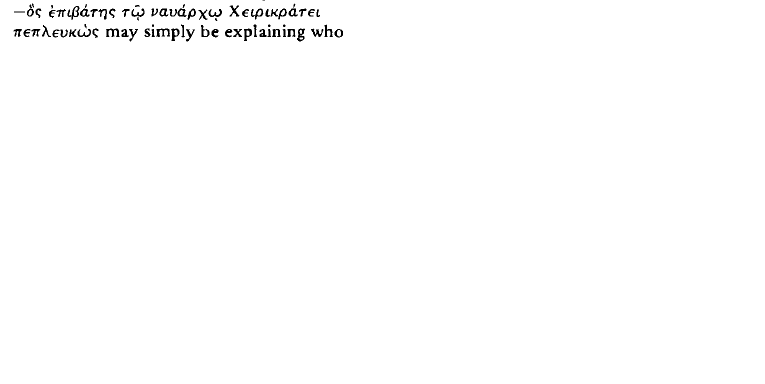 may simply be explaining who the man was and how he came to be in the Hellespont; it does not necessarily prove that Chiricrates was still nauarch. So Xenophon may well be right in his daring of the message which may well have been joined to the answer rejecting Tithraustes' proposal.
It has been suggested to me that the point of the Spartan government letting Agesilaus appoint the nauarch was to secure more effectively the action against Caria which had been demanded of Dercylidas (3.2.12). But such action is unlikely to have been required or expected of Agesilaus, since he proceeded with a quite different strategy.
25 Cf. Accame, Ricerche intorno alla guerra corinzia, 142.
26 For the opposition to the Peace alleged by Xen. Ages. 2.21, see above, note 11.
27 Most recently, de Ste Croix, op. cit., 161.
28 R. E. Smith, Historia 2 (1953–4), 277, n. 6 gives the history of the rejection. E. Zierke, Agesilaos, 50 f., is an honourable exception.
29 Cf. Plut. Ages. 23.10, where the form of Agesilaus' reply suggests that the offer was made either at the making of a peace or at some later date. ‘The Persian with Callias’ is therefore probably the representative of the King who swore the oaths in Sparta in 386 (Tod, GHI 118, 1.12, and cf. 7.1.39 for a Persian in the same role later). So perhaps when Antalcidas returned to operations in 387 (5.1.25), Callias remained to await the outcome and accompanied the King's representative to Sardis and then to Sparta. However, later negotiations of which we are not informed may have provided the occasion. Callias was in Asia with Agesilaus, perhaps as one of his thirty Spartiate counsellors (4.1.15, 3.4.2), but is not heard of elsewhere.
30 For instance, Ephorus referred to King Pausanias being expelled by the other royal house (FGH 70 F 118 ad fin.) but the notice of the trial and condemnation (3.5.25) gives no hint of this.
31 Ages. 26.3, Mor. 189 F, 213 F, 217 E, 227 C.
32 Plut. Art. 22.6 suggests that Antalcidas went on his final embassy when Agesilaus was in Egypt in 361 (an interesting divergence of policy, the one wooing, the other opposing the King).
33 Cf. E. Bickermann and J. Sykutris, Speusipps Brief an König Philipp (Berichte fiber die Verhandlungen der Sächsischen Akademie, Philol.-hist. Klasse 80, 1928).
34 It is to be noted that Speusippus used the imperfect in the cases of Agesilaus and Dionysius, the aorist of Alexander and Philip; there may have been a number of appeals to the former two.
35 Agesilaus had been on active service in 377 and an appeal two years later is conceivable even though he was by then seventy (cf. above, note 8), not that the practical consideration of the commander's age would have much concerned lsocrates.
36 Cf. 16.77.3.
37 Xenophon remarked on the seriousness of loss of the Paphlagonians (4.1.28), which really aborted the whole plan.
38 There was little novelty in Agesilaus' plan. There had been talk of anabasis in Herodotus' day. Cf. Hdt. 5.49 f., and 6.84.2, projects hardly conceivable before the Persian Wars.
39 For the place of the Anabasis in Xenophon's development, see Cawkwell, Introduction to Xenophon: The Persian Expedition (Penguin Classics 1972).
40 Cf. 1.76.2, and 144.2.
41 In view of the rivalry of Tegea and Mantinea in the fifth century (Thuc. 5.65.4, and cf. 4.134.1) one would expect Tegea to be as strong militarily as Mantinea and have walls, but the argument for a wall in the sixth century based on the city's surviving Spartan attacks (cf. F.E. Winter, Greek Fortifications, 30, n.60) is not very strong. Orchomenus had a wall in 418 B.C. (Thuc. 5.61.5); since when is unclear. Both fortifications may belong to Sparta's time of troubles in the 470s and 460s. If Strabo 337 is to be taken as meaning that Tegea as well as Mantinea was synoecized under Argive influence, a fifth-century date for the fortification of Tegea is preferable.
42 Cf. Diets, VS 88 B 6 ff. and 32 ff.
43 Cf. Tigerstedt, The Legend of Sparta in Classical Antiquity i.123 ff.
44 Phocion did the same (Plut. Phoc. 20.4).
45 One may note that Xenophon withhold the name of the polemarch in command of the division destroyed at the Pathos in Lechaeum (4.5.11 ff.), as too of the pole-march who performed so ineptly at the Isthmus in 369 (7.1.17).
46 Cf. R.P. Legon, ‘Phliasian politics and policy in the early fourth century’ Historia 16 (1967), 324 ff.
47 Diod. 11.54.1 and Strabo 336 for Elis The case of Mantinea is more arguable. Cf. Andrewes on Thuc. 5.47.
48 3.2.27 has been taken to mean that Elis had no walls in the late fifth century, but Diodorus' account of the war contains mention of a siege (14.17.10 f.) and Pausanias' account of the settlement (3.8.5) includes destruction of the wall of the lower city ( ), and in Xenophon's account Agis' unwillingness to take the city
 which was unwalled is hard to reconcile both with his aim in the war and with his damaging buildings outside the
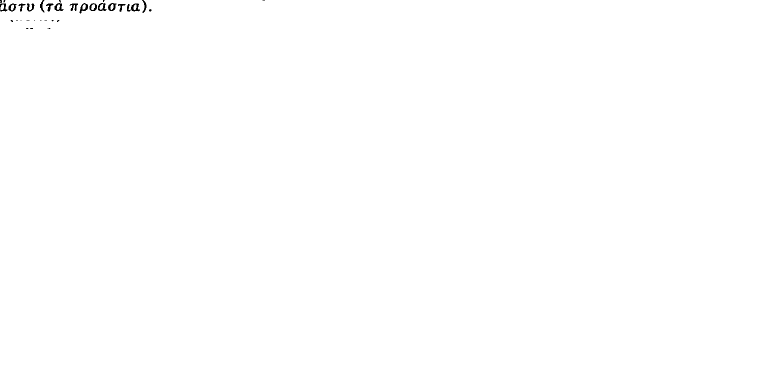 . The explanation is that by
 Xenophon means the Acropolis unwalled and by ancient custom inviolable, and that the
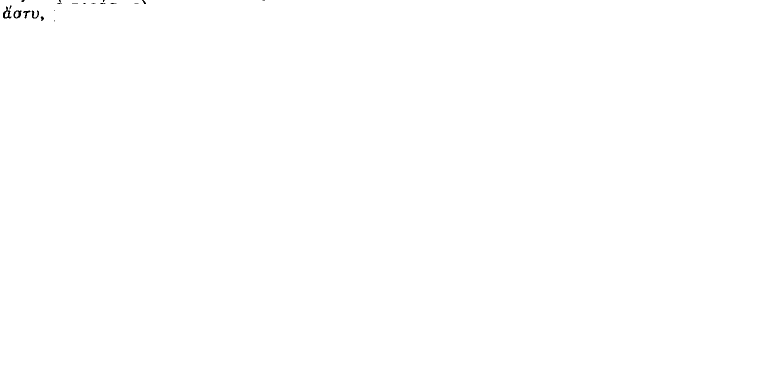 ), which he mentions in § 26, was walled. Cf. the distinction of
 and
 at 7.4.14 f. (One should not forget that the text of 3.2.30 is amended, not necessarily correctly;
 of the manuscripts could be the object of
 the clause about the destruction of
 refer to Elis itself.)
49 3.2.21 f., 30, Diod. 14.17.4 f., Thuc. 5.31 and 49, Hdt. 4.148.4, Str., p. 355.
50 It is characteristic of Xenophon to leave us uninformed about the events alluded to in 5.2.2. Down to (and including) 392 Argos escaped ravaging (cf. 4.4.1, Andoc. 3.27). In 391 Agesilaus ravaged ‘the whole of their land’ (4.4.19). So perhaps the corn was sent then, as well as in 388 (4.7.5). The refusal to join in campaign on the excuse of truce ( ) may relate to 388 when Agesipolis took the trouble to get divine approval for disregarding the proffered sacred truce, but Xenophon makes no mention of this in his fairly full account of that campaign (4.7.2–7) and the suspicion arises that when in 391 Agesilaus ravaged he too disregarded the proffered sacred truce but on his own initiative; hence the elaborate consultations of Agesipolis in 388, and the surprising brevity of Xenophon about the campaign of 391 (4.4.19)—a ‘cover-up’. The reluctance to serve perhaps relates in part to the Nemea campaign of 394; it is curious that the Spartans are said to have taken the Tegeans and the Mantineans north with them but neither is listed in the order of battle (4.2.13 and 16).
51 The almost total discrepancy between Xenophon's account of the Elean War and the Ephoran version in Diodorus 14.17 can-not be satisfactorily explained. E. Meyer, Theopomps Hellenika, 115 f., may have been right to suppose that both accounts are correct as far as they go, although his argument is unsound, viz, that they cannot be synchronized since a law forbade both kings to be on campaign at the same time (cf. Hdt. 5.75.2, and the Phliasians' presumption that they were safe from Agesilaus when Agesipolis went north 5.3.10). Pausanias had gone to Haliartus when Agesilaus was in Asia (and cf. Thuc. 5.75.1), and the law was designed to prevent divided command of the same expedition. So Pausanias and Agis can well have attacked Elis from different directions, and Xenophon have concentrated on what he heard from Agesilaus and omitted the important part played by Pausanias. At any rate such scepticism about Xenophon can be at least entertained. His account of Agesilaus' campaign up the Hermus in 395 would be a parallel. However, there is much to be said for supposing that Diodorus has simply mixed up the names. Cf. the manuscripts at 14.17.4.
52 Cf. art. cit. above, note 46.
53 Diod. 15.40, generally conceded to go with the preceding two chapters and to be wrongly inserted by Diodorus under 375/4.
54 Cf. 7. 1.40 and 7.2.2.
55 Xendphon is not explicit, but the words  at 7.1.28 shows that the allies were in council somewhere else, which presumably was Corinth.
56 The ‘outsiders’ included in the King's Peace appear to be listed in Arist. Panath. 172 and Amyntas is not one. Cf. Cawkwell, CQ, N.S. 23 (1973), n.3.
57 Cf. art. cit. in note 56.
58 Diodorus' ordering of the commanders differs from that of Xenophon. Diodorus (15.20.3) has Eudamidas replace Phoebidas, who is made to command the force of over 10,000 sent in response to Amyntas' appeal (15.19.3); Xenophon has Eudamidas command the small force requested by the Acanthians (5.2.23) to be sent in advance of the large force ( ) under the command of Teleutias (5.2.37), and he makes Phoebidas command, on the request of Eudamidas, a part of the advance force Eudamidas had had to leave behind (5.2.24). No doubt Diodorus epitomized carelessly in making Phoebidas take the 10,000; at 15.21.1 Teleutias is put in command of ‘a considerabl force’ (the same phrase having been used at 15.19.3), and it is wholly unlikely that Ephorus had two large forces sent out against Olynthus in the space of a few months. But can Diodorus' ordering of the commanders be right? Possibly. Xenophon does not say what happened to Phoebidas or who replaced him, but it is surprising that the advance force of 2,000, which was entirely from within the borders of Sparta (5.2.24), is split in two parts. I at any rate incline to accepting the Ephoran order.
59 Teleutias was a step-brother (4.4.19 with Plut. Ages. 21.1). Eudamidas, brother of Phoebidas (5.2.24), is the name of two later Eurypontid kings (cf. PW vi. 892). Of course the mother of Eudamidas I, the wife of Archidamos III, may have been the daughter of our Eudamidas, and imported the name to the Eurypontids.
60 Agesipolis went out in time to damage the corn-crop and died in high summer (5.3.18 f.). So Polybiades was sent out under the same board of ephors, and his appointment perhaps reflects their influence even if they did not have the power to nominate.
61 Cf. Athen. 550 D (prosecution of Nauclidas by Lysander for being over-weight).
62 Cf. CQ, N.S. 22 (1972), 263.
63 Cf. F. W. Walbank, Polybius (1972), 79, n. 72.
64 Cf. A. Andrewes, Phoenix 25 (1971), 217 ff. for such fears in the prelude to the Corinthian War.
65 Cf. 6.4.27 and PW ix. 21.
66 Cf. N.G.L. Hammond, History of Greece, Appendix 6.
67 It is to be presumed that the force sent in 375 (6.1.1) had returned in that year after the Peace.
68 According to W.G. Forrest, A History of Sparta, 134, ‘there can be no doubt that Xenophon in the Lak. Pol. believes that he is writing about a purely Spartan army, not an army contaminated with perioikoi.’ Ch.12.5  argues otherwise:
 only occurs in the chapters concerning the army apart from the official title of the Kings (15.9) and the reference to harmosts (14.2)—and it is well known that there were non-Spartiate harmosts; earlier,
 is found. A further argument derives from 11.6, where the distinction between those who lead and those who follow is readily discernible; presumably he is talking about Spartiates and non-Spartiates, not just fitter and less-fit Spartiates.
69 In the army of the so-called morai (divisions) there were six of hoplites and six of cavalry (Xen. Resp. Lac. 11.4) and we meet a cavalry division at 3.3.10. There was also the so-called hippeis who formed the royal bodyguard in battle and fought on foot (Thuc. 5.72.4, Hdt. 8.124.3, Xen. Resp. Lac. 4.3).
70 Cf. V. Ehrenberg, PW iii A. 1407 f. Aristotle, Pol. 1333b11 ff. alludes to ‘those who wrote’ about the constitution. He may have had in mind partly such writers as Critias (see above, note 42) and Xenophon (Diog. Laert. 2.57), and such treatises as the Resp, Lac. preserved in the Xenophontic corpus, but there may have been a number of Spartans engaged in such theorizing when they were in exile. He mentions a Thibron who is probably (cf. PW vi A. 275) the man whom we meet in Xenophon's Hellenica, and who was exiled for most of the 390s (3.1.8 and 4.8.17). He does not say here anything, as one would dearly wish he had, of the treatise of King Pausanias (Ephorus F 118), composed in exile (1333b34 seems to fit better Pausanias the regent—cf. 1307a4) However, 1301b20 speaks of him trying to destroy the ephorate, and since there is nothing we know of his reign which would justify such a remark, Aristotle may be alluding to the argument of his treatise. Such speculation even by Spartiates would not be surprising, in an age when Spartan society was changing greatly with the new military role of the helotry and the institution of neodamodeis, the intrusion of coinage, albeit still denied to individuals, and the effect of experience outside Sparta in the service of empire.
71 The Ephoran version (Diod. 14.13, Plut. Lys. 30.4) envisaged the opening of the kingship to all Spartiates; another restricted it to certain families (Plut. Lys. 24–6). Xenophon kept a poker face (3.3.3). Nothing happened in Lysander–s lifetime; the reform was known about only from reports of a speech, allegedly composed for him and found in his house. But, if Lysander had never in fact had such a proposal in mind, someone had conceived it, even if only to shock Sparta and discredit Lysander.
- 22
- Cited by