


 cf. Strabo 1. 1. 1 and 1. 3. 13 e.g. in zetemata.

 Similarly Clearchus in the first book of his Erotika (fr. 24 W2) gave a whole list of possible explanations why lovers wore wreaths. Even the first book of Strabo is largely filled with a rambling discussion of a zetema based on Odyssey 1. 24. We are not surprised, therefore, to learn that μακρoλoγíα belongs rather to a syggramma than to a hypomnema (Galen cited by
 λύσεις e gli ύπoμυήμ;ατα’; but I do not think a definite answer will ever be attainable. An incomplete list is given by Gudeman RE s.v. Scholien 628 of similar syggrammata.
 , he took up a position and placed a diple
 ’ But it is not justifiable to argue, as Gudeman and others have done, that since Aristarchus condemns the frivolity of the zetemata of others, he therefore disliked the concept itself. This condemnation takes the form e.g. of allegations that some grammarian has inserted a line to create a zetema (examples collected by
 - a problem as old as Aristotle -, we ought to feel the joy of the scholar in full cry after a zetema. That his questions were not as futile as e.g. those of Zoilus is no reason to say with Pfeiffer (op. cit. 263) that he had no interest in zetemata at all. Ludwich, Homervulgata, p. 168 alleged that Aristarchus distanced himself as far as possible from zetemata, quoting Lehrs, op. cit. 197, who however says the opposite, viz. that such things are to be found in Aristarchus; Ludwich himself elsewhere admitted this (A. H. T. I, p. 30 n. 40, contrast n, p. 190).
 .
 and continues

 The peripatetic methodology behind zetemata and their solutions is explored by
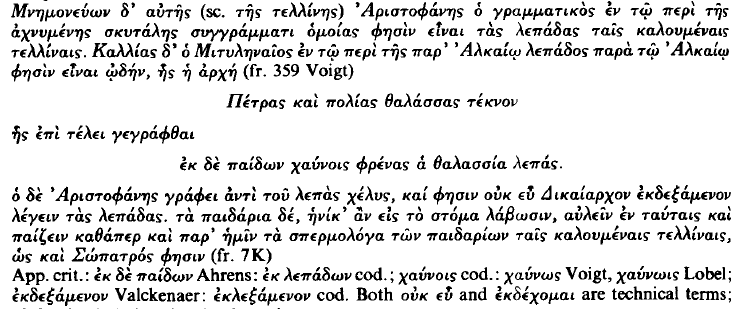
 Athenaeus 4. 177a (from Juba)
 Hesych s.v. σκυτ⋯λια αὐλíδια Cf.


 becomes
 p. 127,9–10L, and Aristophanes keeps the feminine in the epitome until he comes to 611b 26, where Aristotle is once again speaking of does. From H.A. 611 a30 to 611 b20 Aristotle is speaking of the growth of horns on the male, from which Aristophanes has preserved two sentences 127. 12–15L, in which he has altered the original to the feminine. But most revealing is the one passage where Aristotle in an aside says (H.A. 611a25):

 (Zenob. 2.22 = ps.-Zenob. 5.52)
 Aristophanes conceals the fact that Aristotle is speaking exceptionally of a proverb, and alters the order of epitomization so that he can say:


 in connection with Aristophanes. At 21. 130 Aristophanes himself accuses unnamed sources of interpolating lines to solve a zetema, of which we now have no trace!
 are unfortunately not good evidence for omission in actual Homeric texts, as is sometimes thought (Fowler, ZPE 33 (1979), 21 n. 17), for no careful distinction was made in the use of
 to denote whether a text or critical commentary was intended (
 must mean that in Epicurus' day the symposium was the first place to find
 Plutarch goes on after quoting these passages (Mor. 1095e):

 i.e. turning a serious question into a frivolous rhetorical exercise; cf. Aphthonius, Progymnasmata 50. 1 Spengel:


Crossref Citations

This article has been cited by the following publications. This list is generated based on data provided by Crossref.
Jacob, Christian
2005.
« La table et le cercle » Sociabilités savantes sous l’Empire romain.
Annales. Histoire, Sciences Sociales,
Vol. 60,
Issue. 3,
p.
507.
Erto, Maurizio
2011.
Il verbo *metagraphw* e il concetto greco di 'traduzione'.
Glotta,
Vol. 87,
Issue. 1-4,
p.
58.
Schironi, Francesca
2011.
The Homer Encyclopedia.
2012.
Vesperini, Pierre
2018.
Quand les savants modernes font l’histoire des savoirs antiques : problèmes de méthode.
Archimède. Archéologie et histoire ancienne,
Vol. HS1,
Issue. ,
p.
82.
Currie, Bruno
2021.
Intertextuality in Early Greek Poetry: The Special Case of Epinician.
Trends in Classics,
Vol. 13,
Issue. 2,
p.
289.