


 A. Ag. 533,
 Soph. Ai. 579,
 Soph. O.C. 730,
 Soph. O.C. 103. In none of these cases can it be convincingly shown that the poet is consciously employing theatrical terminology meant to be understood as such by the audience.
 , Eur. El. 907, Eur. Phoen. 751
 A. Sept. 375–652, Eur. Het. 1056
 (?) Soph. El. On this topic see
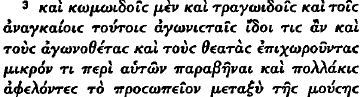
 . It is difficult to be certain of the meaning of

 but I cannot see much point in the translation offered by Sifakis (op. cit. 64), ’the performers necessary to them’. Aristides is surely being sarcastic as befits a holder of the Isocratean belief that all other literature must take second place to epideictic oratory (and also of the view shared by Plato and Isocrates that Comedy is
 see speech 40 Dindorf
 Keil is more apposite when he comments
 qui non boni sunt sed Aristidis aequalium inscitiae et insulsitati necessarii’. I take it from this that he takes
 as ’these, the ones you know about’ rather than ’to them’. (Jebb translates ’atque ills necessariis athlefis’.) Compare Hermogenes, de id. 2. 226 (p. 249.5 Rabe)

 VcAc)

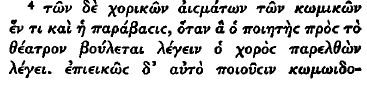

 A. Trendelenburg, Grammaticorum Graecorum de arte tragica iudicioturn reliquiae (Dim. Bonn, 1867), 56 ff., and
 asserts ‘in speaking of themselves as a chorus they step out of the play into the contemporary world’ (G.
 R. xiii [1966], 46 = The Ancient Concept of Progress, 75) and goes on to argue from this that the real speaker is here the poet. But in neither case is it necessary to believe that the sentiments expressed are inappropriate for a collection of Theban old men and peculiarly appropriate to an Athenian poet. The aspects of the odes which seem to remove us from the imagined heroic age and place us firmly in the world of Athenian dramatic competitions,

 Eur H.F. 677 f.,

 ibid. 686, and
 Soph. O. T. 896, are not on closer inspection out of place in their dramatic context. Garlands are after all the appurtenance to any kind of celebration in the ancient world and so is dancing, and the H.F. chorus has reason to celebrate. It may strike people as absurd that a group of old men should describe themselves as dancing or contemplate that activity, but it happens quite often in Tragedy where there is no question of the poet using the chorus as a vehicle, e.g. Soph. Ant. 152–3, Eur. Hcld. 892 (for a collection of passages where choruses refer to themselves as dancing see M. Kaimio, The Chorus of Greek Drama within the light of the Person and Number Used [Commentationes Humanarum Litteranan, 46],119. On the H.F. ode see the excellent article by
 (N.B.

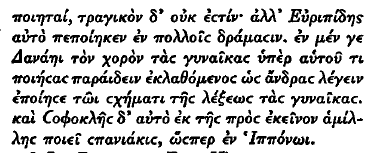
 We are no more justified in believing that in Hipponous there was a passage in which Sophocles sought to refute some statement made in a Euripidean chorus than in believing, as was once believed, that Sophocles like Euripides became confused about the sex of his chorus. Welcker (Griechische Tragödie, 429) rightly rejected the latter view, but he propounded the first and was followed by Pearson in his edition of the Sophocles fragments.
 (It is a pity we do not know more about Douris'
 F.Gr.H. 76, fr. 29 [see Leo, Grtechische-römische Biographie, 105] and Heraclides Ponticus'

 fr. 180 Wehrli. Even if they were not
 the form of their titles does suggest that there was at least an element of comparison contained in them). It is interesting to note that the motif common to Pollux 4. III and ΣSoph. O.T. 264 (see above) is found also in the Plutarchean Comparatio Menandri et Aristophanis (Plut. Mor. 853. 1)
 No
 is traceable back beyond the fourth century B.C. (see
 as a literary form already existed in the sophistic era (see
 as a source for the contest in Aristophanes' Frogs (see
 ,
 might be ad spectatores is unfortunate. Teucer is surely addressing the chorus after turning angrily away from his interlocutor. Soph. O.C. 1348 is exactly parallel.
 in Eur. Hel. 22–3 indicates that the speech is ad spectatores. For characters alone on stage admitting that they are speaking, cf. Aesch. Earn. 43 ff.; Soph. Tr. 21 ff.; Eur. Hipp. 9; I.T. 37, 43 (where the character claims to be speaking to the aither); Phoen. 43; Or. 14–15, 26–8; Telephus fr. 102, 8 Austin, Melanippe Sophe p. 26 von Arnim, 11–12, Phrixus fr. 819N. (cf. also Aesch, Sept. 658, where Eteocles is soliloquizing).

 and see Elsperger, op. cit., 153 ff
 (fr. 560N.) was prefaced by something like ‘O foolish men!’


 I am incline to see the same practice in Men. Dysc. 746 Sandbach ad loc. takes it as audience address.
 used by Dicaeopoli when presumably addressing the audience a Ar. Ach. 12 see

 that the speaker is not addressing the audience. ‘Spectate’ in Ter. Ands. 231 might be a parallel. Plaut. Stith. 410 is different (see above, p. 19).

 5 There are parallels in Sophocles and Euripides for phrases attested in the dialogue of Comedy or Plato appearing in a slightly different, and one is tempted to think, more elevated form. For example Soph. Phil. 1260 seems to allude to the more colloquial expression
 (you will do this) and Eur. Med. 472 to echo but not reproduce the phrase
 See


 (ons would be more sympathetic towards grant ing such an effect for a line like Eur Erectheus fr. 65. 78 Austin). In O.T. the trans formation the audience is supposed to make is particularly remarkable. They must become not merely the citizen body of Thebes, but an unrepresentative collectios out of that citizen body (17 ff.). The effec produced by 78 and 91 would also be very strange if we had to take
 ana
 as references to the audience.

 This ending is sometimes appended to other plays, and Barrett on Eur. Hipp. 1462–6 doubts its authenticity.
 might be taken as an aside and as such addressed to the audience (although this does not necessarily follow). I think it misleading, however, to describe such exasperated comments about an interlocutor delivered in the third person (cf. Soph. Ant. 740, Eur. Hipp. 1038) as asides. Only in cases where the speaker is trying to conceal his reaction is the term appropriate. Clearly this is not the case here and in any case it is clear from what follows that the satyrs hear the remark (
 ; (in this case the visit is to a king's court to seek his daughter's hand).
 .
 in what is obviously a dramatic context, the word
 is disruptive of the illusion. The tragic poets when they wanted to refer to poetry described it as song. The word occurs only once in Tragedy (the second reference in Allen-Italie should be deleted:it depends on a misunderstanding of an entry in the Berlin Photius [Phot. Berolin. 139.14 = Eur. fr. 955g Snell]. The right word
 is in Collard's supplement to Allen-Italie). This is in the famous and often quoted Stheneboia fragment (Eur. fr. 663N.)
 /
 . I suspect that Plutarch's quotation Plut. Amat. 762 b may not faithfully reproduce what Euripides wrote (I do not think that
 in Plut. Symp. 622 c is what he wrote either—this is not really a variant, rather a deliberate alteration of the quotation) and that
 is due to the paraphrase of the line found in Plato Symp. 196 e (on the various allusions to the lines in antiquity see E. Stemplinger, op. cit., 249).

 was called by some the satyricum and because Old Comedy employed in addition to priapea related tetrameter lines of which the eupolidean was one, it is reasonable to suppose that Satyr-drama would have used the eupolidean. This is mere speculation but it would be arbitrary when we have so little of Satyr-drama to exclude any particular type of line or metrical pattern.
 …
 so that it stood after

 and governed

 . In that case Astydamas' Heracles Satyricus would be adduced as evidence for Heracles'
 , and we would be free to guess about the attribution of the decorative quotation that begins the book. The transposition certainly gives a clearer sequence of thought and stylistically smoother opening to the book. (Casaubon also integrated the opening quotation more closely into the next by inserting
 between
 and
 and taking
 …
 closely in conjunction with
 . One might note, however, that the opening of book II is a parallel for the way book 10 opens and might be thought to defend it against emendation.)

Crossref Citations

This article has been cited by the following publications. This list is generated based on data provided by Crossref.
Muecke, Frances
1977.
Playing with the Play: Theatrical Self-consciousness in Aristophanes.
Antichthon,
Vol. 11,
Issue. ,
p.
52.
Stinton, T. C. W.
1977.
Notes on Greek tragedy, II.
The Journal of Hellenic Studies,
Vol. 97,
Issue. ,
p.
127.
Macleod, C. W.
1982.
Politics and theOresteia.
The Journal of Hellenic Studies,
Vol. 102,
Issue. ,
p.
124.
Taplin, Oliver
1986.
Fifth-century tragedy and Comedy: Asynkrisis.
The Journal of Hellenic Studies,
Vol. 106,
Issue. ,
p.
163.
Totaro, Piero
1999.
Le seconde parabasi di Aristofane.
p.
1.
Carter, D. M.
2010.
The demos in Greek tragedy.
The Cambridge Classical Journal,
Vol. 56,
Issue. ,
p.
47.
2013.
The Encyclopedia of Greek Tragedy.
p.
1185.
Bastin-Hammou, Malika
2013.
Le Savoir public.
p.
83.
2013.
The Encyclopedia of Greek Tragedy.
p.
178.
2015.
Finglass, P. J.
2018.
Sophocles: <I>Oedipus the King</I>.
2018.
Tzoref, Shani
2020.
The songs of Miriam, Deborah, Hannah, and Rebecca (Bunch).
Journal of Modern Jewish Studies,
Vol. 19,
Issue. 1,
p.
6.
Farmer, Matthew
2020.
Choral Disrobing in Aristophanes.
Illinois Classical Studies,
Vol. 45,
Issue. 2,
p.
424.
Krämer, Benedikt
2025.
Sophokleisches Spiel im Spiel als Reflexionsmedium des Mitleidsaffekts.
Philologus,
Vol. 169,
Issue. 2,
p.
155.