



 and 37 (defence of the Gates).
 v (1959), 109. For a dis cussion of this attempt to rearrange the whole chronology see Appendix II.

 (16. 43. 1 under 351).
 .

 .

 (

 and, as
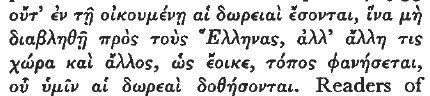 Isocrates understood.
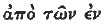
 came to support

 , repeated in the Fourth Philippic (§ 64), at 9. 27 Demosthenes speaks as if Thebes as well as Athens was menaced by the ‘tyrannies’ in Euboea.
 in the Letter of Philip) was not successful, for there are no signs in 339/8 that Persia was obliged by
 to help Athens. No doubt, after the rebuff of 344/3 the Great King was in the mood which he subsequently displayed in the letter to the
 alluded to in
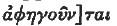
 his Commentary on Androtion (p. 90, 11. 22 f.) has a great deal to say about the Panhellenism of Androtion, all resting on this supplement. Is it the right one ?
 is hardly the word one would expect to find in a literary source: for
 it is inept; for mere proposal
 would be the historian's word. The supplement has in fact found favour for want of a better. I suggest as no worse at any rate
 …] or
 …], the former being two letters longer, the latter one, than the supplement of Diels which is itself one letter short of the possible (to judge by the copy of the papyrus on p. 34 of Diels-Schubart, Didymus). In any case, there is no need to seek for an explanation of why Didymus quoted Philochorus rather than Androtion or Anaximenes: Philochorus was here suitably brief, and Didymus constantly preferred him.

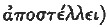 .

 Hegesippus spoke here as if it was Athens who had proposed it, but see §§ 18 and 26.
 would be far too strong a word. So I much prefer Mr. Griffith's suggestion, which goes beyond the similar explanation of the passage by Croiset (in the
 in late 347/6. If this were right, Artaxerxes need not have subsequently asked whether Athens kept her
 .

Crossref Citations

This article has been cited by the following publications. This list is generated based on data provided by Crossref.
Osborne, Michael J.
1971.
Athens and Orontes.
The Annual of the British School at Athens,
Vol. 66,
Issue. ,
p.
297.
Markle III, M.M.
1981.
Demosthenes’ Second Philippic: A Valid Policy for the Athenians against Philip.
Antichthon,
Vol. 15,
Issue. ,
p.
62.
Lewis, D. M.
Boardman, John
Hornblower, Simon
and
Ostwald, M.
1994.
The Cambridge Ancient History.
Radicke, Jan
1995.
Die Rede des Demosthenes für die Freiheit der Rhodier.
p.
33.
Burke, Edmund M.
2002.
The Early Political Speeches of Demosthenes: Elite Bias in the Response to Economic Crisis.
Classical Antiquity,
Vol. 21,
Issue. 2,
p.
165.
ALLEN, KATARZYNA HAGEMAJER
2003.
Intercultural Exchanges in Fourth-Century Attic Decrees.
Classical Antiquity,
Vol. 22,
Issue. 2,
p.
199.
2012.
Why Plato Wrote.
p.
206.
2014.
2015.
2018.
2020.
2021.
Worthington, Ian
2026.
Macedonia under the Argead Kings.