




No CrossRef data available.
Article contents
Enniana VI
Published online by Cambridge University Press: 11 February 2009
Extract
When a poet's work survives only in fragments our judgement of its merit is bound to be strongly influenced by the arrangement given to the fragments by their editors. And yet some superficial indication of the subject-matter is not infrequently seized upon as though it were a sound basis for so responsible an operation, and horror uacui proving stronger than amor ueri, stronger even than desiderium noua docendi, the ill-founded solution is passed on from one edition to the next although it may be wholly out of character with the author's style and may make a great poet appear a wretched hack. An example of this was given in C.Q. N.S. X (1960), 188 f., where the traditional attribution of a commonplace statement to a speech which called for the very opposite of a commonplace was shown to be mistaken. The standard interpretation of the fragment to be discussed here is no less striking as an instance of injustice done to the poet, even more liable to expose him to ridicule, and perhaps of wider interest as a specimen of stylistic indications unduly neglected.
Information
- Type
- Research Article
- Information
- Copyright
- Copyright © The Classical Association 1964
References
page 86 note 1 Apul. de deo Socr. 2 est aliud deorum genus … quorum in numero sunt Mi duodecim numero situ nominum in duo uersus ab Ennio coartati ‘Iuno … Apollo’. Here numero situ is not unsatisfactorily emended to numero(so) situ but coartati suggests nudo situ (or nudo positu), corrupted perhaps through the influence of the preceding numero; i.e. nominibus nud, positis.
page 86 note 2 Ennius, Q., p. 155.Google Scholar Müller adds ‘Ver muthlich stand jenes Fragment am Endedes 15. Buches’, and so he places it in the edition, without a word of explanation in the commentary.
page 87 note 1 Laistner, W. M., Thought and Letters in Western Europe 2, 1957, p. 195.Google Scholar
page 87 note 2 Castiglioni's retroque, based on Lucretius 5. 269 (see below), is impossible also because for Ennius retro is an iamb; see below, pp. 92 f.
page 88 note 1 It was accepted by Havet, L., Rev. de Phil., xv (1891), 71.Google Scholar
page 89 note 1 Zillinger, W., Cicero u. d. altröm. Dichter, Diss. Erl. 1911, p. 77.Google Scholar
page 90 note 1 L. Müller attributed the words to Ennius. Largely because of his hostility to Mommsen and the Berlin school, he was never sufficiently appreciated in Germany, but it cannot be denied that he occasionally showed an astonishing lack of taste and judgement.
page 91 note 1 I am indebted to Professor Bagnani for stressing this point in a Seminar discussion held at Toronto in February 1963.
page 92 note 1 Greek words: Cyclopis; 323 lychnorum (quoted by Macrobius as a parallel to Virgil's lychni, Aen. 1. 726, and described as a uerbum Graecum; note, however, that the line may have had a third trochee caesura); 365 petrisgue (but the line is almost certainly corrupt, and emendation may incidentally restore a short syllable). Metrical lengdiening: 221 sacrificare (cf. Hedyph. 38 apriculum).
page 93 note 1 I pass over 577 In the compound (it cannot occur internally otherwise) fr is treated like other mute and liquid groups
 In an initial position Ennius, having no analogy to it in Greek, seems, if this example is reliable, to have treated f like s. Initial s plus consonant, he decreed, should lengthen a preceding open final: a decision largely disregarded by later poets; see C.Q. N.s. x (1960), 197,Google Scholar n. 5. Havet's, L. idea (Rev. de Phil. xv [1891], 67) that populea is an ablative belonging to Ausonius and that only fruns is
 Ennius fails to convince.Google Scholar
page 93 note 2 In 358 Marx scans (e) I should prefer

page 93 note 3 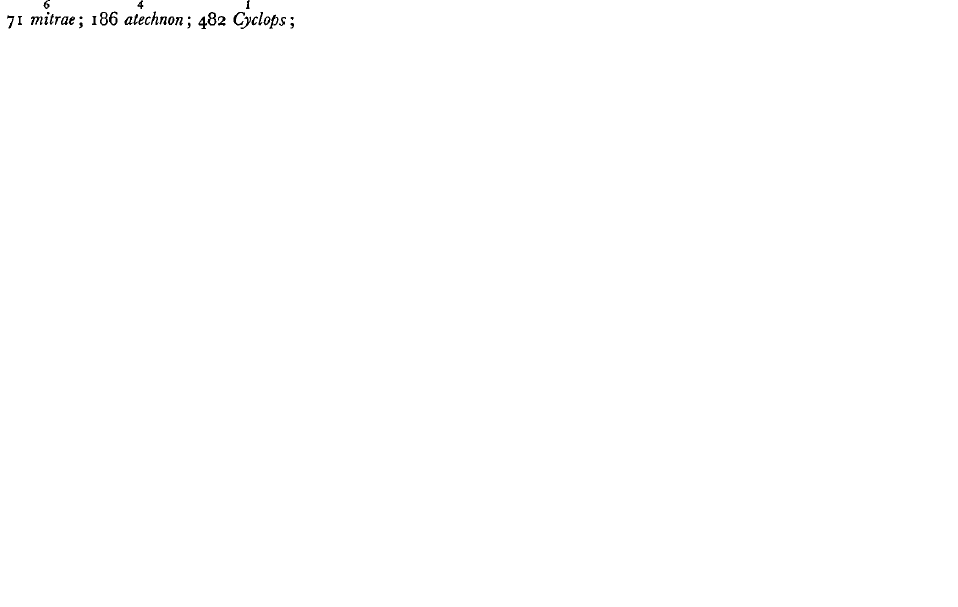 497
 discounted as Greek words, 379 semigraeci as a case of metrical necessity.
page 93 note 4 Here the total of lines, whether whole or fragmentary, is set against the total of Lucilius' hexameters.
- 2
- Cited by