


 in Aristotle's Poetics, ch. 13 means ‘mistake of fact’. The moralizing interpretation favoured by our Victorian forebears and their continental counterparts was one of the many misunderstandings fostered by their moralistic society, and in our own enlightened erais revealed as an aberration. In challenging this orthodoxy I am not moved by any particular enthusiasm for Victoriana, nor do I want to revive the view that
 means simply ‘moral flaw’ or ‘morally wrong action’. I shall try to show that the word has a range of applications, from ‘ignorance of fact’ at one end to ‘moral defect’, ‘moral error’, at the other, and that the modern orthodoxy, though not as clearly wrong as the moralizing interpretation it displaced, restricts Aristotle's meaning in a way he did not intend, and does lessthan justice to his analysis of classical drama.
 in the widest possible sense and explains why, he is constantly criticized for restricting it to the moral sense);
 .
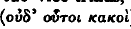 in which the extreme
 are not called
 because they are not particularly harmful in their effects, cf. 1123a31–3.
 . The point is that he sometimes uses the same language to cover both types of situation (cf. p. 226).
 to mean ‘come to be reckoned as’, ‘count as’, rather than ‘become’ (causal); but the causal interpretation is possible, and the argument is not affected. (Cf. 1108a5 for a similar ambiguity.)
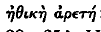 : cf. E.N. 6. 12–13, esp. 1144a8, 20, 35; 1145a5. (
 is often in fact not morally neutral: it means ‘culpable ignorance’, ‘stupidity’, as opposed to plain ignorance,
 . Cf. E. H.F. 347, and Wilamowitz's note.)
 , but the point is well taken, since he describes their agents as
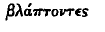
 .
 (coincidences, etc., which are in principle unpredictable, Phys. B. 5–6). In E.N. 5. 8,
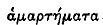 are distinguished from
 in that the
 is within the agent, not outside, as it is if the consequence of his act is unpredictable (see p. 226, and p. 232 with n. t). So here: the fall from prosperity must manifestly result from some action.
 the elements fire and water, which are
 for him but not for Anaxagoras (Met. 984a14, where see Ross).
 by ‘intentional’,
 by ‘not intended’, as being more in accordance with English usage than the traditional ‘voluntary’, ‘involuntary’, ‘non-voluntary’. This translation will not always work, and I am forced to abandon it in the discussion of E.E. 2. 8 (pp. 239–40); nor does it work throughout in E.N. 3. I, where Aristotle debates whether a wrong act done by one acting
 is

 : such an act could not be ‘intentional’. In fact no pair of meaningful terms can be found to correspond exactly to
 and
 , because Aristotle's various criteria for distinguishing between them cannot always be consistently applied. (I owe this point to Professor Ackrill.)
 is read for
 ; the whole em phasis being on
 (cf. Rhet 1374b7). M. Schofield has, however, arguer (P.C.P.S. N.S. xix [1973], 66–70) that Aristotle is not here primarily concernec with negligence, but with unintended act: for which the agent cannot plead in excuse mischances outside his control; he adopt: Burnet's rendering, ‘when the charge (i.e the charge against him) originates in him’. (For this view, cf. Rhet. ad Alex. 1427a34–6.) The interpretation of Joachim-Rees, ‘the origin of the cause of the act qua injurious is within him’ (presumably with a similar emphasis) seems to me very difficult. The point does not affect my argument.

 …

 cf. 1145a10 ff. and 7. 5 on the
 (see Glanville, op. cit. [p. 221 n. 3], 49 nn. 5 and 8).
 here is precluded by Aristotle's list of suitable men’ (cf. pp. 226–8 above). She includes the whole range of apapria in E.N.: a mistake in the practical syllogism; wrong acts due to some kinds of
 ; and any act ‘not

 ’, cl. 1115b15, 1119a34. Dawe describes Glanville's article as ‘an interesting and valuable complement to Hey's discussion’ (90 n. 1). Since Glanville's views for the most part run counter to Hey's, perhaps ‘corrective’ would be a better word than ‘complement’.
 made against this: that although a misdeed, as well as a mistake, could be called

 meaning ‘momentous’ (in its consequences), the same phrase applied to a flaw of character or disposition must mean a serious defect in the character per se, not only serious for its consequences (so M. E. Hubbard, Ancient Literary Criticism [ed. D. A. Russell and M. Winterbottom], 1972, 107 n.). But this would be wrong. A machine can have a defect which is at the same time serious (in its consequences), in that it may be dangerous, and slight, in that it is easily remedied or does not seriously impair the machine's functioning. So a relatively slight defect of character in a man, such as hastiness or irritability, may have grave consequences (through hasty decisions, etc.), and this would be properly termed
 .
 , as well as by the equivalent expression,

 ’, Twining; so most modern editors.
 is a painful feeling caused by the spectacle of undeserved suffering (other factors may contribute, but this one is necessary).
 , its counterpart, is a painful feeling caused by undeserved prosperity (which in Po. 13 is called
 ). Both situations are unjust, and this is what disturbs us (Rhet. 2. 8–9). Excessively unjust suffering so disturbs us that we feel not pity but moral outrage. A situation is
 if it satisfies our moral sense: deserved suffering or deserved prosperity. (That
 is connected with ‘moral sentiment’ was rightly seen by Twining [ed.2, 1812, ii. 104–6] cf.
 means more generally sympathy with, compassion for one's fellow men. Pohlenz's attempt to mediate between these senses [
 in the fifth century (cf. Schadewaldt, op. cit., 141; Adkins, op. cit., 91–5), and possibly also in Aristotle, though here the moral element is necessary and predominant.
 by
 in its limitation by
 : although we tend to pity those who are like us (Rhet. 1386a24), we do not pity the suffering of those who are closely related to us (
 ), but find it terrible and are shocked by it (
 ), though no doubt traditional
 was needed to give it effect (235).) At Ag. 1526 (if Page is right to keep the paradosis) Iphigeneia merits pity because she did not deserve what Agamemnon did to her; he merits none because he deserved what he got. Antigone is
 in her death (S. Ant. 694) not because of her status, but because she does not deserve to die—rather she deserves a reward (699):
 ;
 show that the
 (i.e.
 ) in 223 refers to the decision, not the act (Dawe, 110)—they imply merely that the act was wicked, deliberate, and harmful in its consequences. Of course in Aristotelian terms the deliberation is part of the action, but Aeschylus' account need not be so precisely analytical.
 cannot then be dismissed as an excuse, and her confession cannot technically be faulted, though it is still a wrong choice in a conflict of duties. So even if the wrong choice is due to weakness, it will not be a case of
 , properly so called.
 ) are not in control or themselves: it was not within their own power to say or do what they said or did’ (cf. 233) Madness, epilepsy, etc., are regarded Aristotle in E.N. as a special kind of
 (
 or
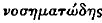 ) to which the normal terms of moral action do no directly apply (cf. 7. 5, esp. 1149a9–20). a court of law the plea ‘I was sent mad a god’ would doubtless not have carrie much weight, since its truth could alway be denied, or the divine visitation ascribe to some sin (see
 .)
 offered by Ajax or Hippolytus: ‘this is not the same as the justice of Zeus.’ Bur Odysseus survives, and the blinding of tin Cyclops is no subject for serious drama while Ajax and Hippolytus have done someo thing to merit the gods' anger. All Heracle: has done is to be begotten by Zeus as tin enemy of Hera (1263 ff.).
 '; cf. Hipp. 120, Batch. 1348, Bellerophon, fr. 292.
 and
 in Euripides’
 (for
 ) is certainly right.
 ); but it is not always so (e.g. S. Trach. 124–6, 723–6; fr. 196; E. frr. 408, 409, 761; D. tS, 97), and in particular it is the mark of an
 to show courage in a tight place, cf. P. I. 8. 16
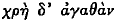
 ,


 . Amphitryon takes the view of the Melians at Thuc. 5. 102, which the Athenians cynically rebut; there is nothing untraditional about his attitude, as Adkins seems to think (op. cit. [P. 251 n. 4], 213). See p. 251 n. 4 above.

Crossref Citations

This article has been cited by the following publications. This list is generated based on data provided by Crossref.
J.M.
1979.
Notes on Aristotle, Poetics 13 and 14.
The Classical Quarterly,
Vol. 29,
Issue. 1,
p.
77.
Fisher, N. R. E.
1979.
Hybrisand Dishonour: II.
Greece and Rome,
Vol. 26,
Issue. 1,
p.
32.
Rutherford, R. B.
1982.
Tragic form and feeling in theIliad.
The Journal of Hellenic Studies,
Vol. 102,
Issue. ,
p.
145.
Halliwell, Stephen
1984.
Plato and Aristotle on the denial of tragedy.
Proceedings of the Cambridge Philological Society,
Vol. 30,
Issue. ,
p.
49.
Gill, Christopher
1984.
TheĒthos/PathosDistinction in Rhetorical And Literary Criticism.
The Classical Quarterly,
Vol. 34,
Issue. 1,
p.
149.
Moles, J. L.
1984.
Aristotle and Dido'sHamartia.
Greece and Rome,
Vol. 31,
Issue. 1,
p.
48.
Gellrich, M.W.
1984.
Aristotle's Poetics and the Problem of Tragic Conflict.
Ramus,
Vol. 13,
Issue. 2,
p.
155.
Griffith, R. Drew
1988.
Disrobing in the Oresteia.
The Classical Quarterly,
Vol. 38,
Issue. 2,
p.
552.
1988.
A New Creed: Fundamental Religious Beliefs in the Athenian Polis and Euripidean Drama.
p.
172.
Riedweg, Christoph
1990.
TrGF 2.624 – A Euripidean Fragment.
The Classical Quarterly,
Vol. 40,
Issue. 1,
p.
124.
Halliwell, Stephen
1990.
The Cambridge History of Literary Criticism.
p.
149.
Nagy, Gregory
1990.
The Cambridge History of Literary Criticism.
p.
1.
Ferrari, G. R. F.
1990.
The Cambridge History of Literary Criticism.
p.
92.
Kennedy, George Alexander
1990.
The Cambridge History of Literary Criticism.
Kennedy, George A.
1990.
The Cambridge History of Literary Criticism.
p.
78.
Heath, Malcolm
1991.
The Universality of Poetry in Aristotle'sPoetics.
The Classical Quarterly,
Vol. 41,
Issue. 2,
p.
389.
Wood, Derek N. C.
1992.
Catharsis and “Passion Spent”: Samson Agonistes and Some Problems with Aristotle.
Milton Quarterly,
Vol. 26,
Issue. 1,
p.
1.
Cropp, Martin
1997.
Antigone's Final Speech (Sophocles,Antigone891–928).
Greece and Rome,
Vol. 44,
Issue. 2,
p.
137.
Fuchs, Andreas
2000.
Dramatische Spannung: moderner Begriff — antikes Konzept.
p.
89.
White, Stephen
2001.
Io's World: intimations of theodicy inPrometheus Bound.
The Journal of Hellenic Studies,
Vol. 121,
Issue. ,
p.
107.