


 were used for P's exemplar and this remoter source respectively. The ancestry of
 in turn was traced back to Λ, the ancestor of L. This, if right, means that L and P (including the end of Ba.) both descend from a single uncial archetype, though with a fair chance that some true variants from a different tradition reached
 and λ. P, however, steadfastly preferred the original reading of λ (= L, in effect) whenever possible. When P differs from L, there are three possibilities: (a) that he is making a fresh error (misreading or carelessness—seldom, if ever, constructive); (b) that λ (before being supplemented) differed from L (probably only in ortkographica); (c) that λ (after contamination) included a variant which P preferred (significant variants are so rare that legibility is likely to have been P's main criterion).
 X.
 P; 1087
 P. Ant. et Chr. Pat.,
 P. Some at least of these variants are likely to be ancient (
 is very different from pulsare. If a Roman poet knew of an Euripidean hyperbole to the effect that the Nile fertilized Cyprus (let alone Paphos), we may be sure that he would have increased, not diminished, the hyperbole in his own version of it (cf. 661).
 (395, 427), who at this point seem to be identifiable with opponents of Dionysus. Seen in this light the whole of Stasimon 1 is coherent. See on 427 ff., 877 ff., and 1005 ff.
 982, which I take to be a comparable usage (q.v.); so too
 905 (Elmsley) which is perhaps the likeliest adjustment of
 P. (See further p. 227 n. 2.)

 (Barrett's ‘9-syllable blunt’ aeolic
 with resolution: see also on 573 below); and it is easier to make 412 match 427 than vice versa (see Dodds). But a suggestion for 427 is offered in the app. crit.
 (Aid.) is probably a mere guess. I doubt whether the corruption here is purely accidental; it is curious that almost every time ‘the right side’ displays coolness towards
 and
 the text should show symptoms of dislocation (cf. 200 ff., 877 ff., 1005 ff.). With the cult of
 in later antiquity it is hardly surprising that apparent blasphemy from a Chorus should be bowdlerized—if not deliberately, then by progressive misunderstanding and well-meaning rectification. Ba. would be strong drink for those brought up in the milk-and-water tradition of pious sentiments exemplified by Hor. AP 196–201.
 , probably rightly (Dodds), against P's hitherto unchallenged
 and
 are much more similar than
 Perhaps we should restore
 at 118 also:

 makes excellent dramatic sense, showing that the Chorus have recently become aware of the
 of the Theban women; 116–19 do not of course refer to the generalized antecedents of any
 recalls 35–36), and
 helps to particularize the description.

 The word-rhythms are strikingly similar to Ba. 416 ˜ 433, though Med. 183 is a syllable short. The simplest way of adding a syllable, and at the same time of accounting for
 can only be an attempted improvement), is to write
 The popular

 (Wecklein) postulates a less probable corruption, and yields inferior word-order (can one really construe
 with
 rather than with
 ?); moreover, a disjunct request (with asyndeton) suits the overall structure better.
 the rabble have inferior views, this I would say’.
 894. Apart from the Parodos, all the choric odes in Ba. are closely related to revelations or statements in the immediately preceding scenes—see below on 859–61 (p. 228, n. 1) and 1002–4 (p. 234, n. 5); also Dodds on 395.
 such a clumsy article is a priori suspect in lyrics. The second
 introduces a third unnamed and unidentifiable river, though doubtless whoever inserted it had no such intention—he was merely unaware that
 could be adjectival.

 but apart from other unusual features (e.g.
 ) it is difficult to justify the final brevis in longo.
 is the counterpart of

 in this context, not; trochaic dimeter (the choriambic base is resolved in 107, 122, 123, 877); 905 may be either
 (with
 Elmsley), or perhaps
 with
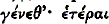 … Dodds argues, per haps rightly, that
 is more meaningful and cf.
 in a very similar song at 421.
 (Murray) is a surprising incongruity.
 an unwelcome feature, but Wilamo-witz's explanation of the error is nonsensical.
 is supposed to have been omitted and replaced before the wrong
 but there is only one
 in his corrected text, and one can hardly visualize an earlier erroneous
 The better alternative
 postulates omission and replacement before the wrong
 and a later insertion of
 : this is imaginable, but one cannot call it likely.

 I prefer to view it as

 with
 covering
 as well as
 The position of
 in the word-order would seem to favour this interpretation; moreover, if, as I believe, the second limb of the antithesis carries the greater emphasis (‘though most powerful as a god, nevertheless most gentle to men’), the first phrase should not be the longer of the two.
 —‘those powerful in respect of office’.

 on metrical and linguistic grounds: (a)
 gives a normal choriam- bic dimeter (glyconic a), which we may expect in such an otherwise regular metrical pattern. (b) ‘What is the fairer boon than … ?’ is scarcely grammatical.
 is the normal usage when a questioner answers his own question with another. Cf. 1290 (
 P) and S. OT 622 (

 ) for an enclitic following
 .
 is something that can be ‘found through keen wits’ (203), ‘given by the gods’ (877–8), and ‘pursued’ (1005–6), but distinct from ‘wisdom’ (395). ‘Cleverness’ is clearly too limited, and question-begging with its derogatory overtones; ‘intellec tuality’ is fair, but too unwieldy a word; ‘braininess’ comes closest, perhaps, but is hardly an attractive rendering. We should not repine at our inability to find a perfect equivalent: the whole point is that
 is an ‘unknown’ which it is one purpose of the drama to evaluate.
 and
 This is inherently improbable: the sentiments expressed by the Messenger are in the nature of a final ‘moral’, and his admired virtues (1150) are close to those praised by the Chorus in 1008 ff. At such a late stage of the drama, Messenger and Chorus are sure to have used key words in the same sense. The truth, surely, is that in 877–81 the Chorus are not yet clear about the meaning of
 and
 (see p. 231, n. 2 below).
 The purely selfish application to those who pursue their own advantage is not attested till much later, and would seem to involve a false equation with


 at all (if we discount
 108,
 409, and
 575, which are merely applied to physically ‘beautiful’ things). 877–81 is thus the first step towards an ethical definition of this difficult word also (see p. 230, n. 4).

 (Wecklein), but here too
 is the commoner word and corruption to
 unlikely; moreover, the verbless relative clause has a makeshift air. But at least it retains the metre.
 and
 are paired as possible means of execution. Tyrrell thought
 could have intruded as a reminiscence of this pas sage; this is untenable, for there is nothing to suggest ‘death by rock’ in

 On the contrary, I should prefer to suppose that IT 1428 tends to support

 here, by showing how the word
 was suggested to the poet; later Pentheus is to be both stoned and impaled, and these thoughts may have been passing in Euripides’ mind; though it is impossible to guess whether a fifth-century listener would have caught sinister overtones in

 follows the noun, rather than precedes the verb, is shown, for example, by
 is a small change, the terminations being often hard to distinguish in manuscripts (cf.
 P—surely for
 —immediately preceding); I owe this suggestion to Professor Page, who also led me, via
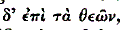 984): cf.
 977 ˜
 997, and
 985 ˜
 1005.
 but 997–1002 are evidently a commentary on Dionysus’ outrageous statement
 965, showing that Dionysus was in one sense speaking the truth. Death, the Chorus are saying, is indeed a way of salvation for the mad.
 Aristarch. Trag. 3, which may have influenced our passage.
 is hardly ad missible as a dochmius, and certainly un welcome in a conjecture. Rare examples of the rhythm are known (
 Tr. 312, and
 HF 1058); but in both these the words form a self-contained phrase, and may not be dochmii at all. One would have to argue that
 is here an extension of
 (983) and
 (1021) by progressive resolution, but such an argument is at best hypothetical. See also

 (
 suppl. Scaliger); it is likely that the correspondence was exact here, but one must remain uncertain whether 998 is substantially corrupt (e.g.
 [Mekler] for
 ) or whether
 could be scanned as a dissyllable (
 and then emending it to a different verb, e.g.
 (Headlam); there is neither evidence nor probability that
 was ever the reading, since
 takes the dative.

 awkward Greek: grammatically improved, perhaps, by the addition

 (Musgrave); but the lumpish result is hardly lyrical.

 elsewhere opposed (877 ff., 1005 ff.), are at last reconciled.
 Ar. Th. 375-a very ‘Euripidean’ phrase.
 E. fr. 909. 1; and cf. 472

 —Pentheus was refused an inswer at the time, but
 473 seems to suggest that an answer will be given later in the play.
 could already mean ‘lathe-turned disks’, and that the process described is ‘stencilling’; this cannot be more than a guess, in the absence of other extant uses of the plural.
 finding it ‘inappropriate in tragedy’: but the tone is here epic (a Messenger-speech -cf.
 ), and detailed pro cesses of carpentry are a characteristic ele ment in epic similes (e.g.
 introdu cing an indicative verb, not a noun qualified by a relative clause.


 explained, and we do not want one leg of a course:
 means the finish, not some artificial halfway mark. I suggest
 (his legs)
 (Schaefer) or
 (Musgrave).
 (pace Page, ad loc.) is against the tradition both here and in El. 883; also context and language here favour a longer course, while the point in El. cannot be a sprint. Galen's
 suggests a modified form of an
 (=
 ?) that originally spiralled inwards in a square
 : thus the metaphors in El. and Thphr. Char. 23. 2 are of ‘running round in circles’.
 (Kirchhoff, Madvig, citing Tr. 383) necessitates a major stop at
 with asyndeton just where the period should be flowing to a smooth close.
 (Heath) is rightly condemned by Dodds.
 984 (p. 233, n. 2) for the possibility of another such indirect allusion to the impaling of Pentheus.
 Musurus, P (crassly). P's sheer carelessness in the last hundred lines ol Ba. may be sufficient to account for the mistakes in 1377; but the coherence of the three errors suggests an earlier, more constructive mind than that of P, who evidently thought little about what he was writing as he neared the end of his task.

Crossref Citations

This article has been cited by the following publications. This list is generated based on data provided by Crossref.
Compton, Todd
1990.
What Are the Topnoi in Philebus 51C?.
The Classical Quarterly,
Vol. 40,
Issue. 2,
p.
549.