




No CrossRef data available.
Article contents
ΛAΩ: Two Testimonia in Later Greek Poetry
Published online by Cambridge University Press: 11 February 2009
Extract
The verb λάω is attested in two passages of early epic poetry, (a) Homeric Hymn to Hermes 360 , where the infant Hermes is hiding in a dark cave, and (b) τ 229 ff.


 , of a hound seizing a fawn on the brooch of Odysseus. Of the several meanings suggested by the ancient lexicographers for λάω, seeing, gazing, or crying, screeching would suit (a). These senses recur in their explanations of (b), with gripping or devouring as additional possibilities. The most extensive modern treatment of λάω is by Leumann, who explains it as a present falsely formed from the perfect λ⋯ληkα (X 141
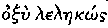 , of a hawk), and originally intended to describe the cry of a bird of prey. The unfamiliarity of the form led to its being associated later on with the sharp-sightedness of such birds, as well as with the bark of a hound fastening on its quarry.
Information
- Type
- Research Article
- Information
- Copyright
- Copyright © The Classical Association 1970
References
page 306 note 1 λάων codd. E and L1, ßλ⋯πω., see Gemoll ad loc.
page 306 note 2 As implied by the variant ßλ⋯πων. Hsch. s.v. see EM 563. 49 al. Apollon. Soph. s.v.

 σ⋯ως(τ 229),


 N 334
 is transmitted by P.Oxy. 769 as
 , with the letters νïδ written above the λ. Allen and Halliday on h. Herrn, loc. cit. complete the text as
 .
page 306 note 3 Hsch. s.v. quoting τ 230. Cyr. Gloss, s.v.

 .
page 306 note 4 Sch. V on τ 229


 See also Sch. on τ 230, EM 563. 52, Apollon. Soph. loc. cit.
page 306 note 5 Leumann, M., Homerische Wörter (Basel, 1950), 233 ff.Google Scholar Earlier accounts by Lobeck, (1846), 6, Fick, , Würterbuch (1890), i. 119 f.Google Scholar, Bechtel, , Lexilogus (1914), 27.Google Scholar See also Boisacq, , Diet. Etym. (1950)Google Scholar, s.v. λάω, Frisk, , Gr. etym. Würterb. (1960 ff.)Google Scholar, s.v. λάω.
page 306 note 6 e.g. Hsch. s.v. λάωύ, Sch. VB on τ 229, Bechtel, loc. cit. See Leumann, 236.
page 306 note 7 Erotici Scriptores Graeci, ed. Hercher, (1859), ii. 521.Google Scholar
page 307 note 1 See LSJ and Supplement, and Stephanus s.vv.
 In κ 493 and µ 267
 init. vs., edd. scan
 as a molossus (see Hermann, G., Elementa Doctrinae Metrical [ed. Glasgow, , 1817], 424Google Scholar), many preferring the late variant µάντηoς.
page 307 note 2 Hermes, liv (1919), 63.Google Scholar Wilamowitz refers to h. Herrn. I.e., and also to Theognostus, Canones 27. 11 λαίω (sic) øoνεύω(see K. Alpers, Theognostus περί
 [Diss. Hamburg, 1964], pp. 82, 82a; Cramer, , An. Ox. ii. 9. 13Google Scholar), Wilamowitz would, however, apparently retain oύ λάoντα in our epigram.
page 307 note 3 oύ µoντα Hecker, , Coram. Crû. de Anthol. Gr. (1843), 87Google Scholar, see Nonn. D. 26. 132
 , Call. Dian. 95
 Jacobs ( I edn. Addenda, t. xiii. 87; 2 edn.), oύκ⋯τ’
 (id., manuscript note in hisown copy of his commentary, preserved in the Bodleian Library).
 and
 Stadt-mueller.
 F. G. Schmidt ap. Stadtm.
 Lumb, , Notes on the Greek Anthology (1920), 17.Google ScholarTucker ap. Lumb.
 παλ. Jacobs (1 edn. comm., and Addenda, t. xiii. 87).
page 307 note 4  med. and intrans., as K 188

 , where νύκτα expresses duration. For
 in Homer, compare line 4 of our epigram,
 .
page 307 note 5 It goes without saying that we should not expect to find the word used by Agathias in an etymologically truer sense than those which the scholia and ancient lexica offer us today. Agathias was doubtless selecting from the same range of alternatives.
page 307 note 6 Friedländer, P., Johannes von Gaza und Paulus Silentiarius (Leipzig and Berlin, 1912).Google Scholar
page 308 note 1 On J as the writer of text and variants here see Preisendanz, C., Anthologia Palatina, Codex Palatinus et Codex Parisinus phototypice ediii (Lugduni Batavorum, 1911), I. lxxxiii.Google Scholar
page 308 note 2 Theophanes i. 238 De Boor
 κτλ. See Janin, R., La Géographie ecclésiastique de i'empire byzantin, pt. i, t. iii (Paris, 1953), 418.Google Scholar The martyrium of St. Platon had been restored from its foundations by Justinian, but as this restoration had taken place forty years before, Friedländer's
 for
 334 is doubtless correct. See Procop, . Aed. i. 4. 27–9.Google Scholar
page 308 note 3 Textkritische Noten zu Paulus Silentiarius, 25, in Verzeichnis der auf der Küniglichen Albertus-Universität zu Königsberg im Sommer-Halbjahre vom 15. April ÍO13 an zu haltenden Vorlesungen. Ludwich's note, which adduced τ 229 and h. Herrn. 360, seems to have escaped the compilers of LSJ (9 edn.) and Supplement.
page 308 note 4 For and λάων without copula see, for example, id. 782

 . It would be technically possible to take
 with θεoû rather than χoρείης; but
 is an appropriate epithet for those celebrating a vigil in church, see Lampe, Patristic Greek Lexicon, s.vv.
 .
- 1
- Cited by