page 28 note 3 ‘There can be no doubt that … the word  means “healer, physician” (Fraenkel ad loc); nor that there is a reference to Apollo, who is here represented as exercising in person the function he delegates at 1202 (). Apollo was invoked by Calchas (146) and by the Herald (512) in his capacity of healer. But it is not in that capacity that he directs Cassandra's prophecies. He is, rather, the destroyer: (1081) and (1257) —a title associated with violence and destruction, though obscure in its precise relevance. (That the function of Apollo should be in debate prepares for the Choephori.) This explanation does not, however, by itself provide a link with the preceding words of the Chorusleader. The link is perhaps twofold, (i) The Chorus, which had referred with distaste to the evil terms in which prophecy is couched (1132 ff., 1154f.), now demands a that would make prophecy impossible, (ii) is characteristic of the paean (see references in Fraenkel), a song closely associated with Apollo as healer and averter of misfortune. But that is not the song appropriate to this occasion. The connexion of thought is subtle, but it is made easier to follow by the opening of the Cassandra-scene, which has already raised the issue of what type of song and cry is appropriate to Apollo. Cassandra invoked him with , to the astonishment of the Chorus, who use the term (1078). When they say (1075, 1079) that he has no concern with and , they imply that his proper invocation is (cf. 146), his proper song the paean. Out of this contrast of songs Aeschylus makes a grim paradox at 645 and, very explicitly, at Cho. 150 f. (The dramatist's references throughout the trilogy to song, hymns, and ritual cries, demand a separate study.)



 Nowhere is tiiere a clear indication that they have a constitutional status. What is more to the point, then, is that here are men exercising their male function of taking counsel—with complete futility in face of the woman with the
 (v. infra)(Note that they are less futile in face of Aegisdius.)
 is of course far more vivid than
 (Schütz) would have been, since
 is the epithet essentially of the messenger (cf. 21, 264, 475, 646). As to the sentence as a whole, the intention of the speaker seems to be rightly explained by Fraenkel ad loc. I cannot help thinking, however, that Aeschylus has cast the sentence in this rather strange form in order to suggest a further alternative, not in the speaker's mind. There is news: but is it really good or bad?

 (352) clearly does refer to this line, but might, surely, refer as easily to
 and
 taken in separation as to

 taken together.
 , the third word of this root, means primarily ‘persuasive, convincing’. In view of the preceding
 and of what is said below about the use of
 and
 -compounds in the trilogy (see p. 28 n. 2) I suspect that it also carries the sense of ‘persuading of good’ (here and also at 982). In any case there is the implication that the queen is too easily persuaded to believe what she wishes to be true.

 , it must be implied that a
 , like a dream, might have a divine origin (though the sensible man would not too readily put his trust in either).
 (475) recalls 262, 264; and
 (479) is a retractation of their
 (351; cf. 275, 277). 485–7
 are very difficult. Is
 active or passive in sense? Fraenkel has shown that only the active sense ‘accords widi the bulk of the evidence from the earlier period’. Is ȯpos genuine? If so, what does it mean? These are the principal questions, but we must also ask of
 Where does the ‘fire’ spread? Whither does it travel so fast? If we read
 (which in some other respects has its attractions), it is the fire of desire spreading in the woman's soul, perhaps with the further suggestion of desire-kindled belief outrunning the evidence: there can be no idea of the topographical dissemination of rumour and belief. Yet nothing is more characteristic of Aeschylus than to repeat at the end of some self-contained section (e.g. a speech, an ode, or a scene) a theme or words from the beginning. When, therefore, we find
 at the beginning of this epode and
 at the end,
 at the beginning and
 at the end, it is virtually impossible to resist the conclusion that

 also refers to the swift spreading of the rumour through the city. But it is not so easy to obtain die required sense from
 either by interpretation or by emendation. Fraenkel defends
 in the sense of decree or ordinance, but there are serious objections. ‘A woman can easily talk men round.’ Yes, but not by issuing orders; nor could the speeches of Pericles, when Persuasion sat upon his lips, be described as
 . A woman's ordinance, qua ordinance, is not more persuasive or swifter-travelling than a man's. Further, this meaning is at once too close to
 and too remote from it. ‘A woman's ordinance travels fast, but a woman's rumour dies fast’ is not good writing.

 We must admit that the problem is not yet solved. This means we cannot be sure whether
 refers to persuasion exercised on or by Clytemnestra. Both are relevant to our theme.
 On
 in the Oresteia see

 ), but closes with a prayer for good (20 f.: note
 ). The theme of the second half is good (
 , 28;
 32), but it reverts to evil at the end (
 36;
 39). The silence of the Watchman is later paralleled by the concealments of the Chorus and the Herald.
 , is intended to convey the opposite impression.
 is both confident and inconsistent widi the tone of 484.
 (583) describes equally well their reaction to Clytemnestra's speeches. In 584, though the primary sense of
 is ‘ease of learning’, I strongly suspect that the idea of ‘learning good news’ is present also (see p. 28 n. 2).

 , the full significance of which does not appear until he makes his final speech. It means more and worse than
 (517).
 (582) is a lie; and, since he has just mentioned the generals (in the plural), he must know it. Why did the truth have to be dragged out of him? Because

 (636 f.).
 whatever the precise meaning, ‘the context points to something depreciatory’ (Fraenkel).
 can be regarded as certain (see Fraenkel ad loc).
 and
 compounds in the trilogy deserves a separate study. A good example of a slight shift between two meanings of
 is to be found in 1187 (quoted above). In other cases there seems to be a deliberate ambiguity (see p. 24 n. 4 and p. 27 n. 2 above). So insistent is this small syllable that
 comevery close in places to meaning the saying of
 . This kind of literal ‘euphemism’ characterizes the closing lines of the Eumenides, where the syllable can at last be reiterated without fear of sinister disclosures, for good has unequivocally prevailed.
 means “healer, physician” (Fraenkel ad loc); nor that there is a reference to Apollo, who is here represented as exercising in person the function he delegates at 1202 (
 ). Apollo was invoked by Calchas (146) and by the Herald (512) in his capacity of healer. But it is not in that capacity that he directs Cassandra's prophecies. He is, rather, the destroyer:
 (1081) and
 (1257) —a title associated with violence and destruction, though obscure in its precise relevance. (That the function of Apollo should be in debate prepares for the Choephori.) This explanation does not, however, by itself provide a link with the preceding words of the Chorusleader. The link is perhaps twofold, (i) The Chorus, which had referred with distaste to the evil terms in which prophecy is couched (1132 ff., 1154f.), now demands a
 that would make prophecy impossible, (ii)
 is characteristic of the paean (see references in Fraenkel), a song closely associated with Apollo as healer and averter of misfortune. But that is not the song appropriate to this occasion. The connexion of thought is subtle, but it is made easier to follow by the opening of the Cassandra-scene, which has already raised the issue of what type of song and cry is appropriate to Apollo. Cassandra invoked him with
 , to the astonishment of the Chorus, who use the term
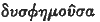 (1078). When they say (1075, 1079) that he has no concern with
 and
 , they imply that his proper invocation is
 (cf. 146), his proper song the paean. Out of this contrast of songs Aeschylus makes a grim paradox at 645
 and, very explicitly, at Cho. 150 f. (The dramatist's references throughout the trilogy to song, hymns, and ritual cries, demand a separate study.)
 been emended with certainty. Headlam adopted Donaldson's
 for
 (pointing to the converse error at 552), and it has its attractions: the weak
 recalls the
 of 1249, while to say
 after the admitted death of Agamemnon is the reductio ad absurdum of evasion and thus prepares us for the course which the debate will follow.
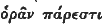 (1353): a tiny point, perhaps, of individual characterization. No doubt, like Aegisthus (Cho. 854), he prides himself upon this quality.
s He underestimates his companions!
 is obscure: it is very doubtful whether it could mean (not
so much ‘I follow’ as) ‘I am supported by’ a
 or majority. That is not to say, however, that a majority of the Chorus is still in favour of action. Just as the effect of 1358–61 is counteracted by 1362–5, so the final and decisive impression upon the audience is made by the unanimity of the last three speakers. It would have been easy in production to convey by gestures the acceptance by the Chorus as a whole of this temporizing policy; and, though it cannot be proved, I think it very likely that this was done.

