

Hostname: page-component-7b7567c8c-fvjsw Total loading time: 0 Render date: 2026-11-14T02:40:24.590Z Has data issue: false hasContentIssue false

The Astronomy of Heracleides Ponticus

Published online by Cambridge University Press:  11 February 2009

Godfrey Evans
Affiliation:
University of Reading

Extract

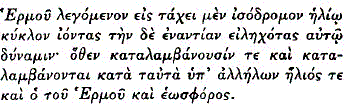
Heracleides Ponticus, a pupil of the schools of Plato and Aristotle, who lived from about 390 to 310 B.C., shared the wide interests of many of his pre-Platonic predecessors. Diogenes Laertius gives a long list of his works, many of them now known only by their titles, which he divided into writings on ethics, physics, grammar, music, rhetoric, and history. Like most of his predecessors he gave some attention to the heavens and speculated about the nature of the moon (frg. 114a), comets (frg. 116), the infinity of the cosmos (frg. 112); he was best known in antiquity, in this field, for his suggestion that the phenomena could be saved if the heavens were at rest and the earth revolved about the central axis (frgs. 106, 108).2 One of two pieces of evidence for his involvement in anything more than this general, inexact speculation in the field of astronomy is contained in the commentary on Plato's Timaeus written in Latin by Chalcidius somewhere at the beginning of the fourth century A.D.; it is this passage which this paper will discuss.

Information

Type
Research Article
Copyright
Copyright © The Classical Association 1970

Access options

Get access to the full version of this content by using one of the access options below. (Log in options will check for institutional or personal access. Content may require purchase if you do not have access.)

Article purchase

Temporarily unavailable