


 (126). Professor Fitton-Brown points out to me that artistic selectiveness (which I find in the Phaedo's account) may have determined Aristophanes' choice of symptoms also. The whole section plays on comic oppositions, as Dionysus criticizes various routes to Hades: hanging is stiflingly hot (
 122), it chokes the throat, hemlock is much too cold (
 , 125), it freezes the legs. The choking in the throat that hemlock also induces is omitted, to sharpen the contrast with hanging.

 (II. 16. 856, 22. 362),
 (Od. II. 222).
 118 a 3–4. Cf.

 515 d 3–4.


 69 b–c, 84 a–b, 106 e–107 a.

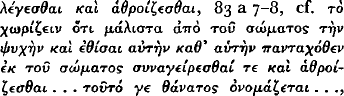 67 c 6–d 4.

 of lust, Rep. 329 c 4.

Crossref Citations

This article has been cited by the following publications. This list is generated based on data provided by Crossref.
Kahn, Charles H.
1981.
Did Plato Write Socratic Dialogues?.
The Classical Quarterly,
Vol. 31,
Issue. 2,
p.
305.
Griffin, Miriam
1986.
Philosophy, Cato, and Roman Suicide: II.
Greece and Rome,
Vol. 33,
Issue. 2,
p.
192.
Most, Glenn W.
1993.
‘A Cock for Asclepius’.
The Classical Quarterly,
Vol. 43,
Issue. 1,
p.
96.
Walters, Geoffrey
2004.
Is there such a thing as a good death?.
Palliative Medicine,
Vol. 18,
Issue. 5,
p.
404.
Heath, John
2005.
The Talking Greeks.
Millett, Paul
2005.
The Trial of Socrates Revisited.
European Review of History: Revue européenne d'histoire,
Vol. 12,
Issue. 1,
p.
23.
Edwards, Catharine
2005.
Modelling Roman suicide? The afterlife of Cato.
Economy and Society,
Vol. 34,
Issue. 2,
p.
200.
Todd, S. C.
2005.
Law, Theatre, Rhetoric and Democracy in Classical Athens.
European Review of History: Revue européenne d'histoire,
Vol. 12,
Issue. 1,
p.
63.
2008.
Medical Toxicology of Natural Substances.
p.
796.
2012.
Why Plato Wrote.
p.
206.
2015.
Hamilton, Andrew J.
2016.
Four famous suicides in history and lessons learned: A narrative review.
Mental Health & Prevention,
Vol. 4,
Issue. 3-4,
p.
138.
Correa, Soledad
2017.
Escritura y autoejemplaridad en la Epistula 30 de Séneca.
Emerita,
Vol. 85,
Issue. 1,
p.
95.
Bond, Helen K.
2019.
A Fitting End? Self-Denial and a Slave's Death in Mark'sLife of Jesus.
New Testament Studies,
Vol. 65,
Issue. 4,
p.
425.
Werner, Daniel
2020.
The End of Plato’sPhaedoand the End(s) of Philosophy.
Apeiron,
Vol. 54,
Issue. 1,
p.
29.
Greenshields, Will
2021.
“Christianity is an epidemic”: on Hölderlin and the plague.
Neohelicon,
Vol. 48,
Issue. 2,
p.
477.
Jansen, Laura
2022.
Classical Absences (1896–2017).
Classical Receptions Journal,
Vol. 14,
Issue. 2,
p.
178.
Glăveanu, Vlad P.
2022.
Embodied, Extended, Ignorant Minds.
Vol. 463,
Issue. ,
p.
99.
Clifford, Emily
2025.
Figuring Death in Classical Athens.
Grau Guijarro, Sergi
2025.
"Un bel morir tutta la vita onora…" o no: formes de morir dels intel·lectuals de la Grècia antiga en la tradició biogràfica.
Studia Aurea,
Vol. 19,
Issue. ,
p.
17.