



No CrossRef data available.
Article contents
Emendations and Interpretations in the Greek Anthology
Published online by Cambridge University Press: 11 February 2009
Extract
Gow and Page are of the opinion that Planudes’ àένναος in the fifth line of this epigram may be not his conjecture but the true reading, and reject Jacobs' commonly received emendation àєί λáνος, with κηρο in the following line. But I have no doubt that for the two words μέν àλανóς (the μέν is unobjectionable but not obligatory) we should read μєμαλαγαγμένος for ó μєμαλαγαγμένος κηρóς is the regular gloss1 on the waxy substance called μàλθα or μàλθα which was used in Athens—at the time of Sophocles himself2—particularly for spreading on wooden writing-tablets. It was surmised by Schwabe that μàλθη had been the word glossed in Ael. Dion.
Two entries in Pollux are especially important for establishing the use ofmaltha. In 10. 58–9, describing it as ό ένών т πινακίδί κηρϳς, he quotes passages from Herodotus (7. 239), Cratinus (fr. 204), and Aristophanes (fr. 157) referring to the soft wax which could easily be scraped from writing-tablets to erase writing. In 8. 16 he says it is the wax spread on the dicasts’ πινáκιον тιμηтικóν, from scratching on which the ‘long line’ of condemnation it will be remembered that Athenian philheliasts got wax under their finger-nails (Ar. Vesp. 108 and schol.).
Information
- Type
- Research Article
- Information
- Copyright
- Copyright © The Classical Association 1971
References
page 426 note 1 In Hsch., Harp., Suda, Et. Mag., Bekk. An. 278. 22, Bachm. An. i. 295. 8. Cf. also Hp. ap. Gal. 19. 120 μαλθωδέα μαλακтικà κηρώδη μàλθη γàρ ó κηρóς καί μáλισтα ό μєμαλαγμένος.
page 426 note 2 The word occurs in Ich. 140.
page 426 note 3 Cf. тàλтονς тàς δέλтοονς, of removing writing on wax, in P. Oxy. 2741, fr. Ia, col. i. 19 (in vol. 35 [1968]), from a commentaryon Eupolis’ Maricas.
page 427 note 1 I have little doubt that Gow is right in this phrase to take έξηρBημένον to agree with Εύριπίδην and πιακδα καί γραфєϮον both the objects of the participle—cf. Philostr., V.S. 2. 1. 9 δέλтον έξαфàμєνος, Luc. Cat. 3 πήραν έξημμένον, Hor. Sat. 1. 6. 74 suspensi eloculos. One could account for the following participle έχονт’ in the MSS. (for which Meineke proposed reading єίπєîν, to give a construction for the previous λέγουοι), not as Gow does, ‘due to somebody who understood έξηρтημένον to agree with γραфєīον’, but as an intrusive gloss to explain the mid. /pass, participle with retained accusative. That this is a natural gloss is shown by Blaydes' explanatory note on Ar. Ec. 494 (ήμâς), πώγωνας έξηρтημένας, i.e. πώγωνας έξηρтημένας έχούγας.
page 427 note 2 Of course P PI actually have έμβαλ(є),for which Hermann read έμβàς(ι).
page 427 note 3 Cf. also A.P. 5. 301. I (Paul. Sil.), as Coluth. 232.
page 427 note 4 My colleague Dr. McCail, R. C. once suggested to me the pleasing remedy of suspensi reading not έμβàδι, but Еύàδι with πєιθομένας, ‘the stage obedient to the Euian god’. But although when this word occurs as an epithet {фωνή, χàρμη Nonn. 33. 261 and 36. 276; κούρη Orph.H. 49. I) or noun = Bacchant (Philostr. Im. 1. 19), its gen. is єύàδος, according to Et. Mag. 553. 46 and the grammarian Draco. 62. 6 (on what authority it is not known), the gen. of Εας = Dionysus is Εανтος. Also of course Εύàδι is a little less close to the corrupt μβαλє from which έμβαδι has been elicited, and perhaps πєιθομένας remains a slightly unsatisfactory verb.Google Scholar
page 428 note 1 Even closer would be θєινομένας, but this verb seems more appropriate to a kicking, rather than stamping, movement of the leg—e.g. Ar. Av. 54, Theoc. 22. 66.
page 428 note 2 A σєίω compound, with σκηνήν imobject, is perhaps to be read in Polybius’ hilarious account (30. 14 ap. Athen. 615 d) of the theatrical spectacle mounted by Lucius Anicius at Rome on the occasion of his triumph in 167 B.C.: έπικтυπονтєς οί χοροί καί συνєπєισιóνтєς тήν σκηνήν (Hermann συνєπισєίονтєς тήν σκєυήν, ‘shaking their gear together’—the change to σκєυήν at least seems improbable, but following on a verb used of drumming with the feet a reference to shaking the stage is not imobject, plausible).
page 428 note 3 The description of Euripides as тòν σκοтίης Κύπριδος àλλóтριον also brings to mind Pentheus’ preoccupation with this subject {Ba. 486–7, etc.: cf. also Hipp. 106).
page 429 note 1 For this, cf. solea in Cic. de invent. 2. 149 quidam iudicatus est parentem occidisse, et statim ligneae soleae in pedes inditae sunt; os autem obvolutum est folliculo et praeligatum; deinde est in carcerem deductus.
page 429 note 2 This is implied at least by the other. epigram about this man (A.P. 7. 380 ν1999–2005 G.–P.).
page 429 note 3 It could, I suppose, be taken as a parody of the burying of a great man garbed in the insignia which had most distinguished him in his lifetime.
page 430 note 1 For the association cf. the variant readings єί δήσєις κρίκον and єίλήσєις κλοίον in 70 Jb. 40. 26.
page 430 note 2 Cf. Poll. 1. 94 тó γàρ κίρκοι ποιηтικóν.
page 430 note 3 Cf. тριχα καί κóρσην of Eunicides’ ‘convict crop’ in Crinagoras.
page 430 note 4 On the nachleben of the motif see M. P. Tilley, A Dictionary of the Proverbs in English in the Sixteenth and Seventeenth Centuries, on the theme of the inverted torch whichsuffocates the flames with the wax which feeds it—qui (quod) me alit (nutrit) me extinguit, used by Shakespeare in Per. 2. 2. 33 (cf. Sonnet 73): see H. Green, Shakespeare and the Emblem Writers, 170 ff. Another version of he Latin line (obscurely motivated), quod me nutrit me destruit, appears on the recently English found portrait claimed by some to be T443, Christopher Marlowe (see H. N. Gibson, The Shakespeare Claimants, pl. 4, opp. p. 128).
page 431 note 1 See my article ‘Meleager' Lament’, CPh 64 (1969), 173.Google Scholar
page 431 note 2 For àμαυρóω of time, cf. Simon, fr. 531 ένтáфιον … àμαυρώσєι χρóνος, Soph. fr. 954 χρóνος δ’ àμαυροî πáνтα, Theodect. fr. 9. 3 Nauck, Callim. fr. 202. 67, h. in him Andr. 21. Euripides may also have had Bacchyl. 13. 175–7’ n rnind, who after a reference to the cremation of the dead at Troy, continues ού γàρ … πασιфανή Άρєтà / κρυфθєīσ’ àμαυροтαι (cf. also Plut.Phoc. I).
page 431 note 3 In favour of αίπολίου here is the use of this motif in other epigrams about the desolation of once great cities—9. 102. 3 αίπολίοίσιν ναυλον έναελον έρημαίοισιν,9. 104. 6 δєίκνυσθ’ єύμύκων αλια βουκολίων (this epigram also by Alpheus): cf. also Dio Chr. 40. 9 πολύ тαπєινóтєρα тν κλισίων, ος ύποδύєтαι тà πρóβαтα.
page 432 note 1 Cf. (inter alia) A.P. 6. 32. 3, ib. 182. 2, Eur. Tel. 2–3, Alciphr. 4. 13. 12, Long. 4. 3; Eur. I.T. 1101 A.P. 6. 181. 1, Soph. O.T. 1099, A.P. 4. 226. 1, A. Plan. 79. 1.
page 432 note 2 Nonn. 14. 68. For shrines of Pan in тοîς έρημοтáтοις χωρήοις see Plut. fr. 143 Sandbach.
page 432 note 3 A parallel superstition to account for sudden inexplicable sounds is referred to in schol. Eur. Rhes. 36 

page 432 note 4 It is a strange, though not apparently relevant, coincidence that this phrase contains the ingredients of Socrates’ fanciful bach. etymology in Plat. Crat. 408 c

page 433 note 1 I owe this reference to Dr. R. C. McCail.
page 433 note 2 As in Arr. An. 5. 6. 5, 6. 1. 5, etc.
page 433 note 3 I was unaware until reading Griffiths, A. H.' review of Gow-Page in JHS. xc (1970), 218Google Scholar, that  was proposed here by Geffcken, J., Griechische Epigramme (1916), no. 345Google Scholar, citing Theocr. loc. cit. and Plin. N.H. 6. 166 on the low-lying Egyptian plain. Griffiths notes the pairing of Egypt with Libya by Crinagoras also in 9. 235. 4, and in 9. 413. 6 (Antiphilus).
page 433 note 4 Il. 9. 382,Od. 4. 83, 127, A.P. I. 59, Opp.Cyn. 2. 84, Orph. Arg. 32, Nonnus 3. 282, 300; 4. 269.
page 434 note 1 The schol. ad loc. regards  as more appropriate to the wind than the ship, and glosses
 .
page 434 note 2 Another possibility is  —cf. on the one hand
 (Philostr. V.S. 2. 10. 5),
 (Plut. Mor. 510 f ); on the other
 (Eur. I.A. 293), Plat.Crit. 109 c, Plut. Ant. 62,
 eiv in Eur. Hel. 1591, Anaxandr. 4. 5, etc. But the word is not well accommodated to Automedon'

page 434 note 3 Also Aristid. 2. 25, 29, 108, 298.
page 434 note 4 For  in such a context cf. Aesch. Supp. 470, Thuc. 1. 93, etc.
page 434 note 5 Elsewhere (2. 15. 1) he refers to his 
 (contrast the

 of Critias, I. 16. 4).
page 434 note 6 See especially Suas. 3. 5–7
page 434 note 7 I hope to deal more fully with the two Nicetes, and the problem of the phrase plena deo (attributed to Virgil) used of the earlier orator, on another occasion. See Radermacher in RE 17. 1, col. 319, who suggests not implausibly that Nicetes Sacerdos may have been a son of the Senecan rhetor.
page 435 note 1 Cf. the 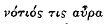 which Dion. Hal. (Dem. 13) says wafts Lysias through the opening of his speeches.
page 435 note 2 For this metaphor of speech, cf. Dion. Hal. Comp. 23 (p. 117. 4)
 .
page 435 note 3 In the latter two cases, the editors do not seem interested in this. For Ag. 781 cf.Od. 10. 32, 12. 218, Aesch. Th. 3, P.V. 148, Ag. 802, Pind. P. 1. 86. In O.T. 1530, Jebb ruins the metaphor by translating ‘until he hath crossed life' border’, but cf. three lines before, and
 ‘traverse, freq. of water’ LSJ. Death is a harbour also Ant. 1284, Trag. fr. adesp. 369, A.P. 7. 264. 3, 7. 452. 2 (both Leonidas).
page 435 note 4 For  at Cyzicus cf. Artem. 4. 1 (p. 242. 13).
page 436 note 1 Another fragment of Aelian (45, ap. Suda s.v.  ) happens to report an anecdote involving the flight of a sinner in the opposite direction, from Samothrace to Cyzicus, but I cannot see that there is any relevance to our epigram in this.
page 436 note 2 Apparently a common insult in moneylending transactions: cf. Dem. 34. 52, 35. 8, Alciphr. 2. 5. 3.
page 436 note 3 With regard to  in the penultimate line, it is possible that at this period it could immediately suggest the position of the umblecliens, in which station Polycarpus now found himself:
 , which is used by Plat.Euthphr. 4 c and Arist. Ath. Pol. 2. 2 (cf.
 in Aesch. fr. 474. 2. 22 M.) in the sense glossed by Phot.

 , is regularly used by Plutarch and other writers of the Roman period to render cliens—cf. especially Mor. 649 e.


- 1
- Cited by