




No CrossRef data available.
Article contents
Futures in Pindar
Published online by Cambridge University Press: 11 February 2009
Extract
J. Wackernagel and E. Löfstedt have both drawn attention to Pindar's ‘Neigung, das Futurum zu setzen bei Verben, die eine jetzt vorhandene, aber auf zukünftiges Tun abzielende Willensrichtung ausdrücken’. But they regarded this as a purely grammatical phenomenon, and did not note that the Pindaric use is practically limited to statements of the type, ‘I shall sing, glorify, testify, etc.’. It was E. Bundy who first drew attention to the conventional nature of these futures and so ended years of misunderstanding. So, for example, Wilamowitz considered that  P. 1.75 represented an optative with
 while Slotty, following Breyer, thought that
 N. 9. 10 was an aorist subjunctive ‘auf Grund des pindarischen Sprachgebrauches’! Postgate, following Gildersleeve, thought that
 0. 8. 57 represented
 though the contrary would appear to be more true, cf. 0. 13. 11: and also Hoekstra sees in the future ‘den Nebenbegriff des Konnens’.
Information
- Type
- Research Article
- Information
- Copyright
- Copyright © The Classical Association 1969
References
page 86 note 1 Vorlesungen über Syntax, Basel, 1920, part 1, p. 61.Google Scholar
page 86 note 2 Syntactica ii, Malmo, 1956, p. 127.Google Scholar
page 86 note 3 Studia Pindarica I, Univ. of California Publ. in Class. Phil., Berkeley, 1962, p. 21.Google Scholar
page 86 note 4 S.B.B., 1901, p. 1306.Google Scholar
page 86 note 5 Der Gebrauch des Konjunktives, Göttingen, 1915. p. 122.Google Scholar
page 86 note 6 Mnemosyne liii (1925), p. 390.Google Scholar
page 86 note 7 Ibid. ser. 4, xv (1962), p. 5.
page 86 note 8 The Works of Pindar, vol. 2, A Critical Commentary, London, 1932, ad loc.Google Scholar
page 86 note 9 Wege und Formen frühgriechischen Denkens, Munchen, 1955, p. 903, (abbreviated W & F).Google Scholar
page 86 note 10 So van Groningen, , La Composition littéraire archaïque grecque, Amsterdam, 1960 2, p. 343.Google Scholar
page 86 note 11 Schwyzer-Debrunner, Gr. Gr. 2. 293. 8: Radt, S., Pindars weiter und Sechster Paean, Amsterdam, 1958, p. 74Google Scholar on Paean 2. 79: Wackernagel, , Vorlesungen, 1. 195.Google Scholar
page 86 note 12 For an explanation, v. Löfstedt, Syntactica ii. 127–8 with literature: parallels may be found in Bruhn's Anhang to Sophocles, p. 61, butP. 3.41  is exactly similar.
page 86 note 13 A comparison of the openings of the Homeric hymns shows that the introduction was stylized either as an imperative ad dressed to the Muse, or as a first person future.
page 87 note 1 Pindaros, Berlin, 1922, p. 158.Google Scholar
page 87 note 2 Der Aufbau despindarischen Epinikion, Halle, 1928, p. 2961, abbreviated Schadewaldt.Google Scholar
page 87 note 3 Dichtung und Philosophie des frühen Griechentums, München, 1962 2, p. 4886, ab breviated D & P.Google Scholar
page 87 note 4 W & F, p. 71.Google Scholar
page 87 note 5 Schadewaldt, , p. 2961,Google Scholar but also implied in Wilamowitz, , Pindaros, 4022.Google Scholar Schadewaldt was defending the text against the emendations of Wilamowitz, but that the point of his remarks has not been seen is clear from the arbitrary interpretation of Forssman, B., Untersuchungen zur Sprache Pindars, Wiesbaden, 1966, p. 1341.Google Scholar
page 87 note 6 For example, Wilamowitz, , Pindaros, 3631Google Scholar on 0. 7. 13 says, ‘ … wird niemand auf eine Reise Pindars nach Rhodos deuten, der den Gebrauch von
 ’. But in I. 5. 21 he interprets
 literally of Pindar's journeying to Aigina (S.B.B., 1909, p. 823,Google Scholar repeated Pindaros, p. 200Google Scholar), ‘Jetzt kam Pindar auch selbst heriiber’. One remembers Housman's acid comments on the journey-ings of Lucilius according to Marx, , C.Q. i (1907), p. 74.Google Scholar
page 87 note 7 Schadewaldt, , p. 2844.Google Scholar
page 87 note 8 Mus. Helv. xxi (1964), p. 5515 with many examples (but 0. 8. 54, N. 1. 10, N. 7. 76 do not belong here).Google Scholar
page 87 note 9 Radt, , Mnemosyne ser. iv, xix (1966), 1531Google Scholar correctly claims this to be an ‘Aorist der unmittelbaren Vergangenheit’ (Wackernagel, , Vorlesungen, i, p. 176Google Scholar): and  …
 N. 1. 19 is perhaps connected with
 ‘I have taken up my position.’ However, he goes perhaps too far in trying to suggest that we can limit the reference of such aorists to the immediate entrance of the chorus: the aorist does not exclude the possibility that the chorus comes from a distance.
page 87 note 10 S.B.B., 1908, p. 343.Google Scholar
page 88 note 1 There are clearly examples which do not fit the general theory proposed here, but they are outnumbered by those that do. Instead of a future we find a present
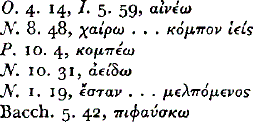
and even an aorist  0. 10. 100. But many of these exceptions are explicable on the following grounds:
(a) The future of the verb is non-existent or avoided, e.g. 
(b) The present denotes that the praise is not restricted to the moment of the song, it is continuing and general, on the lines of p. 5. 107:
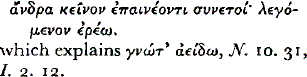
(c) The present expresses the anticipation of pleasure when the song is to be sung, so

Especially a future participle may become a present, ‘vom Zwecke von Gesandtschaften’, explains Classen on Thuc. 6. 88. 10.
We have not enough of Alkman to say what his practice was, but it may be worth noting that fr. 1. 12  is more likely to be an Abbruchsformel, cf.

 0. 13.91, rather than an example of the ‘negative Ausdrucksweise’ assumed by Page to be a praeteritio.
page 89 note 1 Isyllos von Epidauros, Berlin, 1886, p. 168.Google Scholar
page 89 note 2 Pindaros 2, p. 309.Google Scholar
page 89 note 3 Schadewaldt, , p. 2961.Google Scholar
page 89 note 4 In Pape-Benseler, our Aineas is listed as a Theban, which would appear to be false. The name is not very common, but it does occur most frequently in the northern Peloponnese, less frequently in Attica, and never, so far as I can determine, in Boeotia: from the northern Peloponnese,
(a) From Stymphalus, Xen. An. 4. 7. 13; Xen. Hell. 7. 3. 1, 5 (? = Aineas Tacticus).
(b) From Elis, an Iamid, and therefore of the same family as the victor in 0. 6: Paus. 8. 10. 5, 6. 2. 4.
(c) From Arkadia, S.E.G. xi. 1043.Google Scholar
(d) From Corinth, Thuc. 4. 119; I.G. iv2. 1. 119. 49Google Scholar (= S.E.G. xv. 39).Google Scholar
(e) From Epidaurus, I.G. iv2. 1. 102, 101 (= 103, 47). I do not know if he is the same as the second Corinthian Aineas.Google Scholar
The supposition that our Aineas was an Iamid, related to the victor, that he came from Stymphalus, would seem to be not unreasonable, in view of the fact that other names (Iamos, Teisamenos) were traditional in the family.
page 89 note 5 Pindar, Oxford, 1965, 3 f.Google Scholar
page 89 note 6 See Kambylis, A., Anredeformen bei Pindar, Festschrift Vourveris, Athens, 1964, pp. 95 ff.Google Scholar
page 89 note 7 ‘es wird eine ideale Person angeredet’, Wackernagel, , Vorlesungen, i. 109.Google Scholar
page 89 note 8 It must not be forgotten that  may include even the victor, so Fränkel, H., D & P, p. 54312,Google Scholar and, more exactly, Bundy, , Studia Pindarica, 2. 6p.Google Scholar
page 90 note 1 D & P, p. 54312 and p. 4852. But ‘ich werde’ does not imply ‘man soil’ but rather the other way round.Google Scholar
That  on the other hand, though ideally representing poet+chorus, may make statements only appropriate to the chorus is obvious from Paean 4. 21; examp are to be found certainly in the epinikia as well, but our ignorance of the circuistances of performance prevents us in neai all instances from determining this beyoi all doubt.
page 91 note 1  is explained by Bundy, , Studia Pindarica, 2. 65.Google Scholar
page 91 note 2 Archilochos, München, 1959, on fr. 81D.Google Scholar
page 91 note 3 Archiloque (Budé) Paris, 1958, on fr. 224.Google Scholar
page 91 note 4 When van Leeuwen, , Pindarus Tweede Olympische Ode, Assen, 1964, p. 532,Google Scholar lumps Bundy in one basket with E. Schmid, and dismisses both their interpretations with the epithet ‘rhetorical’, he is unwittingly allying himself with what Stanford has called the ihamanistic school of Pindaric interpreta tion (cf. Dornseiff's comment on Wilamowitz, in Die Antike Mythenerzählung, Berlin, 1933, p. 81Google Scholar). The whole complex apparatus of witnessing, affirmation, appealing, invocation, etc. is an almost logical development from the emphasis with which the poet is compelled to affirm the truth of his words. This machinery of persuasion one may justifiably call rhetorical. E. Schmid sought to impose a purely mechanical schema on the poems of Pindar. To discover the rules by which Pindar seeks to convince us has been on the contrary the aim of the school which began with Drachmann and continued with Schadewaldt.
page 91 note 5 Pindars Zweiter und Sechster Paean, Amsterdam, 1958, pp. 84 ff.;Google Scholar see also Hoekstra, , Mnemosyne ser. iv, xv, pp. 1 ff.Google Scholar
page 91 note 6 Hermes lxxxviii (1960), pp. 385 ff.Google Scholar
page 91 note 7 W & F, pp. 359 ff.,Google Scholar a reprint of his review of Schadewaldt, , Gnomon vi (1930), pp. 1 ff.Google Scholar
page 92 note 1 Hermes lxxxviii (1960), pp. 385 ff.Google Scholar
page 92 note 2 Ibid. lxxxix (1961), pp. 385 ff.
page 92 note 3 This is simply not true: indeed it is a legitimate question whether there are any ‘undisguised personal remarks’ in Pindar at all.
page 92 note 4 Kühner-Gerth, , Gr. Gr., 2. 180.Google Scholar
page 92 note 5 The meaning of such an affirmation, ‘Beteuerung der Wahrhaftigkeit’, is excellently explained by Tugendhat, , loc. cit., p. 395Google Scholar. Pindar is a  (v. 49) on behalf of Aigina and her heroes: Tugendhat does not apply his observation to v. 102: Pindar's conception of himself as a
 had already been discussed by Schadewaldt, , pp. 312–14Google Scholar, and Illig, , Zur Form der pindarischen Erzählung, Berlin, 1932.Google ScholarFränkel, , Hermes, 1961, p. 386 emphasizes that the scholiast at this point takes the words to refer to N. 7, not Paean 6.Google Scholar
page 92 note 6 So Fränkel, , Hermes, 1961, p. 386.Google Scholar
page 92 note 7 Cf. Schadewaldt, , p. 2781.Google Scholar
page 93 note 1 In D & P, p. 57114.Google Scholar
page 93 note 2 Mnemosyne Suppl. 7, Leiden, 1962, p. 1441.
page 93 note 3 The scholiast, pace Fränkel, , Hermes, 1961, p. 386,Google Scholar does not imply at this point  ‘drag in’, cf. scholia N. 9. 93a, 3 Dr.; this would be an unjustified deduction from the scholia on v. 1; I should imagine that the meaning is impossible in Pindar.
page 93 note 4 Gardiner, , J.H.S. xxv (1905), p. 266;Google Scholar Headlam-Knox on Herondas 2. 71; the scholiast says  and paraphrases V. 64,


page 93 note 5 D & P, p. 51018, and p. 53044.Google Scholar
page 93 note 6 Kühner-Gerth, , Gr. Gr., 1. 25, 2. 180, give enough examples to illustrate the innate lack of logic of Greek litotes.Google Scholar
page 93 note 7 Pindaros, p. 2763.Google Scholar
page 94 note 1 Schadewaldt, p. 2882, perhaps misunderstood by Bundy, , Studia Pindarica, i. 2971.Google Scholar
page 94 note 2 The conception of  is basic to an understanding of such passages:
(1) The poet is not  (therefore he readily praises).
(2) Others are  (because
 attracts
 ).
(3) The poet must avoid rousing  in others (via
 ).
The following standard thought-sequence results:
(a) I have praised X  (

 etc.: i.e. I am not
 like others).
(b) More (sc. praise) would be too much, for
(c) That would arouse 
 .
Here he gives a+b and implies c. In N. 7. 50–3 he gives a+b+c. In 0. 8. 54, cf. N. 7. 69–71. 75–6,

the b-element is represented by the conditional form: ‘I have praised M; I hope I have not overdone it: I do not wish to arouse  ’ But
 motives 1 and 3 are clearly not always kept apart, and on occasion the poet can imply that he has mastered his own natural instinct towards
 cf. Jebb on Bacch. 13. 200.
- 17
- Cited by