


 ‘can hardly mean “leek” here’ and he assumes it to be ‘groundsel’; Dain in the Budé edition is satisfied with the rather prosaic explanation that it is an ‘observation très juste … la cigale ne se nourrit que des sues des plantes’. I hope to show that the diet of leeks and dewdrops from the mouth is promised by the love-sick swain of Meleager's poem for the same specific reason—to refresh the grasshopper's ‘voice’ for a new day's beguilement by song and persuasion to the sleep which will again free him from the cares of love. Although the ancients were aware of the means by which such insects produced their incessant sound, they remained faithful to the poetic tradition, which made them drink dew as a prelude to their singing, first found in Hesiod, Scut. 395, and clearly expressed in a couplet of Antipater of Thessalonica (A.P. 9. 92):
 (line 91) with the first and last lines of the Anacreontic poem,

 . It is interesting that Callimachus also alludes to these Hesiodic lines (as Hes. schol. ad loc. observed) in Aetia fr. 1. 37–38 immediately after comparing himself to a dew-drinking cicada (29–35).


 (here, however, the destructive locust) is averse to
 .

 (Cf. Plin. N.H. II. 93 sine ore), but in poetry I do not regard this in itself as invalidating this interpretation. Cf. A.P. 7. 193

 (in this poem the unspecified insect is assumed to be an akris).
 ) are successively mentioned.
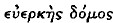 of A.P. 7. 193 (Simias). Dain's ‘dans l'intimité de ma maison’ misses the sophistication of this phrase entirely. A number of epigrams in this part of the Anthology refer to caged grasshoppers. It is commonly stated, e.g. by


 .
 used in this sense, as Mackail alleges.
 was written by the first hand of P and changed to plural by the corrector using the copy of Michael Cartophylax:
 is read also in Plan., and Suid. s.v.
 . The plural is accepted by most edd., and P's unreliability is shown by his

 in the first line. For plural of the speaker's mouth (or the insect's for that matter) cf. Eur. Ale. 403, Ap. Rh. 4. 1607, Theoc. 20. 26, Mosch. 2. 96, A.P. 6. 173, 7. 203 (where the same variation of reading occurs), 9. 87, Nonn. D. 47. 105.
 . Doubtless this would be done through a straw—cf. Geop. 16. 6. 2,

 (to cure leucoma); for othei medical uses of the verb, see P. Oxy. viii (1911), no. 1088, and several examples in the Hippiatrica, e.g. 97. 8

 (sc. the medicament there described).
 of Geop.) usque ad gulam et reiectanda fauces fovi.
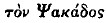 see

 or Hecker's
 are preferable to others recorded by Stadtmueller. Since this article was written,
 as unintelligible, has suggested
 ‘for your fork-tongued mouth’, referring to

 of the tettix in A.P. 9. 273. It is difficult to assess probabilities in the vagaries of poetic descriptions of the sound mechanism of stridulating insects, but according to Ar. (H.A. 532b13)
 of the cicada (which replaces a true
 ) is
 .
 , and the later use of
 . Socrates uses
 as a ‘Gorgianic expression’ for pouring wine in Xen. Symp. 2. 26.
 is the reading of Plan., P having
 , and the words are continually confused—see Wernicke's note on Tryphiodoru 321—but the former is clearly right. Hesych. has
 Cf. also Eust. 229. 28.
 .
 including several by Eubulus, one of which (also from Antiope, fr. 12) compares Athenians and Boeotians. Euripides himself seems to refer to Zethus' predilection for creature comforts in fr. 201.

 .

 , a piece of word-play imitated by Nonnus, D. 41. 64.
 , famous for its fertilizing water (see my article in

 of the Anacreontic poem.
 of his orator who is not one of us


 . For the allusive train of thought, cf. Homer's ‘bloodless gods’ (II. 5. 341–2) and the Anacreontic cicada (34. 17). For the orator's promise to make his disciple a
 see my comments above p. 104.

 , used of open-mouthed expectation. Captare is similarly used—e.g. Curt. Ruf. 4. 7. 14 imbrem … ore hianti captare. Of interest, as it describes Cephalus' longing for Aura (see above), is Ov. Met. 7. 820 meoque / spiritus iste tuus semper captatur ab ore. Finally, Ps.-Quint. decl. 12. 17 auras captamus et rare vescimur clearly alludes to cicada diet.
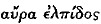 (I. 365 M.). So too in Latin—spes pascis inanis (Verg. Am. 10. 627).
 (334: cf.
 of Ran. 892).
 should be read, and
 in Nicaenet. 1. 7 may also be corrupt. But cf.
 in Synes. H. 3. 4 and
 (v. 1.
 ) of earth-born giants in Callim. H. 1.3; also the lines referring to spontaneous generation from mud quoted by Hipp. Haer. 5. 7 (= Bergk PLG4 iii, p. 712; Page PMG 985). See in general Ar. Gen. An. 762a32.
 in A.P. 9. 264. 6.

 , and the Tithonus myth in h. Aphr. 224, Hor. Od. 2. 16. 30, etc. For cicadas sloughing off the skin see Ar. H.A. 601a6, Lucr. 4. 58, etc. Callimachus' comparison with another celebrated
 ;, Enceladus, may be fortuitous, but it is also remarkable that
 is said by schol. Ar. Nub. 158 to be a stridulating insect similar to the cicada. Words derived from
 are standard terms for the sound of both tettix— e.g. Theopomp. fr. 40 K, A.P. vii. 196 (Meleager), ix. 372 (Anon.), Ael. N.A. 1. 20, Theophyl. Ep. 61—and akris—e.g. A.P. vii 194 (Mnasalcas).

Crossref Citations

This article has been cited by the following publications. This list is generated based on data provided by Crossref.
Pütz, Babette
2003.
The Symposium and Komos in Aristophanes.
p.
279.
Griffith, R. Drew
2010.
Notes and Discussions: TPEΦEIN ΓAΛA (Odyssey 9.246).
Classical Philology,
Vol. 105,
Issue. 3,
p.
301.
2014.
Leitmeir, Florian
2017.
Locusts, Grasshoppers and Cicadas as Muses.
Greek and Roman Musical Studies,
Vol. 5,
Issue. 2,
p.
219.
2018.
Capra, Andrea
2019.
The Gift of Logos. The Life of Aesop and Socrates’ Poetic Initiation.
Giornale Italiano di Filologia,
Vol. 71,
Issue. ,
p.
89.
Telò, Mario
2022.
QUEER (A)EDI-(M)OLOGY: ON CALLIMACHUS’AETIAPROLOGUE.
Ramus,
Vol. 51,
Issue. 1,
p.
21.
Marciniak, Przemysław
2026.
Microhistories Retold.
p.
149.