




No CrossRef data available.
Article contents
Greek BAΣI-ΛEΓΣ
Published online by Cambridge University Press: 11 February 2009
Extract
In analyzing  for composition I start in the most obvious way with
 (from gwm-ti-) in the sense of ‘gang’ (i° ‘uia’ 2° ‘ caterua’), while
 must be a root-noun from *lew-s, and is perhaps immediately cognate with Skr. lu-nati ‘caedit.’1 This analysis makes
 mean something like ‘ uiam-muniens,’ i.e. a sort of ‘ ponti-fex.’ I think more particularly of the sacrificial leader, the
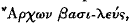 , the Rex Sacrificulus, who, while he may have been concerned with the making of ways on earth, also made paths for man to the gods. But this aside, he who ‘ blazed the trail,’ who ‘ loosed’ or ‘ solved ’ (the problem of) the ‘ ways,’ was ‘ explorer, guide, leader,’ i.e. ‘dux.’
Information
- Type
- Research Article
- Information
- Copyright
- Copyright © The Classical Association 1911
References
page 119 note 1 The root lew- ‘ caedere’ is not different, pace Walde, Wtb. s.v. luo, from the root set down for Lith. lidutis ‘ aufhoren.’ Any Englishman knows the use of cuts for ‘ forsakes, abandons, leaves.’ Examples of this semantic change, and on to ‘ ceases,’ in AJP. 26, 396; 405.
page 119 note 2 Cf. Germ, zieht, intrans. = ‘ mouetur, it’; but trans. = ‘ducit.’ With a somewhat different turn of the factitive sense, the Sanskrit root r as set down by Whitney means ‘ go; send,’ The German fukren is a factitive to Eng. fares,; also cf. Germ, senden (cf. Kluge, Wtb.).
page 120 note 1 Cf. Homeric  ‘ caesus est; cecidit,’
 ‘caesus; casus’ (see on cati.it: cadit, Fay, AJP. 26, 397).
page 120 note 2 Offence need not be taken because of the lack of differentiation of the kinds of cutting, cf. our daily use of chops=‘ splits, cuts, breaks,’ but in chops cotton = ‘ hoes’; and note the wide fission of meaning in French couper, which started with the sense of ‘ a buffet.’
page 121 note 1 In the exhibit of totem poles from Alaska at the Columbian Exposition in St. Louis I was greatly struck by the resemblance of the head on the top of one of these poles, some thirty feet in height, to the type of the Jupiter of Otricoli.