




No CrossRef data available.
Article contents
The Impiety of Socrates
Published online by Cambridge University Press: 11 February 2009
Extract
In Varia Socratica Professor A. E. Taylor devotes his first chapter to a proof that the impiety for which Socrates was condemned consisted in his connection with an Orphic-Pythagorean cult. This argument has more than historical interest, for it is the first step in an attempt to attribute to Socrates, and ultimately to Pythagorean sources, doctrines hitherto regarded as Platonic. Much of Dr. Taylor′s new evidence seems to rest on passages which in their context contradict or greatly modify his inferences; other arguments have no better basis than the dubious principle that any fact shown to be related to Orphism in one connection is always so related; and, above all, the enquiry which set out to give precise legal grounds for the charge of impiety tails away lamentably into a mere discussion of doctrine. I propose, after examining the wording of the charge, to analyze the evidence for regarding Socrates′ offence as the importation of a foreign cultus, then to enquire how far Dr. Taylor′s discussion of doctrine is relevant to the legal charge, and, lastly, to ask whether the Apology of Plato and the Memorabilia really do preserve so suspicious a silence about the impiety as to justify a totally new theory to account for their reticence.
Information
- Type
- Research Article
- Information
- Copyright
- Copyright © The Classical Association 1913
References
page 157 note 1 Mem. I. i. i.
page 157 note 2 V.S. 6.
page 157 note 3 The latter word is Favorinus′ equivalent for εíσφέρων
page 157 note 4 See Herodotus and Thucydides passim for cf. PI. Laws 759c  . Contrast Isocr. Bus. 28, Thuc. IV. 26, Dem. 935, 5, and note contrast in Hdt. VI. 118 and PI. Rep. 370c. I use κομíζειν and εíσáγειν for illustration, as Dr. Taylor does. Above all, cf. the use of έπáγερθαι;n Hdt. V. 67.
page 158 note 1 V.S. 6. 1.
page 158 note 2 Cf. especially vv. 256, 465 (with Sandys′note) and 650.
page 158 note 3 V.S. 23.
page 158 note 4 Cf. Dem. In Timocr. 213: 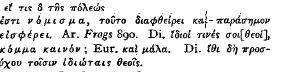 Cf. Clouds is Bacch. 328–9 for the nature of the offence.
page 158 note 5 Arist. Met. 985a 30, Pol. 1266a 15, PI. Laws 797c in the last two combined with καινοτομεîν 5951;, Ar. Frogs 849, Clouds 547, also Bacchae passim (see note 6). For εíσηγήσατο see Nauck T.G.F., p. 771, where τό θεîο νεìηγήσατο is used of the man who invented gods to overawe man kind. The synonyms quoted by Dr. Taylor are κομíζειν and είσγεγιν, cf. especially Arist. Eth. 1096a 13–17, where both words, along with ποιεîν, are used to describe Plato′s introduction of his ideal theory. All three words, as Prof. Burnet′s notes and references (q.v.) show, suggest a certain arbitrariness. Dr. Taylor ignores and seeks to attribute to Aristotle an ‘insinuation’ that ‘ Platonism is a mere modification of Italian Pythagoreanism’; this would be peculiarly offenoffence. sive in the very phrase in which Aristotle apolo-gizes for attacking his master.
page 158 note 6 26, 53, 16a (the last sentence of the dia-logue). The word means ‘ to open up a new vein.’ For its metaphorical use see examples cited above and Ar. Wasps 876, Eccl. 583–586.
page 159 note 1 V.S. 22.
page 159 note 2 V.S. 21. 2.
page 159 note 3 V.S. 2i. 1.
page 159 note 4 Cf. Horn. Hymns XXI., Alcaeus Fr. 3, Eur,Ion 160–9.
page 160 note 1 The phrase  here corresponds to what Socrates says the Apology of his service to the Delphian. As a result of the ‘mission to the dull’
 (23c).
page 160 note 2 The connection of Pythagoras with Delphi is vouched for as a very old tradition by Aris-toxenus. The cities in which Pythagoreans most flourished, Croton and Metapontium, were founded from Delphi. Both cities had the sym-bol of the cult on their coins. If the Crotoniates took Pythagoras for the Hyperborean, then it was in mistake for their own god, as is natural (cf. Acts XIV. 11–13). Compare  Mnesimachus, Alcmaeon. There was a reason why the Pythagoreans should pecially reverence Delphi. ‘ Das Pythagoreische einheitsritual lehnte sich an den Kult des del hischen Apollon an, an einen Gott der Haronie, der Heilungen, und Heiligungen...’ (F. Dummler, Kl. Schr. II. 178). This, of course, does not exclude the Delian from his position as a Pythagorean god, for that, too, is attested.
page 160 note 3 V.S. 22.1.
page 161 note 1 V.S. 20. 31.
page 161 note 2 V.S. 20. 2.
page 161 note 3  Mem. I, 2. 48. It is the orthodox Xenophon who thus uses these Pythagoreans as his final argument for Socrates′ harmlessness as a teacher.
page 161 note 4 V.S. 31. 1.
page 161 note 5 It is hardly necessary to remark that Xeno-phon could no more have insinuated that the seven belonged to one city by the singular πόλειthan that they were all the sons of one father by the singular οΐκώ (Mem. I. 2. 48). The construc-tion is perfectly natural. Cf. Xen. Ap. § 17.
page 161 note 6 In the same vein Dr. Taylor remarks that no one would guess from Mem. IV. 2. 10 that Theodoras was a Pythagorean from Cyrene. As he is specially brought in by Socrates as the geometer, few Athenian readers would be puzzled. Compare the reference to Prodicus in Mem. II. 21, I.
page 162 note 1 V.S. 20.
page 162 note 2 As an Athenian he would be the prey of sycophants, no new trouble for him. Mem. III. 9 This gives a natural reason why foreign pupils should have to intervene.
page 162 note 3 The words are 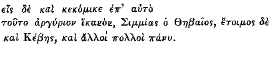 Crito 45b.
page 162 note 4 V.S. 39.
page 163 note 1 Prof. Taylor infers ‘ from the fact that the catalogue of members given by Iamblichus men-tions only one Athenian ’ that the Pythagoreans, with their beliefs about the soul, were ‘not popular ’ in Athens, and concludes that they were ‘ virtually unknown ’ in Attica because the same list attributes four members each to small states like Sicyon and Phlius and a solitary member to Athens. Now Iamblichus omits Thebes and Megara from his catalogue entirely. It is as important a part of Dr. Taylor′s case that Thebes was a centre of Pythagoreanism as that Athens was not, yet the omissions of Iamblichus, obviously inaccurate for Thebes, are made the ground for a set of inferences about the danger Socrates ran if he was a Pythagorean, and if he believed in immortality, and if he was tried for that. It is strange that four scanty undated names should show that Pythagoreanism was known in Sicyon, and one name prove it to be virtually unknown at Athens in 399 B.C. On such reasoning by ratio, if Iamblichus had only the wit to see that the Socratic circle probably formed a Pythagorean όμακοίον(Var. Socr. p. 148), Athens could give Sicyon and Phlius a long lead, with Thebes not even placed. But Iamblichus, who could include Parmenides and Melissus as Pythagoreans, did not set down even Simmias and Cebes as Theban members of the order. Let it be remembered further that, according to Dr.Taylor, this Pythagorizing έταιραhad twenty ve years′ life under Socrates (p. 147), and was ‘ universally known’ from the beginning of that period (p. 133).
page 163 note 2 V.S. 26.
page 164 note 1 Aristophanes did not place too great a strain on the knowledge of his audience. The nurse of Phaedra is the type and precursor of all those women who find reasons for their mistress′s in-clinations. Auge′s defence was long famous, as we see from Clement of Alexandria. Antisthenes publicly protested in the theatre against the sophistry that glossed over Canace′s crime;the stories of Plato′s reproof and Lais′ jest are well known. No contemporary protests against the doctrine of immortality have come down to us, though sufficient evidence to show that Athens laughed at the paradoxical form in which Euripides put it.
page 165 note 1 In assigning the lines to Phrixus the scholiast corrects Aristophanes. If this is right, Dr.Taylor′s contention disappears at once, for Aristo-phanes is simply laughing robustly at the weak sentimentality of Phrixus, who stakes his life for an illusory benefit to the tribe. The feminine Φασκούσας would bear that meaning—there no random hits in the Frogs. But I am not certain that Aristophanes did not mean a woman when he said a woman, and she could only be Ino. The scholiast spoke from memory, for he quotes the passage that Polyeidus spoke, which differs in wording from the Phrixus lines. He may equally have confused Polyeidus and Phrixus, for their situation is almost identical. If Ino did say the words, their supreme hypocrisy would make a fitting climax. It is conceivable that the speaker and circumstances were forgotten because the sentiment did occur twice over in Euripides, and was suited for edification.
page 166 note 1 Phaedo 626 5, with Prof. Burnet′s note.
page 166 note 2 σίτοις must surely be a gloss on διàΨύΧον βΟρâς, as the case shows. There is thus no guide to the word that has slipped out.
page 167 note 1 The scholiast′s metaphorical interpretation rests largely on the reading σίτοις.
page 167 note 2 See the numerous references collected in Sandys′ commentary to the Bacchae v. 255.
page 167 note 3 V.S. 32.
page 168 note 1 The Xenophontic arguments must be left for another time. Meanwhile, in support of my assertion that these beliefs are popular, let me refer to Rohde Psyche 4 II. 264.
page 168 note 2 Plat. Prot. 322a.
page 168 note 3 Diels, Box. 437. 8; cf. Zeller, Ph. d. Gr.5 I. 1013. 4, Siebeck, Gesch. der Psychologic I. 1.
page 168 note 4 It is really amazing that Dr. Taylor, in seeking to show that όμόΦνλος(used by Xenoph in the second argument) is Orphic, should assert that the word is poetic and used only once by Aristotle. It is mainly a prose word, and Aristotle uses it ten times It is a technical term, meaning.of the same (1) tribe, (2) genus or species of animals, (3) sex, (4) material or element, and equivalent (according to Simplicius) to όμογενής A much easier way of showing that the word may have Orphic connections would be to quote the Axiochus, where the σύμΦνλον of ΨνΧή is said to be αίθήρ It is not improbable that Xenophon may have meant that the soul returned to its native element, the aether;the public monument to the fallen at Potidaea is proof that the Athe-nians had adopted the notion officially, so to speak, before the last quarter of the fifth century. Such a fact shows the danger of arguments which assume that everything Orphic is therefore not Athenian. That the expression in Xenophon was a commonplace seems likely from Diels, Dox. 3923 1516 7.
page 169 note 1 V.S. 4.
page 169 note 2 V.S. 14.
page 169 note 3 V.S. 9.
page 169 note 4 V.S. 8–9.
page 169 note 5 Ap. iga–b. 28a.
page 169 note 6 V.S. 15.
page 170 note 1 Ar. Rhet, II. 23. 18. I take the reading Σωκράτονς. Whether this is the true text or hardly matters, for in the Antidosis Isocrates is posing as Socrates did at the trial.
page 170 note 2 V.S. 8. 17.
page 170 note 3 Ap. 24c. 266. 27a.
page 170 note 4 V.S. 9.
page 170 note 5 Compare Ap. 18b with 26d-e.
page 171 note 1 V.S. 11. 13.
page 171 note 2 V.S. 14.
page 171 note 3 The further contention that Socrates should have referred to the divine sign in his examina- tion of Meletus ignores the dialectical purpose of that argument. As for Dr. Taylor′s inference that because Meletus is said to have meant the δαιμόνιον by his indictment (Ap. 3id), therefore cannot have mentioned it in his speech, that seems to imply a perfectly Teutonic exhaustiveness in Socrates. (V.S. n.)
page 171 note 4 Ap. 30d.
page 171 note 5 V.S. 14.
page 172 note 1 σπονδή Χαριεντίζεται (24c) is a similar turn.
page 172 note 2 On Socrates′ last speech to the jurors: The theory that Socrates concealed his Orphic views while on trial gains plausibility in Dr. Taylor′s eyes, because ‘ no sooner is the issue decided than the Orphic ideas make their way to the front.’ Then (1) in his last speech Socrates spoke of life after death without the faintest hint that he had just been condemned for believing in it. Here, at least, there is nothing to indicate that belief or cult had even been mentioned in the trial (see note 54);(2) we are to suppose that Socrates carefully concealed his belief in iramor- tality so long as he was in danger of gaining it (cf. Phaedo 61c), but the moment there was nothing further to risk he had the indecency to flaunt this ‘ hope of a blessed immortality ’ in the face of his judges. Yet Socrates chose this manner of leaving his public life, and Plato perpetuated the intoler- able picture, if Dr. Taylor′s interpretation of the Apology is true. Is it not simpler to believe that Socrates naturally did not mention the life after death till it was fitting, and then said to his judges what all would understand—for that was fitting too ? What does he say after all ? Only that in the next world he would have fairer judges, meet better poets, see other victims like himself, and have better and less dangerous merits with warriors and statesmen—and how his hearers must envy him that, if it is true No Greek would cavil at that. But the judges are Orphic! That is by no means certain, if Dr. Taylor means that they judged sins done in the body. If we may conjecture from Socrates′hope of meeting Sisyphus, he had not then in mind any scheme of rewards and punishments. And does not Dr. Taylor give another part of his case away in saying that, as a true Athenian, Socrates could not forget to add Triptolemus to the com pany of Orphic judges ? As for ‘ Orpheus and Musaeus and Hesiod and Homer ’ (italics Dr. Taylor′s) neither names nor order is suspicious, Their mention can have no religious significance, or every juryman would recognize them as the four great early poets, to whom Socrates would escape out of the present dearth. When Dionysus goes to Hades on a similar errand, Aeschylus recounts to him the names of the same four poets. his predecessors, in the same order (Frogs, 1030–5). Hippias of Elis, no Orphic, keeps that order too. The reason is not far to seek. Many Greeks, like Xenophanes, thought that Hesiod, the more primitive poet, was older than Homer. And what a fine climax ό θεîος Ομηρος made to the list.
page 172 note 3 V.S. 14.
page 173 note 1 PI. Ap. 40a, Xen. Mem. I. r, Ap. § 12 Plut. De Genio Socratis 580c. In the latter passage the discussion about the divine sign starts from an allusion to Socrates′ trial for impiety.
page 173 note 2 Euthyphro 2b.
page 173 note 3 V.S. 10.
page 174 note 1 
page 174 note 2 For its uniqueness cf. especially Xen. Mem. IV. 3. 12, and PI. Rep. 496c. In Eur. I ph. Taur. 1262–82, will be found a striking example of the strife of two deities, Apollo and Ge, for the control of divination. Apollo′s grievance was that Ge had introduced a new form of divination —true dreams, which interfered with the profits of his oracle. It mattered very little to him that both dreams and oracle could be classed under the rubric of divination. Mutatis mutandis, this seems to disprove Dr. Taylor′s contention that if the divine sign was shown to be a kind of divina tion no divine interests were affected, and justifies Xenophon, who" knew about divination, if any man did.