




No CrossRef data available.
Article contents
Is it Wrong to Call Plato A Utilitarian?1
Published online by Cambridge University Press: 11 February 2009
Extract
Such is John Stuart Mill's succinct exposition of the core of utilitarian theory. A contemporary philosopher has aptly described utilitarianism as ‘the combination of two principles: (1) the consequentialist principle that the rightness, or wrongness, of an action is determined by the goodness, or badness, of the results that flow from it and (2) the hedonist principle that the only thing that is good in itself is pleasure and the only thing bad in itself is pain. Although the consequentialistprinciple has attracted the most attention in modern discussions of utilitarianism, it is the second principle which invites immediate comparison with the views of Plato. I propose therefore to start by comparing the Platonic and the utilitarian conceptions of the good in the hope that this will enable us to see too in what sense Plato's position is consequentialist, and whether his ethical and political theories in general can properly be described as utilitarian.
Information
- Type
- Research Article
- Information
- Copyright
- Copyright © The Classical Association 1978
References
2 In his acute and challenging study Plato, Utilitarianism and Education (International Library of the Philosophy of Education, London, 1975).Google Scholar
3 Mill, J. S.Mill, J. S., Utilitarianism, ch. II (Fontana ed., ed. Mary Warnock, p. 257).Google Scholar
4 Quinton, A., Utilitarian Ethics (New Studies in Ethics, Macmillan, 1973) p. 1.CrossRefGoogle Scholar
5 See especially Bernard Williams in J. C. Smart and Williams, Bernard, Utilitarianism For and Against (Cambridge, 1973), pp. 82 ff.Google Scholar
6 See, in addition to the passage from Mill quoted above, Jeremy Bentham, An Introduction to the Principles of Morals and Legislation, ch. 1, § 1, opening sentences: ‘Nature has placed mankind under the governance of two sovereign masters, pain and pleasure. It is for them alone to point out what we ought to do, as well as determine what we shall do’, and the reference later in the section to ‘the principle of utility’, to which a later note is added in the author's final edition ‘To this denomination has of late been added, or substituted, the greatest happiness or greatest felicity principle’.
7 Op. cit. (n. 2), p. 49. Barrow argues with some success against Popper, K., The Open Society and its Enemies Vol. 1, The Spell of Plato, pp. 169 ff.Google Scholar, that aiming at the happiness of the whole does not necessarily mean something different from aiming at the happiness of all the members of the whole.
8 470 d ff. and passim.  is always treated as the opposite of
 .
9 11 d, 

 .
10 See e.g. 1. 352 d, 354 a; 4. 427 d; 5. 472 c; 9. 576 e.
11 See Mill, 's irritation (Utilitarianism, p. 256, Fontana ed.)Google Scholar with ‘the ignorant blunder of supposing that those who stand up for utility as the test of right and wrong, use the term in that restricted and merely colloquial sense in which utility is opposed to pleasure’. It is doubtful whether Plato, any more than twentieth-century philosophers, would have regarded a sense which was ‘merely colloquial’ as calling for such contemptuous treatment.
12 Note especially the listing of the four terms at Cratylus 416 e - 417 a, 

 . Cf. Republic 1. 336 c -d. The word
 which might seem etymologically more akin to ‘useful’ is rarer, and can have a more neutral sense. See especially Hippias Major 295 b - 296 e, where its potentiality for good or bad is contrasted with the unambiguous nature of
 , defined there as

 .
13 There is, however, a distinction implied by Aristotle between  and
 in this account of the
 which seems likely to reflect popular usage; the ‘great-souled’ man is described as


 (E.N. 4, 1125a11–12). For Aristotle's usage in general see n. 19 below.
14 As at Politicus 300 a; Republic 9. 581 a; Laws 7. 831 c. See also the possibly spurious Hipparchus where Socrates presses his companion to accept that  is necessarily
 but where one senses that the identification does some violence to normal usage.
15 Plato does, however, distinguish at Republic 6. 493 c between the ‘necessary’ and the good, and his use here and elsewhere (e.g. Republic 8. 559 a - b) of the term ‘necessary’ ( ), with its apparent connotation of ‘necessary for survival’, has some affinity with a popular English use of the term ‘utilitarian’ which Mill would have disowned.
16 
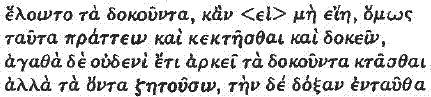
 . The passage contains, however, some obscurities. It is easy to understand that many would choose merely to seem to do what is
 or
 , but what does it mean to say that they choose merely to seem to possess these? Does it mean ‘to possess such things as it is honourable and just for them to possess'? Or, as Cornford's translation implies, ‘to possess the qualities of justice and honourableness’? Either way, the Greek is awkward, and the notion of ‘possession’ seems to be brought in simply to point the contrast with the attitude to
 , where ‘possession’ is an entirely appropriate notion, and
 is not even mentioned - indeed, if
 irpcirrew meant ‘do good deeds’ the point of the contrast would be lost by introducing it.
17 

 . As I have translated it, there is an important discrepancy between this and the Republic passage. The Philebus passage appears to say only that every being that knows it seeks the good, whereas in the Republic there is an unqualified assertion that all seek the good - which Socrates clarifies after the passage quoted by saying that, while every soul pursues the good and does everything for it, souls are at a loss and cannot grasp adequately what it is. Some translators (as J. C. B. Gosling (Plato: Philebus, Clarendon Press Series) who, however, admits in his note that the text is ambiguous) treat
 , as the object of
 and translate
 as ‘every-thing capable of knowing’. Although this interpretation harmonizes better with the Republic, it seems forced Greek to treat
 as absolute when it is followed by a word in the accusative, and unusual for the weak
 to precede the verb of which it is the object.
18 Cf. Meno 77 b ff., and see Gosling, , Plato (Arguments of the Philosophers, London and Boston, 1973) ch. II ‘Wanting the Good’.Google Scholar
19 The uses of these terms in Aristotle in general conform to their uses in Plato and have been usefully discussed by Austin, J. L., ‘ and
 in the Ethics of Aristotle’ (in Aristotle: A Collection of Critical Essays ed. Moravcsik, J. M. E., New York and London, 1978, pp. 261–96Google Scholar; also in Austin, J. L., Philosophical Papers, 2nd edn. (ed. Urmson, and Warnock, ), Oxford University Press, 1970, pp. 1–31)Google Scholar replying to Pritchard, H. A., ‘The Meaning of
 in the Ethics of Aristotle’ (in Moral Obligation, (Oxford, Clarendon Press, 1949), pp. 40–53Google Scholar; also in Aristotle, ed. Moravcsik, pp. 241–60); and by Ackrill, J. L., ‘Aristotle on Eudaimonia’, Proc. Br. Acad. (1974), 339–359.Google Scholar
20 Varieties of Goodness (London, 1963) 104Google Scholar; von Wright's acute analysis of the uses and meanings of ‘good’ does much to illumimate Plato's uses of  , although Plato would scarcely accept the view (VG 18) that moral goodness ‘is a “secondary” form’. The uses so far treated are discussed in chs. III (‘Utilitarian and medical goodness. The beneficial and the harmful. The notions of health and illness‘) and V (‘The good for man‘).
21 I say only ‘liable to be a moral element present’ to allow for cases where the terms are applied to human skills, for which see von Wright, VG, ch. II ‘Instrumental and Technical Goodness’. The influence of these uses of  on Plato's conception of goodness has been frequently emphasized, see e.g. Gould, J., The Development of Plato's Ethics (Cambridge, 1955)Google Scholar, ch. II., and Bambrough, J. R., ‘Plato's Political Analogies’, in Plato, Popper and Politics (Cambridge, 1967).Google Scholar
22 Along with  can be taken most uses of the adjective
 (closer in meaning to
 than the unenthusiastic term ‘pleasant’ is to ‘pleasure’) and the verb
 - also the verb
 which is treated as cognate with
 and, with some difference of nuance,
 . Plato leaves room for doubt about his view of the extension of the word
 ; although he is prepared, and at times keen, to assert that there are intellectual and philosophic
 , he never goes as far as Aristotle's assertion that ‘God always enjoys one simple pleasure’,

 (E. N. 7. 1154b26), he is at pains to make clear that pleasure and pain are inappropriate to the gods (Philebus 33 b; Epinomis 985 a), and he recoils with some horror from any association of it with the Form of the Good (Republic 6. 509 a). In the Protagoras Socrates seems to make light (358 a) of the distinctions Prodicus has drawn (337 c) between
 as intellectual enjoyment and
 as physical enjoyment but he does so without explicitly including
 in the terms he mentions as expressive of the notion of pleasure (

 ), and the distinction between
 and
 is more seriously reasserted at Timaeus 80 b. At the beginning of the Philebus (11 b) the terms listed as denoting pleasure correspond to those listed at Protagoras 358 a -

 .
23 See Tenkku, Jussi, The Evaluation of Pleasure in Plato's Ethics (Acta Philosophica Fennica XI, 1956), pp. 36–9Google Scholar; Sullivan, J. P., ‘The Hedonism in Plato's Protagoras’, Phronesis 6 (1961), 10–28, especially 19–20CrossRefGoogle Scholar. Socrates is of course asserting egocentric hedonism, not utilitarianism here, although Mill clearly has this passage in mind when he talks at the beginning of Utilitarianism of ‘the youth Socrates’ asserting ‘the theory of utilitarianism against the popular morality of the so-called sophist’, cf. his comment (Four Dialogues of Plato, Translation and Notes by Mill, J. S., ed. Ruth Borchard, London, 1946, p. 65)Google Scholar that ‘the principle of utility is as broadly stated and as emphatically maintained against Protagoras by Socrates in the dialogue as it ever was by Epicurus or Bentham’.
24 Thus Hackforth, R., ‘The Hedonism in Plato's Protagoras’, CQ 22 (1928), 39–42Google Scholar; Dodds, E. R., Plato, The Gorgias (1959), p.21 n. 3Google Scholar; Vlastos, G., Introduction to Plato: Protagoras tr. Jowett, B., ed. M. Ostwald, p. xl n. 50.Google Scholar
25 Thus J. and Adam, A. M., Plato: Protagoras (Pitt Press, 1893), p. xxxii.Google Scholar
26 Thus Taylor, A. E., Plato: the Man and his Work (London, 1926), pp. 260–1Google Scholar; Grube, G. M. A., ‘The Structural Unity of the Protagoras’, CQ 27(1933), 203 ff.CrossRefGoogle Scholar, and (most convincingly) J. P. Sullivan, op. cit., who, like Moreau, J., Construction de l'idealisme platonicien (Paris, 1939), pp. 62 ff.Google Scholar, compares the scorn for the vulgar exchange of pleasure for pleasure in Phaedo 68 a - 69 e.
27 We may agree with Vlastos, (op. cit., p. xli)Google Scholar that the views here asserted that ‘pleasure is a good’ and that ‘whatever is best will in fact be the most pleasant’ are both consistent with what Plato asserted ‘in his mature philosophy’, but it is hard to believe that Plato did not see the hedonism he here asserts as going much further than these propositions. See O'Brien, M. J., The Socratic Paradoxes and the Greek Mind (Chapel Hill, 1967), pp. 139–40 (n. 22).Google Scholar
28 Mill, by allowing difference of quality as well as difference of quantity in pleasure to be taken into account has seemed to many to have abandoned a crucial feature of utilitarian theory. See Utilitarianism (Fontana, ed.), pp. 257–62Google Scholar, and Quinton, Anthony, op. cit. (n. 4), pp. 39–43.Google Scholar
29 For the poetry and pushpin comment, see Bentham, , Works (Tait, Edinburgh, 1843) Vol. 2, pp. 253–4Google Scholar; for a critique of the assimilation of the two terms, see Austin, Jean, ‘Pleasure and Happiness’, in Modern Studies in Philosophy, Mill, ed. Schneewind, J. B. (London, 1978), pp. 234–50Google Scholar (originally published in Philosophy 43, No. 163).
30 The point is cogently put by Wright, von, VG, 99–101Google Scholar. Mrs. Austin (op. cit.) thinks that ‘it would be absurd to allow (a man's) own assertion as sufficient grounds’ for assessing his happiness (237), and later claims (247) that a number of moral predicates - ‘mean, unkind, malevolent, evil’ -strike one as logically incompatible with happy, and that ‘this incompatibility arises from the impossibility of a combination of moral condemnation with a favourable overall assessment’. This does not strike me as true of English usage and I would agree with Barrow (op. cit. n. 2, p. 60) that if it is generally true that unkind people are unhappy, ‘it is empirically true’. Barrow's discussion of this question (pp. 52–65) is in the main cogent: his fault lies in supposing the points he makes are equally applicable to  .
31 For useful discussions of these terms see Dover, K. J., Greek Popular Morality inthe time of Plato and Aristotle (Oxford, 1974), p. 174Google Scholar; de Heer, C., MAKAP 
 . (Amsterdam, 1969)Google Scholar; and Austin, J. L., op. cit. (n. 19)), pp. 16–20.Google Scholar
32 Herodotus 1.29–33. For the familiarity of the story see Aristotle, E.N.1, 1100a11 ff.
33 Sophocles O.T. 372–3.
33 And the Greek word  more directly corresponds to ‘fortunate’ or ‘lucky’. The man who is
 is expressly distinguished from the man who is
 or
 by Solon at Hdt. 1. 32.7.
35 Although it does frequently have reference to wealth, and it is in this connection that Dover (loc. cit. n. 30) discusses it.
36 See Ackrill, 's admirable comments, op. cit. (n. 19), pp. 348–9Google Scholar and cf. J. R. Bambrough's notes 2 and 227 to the revised Everyman translation of the Republic by A. D. Lindsay.
37 The suitability of  is never called in question by the Stoics, see, for instance, Zeno's claim (D. L. 7. 127 = von Arnim, SVF 1. 187) about

 . The only exception to this in Greek moralization that I know of comes at the other end of the ethical spectrum, in the view ascribed by D. L. (2. 87–8 = Mannebach, E., Aristippi et Cyrenaicorum Fragmenta (Leiden, 1961) fr. 169)Google Scholar to the Cyrenaics in general (although Mannebach, , op. cit., p. 108Google Scholar, thinks the view confined to the late philosopher Anniceris), that only individual pleasures are an end, not


38  , Phaedo 64 d.
39 Rep. 9. 583 b - 587 c, and cf. the notion of false pleasures in Phil. 36 c ff.
40 Long, A. A., Hellenistic Philosophy (London, 1974), p. 69.Google Scholar Interestingly, however, Mill is happy to count Epicurus as a utilitarian (passage cited above, n. 23, and cf. the reference in the first paragraph of ch. II of Utilitarianism to ‘every writer, from Epicurus to Bentham, who maintained the theory of utility’.)
41 For the interpretation of Thrasymachus' challenge see above all Kerferd, G. B., ‘The Doctrine of Thrasymachus in Plato's Republic’, Durham University Journal(1947-1948), 19–27, especially 25–6.Google Scholar
42 This characteristic of Greek moralization is well described by Quinton, , op. cit. (n. 3), pp. 11–12.Google Scholar
43 See Shorey, P. (‘Plato's Ethics’, a chapter from The Unity of Plato's Thought (1903)Google Scholar, reprinted in Modern Studies in Philosophy, Plato, A Collection of Critical Essays (ed. G. Vlastos) as the first study); Snell, B., The Discovery of the Mind (tr. Rosenmeyer, T. G.) (Harvard, 1953), ch. 8Google Scholar; and Adkins, A. W. H., Merit and Responsibility (Oxford, 1960), chs. XII ff.Google Scholar
44 The phrase is that used as the title of ch. 8 of Snell's The Discovery of the Mind (see previous note).
45 
 On the correct translation of this passage, see Burnet, (Euthyphro, Apology, and Crito ed. Burnet, J. (Oxford, 1924) ad loc.Google Scholar
46 2. 661 c - d, 

 .
47 It was in this form that Aristotle represented Plato as having effected the ‘reconciliation’, when in his elegies to Eudemus he wrote of Plato that ‘he was the only or the first of mortals who clearly showed by his own life and his methods of argument that a man becomes both good and  at the same time’.
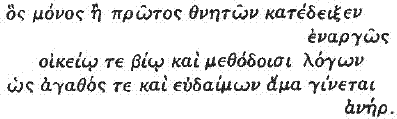
Aristotle Fragment 673, Rose (3rd edn.), = Ross, Aristotelis Fragmenta Selecta (O. C. T.), Carmina 2, p. 146.
48 Gorg. 497 d - 499 b; Phil. 55 b. In the Gorgias, the argument carries conviction with Callicles because he has already declared that a man who is brave and wise is good, and yet a brave man should, if the premiss were accepted and the pleasant was the same as the good, have more pleasure than the cowardly man, but in fact he evidently does not. Thus, the identification of the good and the pleasant is refuted ad Calliclem, and the way cleared for showing that the good man will also be  and just. This is a dialogue in which Adkins' distinction (op. cit. n. 43) between co-operative and competitive virtues is particularly relevant and illuminating - Callicles accepts the latter but spurns the former, and fits exactly into the pattern into which Adkins sees all Greeks as tending to fall. Cf. Dodds, (op. cit. n. 23), p. 314Google Scholar, and for a critique of the argument see Crombie, I. M., An Examination of Plato's Doctrines (London, 1962), i. 231–2Google Scholar, and note his (surely correct) view that ‘there is at least an intimate connection in Plato between the goodness of good men and the goodness of good things’. I do not agree with Crombie, however, that ‘it is taken for granted that moral goodness is the condition we want to attain to and good things are the things we want to have’. I would say rather that the second of these propositions is taken for granted, and that the first is what Plato is anxious to persuade us of.
49 There is room here for argument as to how the passage is to be understood. Is the Stranger asserting that the correct argument does not separate the pleasurable  from the just
 , nor the honourable
 from the good
 as is implied by Taylor's translation (Everyman)? Or is he saying that this argument does not separate the pleasurable on the one hand from the just, honourable, and good on the other, as is implied by Saunder's translation (Penguin)? Either translation is consistent with Platonic usage in general, and the context is very double-edged in its guidance.
50 See especially Rep. 9. 580–8; Laws 5. 732 e - 734 e.
51 Cf. Aristotle E. N. 5, 1130a3.
52 See above all A. W. H. Adkins, Merit and Responsibility.
53 ‘Moral Values in the World of Thucydides’, CQ N.S. 23 (1973), 213–31CrossRefGoogle Scholar, and see Adkins, 's reply, ‘Merit, Responsibility and Thucydides’, CQ 25 (1975), 209–20.CrossRefGoogle Scholar Adkins rightly takes me to task (209) for overlooking his valuable note on the notion of justice as helping friends and harming enemies (MR, p. 279 n. 6), and for appearing to suggest that he did not appreciate the importance of the co-operative element in competitive virtue, or of the prudential element in  . But I see no reason to alter my main points, that he has not established that
 and
 are automatically overriding value-terms, and that there is plenty to suggest that a ‘quiet’ sense of
 is far from novel in the fifth century. I have never, however, maintained that there are not plenty of uses of
 and
 from which any sense of justice is entirely absent.
54 See Dover, , (above, n. 31), pp. 69–70Google Scholar and cf. Dodds, (above, n. 24), pp. 249–50.Google Scholar
55 Charm. 159 c, 160 e; Laches 192 c, 193 d; Prot. 349 e.
56 This argument has been well discussed by Adkins, (above, n. 43, pp. 266–8)Google Scholar, Dodds, (above, n. 24, pp. 248–9)Google Scholar, and Vlastos, (‘Was Polus refuted?’, AJP 88 (1967), 454–60).Google Scholar
57 See Festugière, A. J., Contemplation et vie contemplative selon Platon (2nd edn. Paris, 1950), pp. 334–57, 454–5Google Scholar; and R. A. Markus in A. H. Armstrong and Markus, R. A., Christian Faith and Greek Philosophy (London, 1960) 89–9.Google Scholar Cf. Murdoch, Iris, The Sovereignty of Good (London, 1970), pp. 84 ff.Google Scholar
58 Above all Rep. 1., especially 332 c - 336 a, 352 d - 354 a; also Prot. 318 d ff., 354 e ff.; Hipp. Min. 373 c ff.
59 Euth., Laches, Charm., Prot. passim; for the further question and answer see Rep. 6. 505 b; Laches 199 c ff.; Charm. 174 a - 175 a.
60 Rep. 6.484 a-487 a, 7.537e-539 d (from which it emerges that if not philosophy, at least dialectic could, although it should not, be engaged in by the immature). Dialectic is here perhaps being separated from philosophy; it is certainly the implication of the general line of argument of the Phaedo that true philosophy requires the practice of moral virtue.
61 Rep. 6. 504 c - end of 7.
62 353 e - 354 a. The attempt of Mabbott, J. D. (‘Is Plato's Republic Utilitarian?’ p. 63, in Modern Studies in Philosophy, Plato, ed. Vlastos, Vol. ii)Google Scholar to defend Plato against a charge of ‘fallacious transition’ fails to note the crucial switch from a self-orientated to an externally oriented use of ‘living well’. The fallacious transition here lies surely in supposing that living well in the sense of performing the function of living well (‘instrumental goodness’ in von Wright's analysis) is the same as living well in a hedonic or egoistical sense - and, even if we accept Mabbott's view that the  is blessed or fortunate because he lives under divine protection, there is still a step unaccounted for - that the man who lives well ‘functionally’ will enjoy divine protection; Greek tragedy might appear to abound in examples of men who lived well - justly - and still did not enjoy divine protection.
63 On this crucial aspect of Plato's thought and its implications see Dodds, (above, n. 24), p. 236.Google Scholar Yet this claim for superior knowledge by the government to override preferences is quite consistent with utilitarianism.
64 As Barrow, (above, n. 2, pp. 159–64)Google Scholar seems to suppose; even if we admit, as I have argued we should not, that  is a ‘feeling-word’ like happiness, Plato still allows that philosophers get more enjoyment than others - see especially Rep. 9. 580–8.
65 Rep. 6–7 passim; Phaedo passim, especijally 69. Nor is the principle of equal happiness for all generally seen as essential to utilitarianism; see J. C. Smart in J. C. Smart and Williams, Bernard, Utilitarianism: For and Against (Cambridge, 1973), pp. 35–7.Google Scholar
66 (Above, n. 43), pp. 290–3.
67 Plato has, however, emphasized earlier (6.496–7), as Socrates also does in the Apology (31 c - 32 e), the practical impossibility of a philosopher surviving in contemporary society if he engages in politics.
68 Laws 8. 846 d ff.; 11. 918 a - 920 c, especially 919 c. See Morrow, G., Plato's Cretan City (Princeton, 1960), pp. 138–48.Google Scholar Cf. Aristotle, Politics 7, 1328b33 ff.