


 may be derived from the noun
 which in the modern Greek dialect of Epirus indicates some type of disease that leaves the scalp at least partially bare of its hair. It is often used with words such as
 psoriasis, or
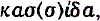 meaning, possibly, a disease caused by a type of ringworm which destroys the hair of the scalp. At present it is still used in mostly derogatory expressions, or in curses, such as:

 ‘Psoriasis and ringworm have eaten him up’ or,

 ‘May psoriasis and ringworm eat you up!’
 appears in Homer.

 cf. also
 Latin. domitor.


 (the proper name was, perhaps, attributed to early baldness due to disease or other reasons; cf. modern Greek surnames,
 ‘lame Demos’,
 ‘short George’). Cf. also as an adjective to
 ‘bald, hairless hair that rests upon the ground’, (or, because it rests upon the ground) Nic. Ther. 662 (variously explained by sch. Od. and sen. Nic): It might also mean ‘young’;
 ‘the young of wild pigs’ (probably so called because hairless when born) Ael. Nat. An. 7.47;
 (possibly a young, or a diseased, swine, or having some derogatory connotation); cf. also


 (Ar. Eg. 1286) N. Gr.
 in Ch. Patsis, M. Greek Lex.; cf. Sanskrit (
 ); mala-vaha, a. productive of impurity, defiling; mal-in a a. dirty, foul; mal-uka, m. a kind of worm.
 , Kroatisch-serhisch-deutsches Wörterbuch): moljac, m. Schabe, Motte; -a, mottenzerfressen; moljaka-nje, Gebettel; Russian: molb, moth; Albanian (

Crossref Citations

This article has been cited by the following publications. This list is generated based on data provided by Crossref.
Pakkanen, Petra
2021.
Beyond Skin-deep: Considering the pig in ancient Greece through the particularities of its skin.
Kernos,
Vol. 34,
Issue. ,
p.
123.