


 ), and what Perseus did to Polydectes and his unfortunate companions. For Zeus acting in this way compare 2. 319

 and (21.475 f.)
 .

 .
 .
 .
 or


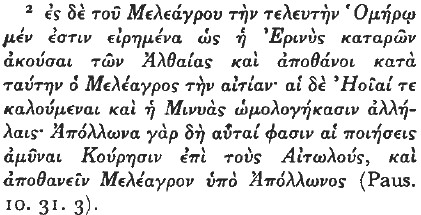
 says Apollo just before Achilles' death, [Q..S. 3. 40]). But Achilles, unlike Diomedes and Patroclus, disobeyed the god. Finally, I should not be surprised if, in some epic version of the fight between the Curetes and the Aetolians, Meleager came up against Apollo in the battle and heard the words of the god
 or
 .
 of Paris in 6. 326 was caused by the regularity of die
 theme as a reason for a hero being absent from the battle.)

Crossref Citations

This article has been cited by the following publications. This list is generated based on data provided by Crossref.
Griffin, Jasper
1978.
The Divine Audience and the Religion of theIliad.
The Classical Quarterly,
Vol. 28,
Issue. 1,
p.
1.
Stinton, T. C. W.
1979.
The First Stasimon of Aeschylus'Choephori.
The Classical Quarterly,
Vol. 29,
Issue. 2,
p.
252.
Gantz, Timothy
1981.
Divine Guilt in Aischylos.
The Classical Quarterly,
Vol. 31,
Issue. 1,
p.
18.
Andersen, Øivind
1982.
Thersites und Thoas vor Troia.
Symbolae Osloenses,
Vol. 57,
Issue. 1,
p.
7.
1983.
Myth and Personal Experience in Roman Love-Elegy.
p.
19.
1983.
Myth and Personal Experience in Roman Love-Elegy.
p.
167.
Janko, R.
1986.
TheShield of Heraclesand the legend of Cycnus.
The Classical Quarterly,
Vol. 36,
Issue. 1,
p.
38.
Held, George F.
1987.
Phoinix, Agamemnon And Achilleus: Parables and Paradeigmata.
The Classical Quarterly,
Vol. 37,
Issue. 2,
p.
245.
O'Brien, Michael J.
1988.
Pelopid History and the Plot ofIphigenia in Tauris.
The Classical Quarterly,
Vol. 38,
Issue. 1,
p.
98.
Swain, S. C. R.
1988.
A Note onIliad9.524–99: The Story of Meleager.
The Classical Quarterly,
Vol. 38,
Issue. 2,
p.
271.
Holt, Philip
1989.
The end of the Trachiniai and the fate of Herakles.
The Journal of Hellenic Studies,
Vol. 109,
Issue. ,
p.
69.
Willcock, M. M.
1990.
The Search for the Poet Homer.
Greece and Rome,
Vol. 37,
Issue. 1,
p.
1.
Yamagata, Naoko
1991.
Phoenix's Speech – is Achilles Punished?.
The Classical Quarterly,
Vol. 41,
Issue. 1,
p.
1.
Jones, P.V.
1992.
The past in Homer's Odyssey.
The Journal of Hellenic Studies,
Vol. 112,
Issue. ,
p.
74.
1995.
Mind, Body and Speech in Homer and Pindar.
p.
355.
1996.
I. Introduction: Background and Problems.
New Surveys in the Classics,
Vol. 26,
Issue. ,
p.
1.
Heath, John
2005.
The Talking Greeks.
Purves, Alex
2006.
Falling into Time in Homer'sIliad.
Classical Antiquity,
Vol. 25,
Issue. 1,
p.
179.
2007.
»... et recouvre d'une montagne leur cité!«.
p.
283.
Ausland, Hayden W.
2008.
Proëmial Prolepsis in Plato'sPoliteia.
Symbolae Osloenses,
Vol. 83,
Issue. 1,
p.
18.