


 ) can be true or false, names (
 ),
 ) of statements, are also capable of being true or false. From Aristotle onwards this view has often been challenged,
 , as R. Robinson has pointed out (‘The Theory of Names in
 .
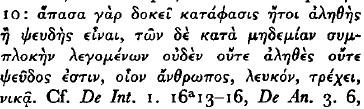 430a26-b2. Also Grote, Plato (2nd edn.), ii, 502 n. e.; Steinthal, Geschichte der Sprachwissenschaft, 108.
 at Sph. 237 d 2.
 presumably arose from ignorance of this idiom.
 III. Cf. Ast, Lexicon Platonicum, s.v.
 : adjectivi instar ponitur.
 in the Cra. is by no means restricted to the grammatical sense of ‘verb’, as defined at Sph. 262 a, though it could be so taken at 425 a and 431 b. Cf. p. 229 n. 1.

 .
 403 a, 404 b, 406 a, 414 a.
 commonly added after verbs of naming, and Ast, Lexicon Platonicum s.v. etwai for examples.
 may be grammatically redundant, but it brings out the point that the name is conceived as stating what the object actually is.
 is to be equated with ‘noun’ and
 with ‘verb’, but this may well be an over-grammatical interpretation. Stenzel (Pauly-Wissowa-Kroll, R.-E. s.v. Logik, vol. xiii, tots, and Plato's Method of Dialectic, tr. D. J. Allan, 126–7) maintains that even in the Sophist
 is not restricted to ‘verb’ but covers any kind of assertion. He points out that at Sph. 257 b the predicate ‘not-big’ is called a
 and refers to 251 a-b where
 and
 are used of predicates. Runciman, Plato's Later Epistemology, to8, n. 3, also questions whether ‘noun’ and ‘verb’ are legitimate translations.
 c. acc. (261 e 5) in contrast with the revelation of the assertorial statement where
 c. gen. is used (262 d 2).
 and
 , and, in connection with his definition of
 introduces the problem of the significance of parts of compound names.

 With
 cf. the many places in the Cra. where the ‘intended meaning’ of a name is expressed by
 e.g. 395 b 8, 401 C2, 410 b 8, 414 a 3, 414 d3, 418 d 5, 421 b 7. Aristotle covers the same ground in Poet. 20, 1457a10–14, but without the concept of
 .
 An. Post. 2, 10, 93b31. Ross, ad loc., takes
 to mean ‘noun-like phrase’.
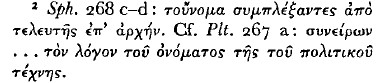
 in Phlb. 38 b ff., with its picture of the soul as a book in which true and false accounts may be written (39 a).
 (trans. by Cornford). In Sph. 234 b Plato exploits the ambiguity of
 (‘draw’ or‘write’) just as he does at Cra. 431 c-d.

 to co-operate with the
 .

Crossref Citations

This article has been cited by the following publications. This list is generated based on data provided by Crossref.
Bagwell, Geoffrey
2011.
Does Plato Argue Fallaciously at Cratylus 385b–c?.
Apeiron,
Vol. 44,
Issue. 1,
Bruzzone, Rachel
2015.
Killing the Past in Thucydides’ Plataean Debate.
Classical Philology,
Vol. 110,
Issue. 4,
p.
289.
2017.
Rahman, Shahid
McConaughey, Zoe
Klev, Ansten
and
Clerbout, Nicolas
2018.
Immanent Reasoning or Equality in Action.
Vol. 18,
Issue. ,
p.
277.
2020.
Healow, C. G.
2020.
Extreme and Modest Conventionalism in Plato’sCratylus.
Apeiron,
Vol. 54,
Issue. 1,
p.
1.