



 . However, he wisely ignores the interpolated
 in his translation. As Wyttenbach later commented (loc. cit. note 2): ‘Locum jam antea corruptum magis etiam corrupit Steph[anus]’!
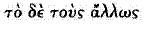

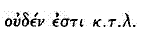
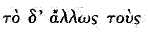

 this could mean ‘neither… nor’ (and, as we saw, Wyttenbach certainly takes it that neither do the gods benefit men, nor do men benefit the gods). However, depending on the context, it can also mean ‘both… and to the same extent’. Cf., for example, Plutarch, q. conviv. 3.5, 727D (chattering is no more characteristic of swallows than of jays or partridges—but both chatter);de prim. frig. 13, 950C (there is no more darkness in air than water—but water is certainly dark); also D. L. 1.66 (Solon has no more quarrel with Pisistratus than any opponent of tyranny—but there is that much quarrel). Since we have just been told unambiguously at least that men benefit the gods (i.e. ‘affect and sustain them by virtue’), this must be the correct way of taking the construction here.
 AS P. Donini rightly argues, Plutarch is not considering a position that Chrysippus could have held: see ‘Plutarco e il Determinismo di Crisippo’, in Aspetti dello Stoicismo e dell' Epicureismo in Plutarco; Quaderni del Giornale Filologico Ferrarese 9 (Ferrara, 1988), pp. 21–32.

Crossref Citations

This article has been cited by the following publications. This list is generated based on data provided by Crossref.
Ferrarello, Susi
2025.
Husserl and Stoicism: The Theory of Meaning as a Bridge to Mindfulness.
Journal of Humanistic Psychology,
Vol. 65,
Issue. 2,
p.
370.
Niccolai, Lea
2026.
Readers of the Living: Interpretive Mastery and Natural Thinking in Plutarch, Celsus, Origen, and Porphyry.
Antichthon,
p.
1.