


No CrossRef data available.
Article contents
Extract
The influence which the Pythagorean society and its leading doctrines exercised upon Athenian intellectual and political developments in the late fifth century leads us to seek in Pythagoras a figure of greater stature and more clear-cut features than modern scholarship is prepared to allow. To us he is a great name but little more, the large body of detailed information about his life which is available in later writers being dismissed as fabulous. This scepticism was reasonable enough when the reader was faced with the garbled hotchpotch of an Iamblichus or a Porphyry. But since the task has been put in hand of determining what portions of this tradition can safely be attributed to the various authorities who concerned themselves with the Pythagorean story in the fourth century, and of considering the respective historical value of these authorities, the scepticism of, for example, Burnet's account becomes unjustified. It is now possible to present a fairly detailed account of Pythagoras' activity, which has at least as much claim to credence as a great deal of what we now readily accept as ancient history, and is furthermore consistent with the general picture of the man that emerges from a careful scrutiny of classical sources. Not only for its own sake, but in the context of the increasingly fruitful investigation of fifth-century Athenian movements, I feel that it may be useful to put together such an account of Pythagoras. It will certainly be regarded by some as mere fiction, but may nevertheless provide others with a convenient summary of what the fifth- and fourth-century writers thought and believed about a man and a movement that had profound influence upon their times. I hope at the same time to suggest some links between what Pythagoras thought and did and the main tradition of Greek social behaviour. If Pythagoras was, as I believe, not so much an innovator as a reformer and developer of some of the central institutions of Greek life, the possibility will be opened of regarding various phenomena in mainland Greece which we have been asked to call Pythagorean, e.g. the Socratic phrontisterion as it appears in the Clouds, not as deriving from Pythagoras but as a parallel growth to the Pythagorean synedria and nourished by the same root.
Information
- Type
- Articles
- Information
- Copyright
- Copyright © The Classical Association 1956
References
page 135 note 1 e.g. the careful work of Fritz, K. von, Pythagorean Politics in Southern Italy, Col. U.P. 1940.Google Scholar
page 135 note 2 Diels-Kranz (hereafter DK), B 7; cf. Heraclides Ponticus fr. 89 W. also Dicaearchus fr. 36 W. and Aristoxenus fr. 12 W. See Kranz, , Hermes lxix (1934), 227.Google Scholar
page 135 note 3 Fr. 30 von Blumenthal. See Kranz, , loc. cit.Google Scholar
page 136 note 1 DK, B 129.
page 136 note 2 DK, B 40.
page 136 note 3 DK, B 81.
page 136 note 4 Fr. 24 von Bl.
page 136 note 5 Diogenes Laertius 9. 18.
page 136 note 6 DK, B 129.
page 136 note 7 4. 95.
page 136 note 8 Following Linforth, (Arts of Orpheus, 1940, pp. 39 ff.)Google Scholar and Nilsson, (Harvard Theological Review, 1935, p. 206, n. 93)Google Scholar I omit (with MSS. A, B, and C) the words 

page 136 note 9 Cf. the phrase of Proclus in Plat. Tim. 42 c, d (O.F. 229): 

page 136 note 10 [Dem.] 25. 11, Plat. Ep. 7. 335 a.
page 137 note 1 Possibly that mentioned at 2. 81.
page 137 note 2 See Eur. Rhesus 941 ff.
page 137 note 3 58 ff. I give the translation of Sir J. E. Sandys in the Loeb edition.
page 138 note 1 114a-c Bowra.
page 138 note 2 127 Bowra.
page 138 note 3 Fr. 192 R.
page 138 note 4 DK, B 146.
page 138 note 5 28 ff.
page 138 note 6 10. 600 b.
page 138 note 7 6. 782 c.
page 139 note 1 Minar, E. L., Jr., Early Pythagorean Politics in Practice and Theory, Baltimore, 1942, p. 4.Google Scholar
page 139 note 2 4. 95 f.
page 139 note 3 See F. Gr. Hist. i. 5.Google Scholar In Suidas he is a contemporary of Herodotus. He was a pupil of Hellanicus and one of his works had the title 
page 140 note 1 Cf. Alcman, p. 71, Diehl: ‘at feasts and in the confraternities of the men's halls  it is fitting to strike up a paean before the face of the diners’. These were admittedly not Ionian occasions: but Callinus and Xenophanes exhorted the
 at their banquets: and Alcaeus, p. 54, speaks of a great hall at Lesbos decorated with arms and armour which reference to Hdt. 1. 34, where arms are said to hang on the walls of the men's rooms
 , shows to be an andreion. See Page, D. L.Sappho and Alcaeus, p. 222.Google Scholar
page 140 note 2 4. 94.
page 140 note 3 298, see Rohde, , Psyche, Eng. tr., p. 279.Google Scholar
page 140 note 4 See Aristophanes, Clouds 507 f. 
 and the very full account in Guthrie, , The Greeks and their Gods, pp. 224 ff., including a translation of the descriptive passage in Pausanias (9–39 ff.).Google Scholar
page 141 note 1 Rk. Mus. xxvii (1872), 49.Google Scholar
page 141 note 2 See also a similar connexion of thought in Lucan's account of the Druids' doctrines: Phars. 1. 452–62.Google Scholar
page 141 note 3 So Minar, , op., cit., p. 5.Google Scholar
page 141 note 4 Aristoxenus fr. 19 W.
page 141 note 5 Op. cit., p. 66.Google Scholar
page 141 note 6 See below, pp. 148 f.
page 141 note 7 F Gr Hist. 566 F 13, 14, 17. 131.
page 141 note 8 2. 39.
page 141 note 9 Pompeii Trogi Hist. Phil. Epit. 20. 4. 1 (Seel, Teubner, 1935).Google Scholar
page 141 note 10 14. 638.
page 142 note 1 ap. Iamblichum, V.P. 254–64.
page 142 note 2 1. 118. A2, fr. 14 W.
page 142 note 3 V.P. 15.
page 142 note 4 Cf. also Aristotle fr. 191 R. for P.'s connexion with Pherecydes.
page 142 note 5 Iamblichus, V.P. 248, is evidence that there were some who said that P., when he left Croton at the time of the first conspiracy against the Pythagoreans, went to Delos to bury Pherecydes. In Porphyry (V.P. 56) this account is specifically rejected on the authority of Dicaearchus and 
page 142 note 6 Apollonius of Tyana (Porph. V.P. 4) is evidence that he was a pupil of Anaximander.
page 142 note 7 Op. cit., pp. 53 ff.Google Scholar
page 142 note 8 Mary White in J.H.S., 1954, pp. 36 f. argues that the Samian tyranny began under Polycrates' father and that Pythagoras may have reached Italy as early as 550, in time to be responsible for the ‘incuse’ coinages which appear about that time. This early date does not seem to me to fit the course of events in southern Italy.Google Scholar
page 142 note 9 11 and 28.
page 142 note 10 Fr. 16 W. ap. Porph. V.P. 9.
page 142 note 11 The traditional dates are fairly consistent. Diodorus (10. fr. 3) says that P. ‘was recognized’ in the 61st Olympiad, when Thericles was archon at Athens, i.e. in 533. Iamblichus (V.P. 35) says that he came to Italy in the 62nd Ol., i.e. 532–529 (see Jacoby, , Apollodors Chronik, pp. 218 ff.Google Scholar). D. L. (9. 45) states that his akme was in the 60th Olympiad, i.e. 540–537.
page 143 note 1 Fr. 17 W.
page 143 note 2 Porph. 21, Iamb. 33–34.
page 143 note 3 A. is, of course, guilty of gross anachronism in making Zaleucus and Charondas contemporaries of P.
page 143 note 4 Kahrstedt, , Hermes, liii (1918),180 fF.Google Scholar: see Fritz, , op. cit., ch. vi.Google Scholar
page 143 note 5 See Dunbabin, , The Western Greeks, p. 359.Google Scholar
page 143 note 6 Pomp. Trog. Hist. Phil. Epit.: 20. 4. 1.Google Scholar See Fritz, , op. cit., p. 41.Google Scholar
page 144 note 1 29.
page 144 note 2 Fr. 33 W.
page 144 note 3 So Damon addressed, or pretended to address, the Areopagus (DK 37 B 2).
page 145 note 1 ap. Porph. & V.P. 4=F Gr Hist. 566 F 131.
page 145 note 2 Fr. 35 W.
page 145 note 3 45 ff.
page 145 note 4 50.
page 145 note 5 See Gruppe, , Gr. Myth., pp. 615.Google Scholar
page 146 note 1 F. Gr. Hist. 566 F 13a.
page 146 note 2 Ibid. 13b.
page 146 note 3 Fr. 18 W
page 147 note 1 2. 39.
page 147 note 2 Op. cit., p. 68:Google Scholar Neanthes ap. Porph. V.P. 54–57 and Iamb. V.P. 252–3 (Nico-machus).
page 147 note 3 The opinion of ‘Dicaearchus and the more accurate authorities’ is inserted by Neanthes (see Fritz, , op. cit., pp. 6 ff.Google Scholar). There is no ground for supposing that Dicaearchus made the confusion.
page 147 note 4 254–64.
page 147 note 5 Bibl, . de la Facult´ de Liége. xxix. 203 ff.Google Scholar
page 147 note 6 Diss. Koenigsberg. 1914.
page 147 note 7 Op. cit., p. 55.Google Scholar
page 148 note 1 i.e. the Pythagoreans.
page 148 note 2 257.
page 148 note 3 I can see no reason why Minar (p. 56) should insert ‘a period of agitation’. Apollonius says  Once a measure in favour of a popular assembly had been carried there is no reason why the assembly should not have been convened at once.
page 148 note 4 Cf. Iustinus: ‘quasi coetum clande-stinae coniurationis haberent’.
page 148 note 5 M. (p. 57) supposes a break here. His arguments are as follows, with my replies: (1) Exiles are spoken of later (262) without explanation. But this is an easy, if not quite accurate, description of the epheboi, and there is no need to suppose, what M. says is so unlikely, that the exiles were recalled and put on trial. (2) The subsequent sections manifestly refer to c. 453. If there is no break, or only a short passage omitted, Iamblichus' whole narrative, which we have heretofore assumed to refer to the times of Pythagoras and Cylon, must in fact have referred in the original source to the later struggle. But this does not take into account the phrase  at the beginning of 263. (3) ‘In section 263 Litates is called the most prominent of the democratic leaders’ and he has not been mentioned before. But this statement refers to a time ‘after the lapse of many years’. And the descriptive clause ‘who was the most prominent of the revolutionaries’ suggests that the narrator is aware that he has a new character to introduce.
page 149 note 1 We may compare Solon the mediator, who did the former but not the latter.
page 149 note 2 Cf. Polybius 2. 39. 4 (Timaeus). Iustinus knows of only one attack, the latter, and he speaks of exiles as a result of this.
page 149 note 3 Op. cit., pp. 72 ff.Google Scholar
page 150 note 1 ap. Porph. V.P. 56.
page 150 note 2 Nomoi is used in the same sense in a passage in D. L. (8. 3) which may, as Minar believes, rest on Dicaearchus: ‘laying down nomoi for the people of Italy P. gained great fame together with his disciples who to the number of 300 managed the government very well, so that the city was almost an aristocracy’.
page 150 note 3 ap. Iamb. V.P. 254.
page 150 note 4 Iustinus 20. 4. 14; Iamb. V.P. 260.
page 150 note 5 V.P. 71 ff.
page 151 note 1 Cf., e.g., Plato Laches 179 b.
page 151 note 2 Diodorus (10, fr. 3, 5) describes die inner Pythagorean circle as 

page 151 note 3 Cf., e.g., Hdt. 5. 71.
page 151 note 4 Xen. Lac. Pol. 5. 2.
page 152 note 1 De genio Socratis 13. 583 a: 

page 152 note 2 961 ff.
page 152 note 3 e.g. Antiphon DK, B 60 and Iamb. V.P. 51; Ant. DK, B 44 col. 1, 2 and Iamb. V.P. 48; Ant. DK, B 50 and Iamb. V.P. 46.
page 152 note 4 See Porphyry's summary of Pythagoras' secret doctrine in V.P. 19: 
page 152 note 5 See above, p. 136.
page 152 note 6 Math. 9. 127.
page 153 note 1 This doctrine occurs in the discourse to the youths in Iamblichus (V.P. 40).
page 153 note 2 507 e ff.
page 153 note 3 Fr. 84.
page 153 note 4 
page 153 note 5 Fr. 23 W.
page 153 note 6 DK 44 B 6.
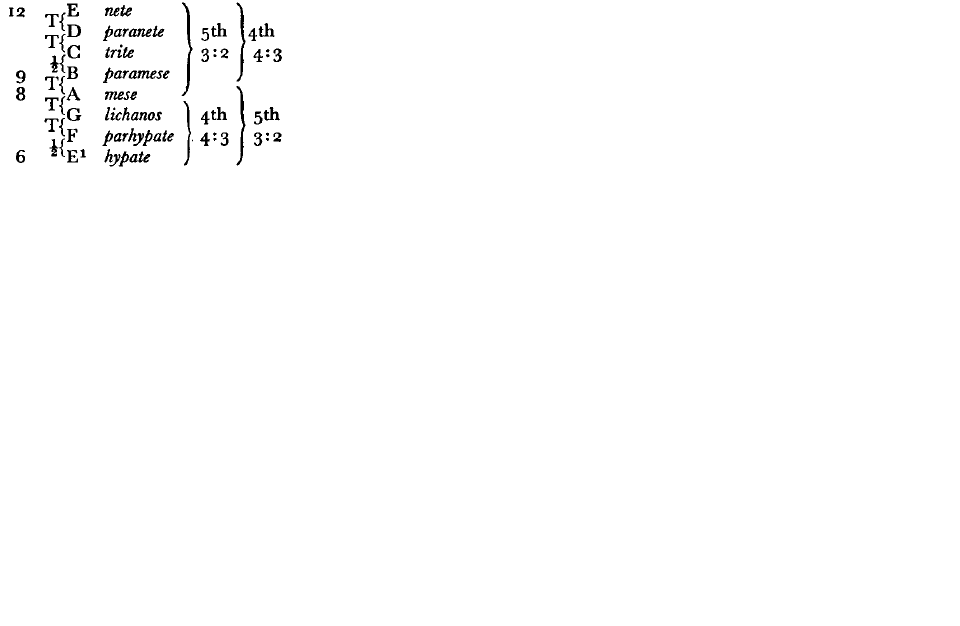
page 153 note 7 The fragment continues: ‘The interval of the octave is a fourth (syllabe 53:4) and a fifth (di' oxeion; 2:3); and the fifth is greater than the fourth by a tone (epogdoon; 8:9). Now from E 1 (hypate) to A (mese) is a fourth, and from A 1 to E (nets) is a fifdi, while from E to B (trite, later paramese) is a fourth, and from B to E 1 a fifth. The interval between A and B is a tone. The fourth is a relationship of 3:4, the fifth of 2:3, while the whole octave is a relationship of 1:2. So a harmonia consists of five tones and two half tones (dieseis), a fifth consists of three tones and a half tone, and a fourth consists of two tones and a half tone.’
The scale may be set out thus:
page 153 note 8 DK B 1.
page 154 note 1 For an example of the way in which a numerical relationship may serve as a bond to preserve the harmony of the universe compare Anaximander's world-picture and the image of the universe in the myth of Er.
page 154 note 2 Greek Mathematics, pp. 84–85.Google Scholar
page 154 note 3 See Heath, , op. cit., p. 86.Google Scholar
page 154 note 4 . 431 d ff.
page 155 note 1 443 d.
page 155 note 2  DK 47 B 3.
page 155 note 3  : the fragments occur in Stobaeus (4. 1. 135–8, 5. 61). These in ch. 1 occur immediately before the fragment from the
 Early critics, e.g. Hartenstein (1833) and Beck-mann (1844), defended the political fragments against the charge of containing Platonic and Aristotelian matter. The Hebraisms which Gruppe saw in them, e.g. the metaphor of a shepherd to describe a ruler, are plainly illusory. I can see no reason why the political fragments should not be classed with the mathematical ones as genuine.
page 155 note 4 135.
page 155 note 5 136.
page 155 note 6 Harmonic: 3, 4, 6, 12; Geometric, 1, 2, 4, 8; Arithmetic 1, 2, 3, 4.
page 156 note 1 See Heath, , op. cit., pp. 85,Google ScholarManual, p. 51.Google Scholar
- 9
- Cited by