


 . ‘A latere eliditur’ (Oltramare's reading) I take to mean ‘is squeezed out by pressure from the side as clouds come together’, i.e. by the clouds exerting pressure from both sides on the exhalation at right angles to its resultant motion (…

 , Mete.369a22–3). But Hine, p.391, points out that ‘a latere’ is not found in the reliable manuscripts, which have ‘alterum’; this makes no sense, and he reads ‘actarum’ (conjectured by Brennecke, p.3 7). I prefer ‘a latere’, as closer to Aristotle.
 (middle, ‘holding them selves around’, unless E. W. Webster's
 is right-see
 into spiritus, reasonably, since exhalation causes wind; and Aristotle's explanation does involve a mass of the stuff encountering flame; but Aristotle says nothing of moisture, nor of exhalation bursting. (I have been much helped by Hine's commentary here.)
 , for the (surprising)
 of Mete.343 b 23. However, neither manuscripts nor ancient commentators support this, nor would it justify Seneca's ‘Aristoteles ait non trabem … fuisse’.


 . This adds nothing.

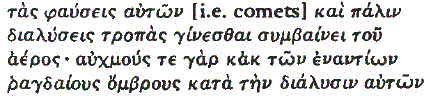
 . Cf. F131b lines 20–2.
 (which dealt with winds: Mete.363a24. The extant Problems 26 is on wind but contains nothing relevant to Seneca). But it is unlikely that any Aristotelian work contradicted Mete.'s statement that comets are a sign of drought and may affect a year's weather, since chat seems to have been the regular view: see above, nn.4 and 6, p .415, and Aratus 109 3,
 .
 , and the younger Pliny tells how his uncle made voluminous notes from his reading, on which (evidently) he based his published works (Ep. 3.5.10, 15, 17). Seneca may have made similar notes.

 from
 , cf. 103 b (
 ) and Parmenides 130 b (distinguishing

 ). Interpreters disagree over whether ‘largeness in us’ (etc.) is really something distinct, in Plato's mind, both from the Form ‘largeness’ and from large objects (see G. Vlastos, ‘Reasons and causes in the Phaedo’, in his Platonic Studies (1973), pp.84 f. and notes). It at least seems clear that Plato did not develop this notion of immanent characters, nor does he in the dialogues call them
 ).

 ; Phaedrus 247 c-e
 ; cf. Seneca's ‘exsuperat omnia’, ‘per excellen-tiam esse’), and Ideas are called divine (e.g. Phaedo 80 b
 ); but they are not said to be deoi or Serfc. The Demiurge is called 6 fled? (Timaeus 30 a 1 etc.), but is not explicitly a supreme sort of being, since he is not said to be superior to the Forms (although many interpreters have supposed that he is so; see
 , and immortal
 of sensible things: Republic 507b-510, 596 b; Timaeus 27 d-29); the fifth kind seems to be a way of referring to genera and species, which in Platonic terms would mean the Forms once again; the sixth kind, ‘quae quasi sunt’, suggests what is said of the Receptacle in Timaeus 49 a–51 a, and of the objects of Srfja which ‘partake in being and in not-being’ in the Republic (e.g. 478 e). (However, Bickel op.cit. gives rather different interpretations, especially of the fourth and fifth kinds; which shows how remote from Plato all this is.)
 (Timaeus 52 a–), which might be identified with void; but the latter identification is not made in the Timaeus.
 and therefore
 but not
 (SVF ii.329, 331; cf. Theiler, quoted by Bickel op.cit. p.4)-note that Seneca, Ep.58, does not accept this, allowing the classification of incorporalia among quod est, and evidently confining the class of
 which are not
 to figments such as centaurs (Ep.58.11–12, 15). (Bickel disagrees with Theiler, but his view (op.cit. pp.6 f.) seems to me much less plausible.)

 and
 Timaeus 29 a, the Demiurge is
 . Form: Pbaedo 100 c,
 of other things' beauty. Purpose: Timaeus 29 d–30 b. (On immanent forms see above, p.417, n.2.)
 and gold.
 , cf. De opificio mundi 17–20; Albinus, Didascalicus 9
 etc. (On this theory see A. N. M. Rich, ‘The Platonic Ideas as the thoughts of God’, Mnemosyne ser.4, 7 (1954), 123–33; A. H. Armstrong ‘The background of the doctrine “That the intelligibles are not outside the intellect”’,
 . See Top.l56a31 ff.,

 . Cf. Rhet.1378a31–3 (similar, but more elaborate).

 (etc.; 953 33 ff.), or

 . (954a31–3).
 .Cf. 369b 19–20:
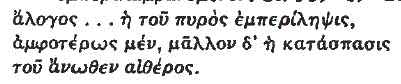 .
 (save for Archelaus, who adopted Anaxagoras' theory: Aetius 3.3.5 DK 60 A 16).
 for
 .
 of thunder. I do not think any of the three questions in ‘Quare inaequalia … in sonum valuit’ are answered elsewhere in any account of a pre-Socratic or in Aristotle.
 , unparal leled in Aristotle Metaph. A 983b6 ff. (DK 11 A 12).


 . But we can hardly regard this as independent evidence for Thales when Aetius does not name him.

Crossref Citations

This article has been cited by the following publications. This list is generated based on data provided by Crossref.
Epp, Ronald H.
1985.
STOICISM BIBLIOGRAPHY.
The Southern Journal of Philosophy,
Vol. 23,
Issue. S1,
p.
125.
Williams, Gareth
2005.
Interactions: Physics, Morality, and Narrative in SenecaNatural Questions1.
Classical Philology,
Vol. 100,
Issue. 2,
p.
142.
Williams, Gareth
2007.
Seneca on Comets and Ancient Cometary Theory in Natural Questions 7.
Ramus,
Vol. 36,
Issue. 2,
p.
97.
Williams, Gareth
2008.
Cold science: Seneca on hail and snow inNatural questions4B.
The Cambridge Classical Journal,
Vol. 54,
Issue. ,
p.
209.
Taub, Liba
2012.
The Encyclopedia of Ancient History.
2012.
Doody, Aude
2013.
A Companion to the Neronian Age.
p.
288.
Taub, Liba
2016.
A Companion to Science, Technology, and Medicine in Ancient Greece and Rome.
p.
232.
Glauthier, Patrick
2018.
Playing the Volcano:Prometheus Boundand Fifth-Century Volcanic Theory.
Classical Philology,
Vol. 113,
Issue. 3,
p.
255.
Taub, Liba
2019.
The Encyclopedia of Ancient History.
p.
1.
de Castro Caeiro, António
2026.
What More Can We Say about Seneca?.
p.
87.