


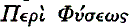
 and the
 There is no agreement about the famous simile to illustrate respiration, generally known as the Clepsydra, and the stages and nature of the cosmic cycle continue to be disputed. Perhaps we can never be certain about these aspects of Empedocles' thought, for the evidence fails at every crucial point and the imaginative reconstructions which have to serve are unlikely to win universal acceptance. It may then appear hazardous to discuss the fragments concerned with thinking and sense-perception, for these too are riddled with problems. I do so prompted partly by the timely reprint of J. I. Beare's book, Greek Theories of Elementary Cognition, and also because this feature of Empedocles has been touched on by modern scholars but not studied in any detail. At the same time the significance of the
 is greatly affected by how we interpret the theory of sense-perception and thinking.
 occurs once in the
 B 138,
 where it is generally taken to mean ‘life’ as in Homer. For
 cf. B 115, B 126, and Plutarch's introduction of B 122. At B 59 in the

 has no meaning of ‘soul principle’ but refers either to Love and Strife (so Diels-Kranz) or to the four elements. Whether every man has been, possesses, or can become a
 is not at all clear. But the principle has nothing to do with cognition.
 and
 are Empedocles' words to denote ‘intellect’, cf. B 2. 8; B 17. 14; B 23. 9; B 136. 2.
 B 115. 13) and
 DK, p. 360, 1 (from Porphyry). But the evidence is too scanty to permit any firm conclusion; see further p. 274.

 was unlikely to have included any theology. But the
 of B 29 is a material entity and the repetition of these lines in B 134 suggests that the two passages may belong together. Yet even if the
 and the
 are closely connected this does not provide a link between human thought and the thought of the ‘holy mind which darts all over the world’; see

 line 5 (if
 is the righi reading) and requires humour in Empedocle: which would be not only unique, but alsc quite inappropriate to the highly serious torn of the
 This interpretation is forcec upon van Groningen because he wishes to find B in spurious, and all claims by Empedocles to superior powers must therefore be explained away. B III should bt interpreted with an eye to B 129,

 Whether or not this refers to Pythagoras, it reveals an awareness in Empedocles that some men possess extraordinary powers, cf
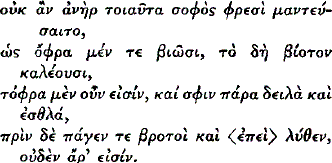


 here equals air as well as water. Galen (A 34) says that the
 of compound bodies is composed from all four elements, but Aetius (A 78) omits air from the formation of sinews and claims that nails are produced when ‘chilled sinews’ encounter air. Em pedocles' position comes close to that of Anaxagoras, but he probably did not hold that ‘everything has a share of everything’; cf.


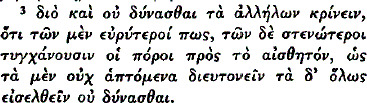


 On its origins and history see

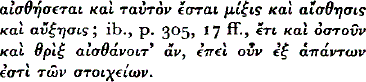

 Diels's supplement is almost certainly right since we have Empedocles' own words for the water in the eye, B 84. 10.
 to the two MSS. readings,
 and
 see
 and
 in Theophrastus mean the eye's fire and fire (light) outside the eye. In B 85 when describing the formation of the eye Empedocles talks of
 meeting earth, and
 is used in B 84. 11. In B 84. 5,
 and
 are both attested for the lantern light.
 in 1. 11 lacks a subject, but
 added by Diels, is certain, cf.

 12–13. I retain
 in 1. 10 with Beare, instead of reading
 (Karsten) adopted by Diels, see


 but questions this in a note, p. 96.
 means something in the ear discovered by dissection. Yet whatever Empedocles referred to by
 cannot now be determined; and at this date philosophers did not feel obliged to modify theories if empirical evidence failed to confirm them. It cannot simply be assumed that Aetius's source is drawing his own conclusions from the word


 for sight, De An. 418a7 ff.) which when actualized provides a communication between object and organ. Aristotle's theory, as Solmsen has shown,
 act directly on the
 Empedocles seems to have welded together a new scientific theory of perception based upon his general postulates about the natural world and the common-sense fact that we appear to see when there is light and to hear when there are sounds to be heard. See in general


 The
 are clearly blood-vessels and probably have nothing to do with transmitting

 as ‘das Seiende’. His attempts to establish a syste matic concept of being in Empedocles are not wholly convincing.
 B 17. 27,


 and
 B 84. 10–11; and especially Heraclitus

 B 1 see
 and
 Parmenides B 1. 28, etc. This is natural enough in poetry.
 and
 to mean ‘our own nature and character’. This is perhaps possible and simpler, but it seems to me more appropriate in the context to refer the words to ‘elements’. At B 17. 28
 it is each element which has its own character. I follow Schwabl's interpretation,
 in a transitive sense, following Wilamowitz, Kranz, and Schwabl against Diels, Burnet, and Bignone. In the active elsewhere in Empedocles
 is transitive, cf.
 B 17. 14, and B 37. Even if we translate with Burnet, ‘these things will each grow into the heart’, the process must still work in the manner outlined above. But the context naturally requires a distinction between external and internal elements, cf. B 106,

 ‘human understanding (internal elements) grows in relation to what is present (external elements)’.


 on the basis of Em pedocles' own words in B 37,


 B 3. 12, where
 may be more than a metaphor.
 B 17. 14,

 a line which sums up in less technical language the essentials of the process set out in B 110.

 and
 and

 are Homericisms not attested elsewhere.


 cf. B 17. 22–23.
 (sc. the other three elements)
 Line 4 of this fragment, though corrupt, repeats the emphasis on approximate equality.


 (sc. Empedocles).
 notion on Empedocles since it was so much a feature of the Academic tradition. It is, moreover, strange if Plutarch (in spite of the work in ten books on Empedocles which the Lamprias catalogue [43] attributes to him) had access to passages of Empedocles unknown to Aristotle. Yet if Aristotle knew of such a passage his vagueness and speculation about
 m Empedocles become very surprising.
 des Empedokles’, Sitzb. Berl. (
 B 110. 1; cf.

 B 3. 2. This is a point well made by
 of the
 is ‘nicht Prinzip der Geistigkeit als solcher, sondern in erster Linie Prinzip des selbstverschuldeten oder selbstverdienten Schicksals’.

Crossref Citations

This article has been cited by the following publications. This list is generated based on data provided by Crossref.
Villing, Alexandra
2002.
For whom did the bell toll in ancient Greece? Archaic and Classical Greek bells at Sparta and beyond.
The Annual of the British School at Athens,
Vol. 97,
Issue. ,
p.
223.
Tell, Håkan
2007.
Sages at the Games: Intellectual Displays and Dissemination of Wisdom in Ancient Greece.
Classical Antiquity,
Vol. 26,
Issue. 2,
p.
249.
Macris, Constantinos
and
Skarsouli, Pénélope
2012.
La sagesse et les pouvoirs du mystérieux τις du fragment 129 d'Empédocle.
Revue de métaphysique et de morale,
Vol. N° 75,
Issue. 3,
p.
357.
Trépanier, Simon
2016.
Oxford Bibliographies in Classics.
Thibodeau, Philip
2016.
A Companion to Science, Technology, and Medicine in Ancient Greece and Rome.
p.
130.
Brémond, Mathilde
2017.
Le Logos d’Empédocle : Reconstruction d’une lecture stoïcienne
.
Elenchos,
Vol. 38,
Issue. 1-2,
p.
127.
Hladký, Vojtěch
2018.
Transmigrating Soul Between the Presocratics and Plato.
Aither,
Vol. 10,
Issue. 20,
p.
20.
2018.
Cain, Emily R.
2018.
Medically Modified Eyes.
Studies in Late Antiquity,
Vol. 2,
Issue. 4,
p.
491.
Carter, Jason W.
2019.
Aristotle on Earlier Greek Psychology.
Bourbon, Marion
2020.
De lakrasisprésocratique à lakrasisstoïcienne : l’émergence d’un modèle organique de l’individualité.
Elenchos,
Vol. 41,
Issue. 1,
p.
165.
Bartoš, Hynek
and
King, Colin Guthrie
2020.
Heat, Pneuma, and Soul in Ancient Philosophy and Science.
Hedrick, Robert E.
2021.
Plato on Democritean Films.
Mnemosyne,
Vol. 75,
Issue. 3,
p.
427.
Santaniello, Carlo
2022.
Putting Fragments in Their Places: The Lost Works by Empedocles.
Elenchos,
Vol. 43,
Issue. 2,
p.
197.
Kaluđerović, Željko
2023.
Empedocles on Ensouled Beings.
Conatus,
Vol. 8,
Issue. 1,
p.
167.
Sassi, Maria Michela
2023.
Blood and the Awareness of Perception. From Early Greek Thought to Plato’sTimaeus.
Apeiron,
Vol. 56,
Issue. 2,
p.
163.
Bromberg, Jacques A.
2023.
A Companion to Aeschylus.
p.
47.
Karatzoglou, Orestis
2023.
Empedocles’ Epistemology and Embodied Cognition.
Ancient Philosophy Today,
Vol. 5,
Issue. 1,
p.
1.
2023.
2024.