




No CrossRef data available.
Article contents
A Use of OγΔEΙΣ and MΗΔEΙΣ
Published online by Cambridge University Press: 29 January 2026
Extract
The use of 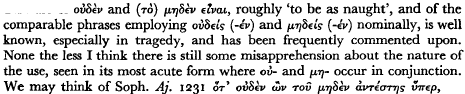 on which much ink has been spilt.
Information
- Type
- Research Article
- Information
- Copyright
- Copyright © The Classical Association 1965
References
page 31 note 1 On this Denniston remarks that we find both and in this use, with and without the article, and also the masculines and that is more generalized than ‘nullity’ as opposed to ‘a nothing’, and that the article further stresses the generality. But he sums up that the distinctions are probably not of much practical importance.
page 31 note 2 In opposition to Jebb, who thought ‘more emphatic and (here) more bitter, since it implies a mental act of comparison. … The angry king scorns Teucer, but his bitterness is against the dead Ajax. So “being naught” (a simple statement): “for him who is as naught”.’
page 31 note 3 But we may well prefer Lloyd-Jones's ‘I am not to be counted as a male’, thus avoiding an awkward repetition.
page 32 note 1 Surprisingly Euripides, who imitates this passage in his Cyclops (672 ff.) and makes much of the ambiguity of leaves out this particular point. Possibly Epic was not thought suitable for his use: its only appearance outside Epic is in the lyric passage of Aeschylus which I next quote.
page 32 note 2
page 32 note 3 in the general sense of ‘ruler’ is tragic and especially Aeschylean.
page 33 note 1 Ar. Lys. 139, referred to by Edmonds, is not in fact an example of the use in question
page 33 note 2 See my discussion of C.Q. N.s. xii (1962), 245–6.Google Scholar
page 34 note 1 See Humbert, Syntaxe grecque 2, 26–27, on the use of with adjectives meaning a kind or type of person.
page 35 note 1 Jebb's note on why is used here rather than despite the protasis, is not helpful. He first refers to cases where the negative is in close union with the following word (): but that feature is not present in Next, he suggests that the special relationship of the and clauses in the protasis is a reason for finding in the former, but in the latter: we should have since its clause is not really hypothetical. The point might seem attractive, but it is not supported. In Lys. 10. 13, quoted by Jebb, occurs after as according to Jebb we could have expected The use after is due to the analogy of the construction after and so sets no precedent for us. However, it is not necessary to look for any extraordinary explanation of El. 244. keeps its form because it is not predicative, but an attribute. Cf. for this have discussed the use in Studies in the Greek Negatives, p. 30, and more fully in C.Q. xlii (1948), 35–40.Google Scholar This view of the negative with the participle has been criticized by W. K. Pritchett, ‘ with the Participle’, A.J.P. lxxix (1958), 392–404, but I think it is the right one.Google Scholar
page 36 note 1 To be more exact, Aj. 767 and 1094 have the negative without the article: in the former () one cannot of course regard the negative as articular.
page 36 note 2 Such a notion may (mistakenly) be thought to arise if one considers the generalizing aspect of a phrase like and compares it with the general condition The idea is not uncommon: cf. Smyth, Greek Grammar, para. 2728 a, with the articular participle is the abridged equivalent of a conditional relative sentence'. But the means are different, even though one may use them to arrive at a similar end.
I shall refer later to a possible preference for () igq86 rather than with finite forms of in conditional protasis and certain other types of clause.
page 36 note 3 It is inevitable that the notions of being near to death, and of dying, should be found should have another example if we followed Kamerbeek at Tr. 1107–8: he suggests reading ‘though I am naught and passing to the grave’, since he finds bathos in ‘I cannot move’.
page 36 note 4 It is likely that we should take the article which precedes as well, rather than regard as anarthrous. We find only (that is, the neuter form) without the article in Sophocles in the uses in question, and that when accompanied by.
page 37 note 1 Yet another version is given by Ellendt, Lex. Soph. 451, s.v. qui magis periit, s. nullus est, quam qui nullus est, h.e. qui maxime omnium peril’. This takes as I would, but gives a different sense to if I understand it properly. Creon would say he is more dead, dead to a greater degree, than . But it would be a curious distortion to speak of degrees of death.
page 37 note 2 So too, B. Th. Koppers, Negative Conditional Sentences, pp. 39, 41. She argues fox a ‘dynamic’ or ‘stressed’ value for so that Aj. 1231 is said to be an emphatic way of contrasting the dead with the living. While in any case I do not feel she is right in discovering ‘stress’ in these uses. it also seems incorrect to take as ‘dead’, so that the supposed contrast cannotbe present.
page 37 note 3 But we should perhaps mention here the possibility that refers to an individual as a member of a class (so distinguished from the generic meaning given earlier, which refers to any such member). It would in fact have no significant value in Aj. 1231, nor in El. 1166, Ant. 1325: while in Aj. 1275 it could have no place at all. There is such meaning in in, for example, O.T. 397 (see Jebb's note), and there it has significance.
page 37 note 4 In this summary is to be regarded as standing for any part of the verb other than the present participle; and for any case. Also, stands for instances of used as predicate without.
page 38 note 1 The phonetic aspect was stressed by Postgate, J. P., Trans. Card. Phil. Soc. 1894,55–58.Google Scholar
page 39 note 1 I see no reason to alter the reading (Elmsley, followed by Murray): Euripides has and Sophocles (Aj. 1094).
page 39 note 2 I should refer here to the review of Koppers, op. cit., by Strunk, K., I.F. lxvii (1962), especially p. 105.Google Scholar He argues rightly in favour of the generalizing force of in relative clauses, finding that expresses eine auflerzeitliche Allgemeingfiltigkeit, while is more zeit- and situationsgebunden. He then goes on (footnote, pp. 105–6) to see the same distinction in Aj. 1114 and I.A. 371 the former would mean all those who are of no account, the latter those who show an individual quality of insignificance. This could be true if we did not look further than these particular examples. It already appears doubtful in Aj. 1231, which Strunk also quotes. Teucer's position, as son of a slave, is hardly more personal to him than is that of Ajax, who is dead, to himself: both belong to classes of people. But the theory clearly breaks down when applied to the two sets of passages from Euripides which follow.
page 40 note 1 Doubtless the author hoped to make his expression in some way more complete and absolute. A similar phrase is found again, in Eur. Ion 594 but the line is unmetrical and corrupt, and probably an interpolation.