


Introduction
Although some level of gambling behavior is common, certain individuals may gamble excessively and develop gambling disorder – a condition characterized by persistent, recurrent maladaptive patterns of gambling behavior.Reference Hodgins, Stea and Grant 1 – 3 Psychiatric comorbidity is common among adults with gambling disorder, with depression, anxiety, alcohol plus substance use disorders, and attention deficit hyperactivity disorder (ADHD) frequently seen in both clinical and epidemiological samples.Reference Dowling, Cowlishaw, Jackson, Merkouris, Francis and Christensen 4 , Reference Theule, Hurl, Cheung, Ward and Henrikson 5 Less often discussed is the possible relationship of obsessive-compulsive disorder (OCD) to gambling disorder. OCD is characterized by unwanted intrusive thoughts, urges, or images (obsessions), and/or repetitive, often ritualistic behaviors with the purpose of neutralizing the obsessive content or preventing an unlikely event. 3 Early small studies suggested a fairly high rate of co-occurring OCD in people with gambling disorder (17–20%),Reference Linden, Pope and Jonas 6 , Reference Bland, Newman, Orn and Stebelsky 7 but other research questioned the overlap between these disorders, often claiming that gambling disorder was underpinned by excessive impulsivity (ie reward driven behavior) while OCD was perhaps quite opposed to impulsivity and was compulsive in nature (anxiety-reducing, avoidant behavior).Reference Allen, King and Hollander 8
Recent research suggests that impulsivity and compulsivity are often inter-related,Reference Lee, Hoppenbrouwers and Franken 9 –Reference Romero-Garcia, Hook and Tiego 13 and one such finding is that OCD symptoms may have a genetic link to gambling disorder.Reference Bottesi, Ghisi, Ouimet, Tira and Sanavio 14 , Reference Scherrer, Xian, Slutske, Eisen and Potenza 15 Furthermore, OCD may in fact have prominent impulsive features. For example, individuals with OCD often report difficulties resisting the urges to engage in specific behaviors (eg, cleaning, ordering, or other ritualistic behaviors) that interfere with functioning because they may find the behaviors rewarding. Many adults with OCD demonstrate high levels of cognitive impulsiveness, as measured by the Barratt Impulsiveness ScaleReference Ettelt, Ruhrmann and Barnow 16 and cognitive tasks.Reference Clarke, Fineberg, Pellegrini and Laws 17 One study found that individuals with OCD and an impulsive disorder were characterized by a greater number and severity of compulsive symptoms and required a greater number of trials with different serotonin reuptake inhibitors during long-term follow-up.Reference Fontenelle, Mendlowicz and Versiani 18
There are also other lines of evidence to suggest that behaviors traditionally regarded as impulsive, and as compulsivity, may in fact be related in terms of underlying brain mechanisms. In other areas of addiction research (besides gambling), it has been posited that there can be a shift between behavior being impulsive (driven by reward) and compulsive (driven in response to negative emotional states) over time.Reference Lüscher, Robbins and Everitt 19 Reward-drive was also found to be a distinct core domain of compulsivity when measured trans-diagnostically both using conventional rigorous factor analysis at large scale,Reference Tiego, Trender, Hellyer, Grant, Hampshire and Chamberlain 11 and when viewed through the lens of network analysis.Reference Liu, Albertella and Lochner 20 Both impulsivity and compulsivity have also been posited as mechanisms contributing to gambling disorderReference Blaszczynski and Nower 21 and problematic usage of the internet.Reference Brand, Brandtner and Antons 22
In light of this research, the objective of the current study was to investigate the rates of gambling disorder and its clinical associations in a sample of adults with OCD. Based on previous research, we hypothesized that the presence of gambling disorder would be associated with more severe OCD and with worse overall functioning. A deeper understanding of gambling disorder comorbid with OCD may lead to more customized and effective therapeutic approaches.
Methods
Participants
Participants were recruited from online Reddit groups for OCD, OCD clinics, and support groups and were invited to partake in an online survey titled “A Pilot Study Assessing Generative Artificial Intelligence Chatbot Use in Obsessive-Compulsive Disorder.” The survey assessed several online and/or addictive behaviors, including artificial intelligence (AI) use, gambling, and problematic internet use. Inclusion criteria for the clinical sample were: (a) diagnosis of OCD using the Obsessive-Compulsive Inventory-Revised (OCI-R) threshold (see below); (b) age greater than 18 years; and (c) fluency in English. Participants were excluded if they were unable to understand the study procedures. The Institutional Review Board of the University of Chicago approved the study and the consent statement. The authors assert that all procedures contributing to this work comply with the ethical standards of the relevant national and institutional committees on human experimentation and with the Helsinki Declaration of 1975, as revised in 2008.
Participants read the online informed consent page and chose to participate in the survey or to opt out. The survey informed all participants that the information they provided was confidential. Participants were compensated at the conclusion of the survey using random prize drawings (15 participants were randomly chosen to receive a $100 gift certificate). Quality checks were performed through rule logic, and REDCap automatically excluded users who had already completed the survey and calculated the time taken for survey completion (participants completing the survey in < 5 min were flagged and excluded as < 5 min for completion was unrealistic). The survey took approximately 25 minutes to complete. In all, 295 participants consented to the survey and answered at least one question; 205 met initial inclusion/exclusion criteria and 186 completed the survey.
Assessments
The intent of the online survey was to collect data regarding the clinical phenomenology of OCD and gambling, in order to measure rates of gambling disorder, and to evaluate relevant clinical features between people with versus without co-occurring gambling disorder. Toward that end, the online survey collected data regarding previously diagnosed psychiatric comorbidities and assessed for a range of impulsive disorders and behaviors using validated screening instruments.
In addition to demographics and phenomenological aspects of OCD and gambling behavior, including inquiry about previous treatments specifically for OCD, the following measures were used:
Obsessive-Compulsive Inventory-Revised (OCI-R). The OCI-R is an 18-item measure used to assess OCD symptoms during the past month. The items are answered via a 5-point Likert scale and add up to a total score as well as six subscale scores on different symptom domains. A score of 21 or higher was used to indicate OCD.Reference Foa, Huppert and Leiberg 23
Minnesota Impulsive Disorders Interview (MIDI) for DSM-5 – Gambling Disorder Module (self-report version). This MIDI Gambling Disorder Module assesses gambling disorder based on DSM-5 criteria over the past year. The 11 items are answered yes-no. 4 or more items answered “yes” indicates gambling disorder.Reference Chamberlain and Grant 24 , Reference Grant 25
Gambling Symptom Assessment Scale (G-SAS). The G-SAS is a 12-item self-report measure that assesses gambling disorder symptom severity over the past seven days. The items ask about urges, thoughts, time spent, pleasure, distress, and personal trouble related to gambling on a 4-point Likert scale. The items are summed into a total score which can then classify a participant’s gambling behaviors as mild, moderate, severe, or extreme.Reference Kim, Grant, Potenza, Blanco and Hollander 26
Internet Severity and Activities Addiction Questionnaire (ISAAQ). The ISAAQ uses an addiction framework to measure problematic internet use and measures frequency of use of online activities. Part A consists of 10 items which ask about frequency of addictive components of internet use on a 6-point Likert scale, which can then be summed into a total score. Part B asks about the frequency of non-work or study-related online activities, such as general surfing, internet gaming, and online shopping.Reference Ioannidis, Tiego and Lutz 27
Barratt Impulsiveness Scale (BIS-15). The BIS-15 assesses trait impulsivity across three domains, which are non-planning, motor, and attention impulsivity. The measure consists of 15 items which participants answer on a 4-point Likert scale, with some items reverse-scored. The items are then summed into a total score as well as three subscale scores for each domain.Reference Patton, Stanford and Barratt 28
Data analysis
The percentage of participants that screened for OCD and for gambling disorder in the last 12 months was determined. Demographic characteristics and current comorbid psychiatric diagnoses were presented as frequencies, and independent samples t tests, chi-square tests of independence, and analyses of covariance (ANCOVAs) were used to determine if there were differences between OCD adults with and without gambling disorder. Fisher exact tests were used when more than 20% of cells had expected frequencies of less than 5. Statistical significance was set at p < 0.01 for all tests due to multiple comparisons. Effect sizes were calculated in the forms of Cohen’s d for t tests (0.2 = small, 0.5 = medium, 0.8 = large), Phi for chi-square and Fisher’s exact tests (0.1 = weak, 0.3 = moderate, 0.5 = strong), and partial eta squared for ANCOVAs (0.01 = small, 0.06 = medium, 0.14 = large).
Results
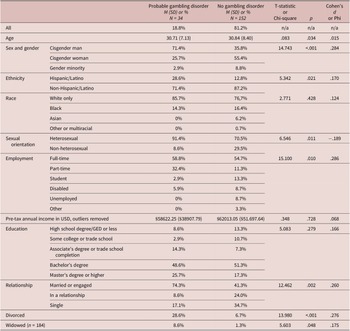
Of 186 adults with OCD, 34 (18.8%) also met criteria for gambling disorder (Table 1). Adults with OCD plus gambling disorder were significantly more likely to be male, currently married or engaged, and divorced (Table 1).
Demographics for 186 Adults with Probable OCD with and without Gambling Disorder
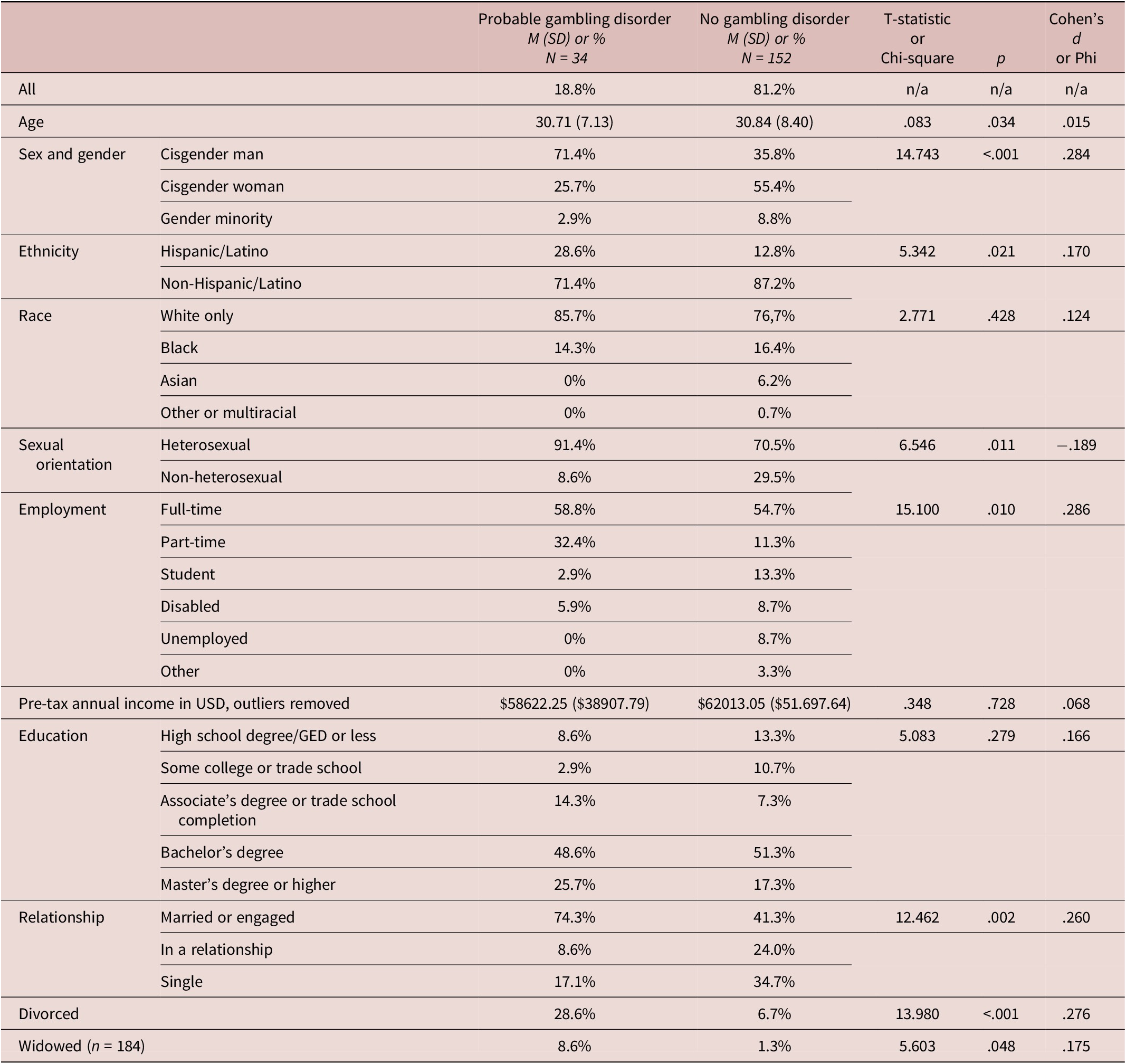
Table 1. Long description
The table contains seven columns: Demographic Category, Sub-category, Probable gambling disorder (N = 34), No gambling disorder (N = 152), T-statistic or Chi-square, p-value, and Cohen’s d or Phi.
* All: Probable gambling disorder 18.8 percent; No gambling disorder 81.2 percent.
* Age: Probable gambling disorder mean 30.71 (S D 7.13); No gambling disorder mean 30.84 (S D 8.40); p = .034.
* Sex and gender: Cisgender men represent 71.4 percent of the gambling group versus 35.8 percent of the non-gambling group (p < .001).
* Ethnicity: Hispanic/Latino individuals represent 28.6 percent of the gambling group versus 12.8 percent of the non-gambling group (p = .021).
* Race: White only is 85.7 percent (gambling) vs 76.7 percent (no gambling); Black is 14.3 percent vs 16.4 percent; Asian is 0 percent vs 6.2 percent (p = .428).
* Sexual orientation: Heterosexual is 91.4 percent (gambling) vs 70.5 percent (no gambling) (p = .011).
* Employment: Full-time is 58.8 percent vs 54.7 percent; Part-time is 32.4 percent vs 11.3 percent (p = .010).
* Pre-tax annual income in U S D: Probable gambling disorder mean $58,622.25; No gambling disorder mean $62,013.05 (p = .728).
* Education: Bachelor’s degree is the most common in both groups (48.6 percent vs 51.3 percent; p = .279).
* Relationship: Married or engaged is 74.3 percent (gambling) vs 41.3 percent (no gambling) (p = .002).
* Divorced: 28.6 percent (gambling) vs 6.7 percent (no gambling) (p < .001).
* Widowed: 8.6 percent (gambling) vs 1.3 percent (no gambling) (p = .048).
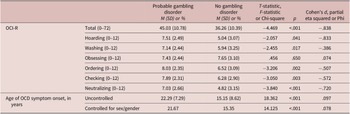
In terms of the OCD clinical characteristics of the two groups, those are presented in Table 2. Those with OCD and gambling disorder scored significantly higher on the OCI-R in terms of the total score, as well as scores on ordering, checking, and neutralizing behaviors. They also reported a significantly older age of OCD onset after controlling for age and sex.
OCD Details for 186 Adults with Probable OCD with and without Gambling Disorder
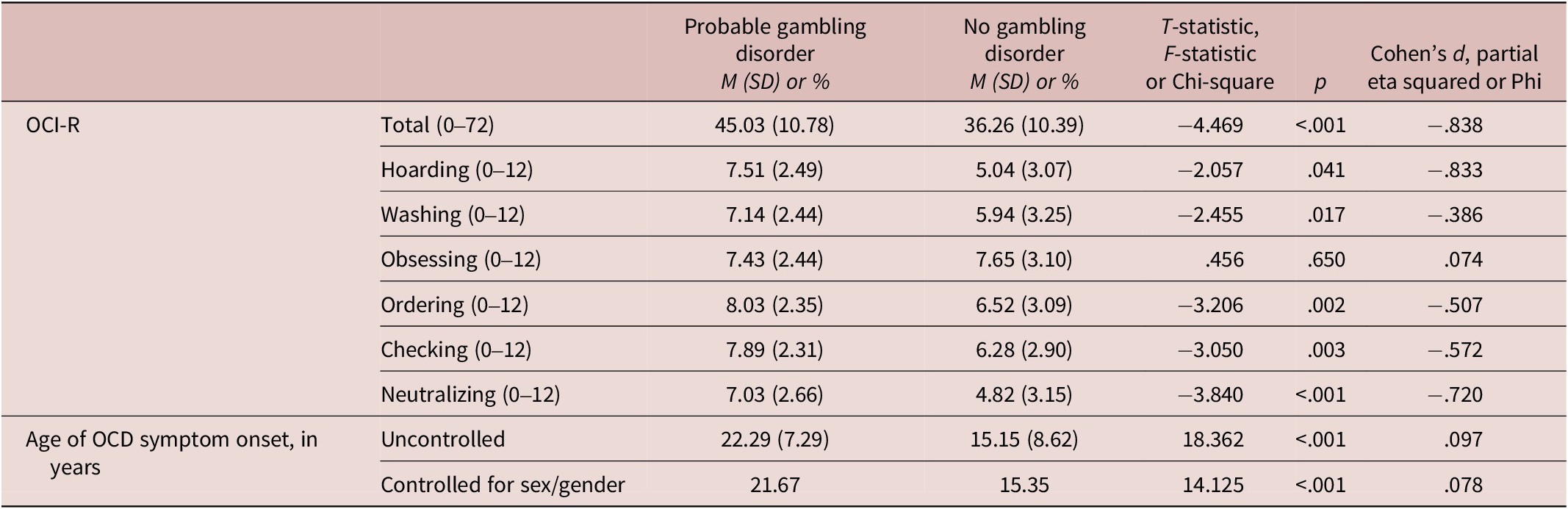
Table 2. Long description
The table contains seven columns: Measure, Sub-category, Probable gambling disorder M (S D) or percent, No gambling disorder M (S D) or percent, T-statistic F-statistic or Chi-square, p-value, and Cohen’s d partial eta squared or Phi.
Under the O C I R section (range 0 to 72):
- Total: Gambling 45.03 (10.78), No Gambling 36.26 (10.39), p < .001.
- Hoarding (0 to 12): Gambling 7.51 (2.49), No Gambling 5.04 (3.07), p = .041.
- Washing (0 to 12): Gambling 7.14 (2.44), No Gambling 5.94 (3.25), p = .017.
- Obsessing (0 to 12): Gambling 7.43 (2.44), No Gambling 7.65 (3.10), p = .650.
- Ordering (0 to 12): Gambling 8.03 (2.35), No Gambling 6.52 (3.09), p = .002.
- Checking (0 to 12): Gambling 7.89 (2.31), No Gambling 6.28 (2.90), p = .003.
- Neutralizing (0 to 12): Gambling 7.03 (2.66), No Gambling 4.82 (3.15), p < .001.
Under Age of O C D symptom onset (in years):
- Uncontrolled: Gambling 22.29 (7.29), No Gambling 15.15 (8.62), p < .001.
- Controlled for sex/gender: Gambling 21.67, No Gambling 15.35, p < .001.
In terms of gambling characteristics (Table 3), we found that those with OCD and gambling disorder were more likely to gamble online only, engage in esports betting, and use some form of AI to help with gambling outcomes (Table 3). Adults with OCD and gambling disorder scored significantly higher on a measure (ie, BIS-15) of overall impulsivity and motor impulsivity. Furthermore, they were more likely to score in the problematic range for overall use of the internet (ie, ISAAQ).
Gambling Details for Adults with Probable OCD with Gambling Disorder Compared to Probable OCD without Gambling Disorder
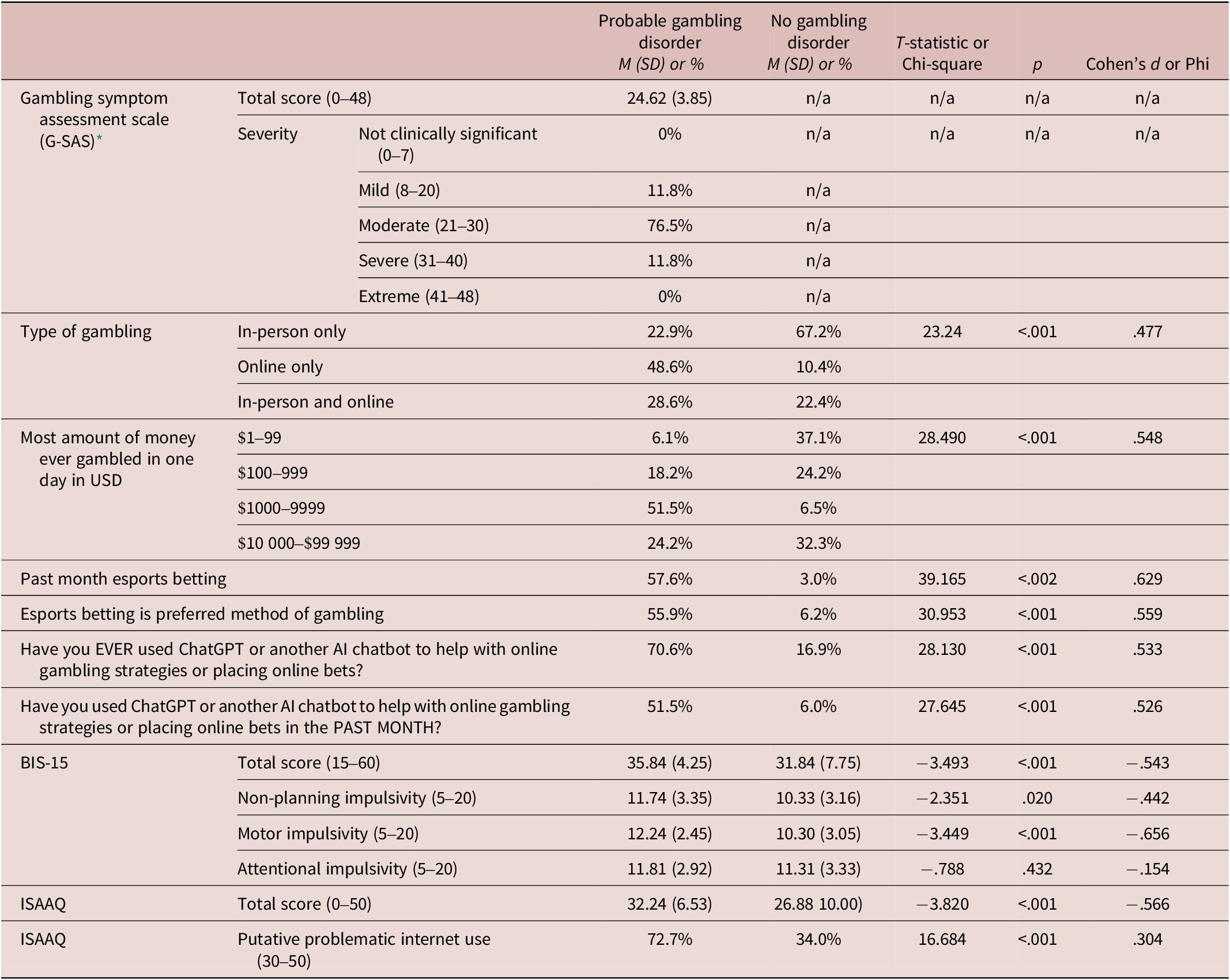
Table 3. Long description
The table compares two groups: Probable gambling disorder and No gambling disorder.
1. Gambling Symptom Assessment Scale (G S A S): The Probable gambling disorder group had a mean total score of 24.62. Severity distribution: 76.5% moderate, 11.8% mild, and 11.8% severe.
2. Type of Gambling: The Probable gambling disorder group preferred online only (48.6%) or in-person and online (28.6%), while the No gambling disorder group was primarily in-person only (67.2%). Chi-square 23.24, p less than .001.
3. Financial Impact: For the most money gambled in one day, 51.5% of the Probable gambling disorder group spent $1,000 to $9,999, compared to only 6.5% in the No gambling disorder group. Chi-square 28.490, p less than .001.
4. Esports and A I: 57.6% of the Probable gambling disorder group engaged in esports betting in the past month compared to 3.0% of the control. 70.6% of the disorder group have used ChatGPT or A I for gambling strategies, compared to 16.9% of the control group (p less than .001).
5. B I S minus 15 (Impulsivity): The Probable gambling disorder group scored higher in total impulsivity (35.84 vs 31.84, p less than .001), non-planning impulsivity (11.74 vs 10.33, p equals .020), and motor impulsivity (12.24 vs 10.30, p less than .001).
6. I S A A Q (Internet Use): The Probable gambling disorder group had a higher total score (32.24 vs 26.88) and a much higher rate of putative problematic internet use (72.7% vs 34.0%, p less than .001).
* G-SAS was not given to participants unless they met criteria for gambling disorder based on the MIDI.
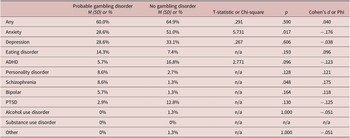
Rates of current psychiatric comorbidities did not significantly differ between adults with OCD with and without gambling disorder (Table 4).
Current Psychiatric Comorbidities for 186 Adults with Probable OCD with and without Gambling Disorder
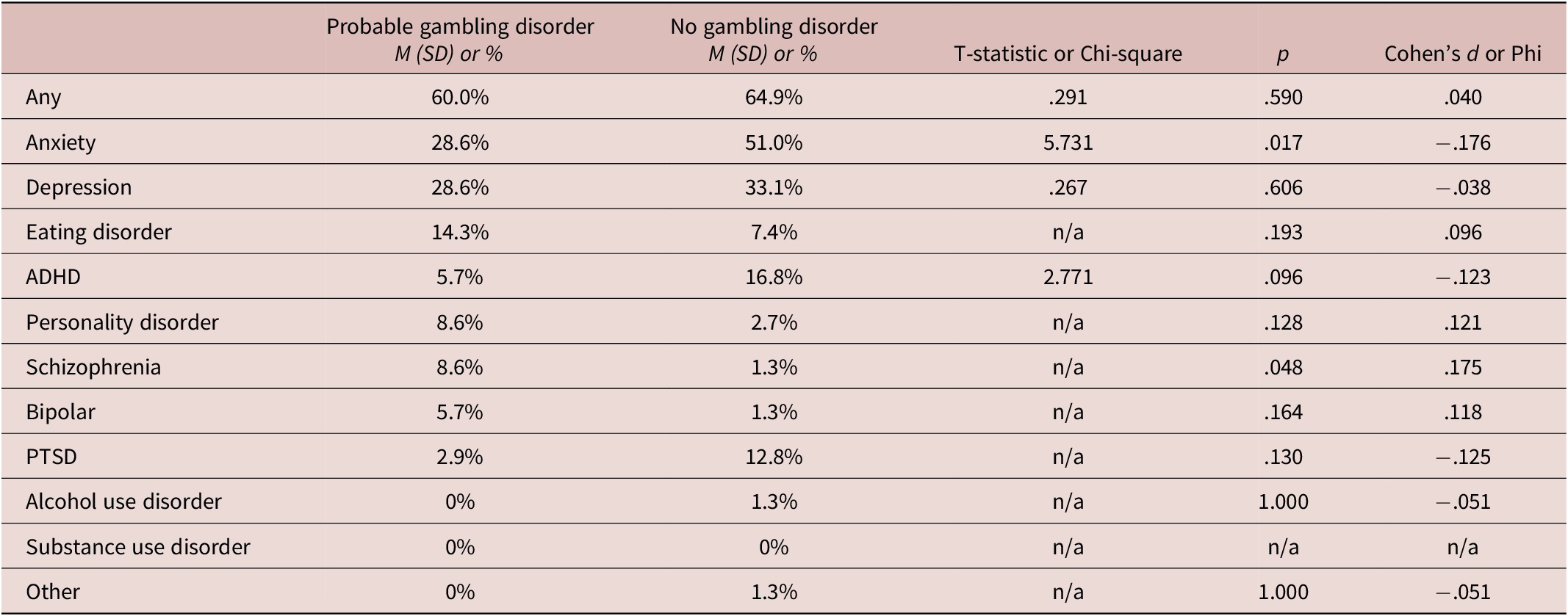
Table 4. Long description
The table consists of six columns: Comorbidity Type, Probable gambling disorder (M (SD) or percent), No gambling disorder (M (SD) or percent), T-statistic or Chi-square, p, and Cohen’s d or Phi.
Data rows are as follows:
* Any: 60.0 percent vs 64.9 percent; T/Chi-square .291; p .590; Effect .040.
* Anxiety: 28.6 percent vs 51.0 percent; T/Chi-square 5.731; p .017; Effect minus .176.
* Depression: 28.6 percent vs 33.1 percent; T/Chi-square .267; p .606; Effect minus .038.
* Eating disorder: 14.3 percent vs 7.4 percent; T/Chi-square n/a; p .193; Effect .096.
* A D H D: 5.7 percent vs 16.8 percent; T/Chi-square 2.771; p .096; Effect minus .123.
* Personality disorder: 8.6 percent vs 2.7 percent; T/Chi-square n/a; p .128; Effect .121.
* Schizophrenia: 8.6 percent vs 1.3 percent; T/Chi-square n/a; p .048; Effect .175.
* Bipolar: 5.7 percent vs 1.3 percent; T/Chi-square n/a; p .164; Effect .118.
* P T S D: 2.9 percent vs 12.8 percent; T/Chi-square n/a; p .130; Effect minus .125.
* Alcohol use disorder: 0 percent vs 1.3 percent; T/Chi-square n/a; p 1.000; Effect minus .051.
* Substance use disorder: 0 percent vs 0 percent; all other values n/a.
* Other: 0 percent vs 1.3 percent; T/Chi-square n/a; p 1.000; Effect minus .051.
Note: Fisher exact tests were used instead of chi-square tests when the expected cell frequencies were less than 5 in more than 20% of cells.
In terms of treatment, those with OCD plus gambling disorder were significantly less likely to have received medication for OCD and received significantly fewer trials of medications for OCD (Table 5).
OCD Lifetime Treatment History for 186 Adults with Probable OCD with and without Gambling Disorder

Table 5. Long description
The table contains four rows of treatment categories compared across two groups. The columns are: Probable gambling disorder M (S D) or percent, No gambling disorder M (S D) or percent, T-statistic or Chi-square, p, and Cohen’s d or Phi.
* Any treatment: 77.1 percent for the gambling group versus 83.6 percent for the no gambling group. Chi-square is .799, p is .371, Phi is minus .066.
* Medication: 28.6 percent for the gambling group versus 61.7 percent for the no gambling group. Chi-square is 12.625, p is less than .001, Phi is minus .262.
* Number of medications: Mean of .59 (S D 1.84) for the gambling group versus 1.93 (S D 2.77) for the no gambling group. T-statistic is 3.149, p is .003, Cohen’s d is .512.
* Therapy: 70.6 percent for the gambling group versus 78.8 percent for the no gambling group. Chi-square is 1.049, p is .306, Phi is minus .076.
Discussion
This study examined the rate of gambling disorder in OCD, and associated clinical characteristics, and identified several important findings. First, nearly one in five participants (18.8%) met criteria for gambling disorder. This rate is broadly consistent with earlier smaller studies reporting elevated rates of OCD among individuals with gambling disorder (eg, 17–20%),Reference Linden, Pope and Jonas 6 , Reference Bland, Newman, Orn and Stebelsky 7 and supports the notion that these conditions may co-occur more frequently than traditionally assumed. Historically, gambling disorder has been conceptualized as primarily impulsive, whereas OCD has been viewed as compulsive and harm-avoidant.Reference Allen, King and Hollander 8 However, more recent studies suggest that impulsivity and compulsivity are overlapping and interacting dimensions rather than distinct constructs,Reference Lee, Hoppenbrouwers and Franken 9 –Reference Romero-Garcia, Hook and Tiego 13 , Reference Fineberg, Chamberlain and Goudriaan 29 which may help explain the co-occurrence observed in the current study.
Second, individuals with comorbid gambling disorder demonstrated significantly worse OCD severity, particularly in ordering, checking, and neutralizing symptoms. This aligns with prior research indicating that the presence of comorbid impulse control disorders in OCD is associated with more severe symptom profiles and greater clinical complexity.Reference Fontenelle, Mendlowicz and Versiani 18 , Reference Matsunaga, Kiriike, Matsui, Oya, Okino and Stein 30 It is possible that certain OCD symptom dimensions are more closely linked to repetitive, reinforcement-driven behaviors, which may increase vulnerability to behavioral addictions such as gambling.
Third, we found significantly elevated trait impulsivity among those with comorbid gambling disorder, particularly in the motor impulsivity domain. This aligns with prior research demonstrating elevated impulsiveness in individuals with OCD.Reference Ettelt, Ruhrmann and Barnow 16 , Reference Clarke, Fineberg, Pellegrini and Laws 17 , Reference Hoehn-Saric and Barksdale 31 Fontenelle et al. previously reported that individuals with OCD and comorbid impulse control disorders demonstrated greater symptom severity and required more pharmacological trials, a pattern consistent with our findings of both increased symptom severity and distinct treatment patterns.Reference Fontenelle, Mendlowicz and Versiani 18
The finding of later OCD onset in the comorbid group may suggest a distinct clinical subtype or developmental trajectory. While the directionality of this relationship cannot be determined in the present cross-sectional design, previous work has highlighted heterogeneity within OCD, including subgroups characterized by differing symptom profiles, comorbidity patterns, and illness course.Reference Bloch, Landeros-Weisenberger, Rosario, Pittenger and Leckman 32 , Reference Lochner, Hemmings and Kinnear 33 Future longitudinal studies are needed to explore the temporal time courses of both gambling disorder and OCD symptoms and therefore how these two conventionally separate disorders might interact in terms of top level symptoms, and involve common versus distinct neurocognitive and biological processes. Such improved understanding could have implications for clinical practice by helping to explore more comprehensive treatment approaches.
We also found that those with comorbid gambling disorder were significantly more likely to meet criteria for problematic internet use (72.7% versus 34.0%). This suggests that the relationship between OCD, gambling disorder, and internet-mediated behaviors may be complex and bidirectional. Problematic internet use may serve as a gateway to online gambling, or both may reflect a common underlying vulnerability to behavioral addictions in individuals with OCD. The Internet Severity and Activities Addiction Questionnaire (ISAAQ) revealed significantly higher scores in those with gambling disorder, supporting recent conceptualizations of behavioral addictions as overlapping conditions with shared risk factors.Reference Ioannidis, Tiego and Lutz 27
A particularly concerning finding was the substantial treatment gap observed in those with comorbid gambling disorder. Despite having more severe OCD symptoms and later onset, adults with both OCD and gambling disorder were significantly less likely to have received medication for OCD (28.6% versus 61.7%). This is consistent with previous evidence suggesting that comorbidity in OCD is associated with poorer treatment outcomes and greater illness burden.Reference Hollander, Stein and Kwon 34 , Reference Veale and Roberts 35 This treatment gap may also reflect several factors. First, individuals with gambling disorder may be less likely to seek treatment due to shame, stigma, or denial.Reference Grant and Potenza 36 Second, the presence of gambling disorder may complicate treatment engagement, as financial consequences of gambling may create barriers to accessing care.Reference Suurvali, Cordingley, Hodgins and Cunningham 37 , Reference Pulford, Bellringer, Abbott, Clarke, Hodgins and Williams 38 Third, clinicians treating OCD may not routinely screen for gambling behaviors, leading to missed opportunities for integrated treatment.
Interestingly, we found no significant differences in rates of other psychiatric comorbidities between those with and without gambling disorder. This is somewhat unexpected given previous literature reporting high rates of depression and anxiety in gambling disorder populations.Reference Black and Moyer 39 , Reference Crockford and el-Guebaly 40 However, we did observe significantly higher divorce rates among those with comorbid gambling disorder (28.6% versus 6.7%), suggesting that while psychiatric comorbidity rates may be similar, the functional impairment and interpersonal consequences of the combined condition may be more severe. This aligns with previous research demonstrating that pathological gambling is associated with poorer quality of life and family functioning.Reference Black and Moyer 39 , Reference Black, Moyer and Schlosser 41 Surprisingly, alcohol and substance use disorders were not significantly higher in those with versus without gambling disorder. In a previous systematic review and network meta-analysis, alcohol use disorder was found to occur in ~21% of people with gambling disorder, and substance use disorders (besides alcohol) in ~7%.Reference Dowling, Cowlishaw, Jackson, Merkouris, Francis and Christensen 4 The current lack of significant difference could reflect the sample not being representative of gambling disorder at large – for example, our sample was relatively highly educated and mostly married, whereas one might expect gambling disorder to be linked to relative deprivation (and by proxy, lower levels of average education) and negative impact on relationships (ie, lower relates of marriage).
The clinical implications of these findings are noteworthy. Routine screening for gambling behaviors in enriched settings (eg, psychiatric and addiction outpatients), particularly online gambling and esports betting, may help identify comorbid presentations that are easily overlooked in standard OCD assessments. In addition, the presence of gambling disorder warrants careful evaluation of prior treatment and current engagement, given the observed treatment gap in this group.
Management of co-occurring OCD and gambling disorder may benefit from approaches that address impulsivity, problematic internet use, and the increasing role of digital and AI-driven gambling environments. Cognitive–behavioral interventions targeting both obsessive-compulsive symptoms and gambling urges, alongside strategies to support behavioral regulation and limit online exposure, may be particularly relevant. Finally, given the genetic links suggested between OCD symptoms and gambling disorder,Reference Bottesi, Ghisi, Ouimet, Tira and Sanavio 14 , Reference Scherrer, Xian, Slutske, Eisen and Potenza 15 family history screening may help identify at-risk individuals.
Several limitations should be considered. The use of self-report measures and online recruitment may introduce selection bias and limit generalizability. We used screening instruments rather than diagnostic interviews, meaning our prevalence estimates may be higher than if we had definitively diagnosed these conditions. Assessment of comorbidities was done via dichotomous variables rather than by measuring severity. In addition, the cross-sectional design prevents conclusions regarding causality or temporal relationships between OCD and gambling disorder.
In conclusion, this study indicates that gambling disorder occurs at elevated rates among adults with OCD and is associated with increased symptom severity, later age of onset, higher impulsivity, problematic internet use, and concerning treatment gaps. These findings support a dimensional perspective in which impulsivity and compulsivity may co-occur and interact, or involve common mechanistic processes, rather than representing entirely distinct constructs. The emergence of online gambling platforms, esports betting, and AI-assisted gambling represents a rapidly evolving landscape that clinicians must be prepared to address. Our results highlight the importance of comprehensive assessment, integrated treatment approaches, and increased awareness of this under-recognized comorbidity. Future research is needed to examine underlying neurocognitive mechanisms, longitudinal trajectories, and the development of integrated treatment approaches targeting both compulsive and impulsive features.
Author contribution
Conceptualization: J.E.G., M.N., S.B., L.A.; Data curation: J.E.G., S.B., L.A.; Formal analysis: J.E.G., I.H.A., M.N., S.B., S.R.C.; Investigation: J.E.G.; Methodology: J.E.G., M.N., S.B., L.A., S.R.C.; Project administration: J.E.G., M.N., S.B., L.A.; Writing - review & editing: I.H.A., M.N., S.B., L.A., S.R.C.
Financial support
S.R.C.’s role in this research was supported by UKRI gambling research partnership grant (APP88128: LONGitudinal STRuctural drivers of gambling-related harms: building partnerships to Identify risk factors and build Evidence at Scale, LONG-STRIDES) and by the NHS and the National Institute for Health and Care Research (NIHR) Applied Research Collaboration (ARC) Wessex. The views expressed are those of the author(s) and not necessarily those of the NHS, the NIHR, or the Department of Health and Social Care (DHSC) UK.
Competing interests
J.E.G. has received research grants from NIDA, and Janssen and Neurocrine Pharmaceuticals, and has received royalties from Oxford University Press, American Psychiatric Publishing, Inc., Norton Press, Johns Hopkins University Press, and McGraw Hill. S.R. C. Dr. Chamberlain receives an honorarium from Elsevier for journal editor work. His research is supported and funded by the NIHR Applied Research Collaboration (ARC) Wessex, UK.



 Open access

