Introduction
The discovery of chlorpromazine's properties in 1952 was a pivotal moment in the management of patients with schizophrenia, yet the limitations of oral medications became readily apparent within a decade, leading to the development of long-acting ester preparations of numerous typical antipsychotics including fluphenazineReference Kurland and Richardson1 in the mid-1960s and later haloperidol.Reference Deberdt, Elens and Berghmans2 Rates of treatment nonadherence are high in all phases of the illness,Reference Robinson, Woerner and Alvir3, Reference Agid, Foussias and Remington4 with data from meta-analyses showing that long-acting injectable (LAI) antipsychotics reduce relapse risk compared to oral formulations in most long-term studies of 1-year duration or more.Reference Leucht, Heres and Kane5
Despite rates of nonadherence estimated at 40% from the time of first admission,Reference Robinson, Woerner and Alvir3 studies demonstrate that psychiatrists significantly overestimate the extent of oral medication adherenceReference Byerly, Thompson and Carmody6—an important oversight leading to the underutilization of LAI preparations.Reference Patel and David7 Before 2002, when no LAI atypical antipsychotics existed, the decreased incidence of neurological adverse effects with oral atypical antipsychotics skewed prescribing away from LAI typical preparations, although later concerns regarding metabolic adverse effects have eroded the perception of relative safety with newer agents.Reference Hartling, Abou-Setta and Dursun8 Large comparative trials, such as the CATIE Schizophrenia Trial and the Cost Utility of the Latest Antipsychotic Drugs in Schizophrenia Study (CUtLASS 1),Reference Lieberman, Stroup and McEvoy9, Reference Jones, Barnes and Davies10 have also cast doubt on the superior efficacy claims for atypical antipsychotics. A recent analysis of long-term outcomes (mean follow-up 2 years) in a large cohort (n = 2588) of first-episode schizophrenia patients also showed that haloperidol decanoate was among the agents associated with numerically lowest relapse risk.Reference Tiihonen, Haukka and Taylor11
The need for both LAI typical and atypical antipsychotics is clear, and these are now viewed within a balanced context of their pharmacodynamic properties (eg, potent D2 antagonism, D2 partial agonism), adverse effect profiles (eg, metabolic impact, sedation, hyperprolactinemia, extrapyramidal effects, or akathisia), and kinetic properties (eg, ability to be loaded, short vs long TMax). The sophisticated psychopharmacologist thus has a broad array of competing LAI antipsychotic options to employ for his or her schizophrenia patients.
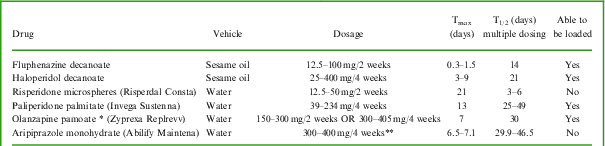
As with most aspects of medication management, the choice of any individual LAI is governed by clinical judgment and informed by patterns of tolerability, response, and patient preference. Yet a critical aspect of the effective initiation of any LAI agent is a nuanced understanding of the kinetic parameters. The purpose of this review is to provide a visual guide to the comparative kinetic profiles of the typical and atypical LAI antipsychotics available in the U.S. (see Table 1), using illustrations of plasma antipsychotic levels under various dosing paradigms, including single-dose kinetics and loading strategies when available.
Kinetic properties of depot antipsychotics
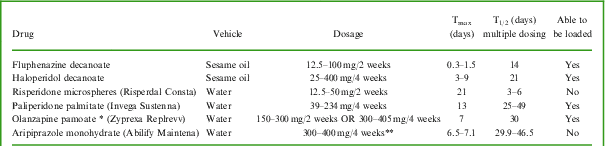
*See recent U.S. FDA bulletin: http://www.fda.gov/Drugs/DrugSafety/ucm356971.htm.
**Lower doses should be used for 2D6 poor metabolizers, or those on 2D6 or 3A4 inhibitors.
General Principles
For depot antipsychotics, the rate-limiting step in disposition is slow absorption from the injection site. The long terminal half-life of LAI antipsychotics (eg, days to weeks) compared to the relatively short half-life of the comparable oral preparation (eg, 24 hours) is a phenomenon referred to as “flip-flop kinetics.” The usual principle of oral drug disposition has been overturned (eg, flip-flopped), with drug disposition from the LAI being limited by absorption from the injection site and not drug metabolism.Reference Ereshefsky and Mascarenas12 For agents that cannot be loaded, oral coverage is necessary to maintain adequate plasma levels until the LAI reaches therapeutic concentrations. A general pharmacokinetic rule is that 5 half-lives of any medication are needed to achieve 97% of steady-state levels. With the long half-lives of depot antipsychotics, the failure to adequately load leads to prolonged cross-titrations from oral antipsychotics, or inadequate plasma antipsychotic levels for weeks and months in those patients who are minimally adherent with an oral regimen. Given the large volume of distribution for antipsychotics, early loading also saturates tissue compartment stores sooner, allowing for lower maintenance doses (Figure 1).Reference Ereshefsky, Saklad and Jann13
Ester LAI antipsychotic disposition.Reference Ereshefsky and Mascarenas12

Fluphenazine Decanoate
Among the earliest ester LAI antipsychotics, fluphenazine decanoate has an unusual kinetic profile, with maximal plasma concentrations seen 20–24 hours following an injection.Reference Ereshefsky, Saklad and Jann13 Doses of 25 mg reliably produce a plasma level increase of 1.2 ng/mL above the baseline level in single-dose studies (Figure 2) and with chronic dosing (Figure 3).Reference Glazer14 This early peak may be of significant benefit in the management of acute or subacute inpatients and outpatients, and represents a useful feature of fluphenazine decanoate, with the caveat that there is a risk for extrapyramidal side effects (EPS) and akathisia during the first 48 hours.Reference Wistedt15 Extensive studies have attempted to establish plasma level-response curves for fluphenazine, often finding limited correlations.Reference Gitlin, Nuechterlein and Mintz16, Reference Marder, Aravagiri and Wirshing17 Nonetheless, there is value in having rough estimates of adverse effects and response by plasma levels to guide treatment decisions (Figure 4).Reference Midha, Hubbard, Marder, Marshall and Van Putten18 As seen in Figure 3, the expected steady-state plasma fluphenazine level on 25 mg every 2 weeks is 1.0 ng/mL.Reference Ereshefsky and Mascarenas12 A significantly lower plasma level would imply a cytochrome P450 2D6 ultrarapid metabolizer or concurrent use of a p-glycoprotein inducer, while plasma levels substantially higher suggest 2D6 slow or poor metabolizer status or exposure to a 2D6 inhibitor.Reference Zhou19, Reference Besag and Berry20
Single dose kinetic profile of fluphenazine decanoate (25 mg).Reference Ereshefsky and Mascarenas12
Plasma fluphenazine levels during chronic dosing with fluphenazine decanoate 25 mg every 2 weeks.Reference Glazer14
Relationship between plasma fluphenazine levels and estimated probability of improvement (gray line) and disabling side-effects (black line).Reference Midha, Hubbard, Marder, Marshall and Van Putten18
The clinical status of the patient should always dictate response to any plasma level. Nonresponse without evidence of adverse effects generally is an indication for further dose increases, since the patient has not reached a hard clinical endpoint of response or intolerability. There are rare patients who seemingly are impervious to the development of EPS or akathisia regardless of doses, and plasma levels can thus serve as a guide to treatment futility.Reference Simpson and Kunz-Bartholini21 While fluphenazine plasma levels > 2.0 ng/mL are generally not well tolerated, among more treatment-resistant patients, there are individuals who both require and tolerate plasma fluphenazine levels of 3.0 ng/mL or higher. Extremely high plasma levels are thus seen at times in stable patients without adverse effects. In those instances, slow downward titration is warranted (10% reduction every 3–6 months) to determine if these patients may do equally well with lower plasma levels. More aggressive reduction is not appropriate in the absence of significant adverse effects, as there will be a subgroup of these individuals who may require high plasma levels for psychiatric stability.Reference Iyo, Tadokoro and Kanahara22
The limitation of fluphenazine decanoate is the 2-week injection schedule, the higher incidence of local site reactions from the sesame oil vehicle, and the greater risk for neurological adverse effects than with atypical antipsychoticsReference Jann, Ereshefsky and Saklad23; however, LAI fluphenazine has a favorable metabolic profile,Reference Covell, McEvoy and Schooler24 low risk of sedation, and lower risk of hyperprolactinemia than risperidone and 9-OH risperidone.Reference Covell, McEvoy and Schooler24 The low incidence of clinically significant weight gain may be of significant appeal in the treatment of first-episode schizophrenia patients, as younger individuals are at greater risk for weight gain.Reference Meyer25 The unique kinetic profile provides advantages in certain clinical situations. While potent D2 antagonism may be a detriment for EPS-sensitive individuals, this can prove useful for those who fail to achieve symptomatic relief from maximum doses of LAI atypical antipsychotics.
Loading and initiation
Various studies have been performed to attempt to establish a conversion formula from oral to LAI fluphenazine; most were performed at times when significantly higher doses of typical antipsychotics were commonly used (eg, fluphenazine 60 mg/d), and are less relevant to current standards. Jann etalReference Jann, Ereshefsky and Saklad23 cite a conversion factor of 1.6 times the oral dose given as a weekly injection for the first month as the most reliable among the methods found in the literature.Reference Jann, Ereshefsky and Saklad23Figure 5 provides an illustration of the plasma levels obtained through a weekly load of 50 mg fluphenazine decanoate over 6 weeks.Reference Jann, Ereshefsky and Saklad23 By week 4, plasma levels start to plateau at 2.0 ng/mL, which is the expected steady state for this dose, and exactly twice the steady state plasma level with chronic dosing of 25 mg every 2 weeks. The use of weekly dosing for the first month has thus achieved in 4 weeks what might take 12 weeks or more with routine biweekly injections without a load,Reference Marder, Midha and Van Putten26 and can be employed with lower dosages for those with less extensive requirements for D2 blockade, or in patients where there is limited information regarding their sensitivity to EPS and akathisia.
Plasma levels with weekly loading of 50 mg fluphenazine decanoate.Reference Jann, Ereshefsky and Saklad23
Haloperidol Decanoate
Haloperidol decanoate has become the most widely used typical depot antipsychotic due to its 4-week dosing schedule, reliable conversion formula from oral dosing, and established loading regimens.27 As seen in Table 1 and Figure 6, the mean Tmax for haloperidol decanoate is longer than that for fluphenazine decanoate. Although the Tmax for haloperidol decanoate is 7 days, the range of 3–9 days results in some episodes of EPS within days of adminstration.23 The response threshold for plasma haloperidol levels ranges from 3–5 ng/mL, with side effects becoming more prominent at levels above 15 ng/mL.Reference Ereshefsky and Mascarenas12 Plasma haloperidol levels ≥ 20 ng/mL are not well tolerated,Reference Ereshefsky and Mascarenas12 but there are patients who require very high plasma haloperidol levels, particularly among more resistant state hospital patients. Given the tolerance of these extremely high levels and the absence of EPS/akathisia, one might suspect that a state of postsynaptic D2 receptor upregulation and supersensitivity exists in these unusual patients. In these instances, it may be worthwhile to precede cautiously with dose rapid reduction, as this may lead to supersensitivity psychosis.Reference Iyo, Tadokoro and Kanahara22 An appropriate clinical response to a schizophrenia patient with very high plasma levels where acute tolerability is not the concern is a very slow taper to maintain psychiatric stability (eg, 10% reduction every 3 months), and possibly allow the use of lower dosages.
Haloperidol decanoate kinetics and tolerability by plasma level (mean dose 243 mg).Reference Ereshefsky and Mascarenas12
Haloperidol decanoate is more convenient than LAI fluphenazine, and is dosed every 4 weeks. Single injection volumes greater than 300 mg (3 mL) are not tolerated due to the viscosity of the vehicle, so patients who require higher doses typically receive the monthly dose as split biweekly injections. As with fluphenazine decanoate, haloperidol decanoate is associated with local site reactions from the vehicleReference Spanarello and La Ferla27 and higher risk for neurological adverse effects than atypicals, but this is balanced by low incidence of weight gain and metabolic dysfunction, low risk of sedation, and lower risk of hyperprolactinemia than risperidone and 9-OH risperidone.Reference Covell, McEvoy and Schooler24 Haloperidol decanoate can also be used in patients who remain symptomatic on maximum dosages of LAI atypical antipsychotics.
Loading and initiation
Numerous studies have been performed exploring conversion formulas of 10, 20, or 30 times the oral daily haloperidol dose.Reference Jann, Ereshefsky and Saklad23 Oral haloperidol bioavailability is 65% (range 60–70%), so a patient on a stable oral dose of 10 mg/d will have total drug exposure calculated as follows: 10 mg/d × 30 days × 65% = 195 mg/month. Thus, 20 times the oral daily dose provides the identical milligram equivalence to the oral preparation. During the early phase of treatment, while tissue compartments are still being saturated, loading with 20 times the estimated oral dose for the 1st month, divided into 2 injections, was superior to lower depot doses, even with oral supplementation.Reference Ereshefsky, Toney, Saklad, Anderson and Seidel28 Weekly loading is also possible, and should be considered in those who are less stable or who refuse oral treatment. In a study of 21 patients who were treated with oral haloperidol for 6 weeks and switched to haloperidol decanoate 100 mg weekly for 4 weeks, then 100 mg every 2 weeks and then every 4 weeks, all patients completed the conversion trial during the first 4 weeks without any problems or adverse side effects. By week 3, mean plasma haloperidol concentrations from depot were comparable to 10 mg/d oral haloperidol (7.95 ± 4.94 ng/mL vs 7.79 ± 4.79 ng/mL).Reference Wei, Jann, Lin, Piao-Chien and Chang29 Steady-state conditions for the decanoate were achieved by the 4th week. To accommodate the needs of shorter stays, the time interval between loading injections can be advanced by 2–3 days for the first 2 injections. In specialized forensic settings, more aggressive loading strategies are employed, up to 300 mg IM weekly for 3 weeks.
Most authors note that, once steady state is achieved, the maintenance dose to keep stable plasma haloperidol levels is often less than the initial conversion formula, likely related to the saturation of tissue compartments.Reference Jann, Ereshefsky and Saklad23 Periodic monitoring of haloperidol plasma levels can facilitate dosing adjustments to prevent unnecessary plasma level creep.
Risperidone Microspheres
The approval of a LAI form of risperidone (Risperdal Consta) in 2002 brought to market the first depot atypical antipsychotic, the first water-based LAI antipsychotic, and a novel depot mechanism in the form of risperidone-impregnated microspheres composed of cross-linked chains of lactide and polyglycolide.Reference Selmin, Blasi and DeLuca30 Doses of 25, 50, and 75 mg every 2 weeks were examined in the pivotal trials, with the range of 25–50 mg subsequently approved as 3 doses: 25 mg, 37.5 mg, and 50 mg.Reference Harrison and Goa31, 32 A 12.5 mg dose was subsequently approved. The rate-limiting step in systemic risperidone absorption is the elution of the drug from the dissolution of microspheres. Erosion time characteristics for the microspheres are determined by the ratio of lactide and coglycolide polymer components, which is 75:25 for LAI risperidone.Reference Selmin, Blasi and DeLuca30Figure 7 shows that the kinetics necessitate the use of oral medication overlap for the initial 3–4 weeks of LAI risperidone treatment, while Figure 8 shows a kinetic comparison of peak and trough active moiety levels in patients on 2 mg oral risperidone for at least 1 month, then switched to LAI risperidone 25 mg with focused sampling at steady state.Reference Ereshefsky and Mascarenas12, Reference Chue33 Comparable trough plasma levels with LAI risperidone combined with the lower post-dose peaks explain the differences in tolerability experienced in some patients who switch between oral and LAI preparations. These kinetic data also provide an estimate of oral equivalence: each 2 mg oral risperidone is approximately 25 mg LAI risperidone every 2 weeks.
Single dose kinetics of LAI risperidone (25 mg) (data on file, Janssen Pharmaceutica).
Comparison Peak and Trough Plasma Levels: 2 mg oral vs 25 mg LAI risperidone every 2 weeks (Ereshefksy L, Mascarenas CA. Comparison of the effects of different routes of antipsychotic administration on pharmacokinetics and pharmacodynamics, J Clin Psychiatry. 64 (suppl 16), 18–23, 2003. Copyright 2003, Physicians Postgraduate Press. Adapted or Reprinted by permission.)Reference Ereshefsky and Mascarenas12
The distinct advantage of risperidone over haloperidol and fluphenazine depots is the lower incidence of neurological adverse effects.Reference Turner, Eerdekens, Jacko and Eerdekens34 Risperidone is, however, associated with greater metabolic adverse effects, and also greater impact on serum prolactin levels than other atypical antipsychotics and high-potency typical antipsychotics.Reference Covell, McEvoy and Schooler24 This disproportionate effect on prolactin release is hypothesized to be related to the high affinity of risperidone and its active metabolite 9-OH risperidone for the p-glycoprotein efflux transporter, resulting in locally high drug levels at the blood–brain barrier.Reference Linnet and Ejsing35, Reference De Leon, Wynn and Sandson36 The single-dose LAI risperidone kits contain specialized needles, and the 2 mL vials must be used completely. If one attempts to split to achieve lower dosages, the suspended particulate solution may not be equally distributed, leading to lower or higher than expected doses when the split dose is administered. The vials also require refrigerated storage, which can be a logistic issue in clinics with limited space.
Loading and initiation
Loading is not possible, precluding acute use. Kinetic modeling demonstrates that the impact of dosing changes or missed doses is seen approximately 4 weeks later,Reference Wilson37 so temporizing measures (eg, supplemental oral medication for inadequate symptom control) are needed until the desired plasma level changes occur. Although the pivotal trials showed no benefit on average for those randomized to 75 mg every 2 weeks, in clinical practice there are patients who may require more D2 blockade than is achievable with 50 mg every 2 weeks. Options include a switch to typical depots, or use of 75 mg dosing (administered as two 37.5 mg injections), bearing in mind the expense involved. For patients who were previously stabilized on oral risperidone with known plasma levels for response, trough plasma levels obtained just prior to the next injection can be helpful. Plasma levels have not proven very useful as guides to treatment for the majority of patients who were nonadherent or transitioned from other antipsychotics, and are best employed to determine whether nonresponders have grossly subtherapeutic plasma levels, as might be seen with ultrarapid 2D6 metabolizers.Reference Meyer38
Paliperidone Palmitate
To overcome the limitations of risperidone microspheres, including the 2-week dosing interval, the inability to load the medication, and the need for refrigeration, risperidone's active metabolite 9-OH risperidone (paliperidone) was converted into a LAI preparation (Invega Sustenna).Reference Samtani, Vermeulen and Stuyckens39 By generating nanomolecular crystals of the ester paliperidone palmitate, a water-based suspension could be delivered intramuscularly with kinetic properties that facilitate loading while maintaining a 4-week dosing schedule.Reference Samtani, Vermeulen and Stuyckens39 The efficacy of paliperidone palmitate in acute patients was demonstrated in multiple clinical trials based on a loading scheme that was designed to realize therapeutic levels in the 1st week of treatment (Figure 9).Reference Samtani, Vermeulen and Stuyckens39 Cost and adverse effect profile are similar to LAI risperidone,Reference De Leon, Wynn and Sandson36 and paliperidone is less susceptible to clinically significant pharmacokinetic interactions, unlike fluphenazine, haloperidol, or risperidone, all of which are greatly impacted by 2D6 inhibitionReference Meyer38 or p-glycoprotein induction.Reference Zhou19, Reference Panagiotidis, Arthur, Lindh, Dahl and Sjoqvist40, Reference Hendset, Molden, Refsum and Hermann41 Plasma paliperidone levels are rarely obtained, and have limited value in guiding treatment.
Kinetics of paliperidone palmitate using standard loading regimen.43
Loading and initiation
The acute schizophrenia trials of LAI paliperidone utilized a standard loading regimen to achieve therapeutic antipsychotic levels without the need for oral supplementation.Reference Pandina, Lindenmayer and Lull42 To maximize plasma levels early in treatment, the first 2 loading injections of 234 mg and 156 mg are administered 1 week apart in the deltoid muscle, as gluteal absorption is approximately 28% lower.Reference Samtani, Vermeulen and Stuyckens39 To avoid missing the second loading dose due to hospital discharge or other issues, patients may be given the second dose 4 days before or after the 1-week time point. Over time, patient preference can determine the injection site. Unlike LAI risperidone, in which all doses were 2 mL injections, paliperidone palmitate injection volume is linearly dose-dependent, ranging from 0.25 mL for the lowest dose (39 mg) to 1.5 mL for 234 mg. There are more dosing options with paliperidone palmitate than LAI risperidone: 39 mg, 78 mg, 117 mg, 156 mg, and 234 mg, corresponding roughly to an oral paliperidone equivalence of 3, 6, 9, and 12 mg, and an oral risperidone equivalence of 2, 4, 6, and 8 mg. Maintenance doses are started 4 weeks after the 2nd loading injection, with dosing based on prior medication requirements and tolerance. If the prior medication history is unknown, 117 mg is recommended as a starting monthly dose among those who respond adequately to the loading regimen.43 The failure to load paliperidone palmitate may result in unacceptably high nonresponse rates; this finding was seen in an early maintenance study, in which a 78 mg monthly dose was started without a loading regimen, leading to significant dropouts before the maintenance randomization phase.Reference Hough, Gopal and Vijapurkar44
Olanzapine Pamoate
Olanzapine pamoate (Zyprexa Replrevv) is a nearly insoluble salt designed for aqueous-based injection, with multiple dosing options available.Reference Mamo, Kapur and Keshavan45, Reference Frampton46 The low solubility allows for slow, sustained release, with kinetics determined in part by particle size of the crystalline salt. The efficacy advantages of oral olanzapine and its low neurological adverse event risk are mitigated to some extent by its metabolic adverse effects. The kinetic profile of various dosing options is illustrated in Figure 10.Reference Spanarello and La Ferla27 Oral supplementation was not used in the clinical trials but may be necessary during the first few months if adequate loading is not pursued.Reference Detke, Zhao, Garhyan, Carlson and McDonnell47 Relapse rates were lowest in the group transitioning from 10 mg/d oral to 300 mg every 2 weeks of olanzapine pamoate (1.5%), but were 12-fold greater (18.8%) in those going from 20 mg/d oral to 150 mg every 2 weeks of LAI olanzapine.Reference Detke, Zhao, Garhyan, Carlson and McDonnell47 A distinct and serious problem in approximately 2% of patients was noted in the clinical trials that was related to severe sedation, often requiring hospitalization, with onset 30–300 minutes after injection.Reference Detke, McDonnell and Brunner48, Reference McDonnell, Detke and Bergstrom49 In June 2013, the U.S. FDA launched an investigation into 2 deaths related to olanzapine pamoate, although the relationship to post-injection delirium/sedation syndrome (PDSS) has not been established.50 Detailed plasma level information from a single PDSS case in the clinical trials and data from other cases (Figures 11a and 11b) illustrates the extremely high plasma levels seen.Reference Detke, McDonnell and Brunner48, Reference McDonnell, Detke and Bergstrom49 Language outlining a mandatory 3-hour observation period for sedation was included in the package insert with initial U.S. approval.51 Concerns over PDSS have greatly limited olanzapine pamoate to a number of specialized clinical settings where individuals can be monitored continuously for 3 hours.
Olanzapine pamoate kinetics.Reference Detke, Zhao, Garhyan, Carlson and McDonnell47
Kinetic profiles of severe sedation cases with olanzapine pamoate.Reference McDonnell, Detke and Bergstrom49 (a) Single detailed case example, (b) multiple examples.
Loading and initiation
Olanzapine pamoate is designed to be loaded during the initial 8 weeks of treatment based on the prior stable dose of oral olanzapine.51 Those on 10 mg/d oral can be loaded with 210 mg every 2 weeks or 405 mg every 4 weeks, while those on 15–20 mg/d of oral should be loaded with 300 mg every 2 weeks.Reference Frampton46, 51 After 8 weeks, dosing options vary based on the prior stable oral dose, with 300 mg every 2 weeks as the highest monthly dose recommended.Reference Frampton46, 51 For those patients who were previously on oral olanzapine, steady-state plasma levels during a period of psychiatric stability may be useful in adjusting LAI olanzapine doses. Plasma olanzapine levels may also be of value in patients moving between smoking and nonsmoking settings, as smoking induces the activity of CYP 1A2, which is a major determinant of olanzapine clearance.Reference Meyer38
Aripiprazole Monohydrate
Approved in February 2013, LAI aripiprazole (Abilify Maintena) is a lyophilized powder of aripiprazole monohydrate crystals with mean particle size of 1–10 μm (primarily 2–4 μm).Reference Spanarello and La Ferla27 The particles are poorly soluble, resulting in slow and prolonged dissolution and absorption. As with the other LAI atypicals, the powder is mixed into an aqueous suspension at the time of administration.Reference Kane, Sanchez and Perry52, Reference Fleischhacker, Sanchez and Johnson53 The aripiprazole monohydrate clinical trials involved stabilization on oral aripiprazole (for those who did not enter on aripiprazole), transition to and stabilization on LAI aripiprazole, and then randomization to LAI aripiprazole or placebo in the double-blind phase of the study.Reference Kane, Sanchez and Perry52, Reference Fleischhacker, Sanchez and Johnson53 The mean oral aripiprazole dose prior to LAI conversion was 19.2 mg.Reference Kane, Sanchez and Perry52, Reference Fleischhacker, Sanchez and Johnson53 All subjects were started on 400 mg LAI aripiprazole every 4 weeks with 2 weeks oral overlap, with 11.4% reducing to 300 for tolerability reasons during the transition phase. In the double-blind phase, 96.3% stayed on the 400 mg dose. The kinetic profile of aripiprazole monohydrate (shown in Figure 12) demonstrates a need for oral coverage during the first 14 days of treatment.Reference Mallikaarjun, Kane and Bricmont54 Advantages for aripiprazole relate to its lower risk for metabolic adverse effects, sedation, neurological side effects, and orthostasis. As a dopamine partial agonist,Reference Burris, Molski and Xu55 aripiprazole lowers serum prolactin levels, thus obviating concerns about hyperprolactinemia. In the double-blind maintenance phase of the clinical trials, the only adverse effect that occurred at an incidence ≥ 5% and more than 2 times that of placebo was tremor (5.9%).56
Kinetic profile of aripiprazole monohydrate (Data on File Otsuka Pharmaceutical Co., Ltd., Presented at APA 2011).Reference Mallikaarjun, Kane and Bricmont54
Aripiprazole has an affinity for the D2 receptor equal to or greater than high potency typicalsReference Burris, Molski and Xu55; however, due to its partial agonist properties, aripiprazole operates at much higher levels of D2 receptor occupancy than other antipsychotics. Mean occupancy by oral dose in positron emission tomography studies is as follows: 1 mg, 57.2%; 2 mg, 71.6%; 10 mg, 85.3%; 30 mg, 86.4%.Reference Sparshatt, Taylor, Patel and Kapur57 For patients who require high levels of D2 receptor antagonism for symptomatic control, the displacement of a full antagonist by the high affinity partial agonist aripiprazole has been reported to result in exacerbation, which is a factor to consider in transitioning patients from higher doses of medium- or high-potency antagonists.Reference Letmaier, Painold, Holl, Grohmann and Vergin58
Loading and initiation
As with LAI risperidone, aripiprazole monohydrate cannot be loaded, and oral coverage is needed for the first 14 days.56 The starting dose for most patients is 400 mg, with possibly downward adjustment to 300 mg for intolerance. The 400 mg dose was chosen on the basis of kinetic data (Figure 12), which shows exposure comparable to that seen with daily 20 mg oral dosing. For individuals who are 2D6 poor metabolizers, or who are concurrently taking agents with strong 2D6 or 3A4 inhibition, dosage adjustments are necessary, and are outlined in detail in the product information.56 One should avoid use of LAI aripiprazole with strong 3A4 inducers due to the subtherapeutic plasma levels that will result.
Conclusions
With 2 commonly used LAI typical antipsychotics, and multiple LAI atypical preparations, clinicians have numerous treatment options at their disposal with varying degrees of D2 effects, adverse effect profiles, and kinetics. A detailed understanding of the pharmacokinetics for each LAI preparation is critical to tailoring their use, as is finding the best match between the dictates of the clinical scenario and the kinetic profile of the LAI antipsychotic. With nonadherence being the norm among patients with schizophrenia, greater comfort in the application of LAI antipsychotics can translate to broader and more effective use of these agents, as well as improved clinical outcomes.
Disclosures
Dr. Meyer is a consultant/advisor to Genentech, and is on the speakers bureaus of AstraZeneca, Bristol-Myers Squibb, Janssen, and Sunovion.
No writing assistance was utilized in the production of this article.
CME Posttest and Certificate
CME Credit Expires: November 30, 2016
CME posttest study guide
NOTE: The posttest can only be submitted online.The below posttest questions have been provided solely as a study tool to prepare for your online submission. Faxed/mailed copies of the posttest cannot be processed and will be returned to the sender. If you do not have access to a computer, contact customer service at 888-535-5600.
1. Martin is a 32-year-old patient with schizophrenia. He has a history of treatment nonadherence and is interested in switching from his current oral antipsychotic to a long-acting depot antipsychotic. Which of the following antipsychotics is currently available in a long-acting injectable formulation?
A. Asenapine
B. Olanzapine
C. Aripiprazole
D. A and B only
E. B and C only
2. Tina is a 61-year-old patient with schizophrenia who is currently only partially adherent to her daily oral haloperidol treatment (10 mg/day). She has agreed to try the depot formulation of haloperidol (haloperidol decanoate). In order to achieve plasma levels of haloperidol that most closely correspond to a 10 mg/day dose, the initial monthly injected dose of haloperidol decanoate should be:
A. 150 mg/month
B. 175 mg/month
C. 200 mg/month
3. Amy is a 17-year-old patient who was recently diagnosed with schizoaffective disorder. She does not like swallowing pills and would prefer a depot antipsychotic. Genetic testing revealed that this patient is an ultrarapid metabolizer of substrates for the cytochrome P450 2D6 enzyme. Given this genetic information, which long-acting injectable antipsychotic would be the best choice?
A. Risperidone microspheres
B. Fluphenazine decanoate
C. Paliperidone palmitate
CME online posttest and certificate
To receive your certificate of CME credit or participation, complete the posttest and activity evaluation, available only online at http://www.neiglobal.com/CME under “CNS Spectrums.” If a passing score of 70% or more is attained (required to receive credit), you can immediately print your certificate. There is no posttest fee. Questions? Call 888-535-5600 or email customerservice@neiglobal.com.